

Parental alienation stories, told by alienated adult children and rejected parents, tend to follow one arc: a warm bond, a campaign of denigration, rupture, and for some a later awakening and slow repair. Read as testimony rather than proof, they reveal how alienation works from the inside and where realistic hope lives.
A note on safety
A child’s distance from a parent is not always alienation. When a parent has been abusive, neglectful, or genuinely dangerous, the child’s distancing is justified estrangement, not parental alienation, and the two must never be conflated. If a child’s safety is at risk, contact local law enforcement or a domestic-violence resource first.
About these accounts
The stories summarized here are lived experience shared in public educational settings, not clinical findings and not verified case files. They illustrate patterns. This page validates no single online story and does not judge any specific family. General claims are anchored to research and named below.
What parental alienation stories are
A parental alienation story is a firsthand account of one parent’s campaign to turn a child against the other parent, told later by the grown child or by the rejected parent. Some appear on survivor channels and support boards. Others surface in research interviews. All of them are testimony, which is different from proof.
That distinction matters. A single story cannot diagnose a family, and an online account is only one side of a relationship. So this page reads stories for their patterns, not as verdicts. The patterns are strikingly consistent, which is exactly why they are worth studying.
These narratives also differ from a symptom list. For the clinical outcomes, see the long-term effects of parental alienation. Here the focus is the story itself: how it starts, how it breaks, and how, for some families, it slowly mends.
The recurring arc of a parental alienation story
Across very different families, the accounts share a shape. Naming that shape helps a reader recognize the pattern without leaning on any one person’s account.
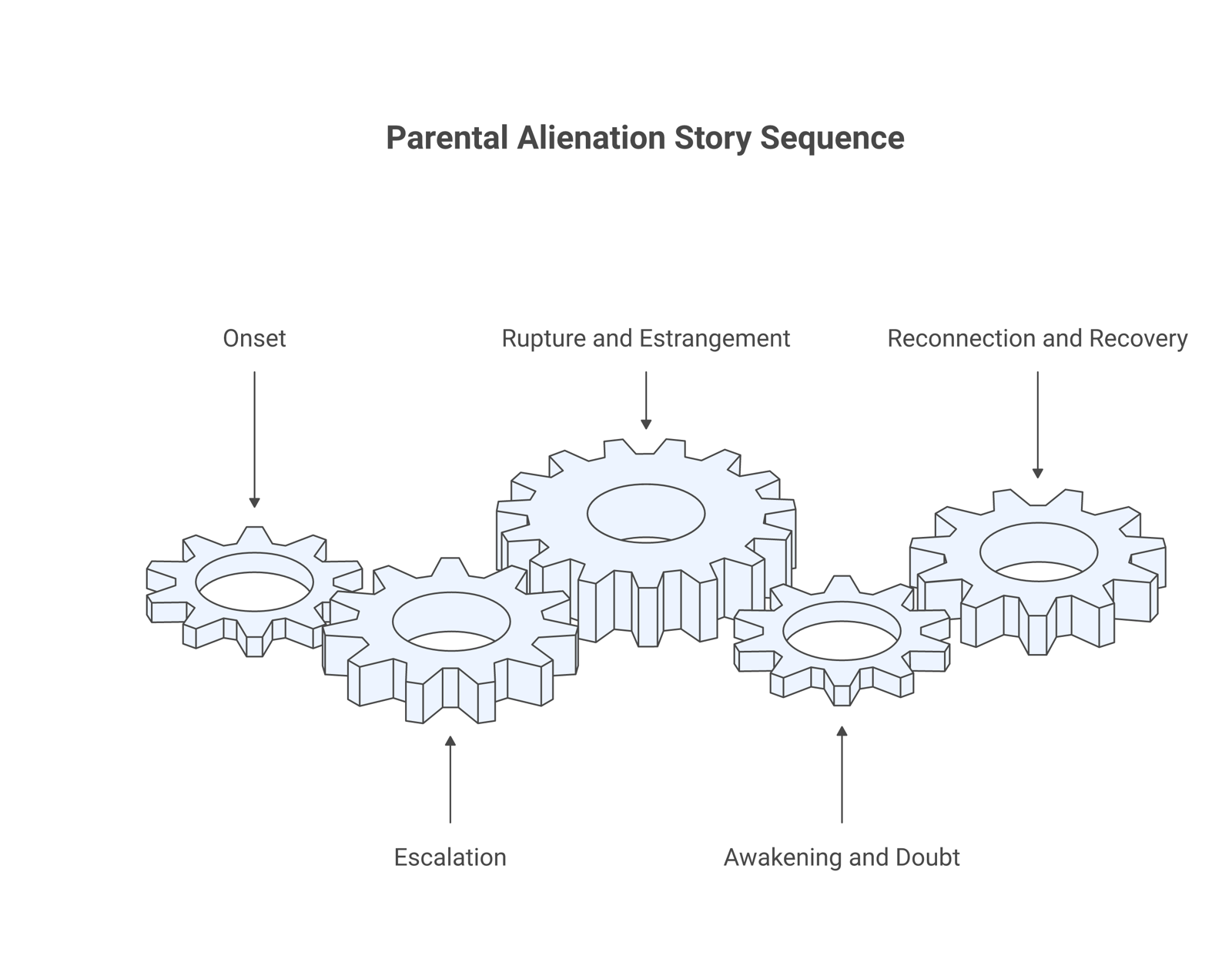
The arc usually runs through five stages. First comes onset, often around a separation, when one parent begins to denigrate the other. Then escalation, as isolation, loyalty tests, and badmouthing build. After that comes rupture, when the child rejects the targeted parent, sometimes for years. For some, an awakening follows, when a “seed of doubt” cracks the story. Last comes reconnection and recovery, which is slow and never guaranteed.
Not every story includes every stage. Many stop at rupture and stay there. Still, the early stages appear again and again, because the tactics behind them are well documented. This is also why the parental alienation trauma frame fits these accounts so closely.
What adult children’s stories reveal
The most striking lesson comes from grown children who once rejected a parent and later understood why. Their accounts are lived experience, and they describe the rejection from the inside.
One recurring detail is how small the world becomes. Ryan Thomas, a formerly alienated child who reconnected with his father after decades, describes an isolation-to-loyalty sequence: shrink the child’s world, remove anyone who offers a second perspective, then convert the resulting closeness into loyalty and guilt (lived experience, RyanThomasSpeaks). Loving the targeted parent starts to feel like a betrayal.
Another lesson is that the child usually believes the rejection is their own idea. Maddie, who hosts The Anti-Alienation Project, says she thought she was simply estranged until, at 28, she realized she had been manipulated into rejecting a loving parent (lived experience, The Anti-Alienation Project). Her account also maps a lifelong isolation pattern, where each new bond the child forms is treated by the controlling parent as a threat.
The turn, when it comes, rarely starts with new facts. It starts with a willingness to ask one question. As Maddie puts it, the change began with a “seed of doubt” that could only grow once she set pride aside. That single move, doubt before defense, is what survivor accounts credit most for opening the door.
What rejected parents’ stories reveal
Targeted parents tell a different half of the same story, and their accounts teach a hard lesson about grief and momentum.
Many describe doing everything right and still feeling stuck. Their accounts draw a hard line between learning about alienation and recovering from it. Reading and community matter; they name the wound and tell a parent “you are not crazy.” Yet a parent can consume content for years, understand every tactic, and watch nothing in the family change. The accounts that move forward pair that knowledge with steady, patient work on themselves and the relationship.
The healthier accounts show a sequence, not a sprint. The trauma specialist Judith Herman describes recovery in three stages: first safety and steadiness, then grief and meaning, then reconnection and service. Targeted-parent stories that find peace tend to follow that order. Parents who skip to reunification before they steady themselves often stall, which is why the recovery path starts with the parent, not the child.
What researchers find when these stories are studied
Testimony gets stronger when researchers study many accounts together and look for what repeats.
Psychologist Amy J.L. Baker did exactly that in her 2005 qualitative study of adults who had been alienated as children. Working from 40 interviews, she found common threads: the campaign often used badmouthing, limited contact, and loyalty pressure, and the long-term cost showed up as low self-esteem, depression, trust problems, and, for some, guilt once they understood what had happened. Baker’s interviews are also where the widely used list of alienating strategies first came from.
Other researchers place these stories inside a larger frame. Harman, Kruk, and Hines, writing in Psychological Bulletin in 2018, argue that parental alienating behaviors map onto recognized patterns of coercive control and amount to a form of family violence. That framing does not prove any single story, yet it explains why the accounts sound so alike. The American Psychological Association’s general guidance on divorce and child custody offers a careful, neutral starting point for the same questions, and it supports the page on whether parental alienation is real.
The theme that recurs: loss of ambivalence
If the stories share one tell, it is the absence of mixed feelings.
Family-law author Bill Eddy frames it cleanly: all real relationships are ambivalent. Even children who have been genuinely mistreated keep some mixed feelings about that parent. So when a child holds one parent as all good and the other as all bad, with no nuance at all, that flatness is usually taught rather than felt.
Survivor accounts describe the same split from the inside. Maddie contrasts her alienation, where the targeted parent seemed to have no redeeming qualities, with her later justified estrangement, where she could still see the other parent as a whole and complicated person. The difference is the gray. Its absence is the marker that recurs most reliably across stories.
Realistic hope, and its limits
Stories that end in reconnection are real, and they are worth holding onto. Some are not, and that is true too.
The honest summary is that outcomes vary. Some adult children return, often years later, after their own doubt does the quiet work that argument never could. Many do not return, or return only partway. No account and no study supports a promised timeline or a guaranteed reunion, so anyone offering one is overselling.
What the stories consistently teach is where effort pays. Survivors credit steady, low-pressure love rather than evidence and confrontation. Targeted parents credit their own recovery first. As a result, the most useful takeaway is not a method that forces a child back, but a posture that keeps the door open and keeps the parent whole while they wait. For deeper reading on each of these themes, see the best books on parental alienation.
Frequently asked questions
What do parental alienation stories have in common?
Most follow a recurring arc: a warm early bond, then a campaign of denigration and isolation, then rupture when the child rejects the targeted parent, and for some a later awakening and slow repair. The tactics in the early stages are well documented, which is why such different families produce such similar accounts.
What does it feel like to be an alienated child?
Survivor accounts describe a small, tightly controlled world and a genuine belief that the rejection is their own choice. Many feel little conscious guilt at the time, because the rejection feels righteous. The realization that they were manipulated usually arrives slowly, sometimes decades later, and it brings grief along with relief.
Do alienated children come back?
Some do, often after a private “seed of doubt” rather than an argument. Many do not, or reconnect only partway. Both survivor accounts and research show that outcomes vary widely, so no story can promise a reunion or a timeline.
Are parental alienation stories reliable?
They are testimony, not proof. A single account is one side of a relationship and cannot diagnose a family. Read together and alongside research, though, the stories reveal consistent patterns that are genuinely informative, even when no individual case is verified.
What is the difference between alienation and estrangement in these stories?
Justified estrangement follows real harm, tends to preserve mixed feelings about the parent, and often eases over time. Alienation rejects a loving parent, tends to be black and white, and tends to keep hurting until it is named. Survivor accounts that lived through both describe this contrast clearly.
Sources and further reading
- Baker, A. J. L. (2005). The long-term effects of parental alienation on adult children: A qualitative research study. The American Journal of Family Therapy, 33(4), 289 to 302.
- Harman, J. J., Kruk, E., & Hines, D. A. (2018). Parental alienating behaviors: An unacknowledged form of family violence. Psychological Bulletin, 144(12), 1275 to 1299. https://doi.org/10.1037/bul0000175
- American Psychological Association. Divorce and child custody. apa.org/topics/divorce-child-custody
If you or your child are in crisis
Free and confidential help is available right now.
- 988 Suicide and Crisis Lifeline. Call or text 988. 988lifeline.org
- Childhelp National Child Abuse Hotline. 1-800-422-4453. childhelp.org
- NAMI HelpLine. 1-800-950-6264. nami.org/help
Last reviewed: 2026-06-07. Author: Alex Buckles (PAC Founder).