
The long-term effects of parental alienation include depression, anxiety, complex trauma, and PTSD, documented across three groups: adults who were alienated as children, the targeted parents, and the wider family. Researchers now frame these as trauma and child psychological abuse, not ordinary family conflict. Recovery is documented through trauma-informed care, though never guaranteed.
A note before you read
A child’s rejection of a parent is not always alienation. If the rejected parent was genuinely abusive, neglectful, or dangerous, the child’s distancing is called justifiable estrangement, not parental alienation. The effects described here apply to engineered alienation. They must not be used to dismiss a child’s real safety concerns. This site treats that line as non-negotiable.
What the long-term effects of parental alienation are
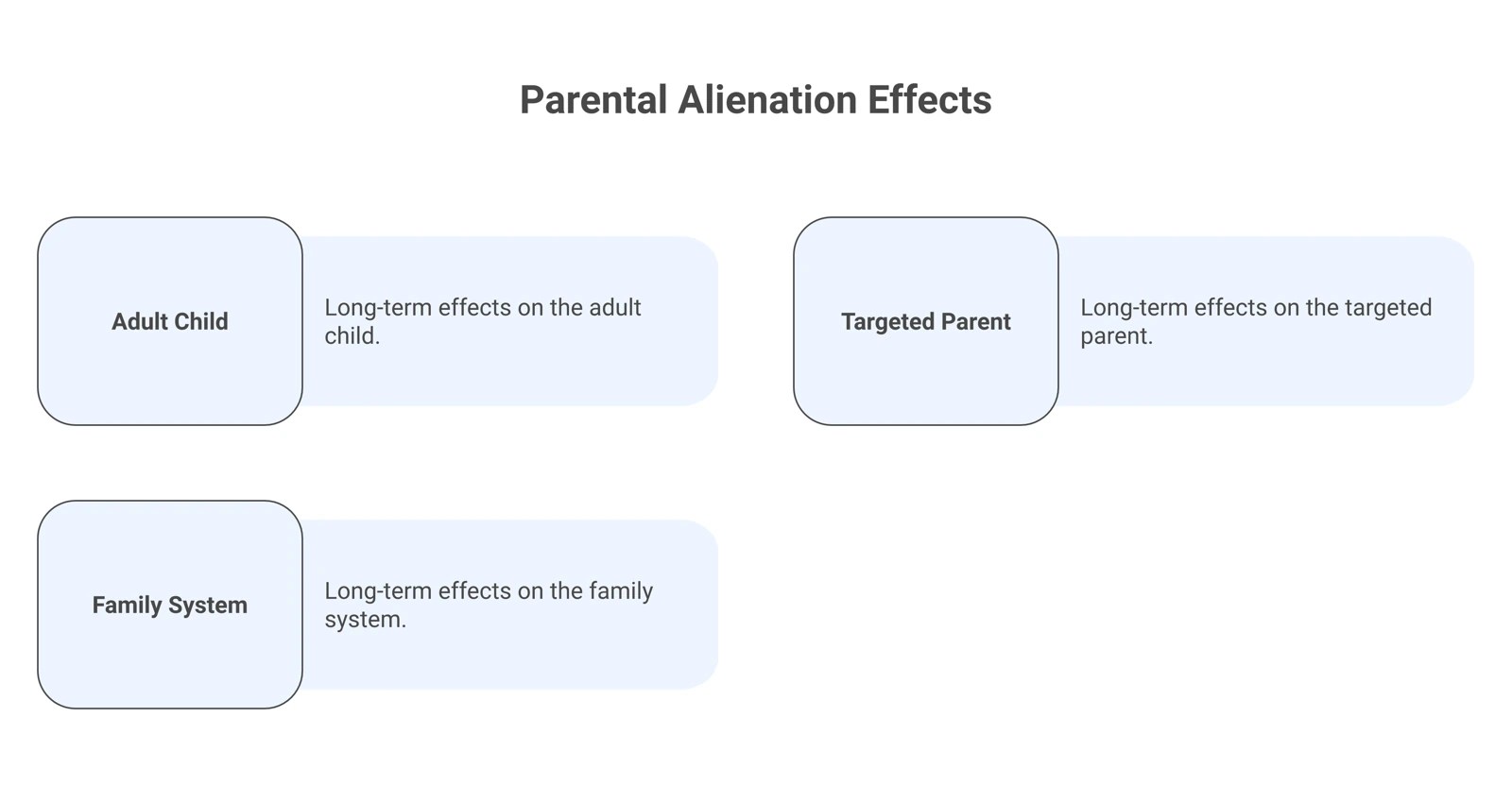
The documented effects fall into three populations. The first is the adult child, the person who was turned against a parent during childhood and now carries the result. The second is the targeted parent, the one who was pushed out. The third is the family system, including grandparents and siblings, plus the cost that lands on society as a whole.
Across these groups, the research points to a common theme. These are trauma effects. Peer-reviewed work, including Harman, Kruk, and Hines’s 2018 review in Psychological Bulletin and studies of adults alienated in childhood (Baker 2007; Verhaar, Matthewson & Bentley 2022), treats the psychological effects of parental alienation as the result of sustained harm, closer to child psychological abuse than to the friction of an ordinary divorce. The sections below name what the literature actually shows for each group, then turn to recovery.
What it does to the adult child
The largest body of long-term damage research looks at adults who were alienated as children. Dr. Amy J.L. Baker’s foundational interviews with forty adults who were alienated as children (Adult Children of Parental Alienation Syndrome, 2007), later survey work by Verrocchio, Baker, and Bernet (2016), and a 2022 study by Verhaar, Matthewson, and Bentley describe a recurring set of outcomes that fall into clear clusters.
Mental health: depression, anxiety, and PTSD
Parental alienation and depression travel together in the adult-outcome data. So do parental alienation and anxiety. In the 2016 study by Verrocchio, Baker, and Bernet, adults who recalled higher exposure to alienating behaviors in childhood reported significantly higher levels of depression and anxiety than peers who did not. Verhaar, Matthewson, and Bentley (2022) documented lasting mental-health impacts, including anxiety, depression, and trauma symptoms, among adults who experienced parental alienating behaviors in childhood. The effects are not vague unhappiness. They are named clinical conditions that show up at elevated rates.
Identity, self-esteem, and parentification
Childhood alienation lands during the years when identity forms. Baker’s adult-children interviews describe deep self-esteem and self-confidence deficits, rooted in children blaming themselves for the parental conflict. Many were drawn into a confidant or partner role by the alienating parent, so the child never had an ordinary childhood and never built an independent sense of self. A painful identity twist often follows in adulthood: the survivor realizes they resemble the targeted parent and feels shame about it, because they were taught that parent was bad.
Relationships and the next generation
Parental alienation trauma reaches into adult relationships. Baker’s interviews document chronic difficulty trusting that anyone could love them, fear of loss patterned on the parents’ breakup, and relationship patterns that can echo the original dynamic. Substance use appears as an early coping strategy in some accounts. Harman, Matthewson, and Baker (2022) catalogue the wider losses alienated children sustain, from the relationship itself to extended family and parts of their own identity. The most far-reaching effect is intergenerational. The patterns can pass forward into the survivor’s own marriages and parenting, which is why clinicians treat early, trauma-informed care as preventive for the next generation. For the symptom cluster that names how this presents in the child, see parental alienation syndrome.
What it does to the targeted parent
The targeted parent carries a different but equally documented set of effects. The core experience is what Dr. Pauline Boss named ambiguous loss, a grief with no closure and no rituals. The child is alive but gone, or physically present at exchanges yet psychologically absent behind a closed door and a silent car ride. Boss developed ambiguous loss as a general grief framework, not as alienation research, but clinicians who work with targeted parents apply it directly to this experience.
Ambiguous loss is not the whole picture. The steady drip of alienation, the blocked calls, the returned gifts, the false allegations, accumulates over years rather than arriving as a single event. Harman, Kruk, and Hines’s 2018 review reports that targeted parents, like victims of coercive control, experience trauma, anxiety, depression, diminished life satisfaction, and elevated suicidality, and Harman’s 2019 prevalence polls found elevated depression, trauma symptoms, and suicide risk among parents who reported being targets. The behaviors that produce these effects are catalogued in the signs silo.
Why these are trauma effects, not ordinary conflict
A reasonable question is whether these outcomes are just the normal pain of a hard divorce. The research says no, and the reason is structural. Parental alienation is rarely one catastrophic moment. It is a long series of smaller harms sustained over years, the pattern trauma clinicians describe as complex or cumulative rather than single-event trauma, and exactly the pattern that overwhelms a person’s ability to reset.
The Harman team’s 2018 review in Psychological Bulletin goes further, arguing that parental alienating behaviors map onto the recognized pattern of coercive control and constitute a form of family violence. That reframing matters for how the long-term effects are understood. They are the predictable result of sustained psychological abuse, not a personality flaw in the people who suffer them.
The cost beyond the family
The effects do not stop at one household. The first UK prevalence study, led by Ben Hine of the University of West London with Jennifer Harman, Sadie Leder-Elder, and colleagues (2025), polled 1,005 separated UK parents and found that 39 to 59 percent reported experiencing parental alienating behaviors, with 36.5 percent qualifying as non-reciprocal targets. These are self-report poll figures, not exact counts.
Findings at that scale make the lasting harm visible beyond the individual family. Mental-health care, lost productivity, litigation, and family-court overhead all flow from the long-term effects. The prevalence figures are treated in fuller detail on parental alienation statistics.
Can you recover from parental alienation?
Recovery is documented, but the honest answer is that it is a process, not a guarantee. Andrew Folkler, a formerly alienated child who was cut off from his mother for roughly twelve and a half years and reconnected with her in adulthood, frames recovery through Viktor Frankl’s trauma stages: shock, apathy, anger, and finally meaning. His account is lived experience from a named survivor, not a measured study. The endpoint, in his framing, is not erasing the past but integrating it.
Folkler’s central shift is from an external to an internal locus of control. Many people wait for an outside event to fix things, the judge’s ruling, the alienator’s change of heart, the child’s return. The recovery move is to focus on what the person can build in their own life regardless of those events. On the question of whether broken relationships can mend, a small retrospective follow-up of Ontario custody-reversal cases by Rachel Birnbaum and Nicholas Bala (2024) found that all six children they interviewed years later had a good relationship with the previously rejected parent, though none retained a relationship with the previously favored parent. The sample is small and self-selected, so the finding is suggestive rather than definitive.
For the targeted parent, Boss offers six sequenced goals: finding meaning, tempering the illusion that more effort alone will fix it, reconstructing identity apart from the blocked parenting role, normalizing mixed feelings, revising attachment, and keeping hope realistic. Across all of these frameworks, the consistent recommendation is trauma-informed therapy with a clinician who understands alienation specifically. For practical, day-to-day coping, see dealing with parental alienation.
Frequently asked questions
What are the long-term effects of parental alienation on adults?
Adults who were alienated as children show elevated rates of depression, anxiety, complex trauma, and PTSD, along with low self-esteem, substance use, and difficulty trusting and sustaining relationships. Many were drawn into adult confidant roles and carry an identity confusion into adulthood. The patterns can transmit to the next generation, which is why early trauma-informed care matters (Baker 2007; Verrocchio, Baker & Bernet 2016; Verhaar, Matthewson & Bentley 2022).
Can parental alienation cause PTSD?
Research links alienation to elevated trauma symptoms in both groups. Harman, Kruk, and Hines (2018) report that targeted parents experience trauma comparable to victims of coercive control, and Verhaar, Matthewson, and Bentley (2022) documented trauma symptoms among adults alienated as children. The driver is usually a long string of smaller traumatic events rather than one catastrophic incident.
Does parental alienation cause depression and anxiety?
The research links them. In the 2016 study by Verrocchio, Baker, and Bernet, adults who recalled more exposure to alienating behaviors in childhood reported significantly higher depression and anxiety than those who did not. Harman’s 2019 prevalence polls likewise found elevated depression, trauma symptoms, and suicide risk among targeted parents.
Can you recover from parental alienation?
Recovery is documented but not guaranteed. Lived-experience accounts such as Andrew Folkler’s describe a stage-based arc from shock to apathy to anger to meaning, paired with a shift toward an internal locus of control. Trauma-informed therapy with a clinician who understands alienation is the consistent recommendation, and Boss’s ambiguous-loss framework guides grief work for targeted parents.
How does parental alienation affect the targeted parent long term?
Targeted parents commonly experience ambiguous loss, a grief with no closure or rituals, alongside elevated trauma symptoms, anxiety, depression, and diminished life satisfaction. The Harman team’s 2018 review reports that these effects mirror what victims of coercive control experience (Boss 1999; Harman, Kruk & Hines 2018).
Where to go next
- For the broader concept and current definitions, read the Learn pillar.
- For the behaviors that produce these effects, see signs.
- For practical, day-to-day coping, see dealing with parental alienation.
- For the symptom cluster in the child, see parental alienation syndrome.
- For an adjacent contested term, see malicious parent syndrome.
Citations
- Baker, A. J. L. (2007). Adult Children of Parental Alienation Syndrome: Breaking the Ties That Bind. W. W. Norton.
- Verrocchio, M. C., Baker, A. J. L., & Bernet, W. (2016). [SCL-90-R Italian adult sample.] Journal of Forensic Sciences, 61(3), 692 to 698.
- Verhaar, S., Matthewson, M. L., & Bentley, C. (2022). The impact of parental alienating behaviours on the mental health of adults alienated in childhood. Children, 9(4), 475. https://doi.org/10.3390/children9040475
- Harman, J. J., Matthewson, M. L., & Baker, A. J. L. (2022). Losses experienced by children alienated from a parent. Current Opinion in Psychology, 43, 7 to 12. https://doi.org/10.1016/j.copsyc.2021.05.002
- Harman, J. J., Kruk, E., & Hines, D. A. (2018). Parental alienating behaviors: An unacknowledged form of family violence. Psychological Bulletin, 144(12), 1275 to 1299. https://doi.org/10.1037/bul0000175
- Harman, J. J., Leder-Elder, S., & Biringen, Z. (2019). Prevalence of adults who are the targets of parental alienating behaviors and their impact. Children and Youth Services Review, 106, article 104471.
- Boss, P. (1999). Ambiguous Loss: Learning to Live with Unresolved Grief. Harvard University Press.
- Hine, B., Harman, J. J., Leder-Elder, S., et al. (2025). Examining the prevalence and impact of parental alienating behaviors (PABs) in separated parents in the United Kingdom. Journal of Family Violence. https://doi.org/10.1007/s10896-025-00910-4
- Birnbaum, R., & Bala, N. (2024). A retrospective study of outcomes of custody reversal in parental alienation cases. University of New Brunswick Law Journal, 75. journals.lib.unb.ca/index.php/unblj/article/view/34796
- Folkler, A. Lived-experience accounts of alienation recovery (andrewfolkler.com; “I believed LIES about my mom for 13 years,” YouTube). Lived experience from a named survivor, not a measured study.
If you or your child are in crisis
Free and confidential help is available right now.
- 988 Suicide and Crisis Lifeline. Call or text 988. 988lifeline.org
- Childhelp National Child Abuse Hotline. 1-800-422-4453. childhelp.org
- NAMI HelpLine. 1-800-950-6264. nami.org/help
Last reviewed: 2026-06-05. Author: Alex Buckles (PAC Founder).