
Malicious parent syndrome (MPS) is a label psychologist Ira Turkat proposed in 1995 to describe a cluster of behaviors in some divorcing parents who attempt to punish the other parent, including by harming or alienating the children and violating court orders. The term is not in the DSM. Its relationship to parental alienation is partial overlap, not equivalence.
A note before you read
A child’s distress around a divorce is not always the result of malicious behavior by either parent. A parent who limits contact between a child and an abusive ex-partner is not “malicious.” The terminology on this page describes a specific proposed pattern, not a label to apply to any contested custody case. If genuine abuse is present, that is a different issue with different protective steps.
What malicious parent syndrome means
Malicious parent syndrome is a proposed behavioral pattern, not a recognized clinical diagnosis. Psychologist Ira Daniel Turkat introduced the term in a 1995 paper in the Journal of Family Violence, originally as “divorce-related malicious mother syndrome.” Turkat later extended the framing to make it gender-neutral in a 1999 paper, after critics noted that fathers presented the same behavioral cluster. He proposed it to capture a recurring pattern he saw in custody cases: one parent embarked on a sustained campaign to harm the other parent, with the children frequently used as instruments of that harm.
The term has never been adopted by any major diagnostic manual. It does not appear in the DSM-5, the DSM-5-TR (2022), or the ICD-11. Its empirical base is limited to Turkat’s clinical case observations and a small number of secondary papers. It has not been validated through independent peer-reviewed replication of the kind the contemporary parental alienation literature has produced. Some commentators continue to use the label; most current clinicians and researchers describe the same behaviors using other frameworks (parental alienating behaviors, coercive control, child psychological abuse).
What Turkat was naming was real. The behaviors he described are still observed in some high-conflict divorces. The question the page works through is whether the syndrome label is the right way to name them today.
The four criteria Turkat proposed
Turkat proposed four criteria that, when present together, would identify malicious parent syndrome. In his original 1995 framing and the 1999 extension, the criteria are these:
- A parent attempts to punish the other parent through a sustained campaign. The campaign includes attempts to alienate the children from the other parent, involve other people in the campaign, and engage the children in the harm.
- The parent attempts to deny the other parent regular contact with the children. This includes interfering with telephone calls, school events, and scheduled parenting time, and frustrating the other parent’s ability to be involved in the children’s lives.
- The parent commits or attempts illegal acts in furtherance of the campaign. Examples Turkat cited include making false reports of abuse, violating court orders, breaking and entering, or other criminal conduct aimed at the other parent.
- The parent does not meet criteria for another mental disorder that would account for the behaviors. Turkat treated MPS as a behavioral pattern, not a personality disorder, and explicitly framed the fourth criterion as a rule-out.
Two practical notes on the criteria. First, the bar Turkat set is high. Criterion three requires illegal or attempted illegal conduct, which is a meaningfully different threshold from the broader behavioral patterns covered under parental alienating behaviors. Second, criterion four has been challenged in the clinical literature because the pattern Turkat described overlaps substantially with traits seen in narcissistic and borderline personality presentations, which would (under criterion four) rule the case out of MPS even when the rest of the pattern fits.
Where the term came from: Turkat, 1995
Ira Daniel Turkat is a clinical psychologist who has worked extensively with high-conflict divorce cases as both a treating clinician and a forensic consultant. His 1995 paper appeared in the Journal of Family Violence under the title “Divorce-related malicious mother syndrome.” The choice of “mother” in the original framing drew immediate criticism. In 1999 Turkat published a short follow-up titled “Divorce-related malicious parent syndrome,” in which he acknowledged the gendered framing had been a mistake and that the pattern occurs in both fathers and mothers.
In 2002 Turkat published a longer review article in the Journal of the American Academy of Matrimonial Lawyers titled “Parental alienation syndrome: A review of critical issues.” That paper engaged the relationship between his MPS framework and Gardner’s PAS, treating the two as overlapping but distinct constructs. It remains the cleanest published account of how Turkat understood the relationship between his own term and the more widely-discussed PAS label.
What Turkat was responding to, in his own framing, was a gap in the available vocabulary. Family courts and forensic clinicians regularly encountered cases that did not fit ordinary post-divorce conflict and did not cleanly fit Gardner’s PAS (which centered on the child’s symptoms). Turkat believed a label that named the parent’s behavior, including the illegal conduct, would help courts respond appropriately. His successor researchers (Harman, Bernet, Baker, Wygant) ended up addressing the same gap through a different vocabulary that anchored in parental alienating behaviors and child psychological abuse rather than in a new syndrome.
Why the DSM and major clinical bodies have not adopted it
Three reasons typically appear in the literature for why malicious parent syndrome remains unrecognized as a clinical diagnosis.
First, the empirical base is thin. Turkat’s papers were clinical observations and case series. The independent peer-reviewed replication that the DSM process requires has not occurred. Compare this to the related parental alienation literature, where Harman, Kruk, and Hines’s 2018 review in Psychological Bulletin framed PABs as a form of family violence, and a 2022 review by Harman, Warshak, Lorandos, and Florian in Developmental Psychology surveyed 213 empirical studies. Forensic researcher Shawn Wygant’s appellate sample coded 1,259 cases, though that study was presented at the Parental Alienation Study Group conference in October 2025 and is not yet published in a peer-reviewed journal. The MPS literature has nothing comparable.
Second, the criteria overlap with other better-established constructs. The illegal-conduct criterion (criterion three) overlaps with antisocial behavioral patterns; the broader pattern overlaps with coercive control as described in the intimate partner violence literature; the rule-out clause (criterion four) sits in tension with the personality-disorder traits frequently observed in the same population. Most clinicians have judged it cleaner to describe the behaviors using existing recognized vocabulary than to add a new syndrome label.
Third, the weaponization risk. Like PAS, the MPS label has been used in both directions in custody litigation: deployed against parents who are genuinely alienating the children, and deployed against parents who are protecting children from an abusive ex. The American Psychiatric Association and major professional bodies have been wary of formalizing labels that can be weaponized in ways that affect children’s safety.
For the broader concept of parental alienation, including its own contested relationship with diagnostic recognition, see the Learn pillar and parental alienation syndrome.
Malicious parent syndrome vs. parental alienation
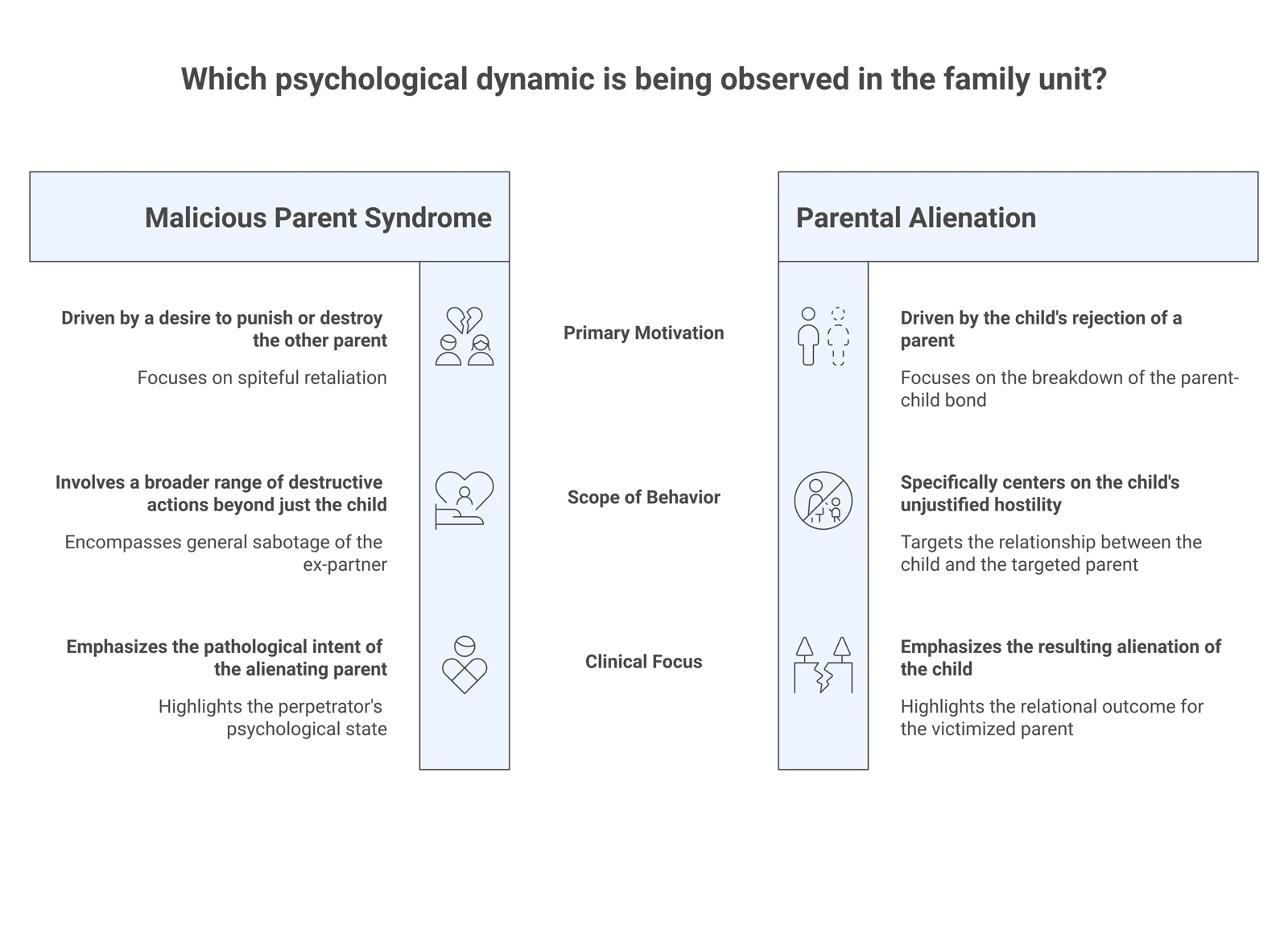
MPS and parental alienation describe overlapping but not identical behavioral patterns. The clearest way to hold the distinction is by scope.
Parental alienation describes a specific dynamic: one parent’s behaviors cause a child to reject the other parent without legitimate cause. The behaviors that produce alienation are well-documented (Baker’s 17-strategy taxonomy, Harman’s mapping onto coercive control, the modern behaviors-first frameworks). The construct has substantial empirical support, regular use in family court, and increasing legislative recognition in some jurisdictions.
Malicious parent syndrome describes a broader pattern that includes parental alienation as one of its components but also encompasses behaviors not necessarily aimed at turning the children against the other parent: illegal conduct in furtherance of harming the ex-partner, false reports, court-order violations, breaking and entering, financial harm. A parent who steals from an ex but does not alienate the children fits MPS criterion three but would not be diagnosed with PA. A parent who alienates the children but never breaks the law fits PA but not MPS (because of criterion three).
| Malicious parent syndrome (Turkat 1995) | Parental alienation (current usage) | |
|---|---|---|
| What it describes | A broader pattern including illegal conduct, court-order violations, and child alienation as one component | A specific dynamic in which one parent’s behaviors cause a child to reject the other parent without legitimate cause |
| Empirical base | Limited clinical case observations; no independent replication | 213 empirical studies reviewed by Harman, Warshak, Lorandos & Florian (2022); 1,259-case appellate coding (unpublished 2025 conference presentation) |
| DSM status | Not in any edition | Not by name; underlying conduct covered by the child psychological abuse code |
| How family courts use it | Rare; appears occasionally in custody filings but does not function as a recognized cause of action | Common; PA appears in trial-court and appellate decisions across all fifty states |
For the closest adjacent contested term, see parental alienation syndrome. For the documented downstream consequences of the underlying behaviors, see effects of parental alienation.
The behaviors the term describes
Whether or not the MPS label sticks, the behaviors Turkat described are real and worth recognizing. They tend to cluster in some high-conflict divorces and meaningfully harm children. The current literature describes them under three overlapping frameworks: parental alienating behaviors (PAB), coercive control, and child psychological abuse.
Behaviors that appear across all three frameworks include:
- A sustained campaign of badmouthing the other parent to the children
- Interference with the other parent’s scheduled contact (telephone, school events, parenting time)
- Withholding cards, gifts, and other communication from the other parent
- False reports of abuse to schools, doctors, child protective services, or police
- Coaching children to make false statements about the other parent
- Violations of court orders relating to parenting time or decision-making
- Engaging the children in conduct designed to harm the other parent emotionally
- Recruiting extended family, friends, or new partners into the campaign
- Financial harm directed at the other parent through the children
Researcher Jennifer Harman’s work argues this behavioral cluster functions as a form of coercive control under the family-violence framework. Researcher Amy J.L. Baker’s interviews with adults alienated as children (Adult Children of Parental Alienation Syndrome, 2007) documented the same behaviors recurring across distinct family patterns. The behaviors persist in the literature even when the MPS label does not. For the wider behavioral inventory, see signs.
How courts use the term today
Family courts in the United States rarely use “malicious parent syndrome” as a controlling label. The term occasionally appears in custody filings, often introduced by an attorney describing an ex-partner’s conduct. It is rare to find an appellate decision in which a court treats MPS as the basis for relief. Compare this to parental alienation, which appears regularly in trial-court and appellate decisions across all fifty states.
The practical reason is the same as the clinical reason. The behaviors the MPS label was meant to capture are now more readily presented under the parental alienation framework, the coercive control framework, or specific causes of action (contempt for violating a parenting order, perjury, false reports to child protective services). Courts respond to documented behaviors and recognized causes of action, not to syndromic labels.
For evidence preparation, the practical implication is straightforward. A reader describing an ex-partner’s conduct in court is generally better served by documenting specific behaviors with dates, communications, and corroborating records than by attempting to introduce MPS as a diagnostic category. The Court silo treats evidence preparation in fuller detail.
Frequently asked questions
What is malicious parent syndrome?
Malicious parent syndrome (MPS) is a label psychologist Ira Turkat proposed in 1995 to describe a sustained campaign by one divorcing parent to harm the other parent, including by harming or alienating the children and committing illegal acts. The term is not in the DSM. It overlaps with but is broader than parental alienation.
Is malicious parent syndrome real?
The behaviors Turkat described are real and documented in clinical practice. The syndrome label is not a current diagnostic category in the DSM-5, the DSM-5-TR (2022), or the ICD-11, and the term has not been validated through independent peer-reviewed replication. Most current clinicians and researchers describe the same behaviors using other frameworks.
What is the difference between malicious parent syndrome and parental alienation?
Parental alienation describes a specific dynamic in which one parent’s behaviors cause a child to reject the other parent without legitimate cause. Malicious parent syndrome describes a broader pattern that includes child alienation but also encompasses illegal conduct, court-order violations, and other forms of harm to the other parent that do not necessarily involve turning the children against them. PA has more empirical support, more legal traction, and is the more widely used current term.
What are the criteria for malicious parent syndrome?
Turkat proposed four criteria: (1) a parent attempts to punish the other parent through a sustained campaign, including child alienation; (2) the parent attempts to deny the other parent contact with the children; (3) the parent commits or attempts illegal acts in furtherance of the campaign; (4) the parent does not meet criteria for another mental disorder that would account for the behaviors.
Is malicious parent syndrome in the DSM-5?
No. MPS has never appeared in any edition of the DSM, including the DSM-5 (2013) and the DSM-5-TR (2022). It is not listed in the ICD-11 either. The behaviors the term was meant to capture are covered in the DSM through the child psychological abuse code (T74.32XA under ICD-10-CM mapping).
Where to go next
- For the broader concept of parental alienation and its current definitions, read the Learn pillar.
- For the closest adjacent contested term, see parental alienation syndrome.
- For the behaviors-side recognition guide, see signs.
- For the documented downstream consequences, see effects of parental alienation.
Citations
- Turkat, I. D. (1995). Divorce-related malicious mother syndrome. Journal of Family Violence, 10(3), 253 to 264.
- Turkat, I. D. (1999). Divorce-related malicious parent syndrome. Journal of Family Violence, 14(1), 95 to 97.
- Turkat, I. D. (2002). Parental alienation syndrome: A review of critical issues. Journal of the American Academy of Matrimonial Lawyers, 18, 131 to 176.
- American Psychiatric Association. (2022). Diagnostic and Statistical Manual of Mental Disorders, Fifth Edition, Text Revision (DSM-5-TR). psychiatry.org/dsm
- Harman, J. J., Kruk, E., & Hines, D. A. (2018). Parental alienating behaviors: An unacknowledged form of family violence. Psychological Bulletin, 144(12), 1275 to 1299. https://doi.org/10.1037/bul0000175
- Harman, J. J., Warshak, R. A., Lorandos, D., & Florian, M. J. (2022). Developmental psychology and the scientific status of parental alienation. Developmental Psychology, 58(10), 1887 to 1911. https://doi.org/10.1037/dev0001404
- Baker, A. J. L. (2007). Adult Children of Parental Alienation Syndrome: Breaking the Ties That Bind. W. W. Norton.
- Wygant, S., et al. (2025). Parental alienation child abuse model: appellate case-coding study. Presented at the Parental Alienation Study Group conference, October 2025. Unpublished conference presentation; not peer reviewed.
If you or your child are in crisis
Free and confidential help is available right now.
- 988 Suicide and Crisis Lifeline. Call or text 988. 988lifeline.org
- Childhelp National Child Abuse Hotline. 1-800-422-4453. childhelp.org
- NAMI HelpLine. 1-800-950-6264. nami.org/help
Last reviewed: 2026-06-05. Author: Alex Buckles (PAC Founder).