

Last reviewed: 2026-06-17. Author: Parental Alienation Center Editorial Team.
The clearest difference between estrangement and parental alienation is ambivalence, which means mixed feelings. An estranged child, even one a parent truly harmed, keeps mixed feelings and a sense of proportion. An alienated child shows an all-good, all-bad split with almost no mixed feelings at all. That one marker separates the two more cleanly than almost anything else.
A note on safety, read this first
A child may pull away because a parent was abusive, neglectful, or frightening. That distancing is justified estrangement, and the child is protecting themselves. This page never asks anyone to relabel real harm as alienation. The ambivalence marker described below is a clue inside a careful assessment, never proof that abuse did not happen, and never a tool for one parent to gain an edge. If anyone in the family is in danger, contact 988 or the Childhelp hotline at 1-800-422-4453 first.
This page offers general information, not clinical or legal advice. It cannot diagnose any child or family, and it does not replace an evaluation by a qualified professional. Anyone weighing these questions should speak with a clinician trained in family dynamics.
Why ambivalence is the dividing line
Real relationships are mixed. Bill Eddy puts it plainly: “All human relationships are ambivalent and ambiguous.” So even a child who was genuinely mistreated usually keeps some love for the parent who hurt them. They may feel safer at a distance. Yet the warmth does not vanish. When a child speaks instead with pure, unbroken hatred and no good memory at all, that flatness is the thing to notice.
Researchers gave this pattern a name. In their 2017 paper in Cogent Psychology, Jaffe, Thakkar, and Piron called the denial of ambivalence a hallmark of parental alienation. Their point is precise. It is not the rejection itself that signals alienation, because rejection happens for many reasons. Instead it is the absence of any mixed feeling, the refusal to hold both love and hurt at once, that stands out as unusual.
Estrangement looks different, because it keeps proportion. For example, a child estranged from a harmful parent can still say, “She was great before the drinking started,” or “I miss who he used to be.” That nuance is a sign of an authentic inner life. Alienation tends to erase it.
What the all-good, all-bad split looks like
Alienation often produces a clean division. One parent becomes wholly good. The other becomes wholly bad, with nothing in between. For example, Amy Baker documented a child who literally drew a devil for the rejected parent and an angel for the favored one. The same pattern shows up in everyday talk. The favored parent can do no wrong, while the rejected parent is called evil, dangerous, or worthless.
Dr. Sue Cornbluth lists this split among her signs of alienation. So do unjustified anger, an inability to recall any positive experience, and a notable lack of guilt about cruel treatment. She is careful, though. “Most people who come to me say they meet every parental alienation criterion,” she notes. “After I take the history, often it’s estrangement.” Her caution is the heart of this page. The marker points, but it does not convict.
A second pattern often rides alongside the split. Authentic complaints respond to repair. Alienation complaints, by contrast, behave like a game of Whac-A-Mole. First, address the three or four real grievances, and a genuinely strained relationship moves forward. In alienation, though, every grievance you resolve is replaced by five new ones, often small and quick to evaporate. The recycling itself is a tell.
The science behind the marker
The ambivalence pattern can be measured, not just observed. In 2020, Bernet and colleagues published a study of something they named the PARQ-Gap in the Journal of Forensic Sciences. They used a standard questionnaire, the Parental Acceptance-Rejection Questionnaire, to score how a child rates each parent. Children experiencing alienation produced an unusually wide gap. One parent was rated as almost entirely accepting, while the other was rated as almost entirely rejecting.
By contrast, children in ordinary high-conflict families tended to rate both parents in a more balanced range. This held true even when those children had real grievances. So the extreme split, not conflict alone, was the standout feature of alienation. In other words, the PARQ-Gap gives a numeric shape to what the clinical eye already sees. It is an absence of ambivalence wide enough to measure.
Neither study claims a single number settles a case. Instead, both treat the gap as one strong signal among several. Used that way, it strengthens an assessment without ever standing in for one.
How it shows up in a child’s own words
A practical way to hear the marker is the past, present, future probe. The questions are simple. The answers separate the two patterns cleanly.
- Past: “Can you tell me about a good time with that parent?” An alienated child often denies any good memory ever existed, sometimes insisting “nothing!” even while looking at happy photographs. A child estranged from real harm usually remembers good times anyway, because both can be true at once.
- Present: “What is the relationship like now?” Alienation tends to sound hostile, contemptuous, and oddly empowered. Estrangement from harm more often sounds sad, fearful, or hurt.
- Future: “What could that parent do to fix things?” An alienated child frequently answers “Nothing,” with the door firmly shut. An estranged child usually names something specific, because they still want repair on the right terms.
These are listening tools, not scripts to corner a child. They belong to trained clinicians and evaluators, and they work only as part of a full history.
Why estrangement and alienation get confused
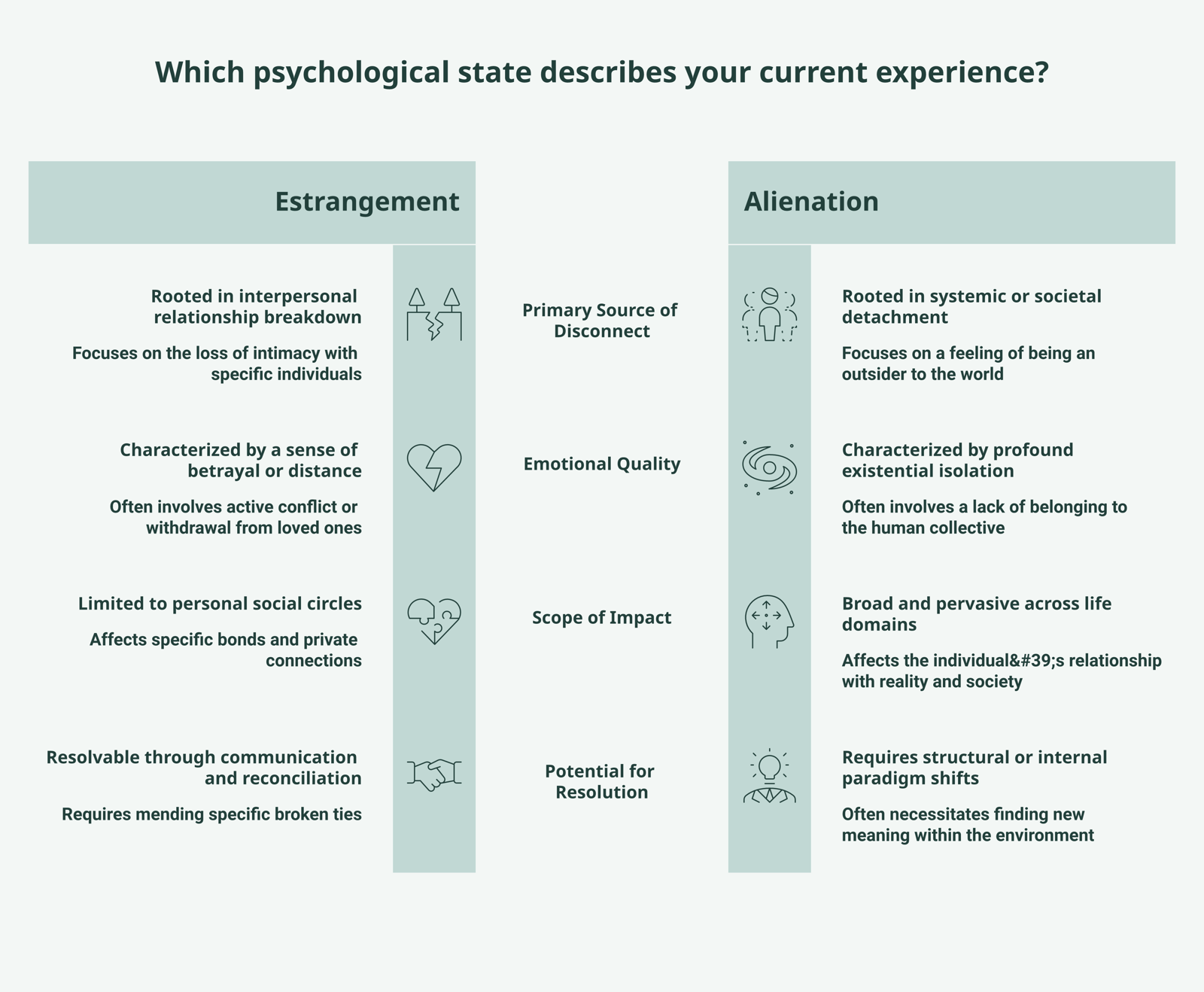
The two can look identical from the outside, which is exactly why care matters. Bill Eddy describes estrangement as the behavioral opposite of alienation. Here, a child resists because of what the rejected parent actually does, while the favored parent may even support contact. He now sees parents falsely accused of alienation when the real story is estrangement. So the surface can mislead in both directions.
It also helps to see how the terms nest. Joshua Coleman frames estrangement as the umbrella term for any cut-off or strained parent-child relationship, with alienation as one pathway inside it. Other pathways include justified estrangement from an abusive or neglectful parent, a controlling partner’s ultimatum, mental illness, enmeshment, and therapist misattribution. Naming the right pathway matters, because each one points toward a different and appropriate response.
For the broader menu of reasons a child may pull away, see why a child rejects one parent. For the consumer-facing version of this comparison built around four plain tests, see parental alienation vs estrangement. Clinicians working a formal assessment can turn to the differential diagnosis of contact refusal, which screens for abuse first and then weighs every cause in order.
The limit of the marker
Ambivalence is a strong clue, yet it has a hard boundary. Its absence never proves that abuse did not happen, and it never outranks real evidence of harm. Some children who were truly hurt do present with flat, all-bad feelings, especially soon after the harm or when fear is high. So the marker raises a question. It does not answer it.
This is why screening for genuine abuse always comes first, and why no responsible framework lets one signal override a safety concern. A child’s all-bad feelings can be the honest residue of fear, not a sign of coaching. So a careful clinician treats the marker as a prompt to look harder, never as a shortcut to a label.
The right use of ambivalence is humble. It sharpens a careful, evidence-led assessment by a qualified professional, and it protects the abuse-not-alienation distinction rather than blurring it. Read well, the marker actually guards abuse survivors, because it reminds everyone that retained love is normal and that flat hatred deserves a closer, slower look in either direction. A child who steps back from a parent who harmed them is doing something healthy, and that truth comes before any marker.
Frequently asked questions
What is the main difference between estrangement and parental alienation?
Ambivalence is the main difference. Estrangement keeps mixed feelings and proportion, even toward a harmful parent. Alienation shows an all-good, all-bad split with little or no ambivalence (Jaffe, Thakkar and Piron 2017).
Can an abused child still have mixed feelings about the parent who hurt them?
Yes, and usually they do. Even children harmed by a parent often keep some love and some good memories. That retained ambivalence is normal, and it is one reason justified estrangement looks different from alienation.
Does a lack of ambivalence prove parental alienation?
No. It is a strong clue, not a verdict. Its absence never proves abuse did not happen, and it never overrides real evidence of harm. A full assessment by a qualified professional is always required.
What is the PARQ-Gap?
The PARQ-Gap is a measured difference in how a child rates acceptance and rejection by each parent. Bernet and colleagues (2020) found that an unusually wide gap is a standout feature of alienation, used as one signal among several.
Is estrangement ever the healthier response?
Yes. When a parent was abusive, neglectful, or frightening, a child’s distance is justified estrangement and a form of self-protection. That rejection is warranted, and it should never be relabeled as alienation.
If you need support now
- 988 Suicide and Crisis Lifeline, call or text 988, 988lifeline.org
- Childhelp National Child Abuse Hotline, 1-800-422-4453, childhelp.org
- NAMI HelpLine, 1-800-950-6264, nami.org/help
Sources
- Jaffe, A. M., Thakkar, M. J., & Piron, P. (2017). Denial of ambivalence as a hallmark of parental alienation. Cogent Psychology, 4(1). doi.org/10.1080/23311908.2017.1327144
- Bernet, W., Gregory, N., Reay, K. M., & Rohner, R. P. (2020). An objective measure of splitting in parental alienation: the PARQ-Gap. Journal of Forensic Sciences, 65(4), 1225. doi.org/10.1111/1556-4029.14300
- American Psychological Association. Divorce and child custody. apa.org/topics/divorce-child-custody