
This page is general information, not legal or clinical advice. It does not create a professional relationship, and it does not address any one state’s licensing or court rules. Anyone facing a custody matter should consult a licensed professional in their own jurisdiction.
A parental alienation expert is a mental health or forensic professional with specialized training in identifying and addressing parental alienation. The role is not a protected title, and it takes several distinct forms. An expert may serve as a custody evaluator, a court educator, an attorney consultant, or a retained testifying witness. Here is how each works.
A note on safety
A child’s rejection of a parent is not always alienation. When a child pulls away because of genuine abuse or neglect, that is justified estrangement, not parental alienation, and the two must never be conflated. A credible expert screens for abuse first. If a child’s safety is at risk, contact local law enforcement or a domestic-violence resource.
What is a parental alienation expert?
A parental alienation expert is a clinician or forensic professional who has studied how a child can come to reject a parent without a good reason. Most are psychologists, psychiatrists, or licensed clinical social workers. Some are forensic specialists who work mainly inside the court system. What unites them is training in the patterns, the assessment methods, and the treatment of this specific family dynamic.
The phrase itself can mislead. No license board issues a “parental alienation expert” certificate. The title is descriptive, not regulated, so anyone can claim it. That is exactly why credentials and method matter more than the words on a business card. The professional standards that govern this work, such as the American Psychological Association’s guidelines for child custody evaluations, apply to the underlying license, not to a special alienation badge.
Because the title is open, the useful question is not whether someone calls themselves an expert. The useful question is what role they fill, what training they hold, and what method they follow. The rest of this page works through each of those.
The four roles a parental alienation expert can fill
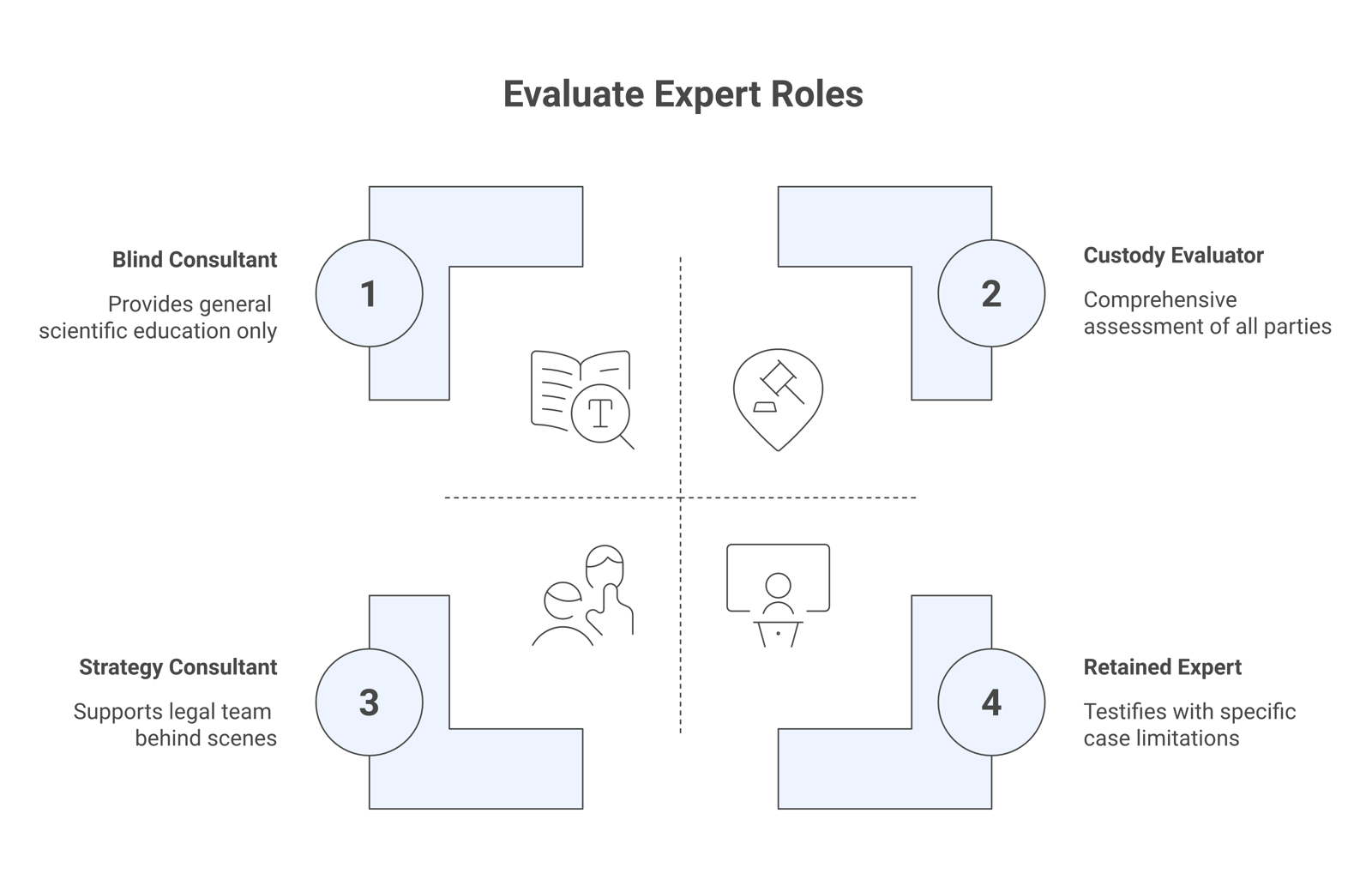
Forensic psychologist Dr. Alan Blotcky describes four distinct scenarios in which an expert can serve. Each role carries a different level of access to the family, and each carries a different limit. Understanding the four roles is the single most clarifying step in this whole topic.
Court-appointed custody evaluator
A court-appointed custody evaluator has the best access of any expert. The court authorizes them to interview both parents, the child, and often collateral witnesses, then to review records. That breadth lets the evaluator form an opinion about the actual family rather than a hypothetical one. The trade-off is cost and time. These evaluations are expensive and can take months. The custody evaluation process is its own structured undertaking.
Blind consultant who educates the court
A blind consultant teaches the court the general science. They explain what alienation is, how it presents, and what the research says, without rendering any opinion about the specific family. They never interviewed the parties, so they stay in the realm of general education. This role lets a judge learn the framework without anyone overreaching into a diagnosis they cannot support.
Behind-the-scenes consultant to the attorney
A behind-the-scenes consultant advises one side’s attorney. They help the lawyer understand the dynamics, frame questions, and read the other experts. This consultant usually does not testify. Their value is strategic and educational, helping counsel avoid the common mistakes that weaken an alienation case.
Retained testifying expert
A retained testifying expert is hired by one party to testify in court. They can speak to the science and to the records they reviewed. They face an important limit, though. If they did not interview all parties, they cannot ethically offer a definitive diagnosis of the specific family. They can describe patterns and explain research; they cannot pronounce a verdict on people they never met.
What credentials and methodology to look for
A credible parental alienation expert starts with a real, current license to practice. Forensic training matters too, because court work differs from therapy. Beyond the license, command of the field’s knowledge base separates a genuine specialist from someone who simply uses the term.
Per Blotcky, that knowledge base is concrete. A solid expert can speak to the roughly 17 alienating behaviors a parent may use, the 8 characteristics seen in an alienated child, a 5-factor diagnostic model, the 3 severity levels (mild, moderate, severe), and the treatment protocols matched to each level. An expert who cannot discuss these has not done the homework.
Methodology matters as much as knowledge. A sound expert uses multiple data sources, screens carefully for abuse, considers alternative explanations for a child’s behavior, and stays within the limits of what they actually observed. The AFCC Model Standards of Practice for Child Custody Evaluation set out how a careful evaluation should be conducted. A parent learning to recognize the patterns can review how to document parental alienation and the separate question of parental alienation diagnosis.
The encapsulation problem: why good experts dig deeper
One trap catches even seasoned evaluators. A child caught in alienation often functions well in the visible parts of life. They earn good grades, keep friends, and seem cheerful at school. On the surface, the child looks fine, so a hurried evaluator concludes nothing is wrong.
This is the encapsulation fallacy, sometimes linked to the work of Richard Warshak. Surface functioning is not the same as an intact relationship with both parents. A child can be doing well in class while their bond with one parent has been hollowed out. A good expert knows to look past the report card and assess the parent-child relationship directly, rather than treating a calm classroom as proof that all is well.
The scientific controversy over expert reliability
Honesty requires saying plainly that the field is contested. Experts do not agree, and a careful page presents the disagreement fairly. Legal scholar Nicholas Bala has mapped the debate into three broad camps.
The first camp, associated with the Parental Alienation Study Group and the more traditional clinicians, treats parental alienation as a well-defined and identifiable phenomenon. The second camp, often described as critical or feminist, argues that the concept is pseudoscience and warns that it can be weaponized against protective parents, especially in abuse cases. The third camp sits in the middle. Researchers such as Janet Johnston, Joan Kelly, Barbara Fidler, and Bala himself accept that alienation is real in some cases while urging caution, rigorous method, and careful screening.
This disagreement is exactly why expert reliability is scrutinized so hard. Research on litigation, including work discussed by attorney Steven Hoffman, shows that intuition fails. Even veteran judges and an evaluator with 5,000 evaluations behind them can guess wrong. One safeguard is “two-expert bracketing,” where each side presents an expert and the court weighs them against each other. Another point Hoffman raises is a medical-malpractice analogy: an expert who never examined the patient should not diagnose the patient, and the same logic applies to an expert who never interviewed the family. The deeper question of whether the concept holds up is covered on is parental alienation real.
How courts appoint and admit a parental alienation expert
Courts do not take the word “expert” on faith. Before testimony is allowed, a judge tests whether it is reliable enough to help the case. In many jurisdictions that test is the Daubert standard; in others it is the older Frye standard. Both ask whether the method is sound and accepted, not merely whether the witness sounds confident.
Appointment works in more than one way. A court can appoint a neutral evaluator on its own or at the parties’ request, giving that expert access to everyone involved. A party can also retain its own consultant or testifying expert, subject to the same admissibility tests. How appointment happens varies by jurisdiction, which is why this page describes the roles rather than naming providers. For the courtroom-specific angle, see the parental alienation expert witness page, and use the Learn hub for the wider topic.
Frequently asked questions
What is a parental alienation expert?
A parental alienation expert is a mental health or forensic professional with specialized training in identifying and addressing parental alienation. The role is not a protected title. It takes four distinct forms: a court-appointed custody evaluator, a blind consultant who educates the court, a behind-the-scenes consultant to an attorney, and a retained testifying expert. Credentials and method matter more than the label.
What does a parental alienation expert do?
It depends on the role. A court-appointed evaluator interviews the whole family and forms an opinion about it. A blind consultant teaches the court the general science. A behind-the-scenes consultant advises one side’s attorney. A retained testifying expert testifies, though without interviewing everyone they cannot offer a definitive diagnosis of the specific family.
What credentials should a parental alienation expert have?
A current professional license is the baseline, usually in psychology, psychiatry, or clinical social work, ideally with forensic training. Beyond the license, a credible expert commands the field’s knowledge base: the alienating behaviors, the child characteristics, a diagnostic model, the severity levels, and the treatment protocols. Sound method, including careful abuse screening, matters as much as the credential.
Is parental alienation accepted by experts?
It is contested. Experts fall into roughly three camps: those who treat alienation as a clear phenomenon, those who call it pseudoscience and warn about misuse, and a middle group that accepts it in some cases while urging caution. Because of this debate, courts apply reliability tests such as Daubert or Frye before admitting expert testimony.
How do you find a parental alienation expert?
This page does not recommend or list providers. Generally, an expert enters a case in one of two ways. A court may appoint a neutral evaluator with access to the whole family, or a party may retain a consultant or testifying expert, subject to the court’s admissibility tests. A licensed family-law attorney in the relevant jurisdiction can explain how appointment and retention work locally.
What this page does not do
This page does not run a directory, recommend any professional, or tell readers where to find one. It does not treat “parental alienation expert” as a regulated title, and it does not take a side in the scientific debate. The goal is understanding, not provider selection. Choices about retaining or requesting an expert belong to a reader working with a licensed attorney and the real facts of their case.
For the diagnostic question, see parental alienation diagnosis. For the validity debate, see is parental alienation real. For the courtroom angle, see parental alienation expert witness. The full Learn hub covers the rest.
Sources and further reading
- American Psychological Association. Guidelines for child custody evaluations in family law proceedings. apa.org/practice/guidelines/child-custody
- Association of Family and Conciliation Courts. Model Standards of Practice for Child Custody Evaluation. afccnet.org
- American Psychological Association. Divorce and child custody. apa.org/topics/divorce-child-custody
If you or your child are in crisis
Free and confidential help is available right now.
- 988 Suicide and Crisis Lifeline. Call or text 988. 988lifeline.org
- Childhelp National Child Abuse Hotline. 1-800-422-4453. childhelp.org
- NAMI HelpLine. 1-800-950-6264. nami.org/help
Last reviewed: 2026-06-08. Author: Alex Buckles (PAC Founder). Editorial review: held to the PAC Editorial Standards (balance, primary-source citation, reader safety); an independent expert review board will be appointed.