
A parental alienation expert witness is a forensic mental-health professional who helps a court understand alienation and apply it to record evidence. There are four distinct roles. None of them diagnose the case from the witness stand. The legal admissibility tests are Daubert and Frye, and using an expert well is a strategy choice. Because the scientific status of parental alienation is contested, any expert, on either side, must also be ready to address the critique, and this page covers it.
This page is general, US-national education. It is not legal advice, it does not create an attorney-client relationship, and it does not address any particular state’s evidence rules or any particular case. State laws vary. Anyone considering retaining an expert should consult a licensed family-law attorney in their own jurisdiction.
A note on safety
A child’s rejection of a parent is not always alienation. If the rejected parent has been abusive, neglectful, or genuinely dangerous, the child’s distancing is justifiable estrangement, not parental alienation, and it is a different legal and safety matter. If a child’s safety is at risk, contact local law enforcement or a domestic-violence resource first.
This page is not a directory and does not refer to specific experts. Choices about whom to retain belong to the reader and a licensed attorney working with the actual facts.
What a parental alienation expert witness actually does
A parental alienation expert witness is a forensic mental-health professional who is retained or appointed to help a court understand parental alienation and how it shows up in the record of a specific case. The job is forensic, which means the audience is the court, not a patient. The expert is not the child’s therapist and is not the parent’s therapist. The expert reads pleadings, transcripts, recordings, messages, and collateral records, and offers opinions to a reasonable degree of professional certainty about what the evidence shows.
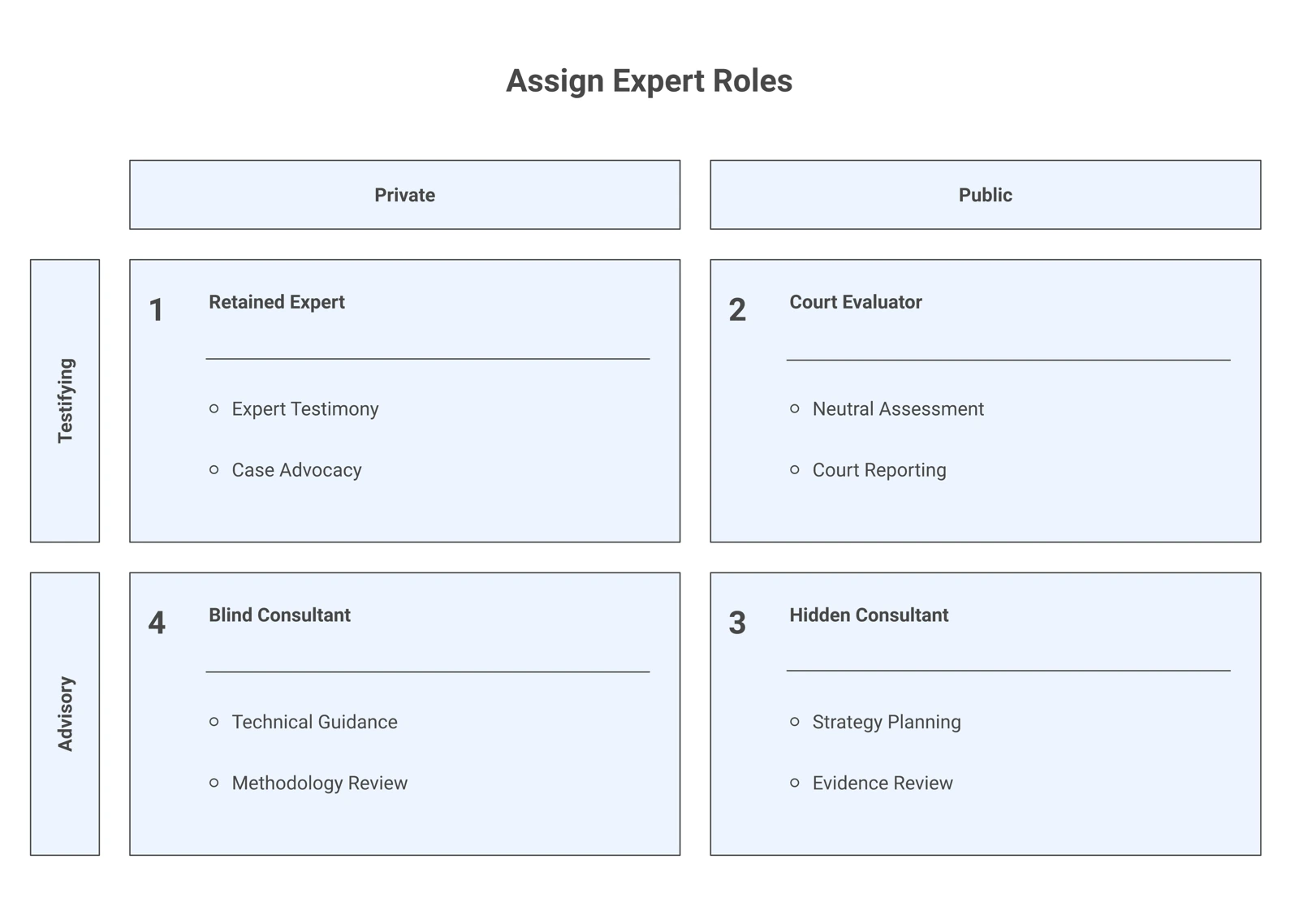
Dr. Alan Blotcky, a clinical and forensic psychologist who has testified in many parental alienation cases, describes four distinct ways an expert can show up in a case. Each role has a different evidentiary purpose, cost profile, and vulnerability to attack. Choosing the right role is itself a strategy decision, made together with counsel. For the venue map, see the Court silo; for the documentation an expert reads, see how to prove parental alienation.
Who qualifies as a parental alienation expert
There is no single license called “parental alienation expert.” Qualification is built from training, experience, publications, and case history applied to a knowledge base specific to the field. Three categories of professional show up most often.
Forensic psychologists and forensic psychiatrists
Forensic psychologists and forensic psychiatrists have specialized training in evaluating people for legal purposes rather than treating them. Their reports and testimony are designed to be cross-examined. The strongest PA experts in this category have a body of work in family-violence, coercive-control, or child-development research, and have testified in many alienation cases.
Court-appointed custody evaluators
A court-appointed custody evaluator is a qualified clinician (often a psychologist or a licensed clinical social worker) ordered by the court to assess both parents, the child, and collateral records. An evaluator is broader than a PA-specific expert and is meant to be neutral. Custody evaluations can identify alienation when the evaluator is trained to see it, but they can also miss it when the evaluator is not.
Named parental alienation researchers and clinicians
A smaller group of researchers and clinicians have published or testified extensively on parental alienation and the related science of coercive control. They are most often used as orienting experts who explain the science to the court rather than as evaluators of a specific family. The work of researchers like Jennifer Harman, whose 2018 paper in Psychological Bulletin framed parental alienating behaviors as a form of family violence, is the kind of scientific foundation these experts build on. For the diagnostic distinctions an expert applies, see parental alienation syndrome.
The four roles a PA expert can play
Blotcky’s four-scenario model is the cleanest practitioner map of how an expert can be deployed in a case. The roles are not interchangeable. Each does something the others cannot.
Court-appointed custody evaluator
A court-appointed custody evaluator is ordered by the court and assesses both parents, the children, and collateral sources (teachers, therapists, doctors), runs psychological testing where appropriate, observes parent-child interactions, and writes a report. Strengths: most comprehensive view of the family, least vulnerable to “hired gun” attacks, typically near the top of a judge’s decision stack. Limits: time-intensive, expensive, and almost always requires a court order rather than a parent-side request. Evaluations can also confuse a pathologically enmeshed parent-child bond with a healthy one, which is part of why experienced litigators treat them as one input, not a verdict.
Blind consultant to the court
A blind consultant to the court is invited in to educate the court generally on parental alienation principles, without being retained by either parent. Strengths: usually safe from “hired gun” attacks, and opposing-counsel relevance objections are typically denied because the court invited the testimony. A hypothetical-question technique connects general principles to specific case facts without crossing into individual diagnosis. Limits: the expert cannot offer a case-specific opinion in this posture.
Behind-the-scenes consultant to counsel
A behind-the-scenes consultant never testifies. The expert trains the attorney on parental alienation principles (Baker’s seventeen alienating strategies, the eight behavioral manifestations, the Bernet and Greenhill Five-Factor Model, the severity continuum) and helps with deposition questions, motion strategy, witness preparation, and responding to a custody-evaluation report counsel believes is inaccurate. Strengths: cost-effective and the expert never faces cross-examination. Limits: the court does not hear from the expert directly.
Retained testifying expert
A retained testifying expert is hired by one parent’s counsel to review the file (timeline, pleadings, recordings, texts, emails, evaluator reports) and offer opinions on parental alienation principles and how they apply to the documented record. Strengths: brings parental alienation expertise the court may not otherwise hear. Limits: because the expert typically has not interviewed the alienating parent or the children, explicit case-specific diagnosis should be avoided. The retained expert describes what the record shows under the framework, not the family itself.
What an expert can and cannot testify to (Daubert and Frye)
Two admissibility standards govern when an expert’s testimony gets in. Federal courts and most state courts use the Daubert standard, articulated by the US Supreme Court in Daubert v. Merrell Dow Pharmaceuticals. Under Daubert (and Federal Rule of Evidence 702), a judge acts as a gatekeeper and asks whether the expert’s testimony is reliable and relevant, whether the methods have been tested and peer-reviewed, whether there are known error rates, and whether the methods are generally accepted in the field. The primary sources are Federal Rules of Evidence Rule 702 via Cornell Legal Information Institute and the Daubert opinion itself.
A smaller set of states still use the older Frye standard, which asks only whether the expert’s methods are generally accepted in the relevant scientific community. The two standards overlap. A licensed attorney in the reader’s state can confirm which standard applies.
The case law on parental alienation expert testimony is more extensive than many readers expect, and also more contested. The “well over a thousand decisions” figure that practitioners cite comes from forensic psychologist and attorney Demosthenes Lorandos, whose 2020 survey in Family Court Review conservatively coded 1,181 US cases from 1985 through 2018 in which courts treated parental alienation as material to the decision, and found such cases in every US state. That survey is proponent-authored, and by design it counts only the cases where alienation figured in the outcome, so it measures presence in the case law rather than judicial endorsement of the science. The counterpoint is Joan Meier’s 2020 study of published US custody decisions, which found that alienation cross-claims sharply worsened outcomes for mothers alleging abuse; the methodological exchange between Meier and the Harman-Lorandos camp remains unresolved, and the contested-status section below covers it. Peer-reviewed research such as Jennifer Harman, Edward Kruk and Denise Hines’s 2018 Psychological Bulletin review, which frames parental alienating behaviors as a form of family violence, supplies one scientific foundation experts cite; critics weigh that framing differently.
What an expert can ethically testify to has limits even when the testimony is admissible. A retained expert who has not interviewed the parties should describe what the record shows under the framework, not announce a diagnosis. A blind consultant explains the science without giving an individual opinion. A custody evaluator can do both because the evaluator has access to the people. An expert opinion should be no broader than the foundation that supports it.
The contested status every expert must be ready to address
The science behind parental alienation is genuinely contested, and any expert who testifies about it should expect to be cross-examined on the critique. For the parent or attorney preparing a case, understanding these counter-arguments is case preparation, not concession. An expert who cannot answer them is a liability; an expert who addresses them candidly is more credible, not less.
The first point is diagnostic. Parental alienation is not a standalone diagnosis in the DSM-5-TR. Related concepts appear under parent-child relational problem and child affected by parental relationship distress, and child psychological abuse covers the underlying acts, but an expert who testifies that alienation is a recognized mental-health diagnosis is overstating the record and inviting exclusion.
The second is empirical. Law professor Joan Meier and colleagues published a 2020 study of published US custody decisions (Meier et al., 2020, Journal of Social Welfare and Family Law) finding that courts credited mothers’ abuse claims in 41 percent of cases and child sexual abuse claims in only 15 percent, and that a father’s alienation cross-claim roughly doubled the rate at which mothers alleging abuse lost custody, from 26 percent to 50 percent, while making courts about 3.9 times more likely to disbelieve the mother’s child-abuse claim. Proponent researchers Jennifer Harman and Demosthenes Lorandos challenged the study’s methods; Meier published a rebuttal in 2022; the exchange is unresolved. Opposing counsel will know this study, and a competent expert will too.
The third is policy. The UN Special Rapporteur on violence against women and girls, Reem Alsalem, issued a 2023 report (UN Doc A/HRC/53/36) calling parental alienation a “discredited and unscientific pseudo-concept” and urging states to bar its use in custody proceedings. It is an advocacy and policy report rather than a study, and proponent scholars published organized rebuttals, but it shapes how some courts and legislatures view the field.
The fourth bears directly on expert practice. Title XV of the Violence Against Women Act Reauthorization Act of 2022, known as Kayden’s Law (Pub. L. 117-103, codified at 34 U.S.C. 10446(k)), created grant incentives for states that adopt judicial training standards, limits on reunification treatment, and stricter qualification requirements for experts in custody cases involving abuse allegations. As of mid-2026, Colorado, California (Piqui’s Law), Pennsylvania, and Utah (Om’s Law) have enacted conforming legislation. In those states, the qualifications of any proposed expert, including a parental alienation expert, face heightened statutory scrutiny. Vetting an expert’s credentials carefully is no longer just good practice; in a growing number of jurisdictions it is what the law expects.
Treating clinician vs. forensic expert
A common mistake is asking the child’s therapist, or the targeted parent’s therapist, to testify as a parental alienation expert. The two roles do different work. A treating clinician’s job is the patient’s welfare. A forensic expert’s job is the truth as the record shows it, for the court. Forensic-psychology ethical guidance cautions against blending them.
A treating clinician can give factual testimony about what happened in sessions (within privilege and consent rules) but should not be put forward as an expert offering opinions on parental alienation as a phenomenon or on what the broader record shows. The American Psychological Association publishes general guidance on divorce and child custody that helps families understand the difference. When a case needs forensic opinions, retain a separate forensic expert; when a case needs information about the child’s treatment, the treating clinician is the right witness for that narrow purpose.
How to deploy an expert: the Joshi three-goal framework
An expert is not a verdict. The strongest use of an expert is as part of a coherent case strategy. Attorney Ashish Joshi describes a three-goal courtroom framework. The goals are sequential, and an expert can support each one.
First, persuade the court that parental alienation is a real, studied phenomenon. An orienting expert lays out the peer-reviewed research, the identification frameworks, and the case law, and is most credible when they also acknowledge the contested status covered above rather than waiting for cross-examination to raise it. Some judges have not been trained on parental alienation at all, so the foundation has to be built before the facts of the case are argued.
Second, persuade the court that alienation is occurring in this case. A custody evaluator or a retained testifying expert applies the Five-Factor Model (Bernet and Greenhill, 2022) to the documented record: the child’s resistance or refusal of contact, a prior positive relationship with the now-rejected parent, the absence of abuse or neglect by that parent, alienating behaviors by the favored parent, and the behavioral signs of alienation in the child. The model is Baker’s four factors with contact refusal added as factor one, and it is a clinical identification framework a court may weigh, not a diagnosis or a legal test.
Third, persuade the court that the child needs timely, appropriate intervention. An expert can speak to treatment options and the window for intervention. An expert who only diagnoses without addressing remedies leaves the court without a way forward.
Veteran litigators sometimes use two experts to bracket a case. Texas family-law attorney Robert Hoffman describes one expert who opens and orients the court to the science, and a second expert who sits through the trial and connects the science to the evidence at the end. The two-expert model is not always financially possible, but it is the cleanest expression of the three-goal frame. A retained expert who has not personally interviewed the parties can still testify: experts in malpractice and workers’-compensation cases regularly testify from records, depositions, videos, and messages. An opinion is admissible when the available evidence supports it to a reasonable degree of professional certainty.
When a case can proceed without an expert
Most parental alienation cases have no expert and no guardian ad litem. Often there is only a judge and two parents. That reality is exactly why the behaviors-not-labels standard matters.
Joshi and Judge Jon Van Allsburg of Ottawa County, Michigan, describe how a trial court can find alienation on behaviors alone, without an expert diagnosing a syndrome. In their account, appellate courts have recognized that high-conflict custody disputes frequently involve acts by one parent designed to sabotage the other parent’s relationship with the child. Courts have always evaluated bad behavior without requiring it to carry a clinical label. As Van Allsburg puts it, “Labels don’t give us any basis on which to make a ruling. It’s the facts that give us that ability.” For a pro-se reader, the lesson is to arrive with a clean fact pattern, not diagnostic terms.
The point is not that experts do not matter. The point is that an expert is a tool for a record, and a clean record without an expert is often better than a thin record with one. When a case genuinely needs an expert, a parental alienation lawyer can advise on whether and which role to retain.
What to look for, what to watch out for
Vetting a parental alienation expert is a careful exercise, ideally done together with counsel. Several features tend to predict useful testimony.
Look for documented training and publications in parental alienation, family violence, or coercive control, and working knowledge of the standard frameworks (Baker’s seventeen strategies, the eight behavioral manifestations, the Bernet and Greenhill Five-Factor Model, the severity continuum). Look for case experience across states and across all four Blotcky roles, since breadth tracks with honest scope discipline. Look for an expert who knows the critical literature, Meier’s research and the UN report included, as well as the proponent literature, because that expert will not be surprised on cross-examination. Look for an expert who will tell the court what the record shows under the framework, not pronounce on individuals they have not assessed.
Watch for experts who promise an outcome or claim to diagnose from a thin file. Watch for testimony that drifts from the record in either direction. Joshi cautions against euphemism when the documented evidence supports the term parental alienation; the same discipline forbids reaching for the term when the record does not support it. An expert whose conclusions never vary with the facts is an advocate, and courts discount advocates.
Blotcky emphasizes that an expert in any of the four roles must know the field deeply and must be able to withstand vigorous cross-examination. The most defensible posture is neither salesmanship nor vagueness but precision: testify clearly and firmly to what the record shows, acknowledge what it does not show, and stop there. An expert’s value to the court is fidelity to the evidence, not allegiance to the side that retained them.
On the stand: composure under cross and qualification challenges
The hardest part of the expert role is cross-examination, and experienced experts treat composure as a method rather than a personality trait. Practitioners describe a simple physical routine: sit with both feet flat, hands resting, and slow everything down. A phrase like “let me think about that, Counsel” buys time and signals care. The expert never argues with opposing counsel, because, as one veteran puts it, “he who throws dirt loses ground.” A calm witness reads as the credible one.
Staying in your lane is the companion discipline. The expert acts as an aid to the court, acknowledges the limits of what the record supports, and does not try to “win” the case for a side. A treating therapist, in particular, should not offer custody recommendations, because that exceeds the foundation of a treatment relationship. One practical safeguard is a pre-trial clause requiring any side to flag claimed errors in a report before the hearing; if opposing counsel ambushes with a supposed error instead, the expert can read the clause aloud to show the bad faith.
Qualification challenges are part of the process, and they run in both directions. Voir dire, the procedure for testing an expert’s credentials and the basis for their opinions, applies to every expert in a case, including the one a parent retains. Testing whether any witness has actually read the literature they characterize, on either side of the debate, is legitimate and routine. An expert who asserts that parental alienation testimony is categorically inadmissible should be able to square that with the Lorandos 2020 survey of 1,181 coded cases; an expert who asserts the science is settled should be able to answer Meier’s 2020 findings and the unresolved methodological exchange that followed. A parent or attorney should expect their own expert’s qualifications and familiarity with both literatures to be tested just as rigorously, and should prefer an expert who welcomes that testing. In states with Kayden’s-Law-style statutes, that scrutiny is increasingly required rather than optional.
Frequently asked questions
Who qualifies as a parental alienation expert witness?
There is no single license called “parental alienation expert.” Qualification is built from training, experience, publications, and case history. Forensic psychologists and forensic psychiatrists with a body of work in parental alienation, family violence, or coercive control are the most common. Court-appointed custody evaluators and named PA researchers and clinicians also serve as experts in specific roles.
How much does a parental alienation expert witness cost?
Cost varies widely by jurisdiction, by the expert’s experience, and by the role. Custody evaluations are the most expensive (often a court-ordered process running into many thousands of dollars). Retained testifying experts and behind-the-scenes consultants charge hourly rates that vary by region. A licensed attorney in the reader’s state can give a realistic cost range for a specific case.
Can a parental alienation expert diagnose the case?
Only an expert who has personally evaluated the family (typically a court-appointed custody evaluator) is in a position to offer a case-specific diagnostic opinion. Retained testifying experts and blind consultants describe what the record shows under the framework. The rule across all roles is that an opinion should be no broader than the foundation that supports it.
What is the difference between a custody evaluator and a parental alienation expert?
A custody evaluator is appointed by the court to evaluate the whole family and is meant to be neutral. A parental alienation expert (typically retained by one parent or invited as a blind consultant) brings specialized knowledge of the parental alienation framework. The two roles can overlap, and a custody evaluator trained in parental alienation can do both jobs at once. A retained PA expert generally cannot, because the expert has not interviewed the parties.
Is parental alienation testimony admissible in court?
Often, yes, when the expert and the methodology pass the applicable admissibility standard (Daubert in federal courts and most states, Frye in a smaller number of states). The Lorandos 2020 survey identified 1,181 conservatively coded US cases from 1985 through 2018 in which courts treated parental alienation as material, across every US state, though the survey is proponent-authored and counts only cases where alienation figured in the outcome. Critics, led by Joan Meier, dispute how alienation claims function in court, and the exchange is unresolved. Admissibility is a per-case judgment by the trial court, and testimony framed as a syndrome diagnosis faces the strongest challenges.
How does Kayden’s Law affect parental alienation expert witnesses?
Kayden’s Law (Title XV of the Violence Against Women Act Reauthorization Act of 2022) gives states grant incentives to adopt judicial training standards, limits on reunification treatment, and stricter qualification requirements for experts in custody cases involving abuse allegations. As of mid-2026, Colorado, California (Piqui’s Law), Pennsylvania, and Utah (Om’s Law) have enacted conforming laws. In those states, a proposed parental alienation expert’s credentials face heightened statutory scrutiny, which makes careful vetting a legal requirement as well as good practice.
What this page does not do
This page is not legal advice. It does not refer to or recommend specific experts, since the site is not a directory at launch. It does not name any one state’s evidence rules as if they applied nationally, and it does not tell readers when to retain anyone. Choices about whether to seek a custody evaluation, retain a testifying expert, or engage a behind-the-scenes consultant belong to a licensed attorney working with the real facts. The page does not promise that an expert will produce any particular outcome, and it does not present the underlying science as settled: the contested status described above is real, and a credible expert engages with it. The right use of an expert is the careful, evidence-led one.
Where to go next
- For the broader legal venue map, visit the Court pillar.
- For the documentation an expert reads, see how to prove parental alienation.
- For vetting counsel and deciding when an expert is needed, see how to choose a parental alienation lawyer.
- For the criminal and civil status of alienating conduct, see is parental alienation illegal and can you sue for parental alienation.
- For the diagnostic distinctions an expert applies, see parental alienation syndrome and the signs inventory.
Objective measures an evaluator may use
Some evaluators support their opinion with a validated instrument rather than impression alone. The PARQ and its derived PARQ-Gap, described in Bernet et al., Journal of Forensic Sciences (2018) and Bernet et al., PARQ-Gap, Journal of Forensic Sciences (2020), measure the all-good and all-bad splitting that tends to mark alienation, and they can be cited as one objective input. A measure like this still faces Daubert or Frye scrutiny, and it is never a verdict on its own. For how the instrument works and its limits, see our page on measuring parental alienation with the PARQ.
Sources and further reading
- Federal Rules of Evidence Rule 702. Cornell Legal Information Institute. law.cornell.edu/rules/fre/rule_702
- Daubert v. Merrell Dow Pharmaceuticals, 509 US 579 (1993). Cornell Legal Information Institute. law.cornell.edu/supremecourt/text/509/579
- Lorandos, D. (2020). Parental alienation in U.S. courts, 1985 to 2018. Family Court Review, 58(2), 322-339.
- Meier, J. S., Dickson, S., O’Sullivan, C., Rosen, L., & Hayes, J. (2020). U.S. child custody outcomes in cases involving parental alienation and abuse allegations: What do the data show? Journal of Social Welfare and Family Law, 42(1), 92-105.
- Bernet, W., & Greenhill, L. L. (2022). The Five-Factor Model for the diagnosis of parental alienation. Journal of the American Academy of Child & Adolescent Psychiatry, 61(5), 591-594. https://doi.org/10.1016/j.jaac.2021.11.026
- Baker, A. J. L. (2020). Reliability and validity of the four-factor model of parental alienation. Journal of Family Therapy, 42(1), 100-118. https://doi.org/10.1111/1467-6427.12253
- Harman, J. J., Kruk, E., and Hines, D. A. (2018). Parental alienating behaviors: An unacknowledged form of family violence. Psychological Bulletin, 144(12), 1275 to 1299. https://doi.org/10.1037/bul0000175
- Alsalem, R. (2023). Custody, violence against women and violence against children. Report of the UN Special Rapporteur on violence against women and girls, UN Doc A/HRC/53/36. ohchr.org
- Keeping Children Safe From Family Violence Act (Kayden’s Law), Title XV, Violence Against Women Act Reauthorization Act of 2022, Pub. L. 117-103, codified at 34 U.S.C. 10446(k).
- American Bar Association, Section of Family Law. americanbar.org/groups/family_law
- American Psychological Association. Divorce and child custody. apa.org/topics/divorce-child-custody
- Joshi, A. (2024). Litigating Parental Alienation. American Bar Association.
Crisis resources
If safety, self-harm risk, or a child-welfare concern is at issue, reach out immediately.
- 988 Suicide and Crisis Lifeline. Call or text 988. 988lifeline.org
- Childhelp National Child Abuse Hotline. 1-800-422-4453. childhelp.org/hotline
- NAMI HelpLine. 1-800-950-6264. nami.org/help
Last reviewed: June 17, 2026. Author: Alex Buckles (PAC Founder).