

Preparing for custody evaluations comes down to one honest goal: showing an evaluator that a child’s wellbeing comes first. The evaluator is neutral, not an opponent, and the assessment is not something a parent wins or loses. The strongest preparation is telling the truth, staying child-focused, and bringing organized documentation.
A note on safety
If there is genuine abuse, neglect, or family violence in the picture, raise it honestly and safely with the evaluator and with counsel. A child protecting themselves from a parent who has harmed or frightened them is showing justified estrangement, not alienation. Real safety concerns belong on the record, supported by evidence, not minimized to look cooperative.
This page is general information, not legal advice. Reading it does not create an attorney-client relationship. Evaluation processes vary by jurisdiction. Anyone facing a custody evaluation should consult a licensed family-law attorney in their own area.
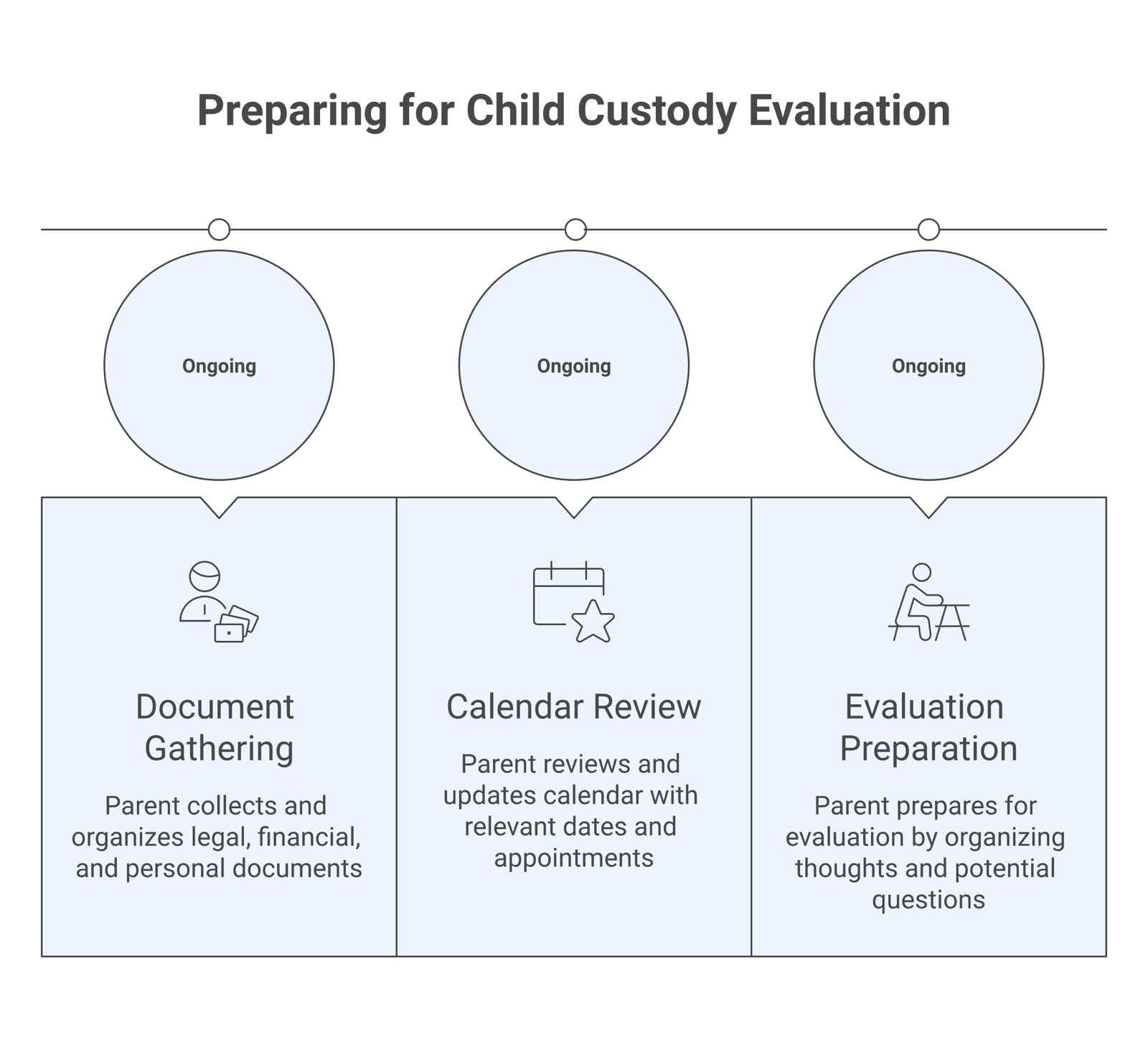
What preparing for custody evaluations actually means
Preparing for custody evaluations is often misunderstood as learning how to perform well or how to make the other parent look bad. That framing backfires. An evaluation is not a contest with a winner. It is a structured assessment whose purpose is the child’s best interest, and evaluators are trained to notice when a parent treats it as a game.
Honest preparation means three things. A parent gets ready to tell the truth, including the parts that are uncomfortable. A parent organizes records so the evaluator can see the real history without digging. And a parent keeps the child at the center of every answer, instead of using the process to relitigate the relationship with the other parent.
This page is written for the parent being evaluated. It is distinct from the clinical methodology page on the parental alienation custody evaluation, which explains the evaluator’s own forensic process. Understanding what the evaluator is doing helps a parent cooperate with it rather than fight it.
What a custody evaluation is and who the evaluator is
A child custody evaluation is a court-ordered assessment, usually carried out by a mental-health professional, that gathers information about both parents, the child, and the family. The evaluator interviews each parent, often observes each parent with the child, may interview the child, and reviews collateral sources such as school and medical records. That work produces a report and, in many cases, a recommendation to the court.
One thing matters more than any other here: the evaluator’s stance. The evaluator is neutral. They are not the parent’s advocate and not the other parent’s advocate. Their client, in effect, is the child and the court. The American Psychological Association’s Guidelines for Child Custody Evaluations describe this impartial, multi-source posture, and the American Bar Association Section of Family Law publishes general consumer information on how custody matters proceed.
Because the evaluator is neutral, the goal of preparation is not to charm them. It is to give them accurate, child-focused information they can rely on. Procedures differ between jurisdictions, so a local family-law attorney is the right source for what a specific court expects.
What evaluators look at
Evaluators are not just measuring who is the nicer parent. They are testing why a child behaves and feels the way they do, and which arrangement serves that child. When a child rejects or resists a parent, a careful evaluator asks whether that reaction is justified estrangement from real harm, a realistic preference, or alienation driven by one parent’s conduct. Researchers Jennifer Harman, Edward Kruk, and Denise Hines argue in Psychological Bulletin that some parental alienating behaviors map onto recognized patterns of coercive control, which is one reason evaluators screen carefully in both directions before drawing conclusions.
Baker’s four-factor model: what an evaluator weighs
One widely cited framework that informs how many evaluators think comes from Dr. Amy J.L. Baker, a developmental psychologist. Her four-factor model is a way of distinguishing a child who has been turned against a parent from a child who is pulling away for valid reasons. A parent preparing for an evaluation benefits from understanding it, because it shows what an evaluator is actually weighing.
The four factors are these. First, was there a prior positive relationship between the child and the now-rejected parent? Second, is the rejected parent free of genuine abuse or neglect, since a child distancing from real harm is a protective response, not alienation? Third, has the favored parent used behaviors that undermine the child’s bond with the other parent, such as bad-mouthing, limiting contact, or telling the child the other parent does not love them? Fourth, does the child show the patterns seen in alienation, such as unwavering, one-sided contempt with only weak or trivial reasons behind it?
Baker published a reliability and validity study of this model in 2020, and the field’s Five-Factor Model (Bernet and Greenhill, 2022) is Baker’s four factors with the child’s contact refusal added as factor one: factor one establishes that there is a problem to explain, and the remaining factors distinguish alienation from justified estrangement.
The practical lesson for a parent is simple. An evaluator looks at the whole pattern over time, not at a single bad day or a single rehearsed statement. Honesty and a clear record serve a parent far better than a polished performance.
Baker’s strategy questionnaire as a measurement tool
Baker’s work also produced a validated instrument. The Baker Strategy Questionnaire grew out of interviews with adults who had been alienated as children and with targeted parents, and it was distilled into a short measure of the alienating strategies a favored parent may use. It has been studied across multiple samples and is free to use.
For a parent, the point is not to memorize the questionnaire. The point is that the field has objective, peer-reviewed tools, so an evaluator’s conclusions can rest on more than impressions. A parent who has documented specific events gives those tools something real to work with.
Objective instruments an evaluator may use
Evaluators do not rely on gut feeling alone. Many use standardized instruments alongside interviews and records, which adds an objective layer beyond opinion. A parent does not need to study for these. Understanding them simply removes the fear of the unknown.
The PARQ, explained at a parent level
The Parental Acceptance-Rejection Questionnaire, or PARQ, is one validated, court-tested instrument an evaluator may use. It is a 60-item self-report that measures how a child perceives a parent’s acceptance or rejection. Each item is rated on a simple scale, from almost always true to almost never true.
Researchers have found the PARQ can help surface the all-or-nothing thinking, sometimes called splitting, that appears in severe alienation. A very high score can suggest genuine rejection, while a very low score can suggest enmeshment with one parent. An important safeguard is built in. A single extreme score never proves a child’s true preference on its own. Extreme scores are treated as a signal to ask more questions, integrated with everything else the evaluator has gathered. A parent has no reason to fear an honest instrument, and no way to game it usefully.
How a calm, child-focused parent comes across
How a parent presents in the evaluation room matters, though not in the way many fear. The goal is not to act. The goal is to stay regulated enough that the evaluator can see the real, caring parent rather than a person consumed by the conflict.
The four A’s and the four C’s
Family-law attorneys and evaluators who handle these cases describe a recurring pattern, sometimes summarized as the four A’s and the four C’s. Targeted parents, worn down by a long fight, often arrive angry, anxious, agitated, and afraid. Those feelings are understandable. They also read poorly in an evaluation, where they can be mistaken for the source of the problem. A parent driving the conflict, by contrast, may present as cool, calm, charming, and convincing.
There is a related trap worth naming. When a parent spends the interview attacking the other parent, the listener starts to associate the negativity with the speaker. Bad-mouthing tends to stick to the person doing it. The healthier discipline is to acknowledge that the situation is not all black and white, to name genuine strengths where they exist, and to own one’s own shortcomings honestly.
None of this is about suppressing feeling. Passion for a child is good. Anger turned on the other parent is not. A parent who stays calm, balanced, and focused on the child is not performing. They are letting the evaluator see clearly. The documentation work behind that calm is covered in how to prove parental alienation.
How to prepare honestly
The steps below are about preparing truthfully, not about gaming an assessment. Each one strengthens the evaluator’s ability to see the child’s real situation.
- Understand the order and the role. Read the court order that set up the evaluation. Know what the evaluator was asked to assess and confirm the logistics with counsel. Treat the evaluator as a neutral fact-finder, because that is what they are.
- Organize documentation before the first session. Gather a clear, dated record: the parenting schedule, communication logs, school and medical records, and any prior court orders. Keep it factual and organized so the evaluator can follow the history without untangling it. Guidance on building that record sits in how to document parental alienation.
- Tell the truth, including the hard parts. Answer questions honestly, even when the honest answer is not flattering. Evaluators cross-check stories against records and the other parent. Admitting a real mistake builds more credibility than a tidy story that does not hold up.
- Keep every answer child-focused. Frame responses around the child’s needs, routines, and wellbeing rather than around grievances. When asked about the other parent, describe behavior and its effect on the child, not character.
- Do not coach or rehearse the child. Evaluators are trained to detect coached, borrowed, or rehearsed statements, and coaching damages a parent’s credibility badly. Let the child speak for themselves. Reassure the child that it is fine to love both parents and to tell the truth.
- Do not bad-mouth the other parent. Denigrating the other parent is one of the clearest red flags an evaluator looks for, and it can be mistaken for alienating behavior. State concerns calmly, factually, and only when relevant to the child’s safety or wellbeing.
- Raise genuine safety concerns the right way. If there is real abuse or family violence, bring it forward honestly and support it with evidence and with counsel. Do not exaggerate, and do not stay silent to seem agreeable. Accuracy protects the child and protects credibility.
- Take care of your own regulation. Rest, prepare, and find support so the evaluation does not catch a parent at their most depleted. A steady parent is better able to stay calm and child-focused under questioning.
What to avoid
A few behaviors reliably undermine a parent, no matter how strong the underlying case. Coaching the child tops the list. Bad-mouthing the other parent runs a close second. Exaggerating or inventing allegations destroys credibility and can harm the very child a parent is trying to protect. Treating the evaluator as an adversary to be won over, rather than a neutral to be informed, sends exactly the wrong signal.
The reframe that helps most is this. The evaluation is not a battle to be won. It is a chance to give a neutral professional an accurate, child-centered picture. For how this fits the wider custody process, see parental alienation and child custody, and for the judicial perspective, see how judges view parental alienation. The full set of legal topics lives in the Court section.
Frequently asked questions
How should a parent prepare for a custody evaluation?
A parent prepares by understanding the evaluator’s neutral role, organizing clear and dated documentation, telling the truth, and keeping every answer focused on the child’s wellbeing. Preparation is honest readiness, not rehearsal. Coaching a child or attacking the other parent works against a parent. Because procedures vary by jurisdiction, a local family-law attorney should confirm what a specific court expects.
What do custody evaluators look for?
Evaluators look at why a child feels and behaves as they do, and which arrangement serves the child. They weigh each parent’s relationship with the child, each parent’s support for the child’s bond with the other parent, any safety concerns, and the child’s needs. They notice coaching, bad-mouthing, and exaggeration, and they screen for genuine abuse so a protective response is not mistaken for alienation.
Will a custody evaluator be able to tell if a child has been coached?
Evaluators are trained to notice coached, borrowed, or rehearsed statements, and they cross-check what a child says against records and interviews. Coaching tends to surface, and when it does it badly harms the coaching parent’s credibility. The honest approach is to let the child speak freely and to reassure the child that loving both parents is allowed.
What should a parent never do during a custody evaluation?
A parent should never coach the child, never bad-mouth the other parent, and never exaggerate or invent allegations. These behaviors are the exact red flags evaluators watch for, and they can do more damage than the underlying dispute. Genuine safety concerns are different and should be raised honestly, with evidence and with counsel, never minimized to appear cooperative.
Is the custody evaluation something a parent can win?
No. A custody evaluation is not a contest with a winner. The evaluator is neutral, and the goal is the child’s best interest, not victory over the other parent. Treating it as a battle to win usually backfires. The most effective preparation is honesty, organized documentation, and a steady focus on the child.
Sources and further reading
- American Psychological Association. Guidelines for Child Custody Evaluations in Family Law Proceedings. apa.org/practice/guidelines/child-custody
- American Bar Association, Section of Family Law. americanbar.org/groups/family_law
- Harman, J. J., Kruk, E., & Hines, D. A. (2018). Parental alienating behaviors: An unacknowledged form of family violence. Psychological Bulletin, 144(12), 1275 to 1299. https://doi.org/10.1037/bul0000175
- Baker, A. J. L. (2020). Reliability and validity of the four-factor model of parental alienation. Journal of Family Therapy, 42(1), 100 to 118. https://doi.org/10.1111/1467-6427.12253
- Bernet, W., & Greenhill, L. L. (2022). The Five-Factor Model for the diagnosis of parental alienation. Journal of the American Academy of Child and Adolescent Psychiatry, 61(5), 591 to 594. https://doi.org/10.1016/j.jaac.2021.11.026
If you or your child are in crisis
Free and confidential help is available right now.
- 988 Suicide and Crisis Lifeline. Call or text 988. 988lifeline.org
- Childhelp National Child Abuse Hotline. 1-800-422-4453. childhelp.org
- NAMI HelpLine. 1-800-950-6264. nami.org/help
Last reviewed: 2026-06-06. Author: Alex Buckles (PAC Founder).