

A parental alienation child custody case turns on documented conduct, not on the label itself. When one parent works to damage a child’s bond with the other parent, courts can respond, but only to proven behavior. Remedies range from parenting-time enforcement up to, in rare and severe cases, a court-ordered custody change.
A note on safety
A child’s rejection of a parent is not always alienation. If the rejected parent has been abusive, neglectful, or genuinely dangerous, the child’s distancing is justified estrangement, not parental alienation, and it is a different legal and safety matter. Custody remedies built for alienation are dangerous if aimed at a protective parent. If a child’s safety is at risk, contact local law enforcement or a domestic-violence resource first.
This page is general US-national education. It is not legal advice, does not create an attorney-client relationship, and does not address any one state’s law. State laws vary widely. Anyone considering legal action should consult a licensed family-law attorney in their own jurisdiction.
How parental alienation affects child custody
Parental alienation can affect child custody, but not in the way many parents expect. A court does not change custody because someone uses the phrase parental alienation. It acts on documented behavior. When the record shows that one parent has worked to damage the child’s relationship with the other parent, that conduct becomes relevant to the best-interest analysis that drives every custody decision.
The available responses sit on a spectrum. At the lighter end, a court can enforce its existing parenting-time order and order makeup time. In the middle, it can modify the custody arrangement when the evidence supports a substantial change. At the far end, in rare and severe cases, it can reverse custody. Each step up the spectrum demands a stronger record. None of them is automatic, and outcomes vary widely by court and by the quality of the evidence.
The behaviors-not-labels rule
Family courts decide custody on facts, not on diagnostic terms. Attorney Ashish Joshi, author of an American Bar Association book on litigating these cases, and Judge Jon Van Allsburg, who spent more than two decades on the bench, describe this as a behaviors-not-labels standard. As Van Allsburg frames it, labels divide while stories unite, and a court does not need to be told that the other parent is a narcissist. It needs to see what the other parent did.
The practical effect is large. A parent who walks into court armed with the term parental alienation but no fact pattern tends to lose ground. A parent who can show specific conduct, such as blocked phone calls, denied exchanges, and messages that denigrate the other parent, gives the court something it can rule on. This is why proving the behavior matters more than naming a syndrome. The documentation work behind that record is covered in how to prove parental alienation.
Where alienation enters the custody analysis
Every state decides custody under some version of the best interests of the child standard. The factors differ by jurisdiction, but most lists include one that matters here directly: each parent’s willingness to support the child’s relationship with the other parent. A documented pattern of undermining that relationship speaks straight to that factor.
This is the doorway through which parental alienation enters a child custody case. The court is not asked to diagnose a condition. It is asked to weigh whether one parent fosters or sabotages the child’s bond with the other. Conduct that sabotages the bond counts against the parent doing it. The American Bar Association’s Section of Family Law publishes general consumer information on how custody and best-interest analysis work. Because the factors and their weight vary by state, a licensed family-law attorney in the relevant jurisdiction is the only reliable source on how a particular court applies them.
The remedy spectrum: from enforcement to reversal
Courts have a graduated set of tools for alienation that shows up in a custody case. The tools run from the routine to the drastic, and a court generally starts at the lightest effective level. The figure below maps the spectrum.
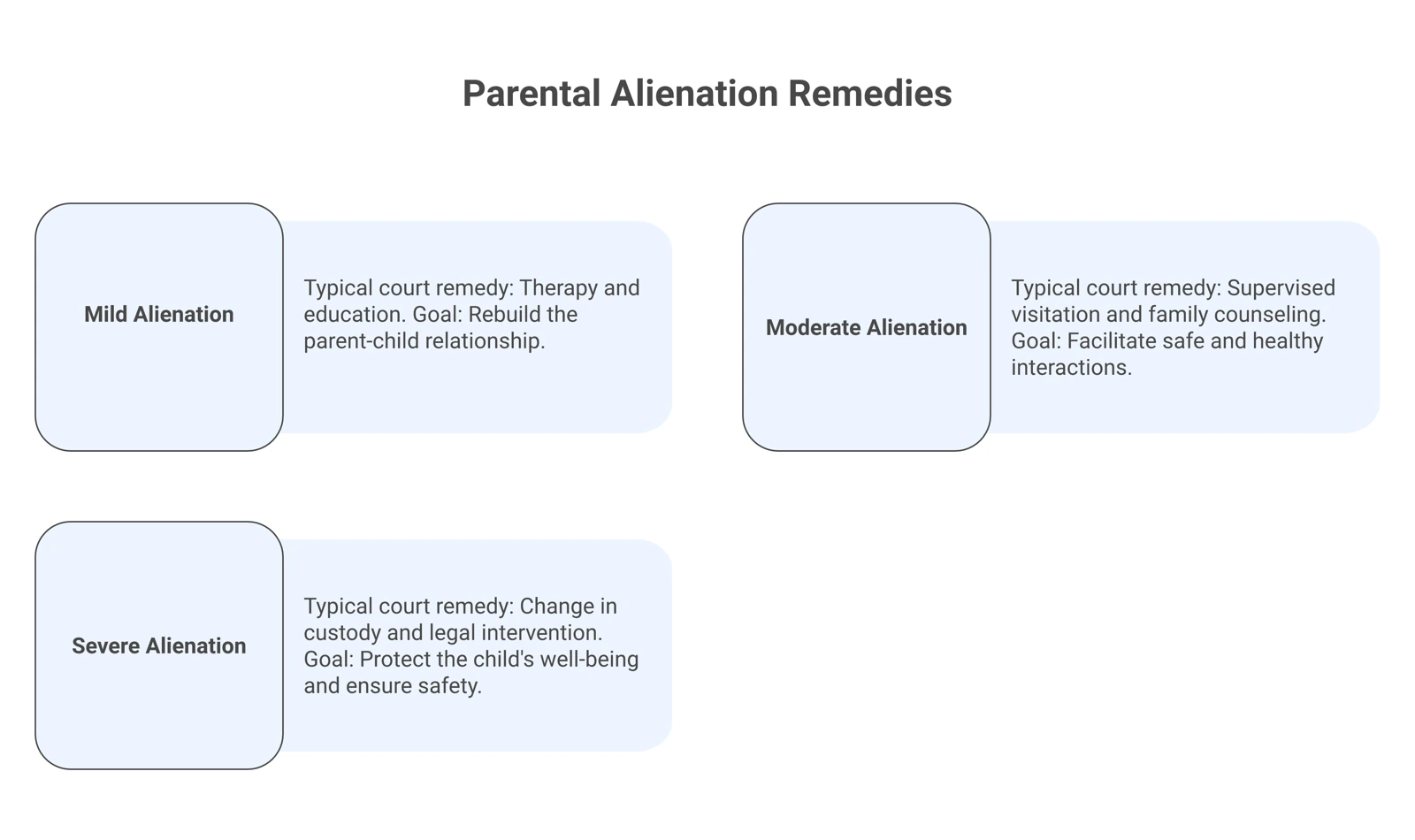
The principle underneath the whole spectrum is proportionality. A single missed exchange does not justify reversing custody, and a years-long campaign that has driven a child to refuse all contact is not cured by a stern warning. The remedy a court reaches for depends on the severity of the conduct, the harm to the child, and the strength of the record.
Parenting-time enforcement and contempt
When a court has entered a parenting plan, violating that plan is contempt of court. This is the workhorse tool. The targeted parent documents each specific violation, such as a denied weekend, a screened phone call, or a blocked school event, and asks the court to enforce its own order.
A court that finds willful contempt has options. It can order makeup parenting time. It can shift attorney’s fees. It can impose escalating fines, and in serious or repeat cases it can order jail time. One point deserves emphasis. Nobody is sanctioned for parental alienation by name. The parent is sanctioned for violating a parenting-time order or a reunification-therapy order. The label is not the offense; the broken order is. That distinction keeps enforcement grounded in conduct a court can verify, and it is one reason a civil damages suit is rarely the right vehicle, as can you sue for parental alienation explains.
Modifying the custody order
The next step up is a motion to modify custody. Most state custody laws let a parent seek a change when there has been a substantial and material change in circumstances. A documented pattern of alienating behavior can support that showing, and the best-interest factor on supporting the child’s relationship with the other parent often carries real weight.
A modification is evidence-heavy. It usually needs proof of the alienating conduct, proof of its effect on the child, and a proposed new arrangement that better serves the child. Joshi’s litigation framework warns against retreating to a hybrid finding that treats a targeted parent’s frustration as equal to the alienating conduct, since a reaction is not the same as a cause. Whether a court modifies custody still depends on the record and the jurisdiction, so the outcome is never guaranteed. A modification is a serious request, and many families consult a parental alienation lawyer before filing.
Custody reversal in severe cases
At the far end of the spectrum is custody reversal, where primary custody shifts from the favored parent to the rejected parent. This is the most drastic remedy, and it is rare. Law professor Nicholas Bala, who studies how these cases resolve, notes that the most common judicial response to alienation is not reversal at all. It is more time with the rejected parent paired with community-based, family-systems counseling. Reversal is reserved for severe, well-documented cases where lesser measures have failed.
Specialists frame severe alienation as a child-protection matter rather than an ordinary custody dispute. Canadian attorney Brian Ludmer, drawing on a 1991 decision by Justice John Gomery, argues that once severity is established, the court’s response should match a child-protection standard, because a child’s complete rejection of a once-loved parent signals real developmental harm. In that framing, a reversal paired with a structured reunification program is treated as medical and protective, not punitive. It is never a prize to pursue.
Why custody reversal is rare and court-driven
Reversal is rare for good reasons, and the decision belongs to the court, not to either parent. A change this large can be as disruptive as the alienation it aims to correct if a court gets it wrong, so judges move carefully and demand a strong record.
The available follow-up evidence is cautiously encouraging but small. Bala and a colleague tracked six children for more than ten years after a court-ordered custody reversal. All six were doing well, and all said the judge had been right to force the change even though they had fought it at the time. A striking finding was that many of the formerly favored parents drifted out of the children’s lives afterward, not by court order but by their own choice, while the formerly rejected parents supported continued contact. The sample is small, so the study informs rather than proves. Bala’s broader argument is to trust trained judges to weigh each case on its evidence rather than apply any blanket rule.
When alienation escalates after a custody ruling
A custody ruling does not always end the conflict. Counselors who work with these families warn that alienation can intensify after a decision, in either direction. When the favored parent gains what they sought, the alienation can feel validated and continue. When the favored parent loses, they may conclude they did not push hard enough and escalate, sometimes by working to make the child appear more distressed so the order can be relitigated.
For the targeted parent, this is the moment to stay measured rather than reactive. A child may arrive for parenting time angry and coached to make the visit difficult. Continuing to document conduct, keeping communication calm and consistent, and refusing the bait all preserve the record a court relies on. For families rebuilding a damaged bond, how to reverse parental alienation covers the relationship side, while the stages of parental alienation explain how these patterns develop over time.
When it is not alienation: protective parents and justified estrangement
Not every rejected parent is a victim of alienation. A child who pulls away from a parent who has been abusive, neglectful, or frightening is showing justified estrangement, and that is a different legal and safety matter entirely. The same custody remedies that protect a child from alienation become dangerous when they are aimed at a protective parent who is responding to genuine harm.
This is why courts must distinguish alienation from estrangement before reaching for any remedy, and why responsible advocates insist on it. Affinity, where a child simply prefers one parent during a developmental stage, is also not alienation. A custody case built on the alienation label without a clean, documented record of conduct risks punishing the wrong parent. When abuse or danger is part of the picture, that issue comes first. The broader emotional-abuse lens is covered in child custody and emotional abuse.
What courts can and cannot do
It helps to be honest about the ledger. A family court can enforce an existing order, order makeup parenting time, shift attorney’s fees, modify custody when the record supports it, order reunification or family-systems counseling, and in rare and severe cases reverse custody. Those are real tools.
There are limits. No court can order a child to feel differently about a parent. No filing produces a fast fix, since these cases take time and careful proof. And the goal that matters, repairing the child’s relationship with the rejected parent, is treated by specialists as a clinical and protective process, not a punitive one. The seriousness of the harm does not turn custody into a weapon. For the full set of court-facing resources, see the Court silo.
Frequently asked questions
Can parental alienation affect custody?
Yes. When the record documents that one parent has worked to damage the child’s relationship with the other parent, that conduct is relevant to the best-interest factors courts use to decide custody. Most state factor lists include each parent’s willingness to support the child’s bond with the other parent. Courts act on the documented behavior, not on the parental alienation label, and outcomes vary by jurisdiction and by the strength of the evidence.
Can parental alienation change custody arrangements?
It can, but a change is never automatic. A parent usually must show a substantial and material change in circumstances, prove the alienating conduct and its effect on the child, and propose an arrangement that better serves the child. Courts more often respond with parenting-time enforcement or additional time for the rejected parent than with a full custody reversal, which is reserved for severe, well-documented cases.
How does a court prove parental alienation in a custody case?
A court does not need a diagnosis. Under a behaviors-not-labels standard, it looks at documented conduct, such as blocked contact, denigration, and interference with the other parent’s time, along with the child’s response. Recordings, messages, and contemporaneous records carry more weight than self-report. The documentation process is covered in how to prove parental alienation.
Does parental alienation always lead to custody reversal?
No. Reversal is the rarest remedy and is reserved for severe cases where lesser measures have failed. Research on how these cases resolve shows the most common response is more time with the rejected parent combined with family-systems counseling, not a change of primary custody. Reversal is a court-driven, child-protection decision, never a goal a parent should pursue.
What if the child’s rejection is justified?
If a child is pulling away from a parent who has been abusive, neglectful, or genuinely frightening, that is justified estrangement, not parental alienation, and it is a separate legal and safety matter. Custody remedies designed for alienation can cause harm if applied to a protective parent. Courts must distinguish the two, and any safety concern should be addressed first.
What this page does not do
This page is not legal advice. It does not name any one state’s statutes or custody factors as if they applied nationally, and it does not tell readers what to file or when. Choices about a contempt motion, a modification, or any custody change belong to a licensed family-law attorney working with the real facts. The page also does not frame custody as a weapon or a contest to win. Custody reversal in particular is presented here as a rare, severe-case remedy that a court orders to protect a child, never as an outcome to chase. The right use of these tools is the careful, evidence-based one, oriented to the child’s wellbeing.
Sources and further reading
- Harman, J. J., Kruk, E., & Hines, D. A. (2018). Parental alienating behaviors: An unacknowledged form of family violence. Psychological Bulletin, 144(12), 1275 to 1299. https://doi.org/10.1037/bul0000175
- American Bar Association, Section of Family Law. americanbar.org/groups/family_law
- American Psychological Association. Divorce and child custody. apa.org/topics/divorce-child-custody
If you or your child are in crisis
Free and confidential help is available right now.
- 988 Suicide and Crisis Lifeline. Call or text 988. 988lifeline.org
- Childhelp National Child Abuse Hotline. 1-800-422-4453. childhelp.org
- NAMI HelpLine. 1-800-950-6264. nami.org/help
Last reviewed: 2026-06-06. Author: Alex Buckles (PAC Founder).