

A parental alienation court order is any order a family court issues to address one parent undermining a child’s bond with the other. Common types include parenting-time enforcement, contempt findings, reunification or therapy orders, protective provisions, and custody modification. Each does a specific job, and an order on its own rarely repairs the relationship.
A note on safety
A child’s rejection of a parent is not always alienation. If the rejected parent has been abusive, neglectful, or genuinely dangerous, the child’s distancing is justified estrangement, not parental alienation, and it is a different legal and safety matter. Protective orders and the abuse-versus-estrangement difference both matter here. A court order for contact is never appropriate where a child is protecting themselves from genuine abuse. If a child’s safety is at risk, contact local law enforcement or a domestic-violence resource first.
This page is general information, not legal advice. It does not create an attorney-client relationship, and it does not address any one state’s law. State laws vary widely. Anyone considering legal action should consult a licensed family-law attorney in their own jurisdiction.
What a parental alienation court order does
A parental alienation court order is not a single document that carries that title. Courts rarely write the phrase “parental alienation” into an order at all. A family court instead issues orders that address specific conduct: an order to follow a parenting schedule, an order finding a parent in contempt, an order for reunification or therapy, a protective provision, or an order changing custody. Each tool targets a behavior a court can verify, not a diagnostic label.
This distinction matters because courts act on documented facts. A parent who walks in asking a judge to punish “parental alienation” by name tends to lose ground. A parent who can show specific conduct, and ask for a specific order that responds to it, gives the court something it can rule on and enforce. The page on parental alienation and child custody covers that behaviors-not-labels principle in more depth.
The spectrum of orders in parental alienation cases
Court orders in these cases sit on a spectrum, from routine enforcement to the rarest and most drastic remedies. A court generally starts at the lightest effective level and moves up only when the record and the harm to the child justify it. The figure below maps the main order types.
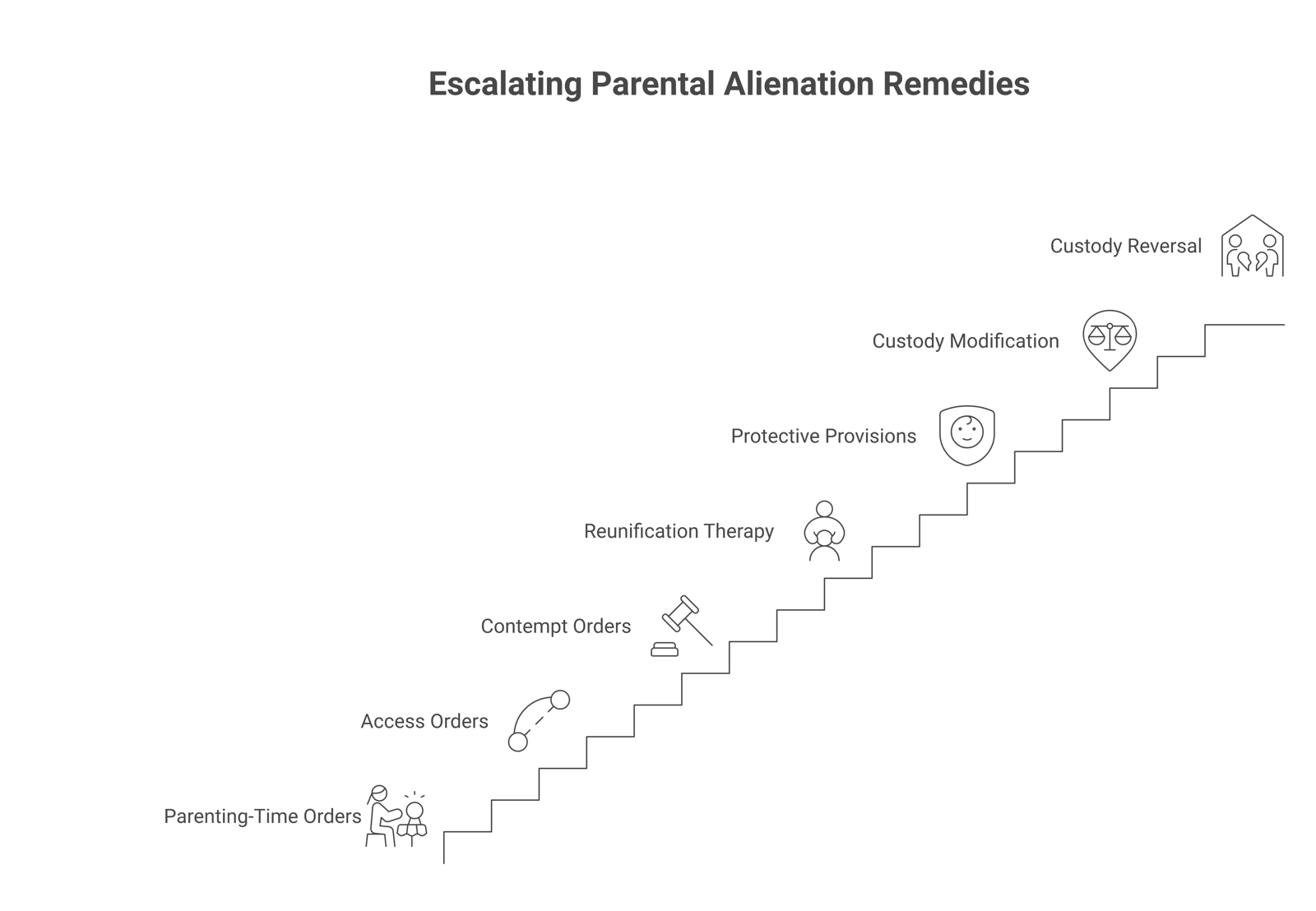
The principle under the whole spectrum is proportionality. A single missed exchange does not justify changing custody, and a years-long campaign that has driven a child to refuse all contact is not cured by a one-line warning. The order a court reaches for depends on the severity of the conduct, the harm to the child, and the strength of the evidence. Outcomes vary widely by court and by jurisdiction, so nothing on this spectrum is automatic.
Parenting-time and access orders
The foundation of most cases is the parenting-time or access order, often folded into a parenting plan. It sets out when the child is with each parent, how exchanges happen, and how the parents communicate. When alienation is a concern, a court can write the plan to reduce opportunities for interference: fixed exchange times and locations, clear rules about phone and video contact, and limits on one parent scheduling activities over the other parent’s time.
An access order is only as strong as its enforcement. When one parent repeatedly blocks contact, the order does not execute itself. The targeted parent has to return to court and ask the judge to act, which is where the enforcement tools come in. A well-drafted plan still helps, because it converts vague conflict into specific, documentable violations a court can later address.
Contempt orders for violating a parenting plan
When a court has entered a parenting plan, violating it is contempt of court. The contempt order is the workhorse enforcement tool. The targeted parent documents each specific violation, a denied weekend, a screened phone call, a blocked school event, and asks the court to enforce its own order.
A court that finds willful contempt has options. It can order makeup parenting time, shift attorney’s fees, impose escalating fines, and in serious or repeat cases order jail time. One point deserves emphasis. Nobody is sanctioned for “parental alienation” by name. The parent is sanctioned for violating a parenting-time order or a therapy order. The broken order is the offense, not the label, and that keeps enforcement grounded in conduct a court can verify. The American Bar Association’s Section of Family Law publishes general consumer information on how these motions work. For whether any of this is a crime, see is parental alienation illegal. For why a separate civil damages suit is rarely the vehicle, see can you sue for parental alienation.
Reunification and court-ordered therapy orders
When a relationship has already been damaged, a court can order reunification work or family therapy. The quality of the order matters as much as the fact of it. Canadian attorney Brian Ludmer, drawing on foundational principles articulated in a 1991 decision by Justice John Gomery, argues that a therapy order in a serious case has to be directive and structured, not open-ended. A useful order names who attends, sets a regular cadence, and makes clear that the work serves the child and the court, not the comfort of the parent who caused the rupture. An open-ended order that drops a damaged family into generic counseling often stalls.
The sequence the order builds in matters too. Clinician Linda Gottlieb argues that once a court treats alienation as a form of child abuse, protection has to come first and reunification second. An order that pushes a child into reunification sessions while the alienating behavior continues unobstructed tends to backfire and can re-traumatize the child. Protection first, then reunification, is the sequence that holds, and an order that reverses it predicts failure. A therapy order is best read as a structure for clinical work, not a switch that restores a relationship on its own.
No-contact and protective provisions
Some orders restrict contact rather than expand it. In severe alienation cases, specialists sometimes describe a temporary, court-ordered pause in the alienating parent’s contact as a protective separation, framed as child protection rather than punishment. Ludmer describes this kind of measure as a residual remedy, used only after directive therapy and compliance motions have failed and a court is satisfied the conduct is severe. It is rare, it is court-driven, and it is never a routine request.
The same category of provision is appropriate, and often necessary, in the opposite situation. Where a child is distancing from a parent who has been abusive, neglectful, or frightening, a no-contact or protective order shields the child, and that distancing is justified estrangement, not alienation. A court order for contact is never appropriate where a child is protecting themselves from genuine abuse. Courts must distinguish alienation from estrangement before reaching for any provision in either direction, because a protective tool aimed at the wrong parent causes real harm.
Custody-modification orders and rare custody reversal
The most consequential order is a change of custody. Most state laws let a parent seek modification when there has been a substantial and material change in circumstances, and a documented pattern of alienating behavior can support that showing. A modification is evidence-heavy. It usually needs proof of the conduct, proof of its effect on the child, and a proposed arrangement that better serves the child.
At the far end of the spectrum is custody reversal, where primary custody shifts from the favored parent to the rejected parent. It is the rarest remedy, reserved for severe, well-documented cases where lesser orders have failed. Reversal is a court-driven, child-protective decision, never a goal for a parent to pursue. The parental alienation and child custody page covers modification and reversal, and the research on how these cases resolve, in detail.
Why an order alone does not repair the relationship
An order can change where a child sleeps and who must attend therapy. It cannot order a child to feel differently about a parent. The repair of a damaged bond happens in clinical work and in daily life, not in the courtroom.
Reunification specialists describe a multi-year arc rather than a single hearing. Cindy Hirsch, who leads a reunification organization, frames the targeted parent’s own steadiness as the lever of reconnection: a stable, regulated “lighthouse parent” gives the child something safe to come back toward, and a full reunification can take roughly three years to stabilize. An order can create the conditions for that work, by enforcing contact, structuring therapy, or protecting the child, but the relationship itself is rebuilt outside the order. For the relationship side of that work, see how to reverse parental alienation.
Enforcement gaps and honest expectations
It helps to be honest about the limits. Orders depend on enforcement, and enforcement depends on the targeted parent returning to court, often more than once, with documentation. A court will not monitor compliance on its own. Each trip back costs time and money, and time tends to favor the parent doing the alienating, because every month of blocked contact deepens the rupture.
Ludmer describes effective case management as a staged campaign in which the first order imposes structure early, precisely because delay is the enemy. That framing is honest about the gap between having an order and having a remedy. An order is a tool, not a result. Its value depends on how clearly it is written, how consistently it is enforced, and how well it is paired with the clinical work that actually repairs the bond. None of that is guaranteed, and outcomes vary by court, by jurisdiction, and by the strength of the record.
Frequently asked questions
What is a parental alienation court order?
It is not a single named order. It is any order a family court issues to address one parent undermining a child’s relationship with the other: a parenting-time or access order, a contempt finding, a reunification or therapy order, a protective provision, or a custody modification. Courts act on documented conduct rather than on the “parental alienation” label, so the order targets a specific behavior the court can verify and enforce.
Can a court order reunification therapy for parental alienation?
Yes, a court can order reunification work or family therapy, and in serious cases specialists favor a directive, structured order that names who attends and sets a regular cadence. Many clinicians stress that protection of the child has to come first and reunification second, because pushing a child into sessions while the alienating behavior continues tends to fail. A therapy order creates the structure for clinical work; it does not repair the relationship by itself.
What happens if a parent violates a parental alienation court order?
Violating a parenting plan or therapy order is contempt of court. A court that finds willful contempt can order makeup parenting time, shift attorney’s fees, impose fines, and in serious or repeat cases order jail time. The parent is sanctioned for breaking the order, not for “parental alienation” by name. Enforcement is not automatic, so the targeted parent usually has to return to court and document each violation.
Can a parental alienation court order change custody?
It can. A parent can seek a custody modification by showing a substantial and material change in circumstances, and a documented pattern of alienating conduct can support that. Custody reversal, where primary custody shifts to the rejected parent, sits at the far end of the spectrum and is rare, reserved for severe cases where lesser orders have failed. It is a court-driven, child-protective decision, never a goal to pursue.
What this page does not do
This page is not legal advice. It does not name any one state’s statutes or rules as if they applied nationally, and it does not tell readers what to file or when. Choices about a contempt motion, a therapy order, a protective provision, or a custody change belong to a licensed family-law attorney working with the real facts. The page also does not frame any order as a weapon or a way to win against the other parent. Protective separation and custody reversal in particular are presented here as rare, court-driven, child-protective measures, never as outcomes to chase. The right use of these tools is the careful, evidence-based one, oriented to the child’s wellbeing. The full Court silo covers the rest.
Sources and further reading
- Harman, J. J., Kruk, E., & Hines, D. A. (2018). Parental alienating behaviors: An unacknowledged form of family violence. Psychological Bulletin, 144(12), 1275 to 1299. https://doi.org/10.1037/bul0000175
- American Bar Association, Section of Family Law. americanbar.org/groups/family_law
- American Psychological Association. Divorce and child custody. apa.org/topics/divorce-child-custody
If you or your child are in crisis
Free and confidential help is available right now.
- 988 Suicide and Crisis Lifeline. Call or text 988. 988lifeline.org
- Childhelp National Child Abuse Hotline. 1-800-422-4453. childhelp.org
- NAMI HelpLine. 1-800-950-6264. nami.org/help
Last reviewed: 2026-06-06. Author: Alex Buckles (PAC Founder).