

The UCCJEA is the uniform law that decides which state’s courts can make and change a child custody order. It uses a home-state rule, keeps later changes in the original court, and allows emergency orders anywhere the child is present. Adopted in 49 states, it matters most when a parent moves, or threatens to take the child.
A caveat before anything else
Jurisdiction rules exist to protect children from being shuttled between states in search of a friendlier judge. They are not a tool for trapping a co-parent. And a parent who flees with a child to escape genuine domestic violence is in a different legal and safety situation from a parent who relocates to defeat the other parent’s relationship with the child; the law treats those differently, and so does this site. If you or a child are in danger, contact local law enforcement or a domestic-violence resource first. If a child has been abducted, see parental child abduction.
This page is general US-national education. It is not legal advice, it does not create an attorney-client relationship, and it does not address any one state’s version of the UCCJEA, which states adopt with local variations. Jurisdiction questions are technical and fact-sensitive. Anyone facing an interstate custody issue should consult a licensed family-law attorney promptly, ideally in both states involved.
The short answer
The Uniform Child Custody Jurisdiction and Enforcement Act, the UCCJEA, answers one question: which state’s courts have the power to decide custody of this child? Drafted by the Uniform Law Commission in 1997, it was designed so that only one state at a time can control a custody case. Before laws like it, a parent unhappy with one state’s ruling could take the child to another state and try again, and children were sometimes abducted across state lines precisely to find a friendlier court.
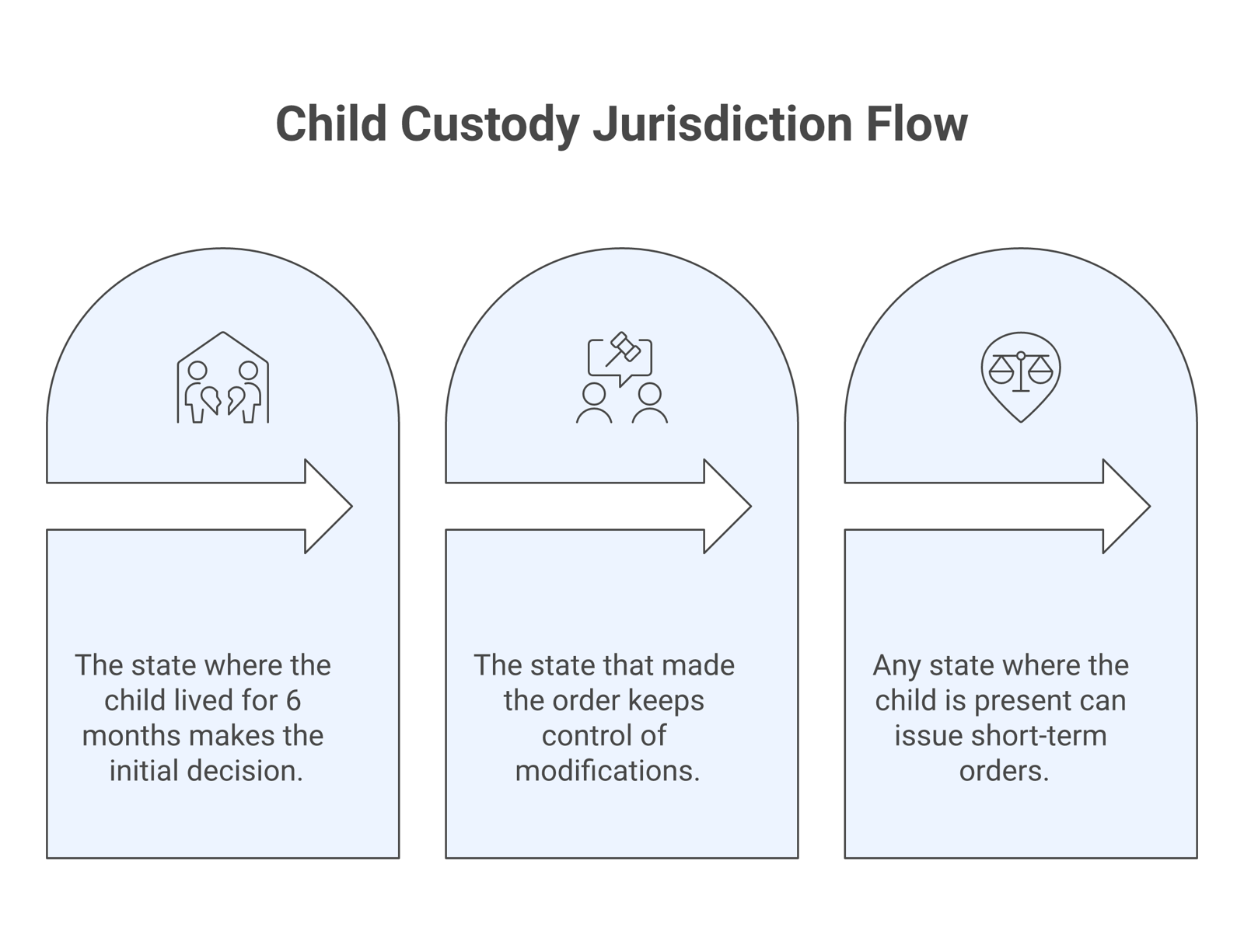
The act’s core machinery is simple to state: the child’s home state gets first claim to make the initial custody decision; the state that made the decision keeps control of changes; and any state can act briefly in a genuine emergency. The details, as always, carry the weight.
The home-state rule
Under the UCCJEA, the state with priority to make an initial custody determination is generally the child’s home state: the state where the child has lived with a parent, or a person acting as a parent, for at least six consecutive months immediately before the case begins (for an infant younger than six months, the state where the child has lived since birth). Temporary absences usually count as part of the period. A state can also qualify as the home state if it held that status within the six months before filing and a parent still lives there, which keeps a parent from creating a new home state by simply leaving with the child and waiting.
The practical effect is that a parent who moves to a new state with the child cannot, in general, immediately file for custody there. Courts in the new state are normally required to defer to the home state. The Office of Juvenile Justice and Delinquency Prevention’s practitioner guide to the UCCJEA explains that the act deliberately prioritized this bright-line rule over looser “best interests” jurisdiction tests, precisely to remove the incentive to relocate a child for litigation advantage.
Exclusive, continuing jurisdiction
Once a state properly makes a custody determination, the UCCJEA generally gives that state exclusive, continuing jurisdiction over the case. Other states are expected not to modify the order while the original state retains its connection to the case. Broadly, that continuing control lasts until the original state determines that the child and parents no longer have a significant connection with it, or until a court determines that the child and both parents have all moved away.
This is the provision that most often surprises parents. Moving to a new state, even years into a custody order, does not by itself move the case. The original court usually keeps it, and requests to change the order generally must go back there until jurisdiction properly transfers. Judicial-education materials such as the National Council of Juvenile and Family Court Judges’ UCCJEA guide for judges and court personnel walk courts through exactly these questions, including the act’s requirement that judges in two states confer directly when cases collide.
Temporary emergency jurisdiction
The act keeps one safety valve open. A state where a child is physically present can exercise temporary emergency jurisdiction if the child has been abandoned, or if emergency protection is necessary because the child, a sibling, or a parent is subjected to or threatened with mistreatment or abuse. This is how a parent who flees across state lines with a child to escape violence can still get immediate protective orders in the new state.
The key word is temporary. An emergency order is a bridge, not a destination. The emergency court is generally expected to communicate with the home-state court, and the order lasts only until the state with proper jurisdiction acts. Emergency jurisdiction is not a way to convert flight into a permanent forum change, and courts examine emergency claims carefully for exactly that reason. The companion procedural tool inside a single state, the emergency custody motion, is covered in emergency custody and parental alienation.
Enforcement across state lines
The E in UCCJEA is enforcement, and it is half the point of the act. A custody or parenting-time order from one state can be registered in another, and the act provides expedited enforcement procedures for violations, including remedies aimed at the swift return of a wrongfully removed or retained child. It also authorizes prosecutors and law enforcement to assist in locating children and enforcing orders in defined circumstances. Federal law works alongside this framework: the Parental Kidnapping Prevention Act requires states to honor each other’s properly made custody determinations.
Why the UCCJEA matters in alienation cases
Severe alienation dynamics and jurisdiction problems travel together, and the connection runs in both directions.
First, relocation is a recognized interference pattern. Among the alienating strategies catalogued in the research literature, limiting the child’s contact with the other parent sits near the center, and an interstate move is the most absolute form of limiting contact. A parent who moves the child away, then files in the new state once enough time passes, is attempting exactly the maneuver the home-state rule and the six-month lookback were built to blunt. Understanding the timeline rules helps a left-behind parent act quickly instead of waiting while a new home state quietly forms.
Second, abduction risk is the extreme end of the same spectrum. Where threats to disappear with the child, passport concerns, or actual concealment are in play, the UCCJEA’s enforcement tools operate alongside criminal custodial-interference laws and, for international cases, the Hague Convention framework. That terrain is covered in parental child abduction.
Third, the act cuts both ways, and honesty requires saying so. The same machinery that stops an alienating parent from forum shopping also governs a protective parent who flees with a child from genuine abuse; that parent’s lawful route runs through temporary emergency jurisdiction and prompt communication between courts, not through silence and hoped-for delay. A parent in that situation needs counsel immediately, in both states.
Finally, jurisdiction is the gate to every other remedy this site describes. Contempt, modification, enforcement of parenting time, and evaluation orders all presuppose a court with power to act. Filing in the wrong state can cost months exactly when an alienation dynamic is hardening; see what is visitation interference and how to respond to visitation interference for the conduct side of that clock.
The Massachusetts exception, as of mid-2026
One footnote matters for completeness. The UCCJEA has been enacted by 49 states, the District of Columbia, Guam, Puerto Rico, and the U.S. Virgin Islands. Massachusetts is the lone holdout. It still operates under its older Massachusetts Child Custody Jurisdiction Act, Chapter 209B, which is based on the UCCJEA’s 1968 predecessor. The Massachusetts Senate passed a UCCJEA adoption bill in July 2025, but as of mid-2026 the bill had not completed passage in the House, so the older law remains in force there. The practical meaning for families: any custody case touching Massachusetts involves an extra layer of jurisdictional analysis, and local counsel is essential.
Frequently asked questions
What is the UCCJEA in simple terms?
It is the uniform state law that decides which state’s courts can make, change, and enforce a child custody order. Generally the child’s home state, where the child lived for the six months before filing, makes the first order; the state that made the order keeps control of changes; and any state where the child is present can issue short-term emergency orders to protect the child.
What is the home-state rule?
The child’s home state, generally the state where the child lived with a parent for at least six consecutive months immediately before the case began, has priority to make the initial custody decision. A state can also keep home-state status for six months after the child leaves, if a parent still lives there. This stops a parent from creating a friendlier forum by moving the child and filing quickly.
Can the other parent move to another state and refile for custody there?
Generally no. Under exclusive, continuing jurisdiction, the state that properly made the custody order keeps authority over changes until that connection ends, broadly when the child and parents no longer have a significant connection there or everyone has moved away. A new state normally cannot modify the order just because the child now lives there.
Does the UCCJEA protect a parent fleeing domestic violence?
It contains a safety valve for that situation. A state where the child is present can take temporary emergency jurisdiction when the child, a sibling, or a parent is threatened with or subjected to abuse. But the order is temporary, courts in the two states are expected to confer, and the home state generally retains the long-term case. Anyone in this situation needs an attorney immediately.
Has every state adopted the UCCJEA?
Forty-nine states plus the District of Columbia and several territories have adopted it. Massachusetts is the only state that has not; as of mid-2026 it still uses its older MCCJA, although a UCCJEA bill passed the Massachusetts Senate in 2025 and remained pending in the House.
What this page does not do
This page does not analyze any reader’s jurisdiction question, and it does not state any single state’s version of the act, since states adopt the UCCJEA with local variations. It does not coach any parent on using jurisdiction rules to gain advantage, to outmaneuver a co-parent, or to delay a case. The right use of this information is to recognize when an interstate issue exists, understand why timing matters, and get to a licensed attorney before positions harden.
For the conduct patterns that often trigger these issues, see parental child abduction, what is visitation interference, and emergency custody and parental alienation. The full Court silo covers the rest.
When alienation crosses an international border, a different legal framework applies. See parental alienation and the Hague Convention.
Sources and further reading
- Uniform Law Commission. Child Custody Jurisdiction and Enforcement Act (1997): act summary and enactment status. uniformlaws.org
- Hoff, P. M. (2001). The Uniform Child-Custody Jurisdiction and Enforcement Act. Office of Juvenile Justice and Delinquency Prevention, U.S. Department of Justice. ojp.gov
- National Council of Juvenile and Family Court Judges. The UCCJEA: a guide for court personnel and judges. ncjfcj.org
- Massachusetts General Laws, Chapter 209B (Massachusetts Child Custody Jurisdiction Act). malegislature.gov
- Massachusetts Senate press release (July 2025). Senate votes to modernize child custody jurisdiction laws. malegislature.gov
If you or your child are in crisis
Free and confidential help is available right now.
- 988 Suicide and Crisis Lifeline. Call or text 988. 988lifeline.org
- Childhelp National Child Abuse Hotline. 1-800-422-4453. childhelp.org
- NAMI HelpLine. 1-800-950-6264. nami.org/help
Last reviewed: 2026-06-10. Author: Alex Buckles (PAC Founder).