

This page is general information about an international treaty and US law. It is not legal advice. Outcomes vary by country, by jurisdiction, and by the facts of each case. For advice about a specific situation, consult a licensed attorney experienced in international child abduction in your jurisdiction.
When a child is wrongfully taken to or kept in another country, the 1980 Hague Convention offers a fast civil process. So it orders the child’s prompt return to their country of habitual residence, and then that country’s courts decide custody. The treaty also protects access rights. But it does not decide custody itself.
Before anything else: abuse is not alienation
First, a child who is moved or kept away from a parent because that parent is genuinely abusive is not being alienated. Instead, the protective parent and the child may be fleeing real harm, and protecting the child comes first. By contrast, parental alienation describes a different situation, where a child is turned against a safe, loving parent without a good reason. Because the stakes here are a child’s safety, the Convention itself builds in a protection: a court can refuse to return a child who would face a grave risk of harm. So this page treats the abuse question as central, not as an afterthought, and it never reads the treaty as a tool for one parent to gain an edge over the other.
The short answer
Can an international treaty force a child’s return after a cross-border removal? In many cases, yes. The Hague Convention on the Civil Aspects of International Child Abduction, published by the Hague Conference on Private International Law, creates a civil remedy for the prompt return of children wrongfully removed or retained across an international border. In the United States, that treaty is carried into law by the International Child Abduction Remedies Act, 22 U.S.C. ch. 97, known as ICARA. Together they answer one question: which country’s courts should decide custody. They do not answer who should win.
When removal or retention becomes a Hague case
The Convention turns on a few defined terms, so it helps to take them one at a time.
First, a removal or retention is wrongful when it breaches rights of custody that someone held under the law of the country where the child was living. So a parent who takes a child abroad against the other parent’s custody rights, or who keeps the child abroad after an agreed visit ends, may have triggered the treaty. Next, the Convention protects two kinds of rights. First, it protects rights of custody, which include the right to decide where a child lives. Second, it protects rights of access, which cover a parent’s right to spend time with the child.
So the pivot point is the child’s habitual residence, meaning the country that was the center of the child’s daily life before the removal or retention. But courts do not reduce that question to a single factor. In Monasky v. Taglieri, 589 U.S. 68 (2020), the Supreme Court of the United States held that a child’s habitual residence is a fact-driven determination based on the totality of the circumstances, not a rigid test. So a court weighs where the child lived, went to school, and built relationships, rather than applying a formula.
What the Convention does, and what it does not
This distinction is the one most worth getting right, because it shapes everything that follows.
First, the Convention is a return mechanism. So when a child has been wrongfully removed or retained, its job is to send the child back to the country of habitual residence quickly, before a new status quo sets in. The treaty was designed for speed precisely because delay can let a taking parent run out the clock until the child settles into the new country.
But the Convention is not a custody ruling. So it does not decide which parent should have primary custody, how time should be shared, or what serves the child’s best interest over the long run. Instead, those questions belong to the courts of the home country once the child is back. So a Hague return is better understood as a decision about venue, not a decision about the family’s future.
How a return petition works
A return case follows a recognizable pathway, even though the details differ by country. The diagram below traces it from start to finish.
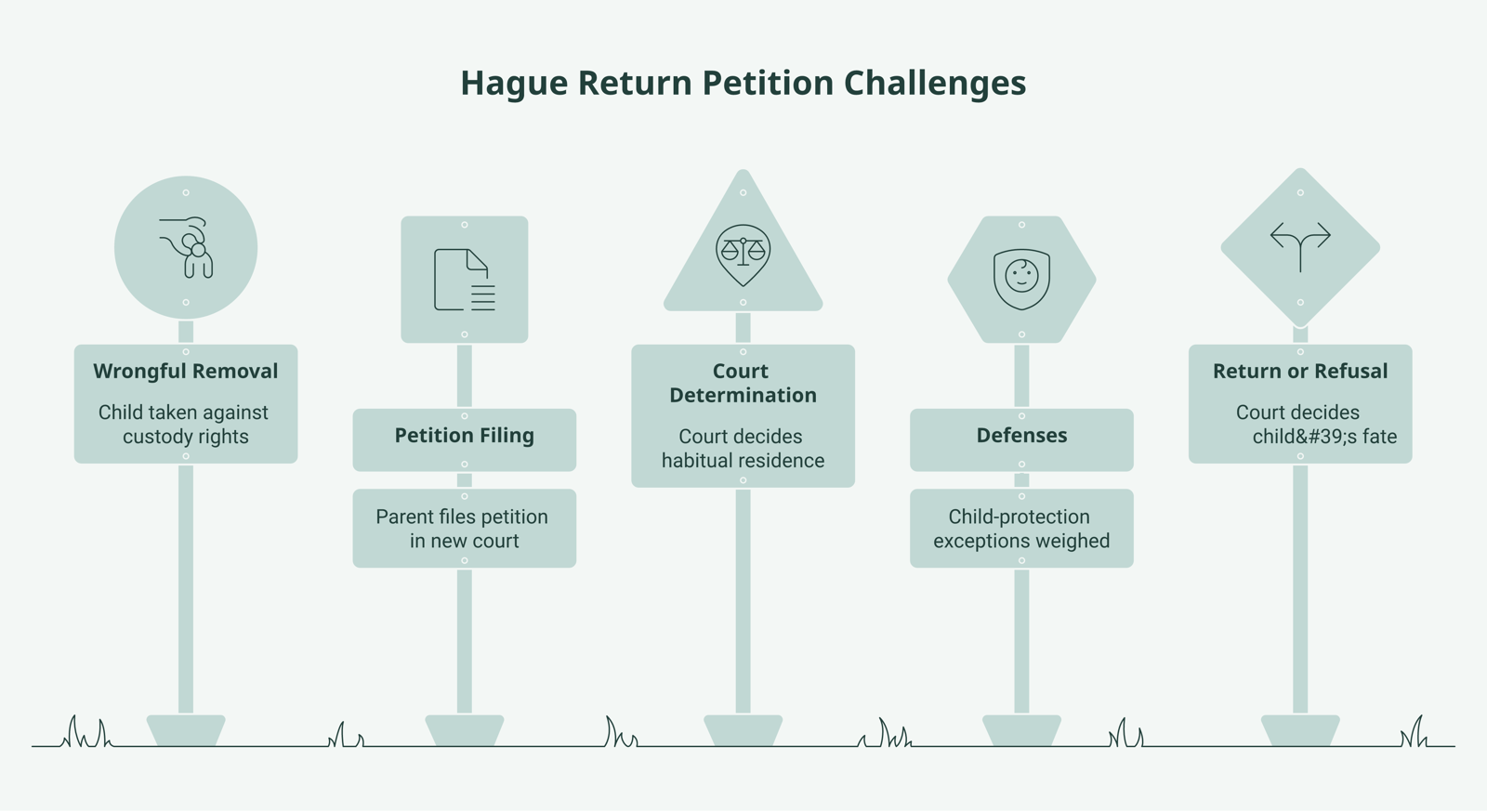
First, a left-behind parent usually files an application, often through a national Central Authority that helps locate the child and route the case. Then a petition for return is brought in a court in the country where the child now is. Next, that court decides two threshold questions: whether the country claimed as habitual residence really was the child’s home, and whether the removal or retention was wrongful. After that, the court considers any defenses the taking parent raises. Finally, the court orders the child’s return or refuses it. Because the treaty favors prompt resolution, many countries aim to handle these cases on an expedited schedule.
The grave-risk exception (Article 13(b))
So the Convention is not automatic, and Article 13(b) is the reason. Under Article 13(b), a court may refuse to return a child if there is a grave risk that return would expose the child to physical or psychological harm, or otherwise place the child in an intolerable situation. But this exception is a safeguard for the child, not a loophole for either parent. It is where the abuse question lives inside the treaty. So when a parent has fled with a child to escape genuine domestic violence or abuse, the grave-risk exception is the provision that lets a court protect that child rather than send them back into danger. Still, courts generally read the exception narrowly and demand strong evidence, because a broad reading would swallow the treaty’s return purpose. So both things are true at once: the exception is meant to be hard to meet, and it exists because some returns would genuinely harm a child.
How the United States implements the Convention
First, the United States ratified the Convention and implemented it through ICARA. So the statute lets a parent file a return petition in either state or federal court, and it places the burden on the petitioner to show wrongful removal or retention by a preponderance of the evidence. But a taking parent who raises the grave-risk defense generally carries a higher burden, clear and convincing evidence, because the defense blocks the treaty’s core remedy. Meanwhile, the US Central Authority sits within the State Department’s Office of Children’s Issues, which helps process applications in both directions. As a jurisdiction note, the Convention applies only between countries that are treaty partners with each other, so the first practical question in any cross-border case is whether both countries are parties to the Convention.
Where alienation fits
So cross-border removal can be one of the ways alienation plays out. As the advocate Dan Mason describes it, taking or keeping a child in another country can function as a vehicle for parental alienation, because distance and a new environment can be used to erode the child’s bond with the left-behind parent. But Mason is a lived-experience advocate rather than a lawyer, so his framing is best read as one informed perspective, not legal authority. For example, his own account illustrates how the treaty can work in practice. He has described his child being taken from Canada to Arizona amid allegations of harm that he says were false, after which he invoked the Convention, obtained an independent psychological assessment that did not support the allegations, and saw a court order the child’s return within about two weeks. That is a single, decades-old, first-person account that has not been independently verified here, so it is offered as a labeled illustration rather than as proof of a typical timeline.
Still, the same example shows why the abuse boundary cannot be dropped. Allegations of harm are sometimes false, and sometimes they are true. Because a wrong call in either direction can hurt a child, the grave-risk exception and independent assessment exist to test the claim rather than to assume an answer. So the alienation lens and the child-protection lens are not rivals. Both ask the same court to look hard at the evidence before deciding.
What this means for a parent facing this
If a child has been taken abroad or kept abroad, then the Convention may offer a route to return, but it is a legal process with real deadlines and country-by-country differences. So a few honest points are worth stating plainly.
- It decides venue, not custody. A successful return sends the custody question home; it does not resolve it.
- Time matters. The treaty rewards prompt action, and long delay can complicate a case as the child settles in.
- It depends on treaty partnership. The remedy works only between countries that are parties to the Convention with each other.
- It does not erase the abuse question. Where a child faces a grave risk of harm, the exception is designed to protect the child.
Because the details turn on specific facts and on two countries’ laws, a parent in this situation should speak with an attorney experienced in international child abduction as early as possible.
Frequently asked questions
Does the Hague Convention decide custody?
No. The Convention decides where a child should be returned so the courts of the child’s home country can decide custody. It is a return mechanism, not a custody ruling. The custody questions are resolved later, in the country of habitual residence.
What counts as wrongful removal or retention?
A removal or retention is wrongful when it breaches rights of custody held under the law of the country where the child was living. So taking a child abroad against the other parent’s custody rights, or keeping the child abroad after an agreed visit ends, can be wrongful under the Convention.
What is habitual residence?
Habitual residence is the country that was the center of a child’s daily life before the removal or retention. In Monasky v. Taglieri (2020), the Supreme Court held that it is a fact-driven question based on the totality of the circumstances, so courts weigh where the child actually lived rather than applying a fixed formula.
What is the grave-risk exception in Article 13(b)?
Article 13(b) lets a court refuse to return a child if return would expose the child to a grave risk of physical or psychological harm or an intolerable situation. It is a child-protection safeguard, read narrowly and supported by strong evidence, and it is where genuine abuse is weighed.
What is ICARA?
ICARA is the International Child Abduction Remedies Act, 22 U.S.C. ch. 97, the US law that implements the Hague Convention. It lets a parent file a return petition in state or federal court and sets the burdens of proof for return and for the grave-risk defense.
Related reading
To understand the underlying construct, start with what parental alienation is in Learn. To recognize the behaviors involved, see the patterns described in Signs. When you are preparing a clear record, see how to document a pattern in Court, and explore the broader Court and Recover sections for evidence and reunification resources.
Sources
- Hague Convention on the Civil Aspects of International Child Abduction (1980), Hague Conference on Private International Law. Cited for the treaty’s scope, the return obligation, rights of custody and access, and the Article 13(b) grave-risk exception.
- International Child Abduction Remedies Act, 22 U.S.C. ch. 97 (ICARA). Cited for US implementation, the return petition, and the burdens of proof.
- Monasky v. Taglieri, 589 U.S. 68 (2020). Cited for the habitual-residence standard as a totality-of-the-circumstances determination.