

This page is general information, not legal or clinical advice. It does not create a professional relationship and does not address any one state’s rules.
Parental child abduction is when one parent takes or keeps a child in violation of the other parent’s custody rights. It is rare, and most high-conflict cases never reach it. But certain warning signs warrant a professional threat assessment and a safety plan. This page explains the signs, how risk is judged, and the steps to take.
If this is an emergency, and a note on safety
If you believe a child is being taken right now, this is an emergency: call 911 and the National Center for Missing and Exploited Children at 1-800-843-5678. And a parent who flees with a child to escape genuine abuse or danger is in a different situation from an abductor. Protecting a child from harm is not the same as abduction, and a parent in that position should get safety and legal help right away.
What parental child abduction is
Parental child abduction, sometimes called parental kidnapping, is the taking or keeping of a child by one parent in violation of the other parent’s lawful custody or parenting-time rights. It ranges from wrongly withholding a child after a visit to taking a child to another state or country. It is different from ordinary visitation interference, which is a violation of the schedule, though serious interference can be a warning sign of more.
It helps to keep perspective. Most high-conflict custody situations, even bitter ones, never involve an abduction. The point of understanding the warning signs is not to live in fear or to assume the worst about a co-parent. It is to recognize the smaller number of situations that genuinely warrant a professional assessment and a safety plan, so the right people can act early.
Warning signs that warrant a threat assessment
Research summarized by the US Department of Justice, through its Office of Juvenile Justice and Delinquency Prevention, identifies factors associated with elevated abduction risk. These are not a checklist for a parent to use to accuse the other parent. They are the factors a qualified professional weighs, together, to decide whether a formal threat assessment and safety plan are warranted.
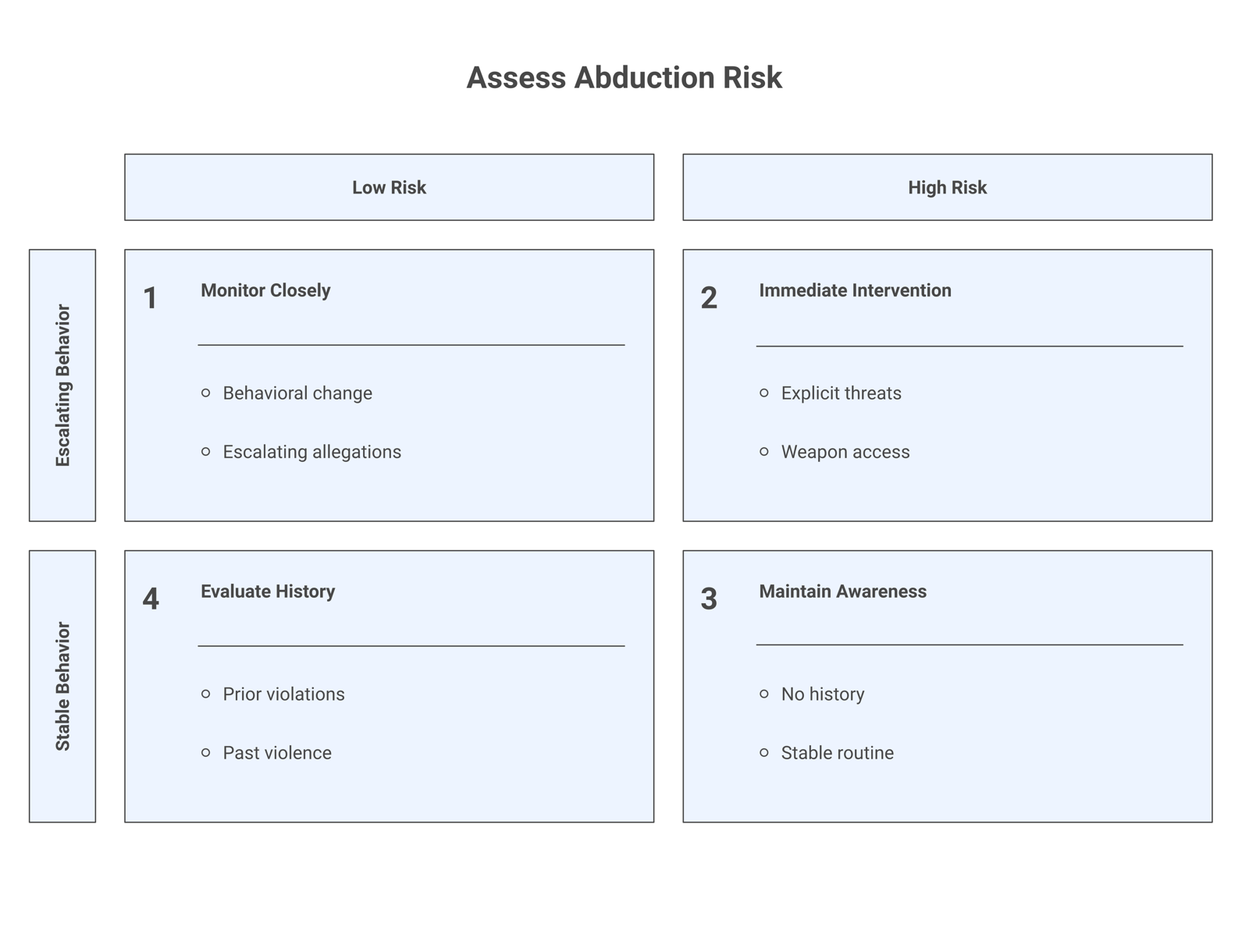
The factors include prior threats to take the child or prior attempts, and a pattern of violating court orders. They include access to weapons, a history of violence, substance abuse, and a mental-health or suicide history. They include a rising count of allegations and restraining orders. And they include sudden behavioral changes that can signal preparation: quitting a job, selling a home or possessions, liquidating accounts, or obtaining passports and travel documents for the child. An explicit threat to take the child and disappear is the most direct sign of all.
How a threat is delivered matters too. Professionals weigh a threat written and handed over, or made in a way meant to instill fear, more heavily than an offhand remark. One more point is easy to miss: when a court’s orders are not being enforced, that lack of consequence is itself documented as a factor that can embolden escalation. None of these factors stands alone. Any single one may mean nothing. It is the pattern, judged by someone trained to judge it, that matters.
How professionals assess abduction risk
A real threat assessment is a structured process, not a gut feeling. It pulls together the factors above into a weighted picture a court can act on, which is why converting vague fear into a professional assessment is so valuable. It turns “I am scared he might take her” into something a judge can evaluate and respond to.
Researchers describe several broad profiles of parents who pose elevated risk, including a parent who has already threatened or attempted abduction, a parent backed by family in a fixed belief that abuse occurred, and, at the highest level of concern, a parent whose thinking has become paranoid or delusional. That last profile carries the greatest danger, which is exactly why assessment belongs with a qualified clinician rather than a worried parent reading a list. A professional can tell the difference between ordinary high-conflict bitterness and a genuinely elevated risk, and can recommend proportionate steps.
This is the core message of this section: if your fear is real and specific, the move is not to accuse or to act alone. It is to bring the concern to your attorney and, where appropriate, a qualified evaluator, so the risk can be assessed properly and the court can be given something concrete.
Immediate steps if you fear abduction
If you have genuine, specific concerns, a few steps help. Keep a calm, factual record of the threats, the order violations, and any preparation behaviors you have seen; the page on how to document parental alienation explains how to build a record that informs rather than inflames. Tell your attorney promptly and ask about preventive measures a court can order, which vary by place.
Keep practical safeguards current. Have recent photographs of your child and know their identifying details. Keep copies of your custody order accessible. Many parents in higher-risk situations ask the court about measures such as supervised exchanges, travel restrictions, or holding the child’s passport, though what is available depends entirely on local law and your attorney’s advice.
If you believe an abduction is imminent or in progress, treat it as the emergency it is. Call 911, and contact the National Center for Missing and Exploited Children, which assists families and works with law enforcement. Acting quickly matters far more than acting perfectly.
Safety at exchanges and around hearings
Two flashpoints deserve special planning, because they put the parents in proximity at high-stress moments. The first is the everyday handoff. Where there is real risk or volatility, a staggered exchange, in which one parent drops the child and leaves before the other arrives, removes the parent-to-parent contact that can ignite a confrontation. A neutral, supervised exchange location serves the same purpose.
The second flashpoint is a custody hearing, especially one that may change the schedule. Professionals who work these cases recommend coordinating an exit plan with the court and, where warranted, with security or law enforcement, so a parent who has just lost time does not leave a hearing and act on impulse. Steady enforcement matters here as well. Filing for contempt when orders are broken, and understanding whether police can enforce parenting time, can create the consequences that interrupt an escalating pattern before it becomes a crisis.
The legal framework, briefly
The law that governs which state decides custody and how orders are enforced across state lines is, in the United States, the Uniform Child Custody Jurisdiction and Enforcement Act. It exists in part to stop a parent from crossing a state line to find a friendlier court. International situations bring in additional frameworks, such as the Hague Convention on the Civil Aspects of International Child Abduction, which is complex and time-sensitive.
This page deliberately stays general. Which preventive orders a court can issue, how the UCCJEA applies to a particular case, and what an international situation requires are all questions for a family-law attorney in the relevant jurisdiction, often urgently. The aim here is to help a worried parent recognize when to seek that help, not to substitute for it.
Frequently asked questions
What is parental child abduction?
Parental child abduction, or parental kidnapping, is when one parent takes or keeps a child in violation of the other parent’s lawful custody or parenting-time rights. It can range from wrongly withholding a child after a visit to taking the child across state or national lines. It differs from a parent fleeing with a child to escape genuine danger, which is a protective act.
What are the warning signs a parent might abduct a child?
Professionals weigh a pattern of factors: prior threats or attempts to take the child, repeated order violations, access to weapons, a history of violence or substance abuse, a mental-health or suicide history, escalating allegations, and sudden preparation such as quitting a job, liquidating assets, or obtaining passports. No single factor is proof; the pattern, judged by a trained professional, is what matters.
What should I do if I think my co-parent will take my child?
Keep a calm, factual record, tell your attorney promptly, and ask about preventive measures a court can order. Keep recent photos and your custody order accessible. If you believe an abduction is imminent or happening, call 911 and the National Center for Missing and Exploited Children right away.
How do courts prevent parental abduction?
Depending on local law, courts can order measures such as supervised or staggered exchanges, travel restrictions, surrendering a child’s passport, and clear enforcement of the parenting order. The Uniform Child Custody Jurisdiction and Enforcement Act governs which state has authority and helps stop a parent from seeking a friendlier court elsewhere. A local attorney can say what applies.
Is it abduction if a parent is fleeing abuse?
A parent who takes a child to escape genuine abuse or danger is in a fundamentally different situation from an abductor, and the priority there is safety. The law treats protective action differently, but it is complex and varies, so a parent in that position should get safety help and legal advice immediately rather than acting without support.
What this page does not do
This page does not give a checklist for accusing a co-parent, and it does not provide any guidance that could help someone take a child. It does not give legal advice, promise any outcome, or address any one state’s rules. It does not treat a parent fleeing genuine danger as an abductor. Decisions about a specific situation belong to a family-law attorney, and an emergency belongs to law enforcement and NCMEC.
When alienation crosses an international border, a different legal framework applies. See parental alienation and the Hague Convention.
Sources and further reading
- National Center for Missing and Exploited Children. missingkids.org
- US Department of Justice, Office of Juvenile Justice and Delinquency Prevention. Family abduction research. ojjdp.ojp.gov
- Cornell Legal Information Institute (Wex). Uniform Child Custody Jurisdiction and Enforcement Act (UCCJEA). law.cornell.edu/wex/uccjea
If you or your child are in crisis or a child is missing
- If a child is being taken or is missing, call 911.
- National Center for Missing and Exploited Children. 1-800-843-5678. missingkids.org
- 988 Suicide and Crisis Lifeline. Call or text 988. 988lifeline.org
- Childhelp National Child Abuse Hotline. 1-800-422-4453. childhelp.org
Last reviewed: 2026-06-10. Author: Alex Buckles (PAC Founder). Reviewed by: the future expert review board.