

This page is general information, not legal advice. It does not create an attorney-client relationship, and it does not address any one state’s law. Anyone in a custody matter should consult a licensed family-law attorney in their own jurisdiction.
What can be used against you in child custody is mostly your own conduct. Your text messages, your social-media posts, your behavior at exchanges, and how you speak about the other parent all matter, because courts weigh the best interests of the child. Here is what tends to count, and how to carry yourself well.
A note on safety
Keeping a child safe from genuine abuse is not the same as keeping a child from the other parent. A parent who acts to protect a child from real harm is doing something different from gatekeeping. Document any genuine safety concern carefully and report it through proper channels. If a child’s safety is at risk, contact local law enforcement or a domestic-violence resource first.
What can be used against you in child custody, in plain terms
The honest answer surprises many parents. The evidence most often used against a parent is not something the other side invents. It is the parent’s own record, their messages, their posts, and how they behave when they think a court is not watching. Courts decide custody by asking what serves the best interests of the child. The Cornell Legal Information Institute keeps a general reference on child custody and the best-interests standard.
This page is written for either parent, and it is not a guide to attacking the other one. The point is defensive awareness. A parent who understands what reads badly can avoid self-inflicted harm and focus on the child.
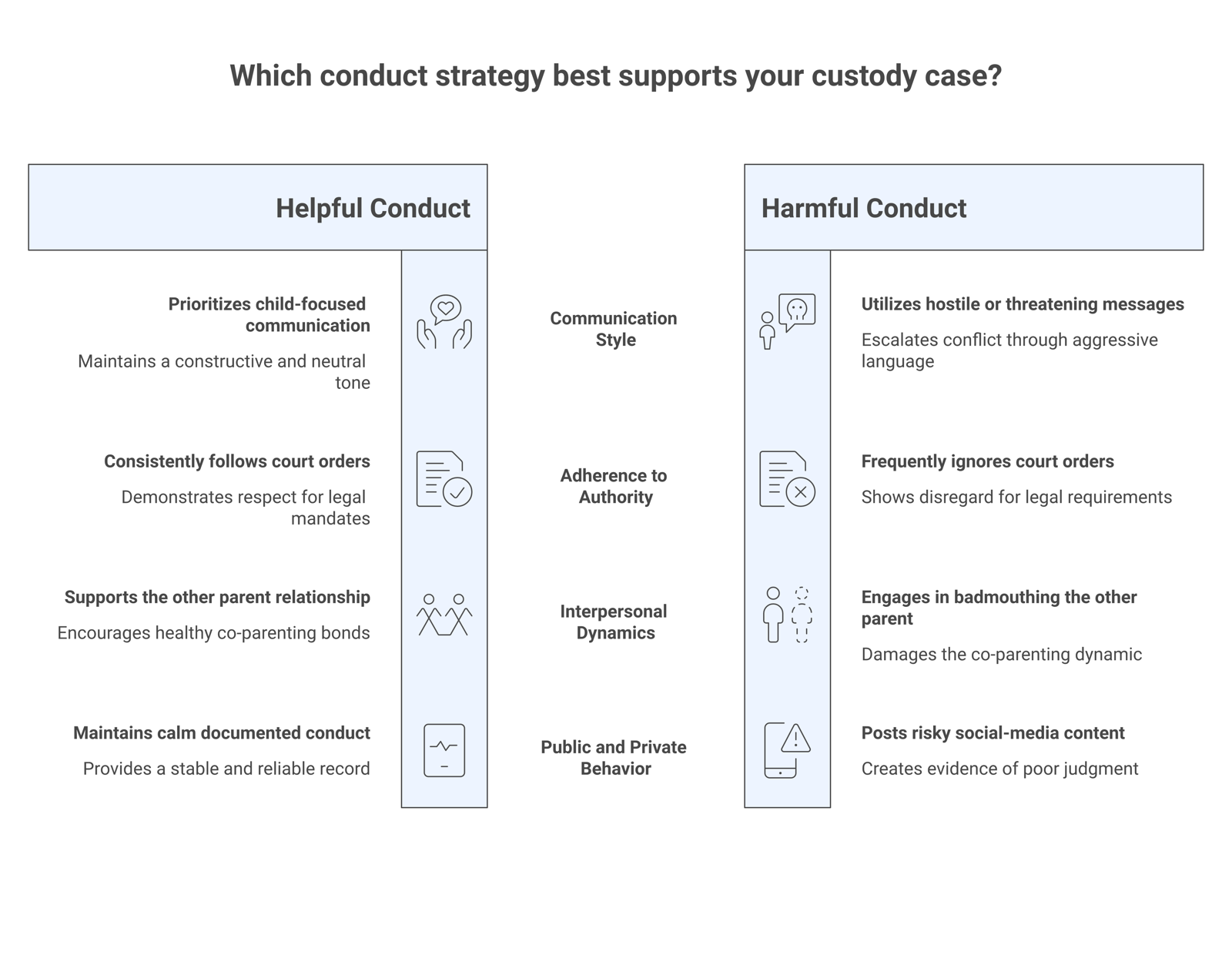
Most of what follows comes down to two questions a court keeps asking. Does this parent act in the child’s interest, and does this parent support the child’s relationship with the other parent? Conduct that answers no to either question is the conduct that tends to count against a parent.
Your messages: texts and emails
Text messages and emails are routinely used as evidence in custody cases. They are easy to save, easy to screenshot, and hard to take back. A single angry message can be read aloud months later, stripped of the moment that produced it.
Tone is what does the damage. A parent who calls the other parent names, makes threats, or sends a wall of hostile texts hands a court a clear picture, and not a flattering one. Pattern matters as much as any single message. Ten calm, child-focused messages and one outburst tell a different story than a steady stream of contempt.
The safe default is simple. Write every message as though a judge will read it, because one might. Keep it factual, brief, and centered on the child. The page on how to communicate with a toxic ex walks through keeping exchanges calm even when the other parent provokes. For the related question of whether messages can prove the other parent’s conduct, see can text messages prove parental alienation.
Social media and what you post
Social media is a frequent source of evidence, and many parents forget that posts outlive moods. A photo from a party, a rant about the other parent, a sudden show of spending after pleading poverty on child support, any of these can be captured and produced.
Posts about a new partner can also surface. A court may take an interest in who spends time around the child and how soon. None of that means a parent must vanish from the internet. It means treating every public post as potential evidence.
Privacy settings help less than people hope. A mutual friend can screenshot a private post. A child old enough to read can repeat what they see. The steadier path is to assume nothing online is truly private during a custody case, and to keep the child off social media as a subject of conflict.
Recordings and what they really show
Recordings of the other parent, or of the child, are sometimes offered as evidence. They are also governed by laws that vary widely from place to place, so whether a recording is even allowed, and whether a court will consider it, depends on the jurisdiction. A licensed attorney is the right source on that question.
Two cautions hold generally. A recording often reveals as much about the parent who made it as about the other parent. Pressing a child to perform on camera, or provoking the other parent to capture a reaction, can read as manipulation. Courts notice the setup, not just the moment.
A parent considering a recording should raise it with counsel first rather than acting alone. The page on what to tell your lawyer about parental alienation covers how to bring this kind of material to an attorney the right way.
Behavior at exchanges and the “four A’s”
Exchanges are one of the few moments a court can observe through witnesses, and they leave a strong impression. A parent who argues at the curb, refuses to hand over a bag, or films the handoff creates a record of conflict, whatever the underlying merits.
Stress makes this harder. One judicial framework describes the “four A’s” of a parent under pressure: angry, anxious, agitated, and afraid. A parent who is genuinely frightened or grieving can still come across as volatile. The stress may be justified, yet the conduct is what a court sees. Consistency and a calm, predictable manner protect a parent here more than any explanation offered later.
The reframe that helps is to treat the exchange as the child’s moment, not the parents’ battleground. A brief, warm, businesslike handoff serves the child and, as a side effect, protects the parent.
Badmouthing and the friendly-parent principle
Here is the part that connects most directly to alienation. Courts pay close attention to whether each parent supports the child’s relationship with the other parent. This is sometimes called the friendly-parent principle, and it cuts both ways. Badmouthing the other parent, blocking calls, or quietly undermining the child’s bond can count against the parent who does it.
A child should not carry adult grievances. When a parent runs the other parent down, interrogates the child after visits, or treats the other home as the enemy, a court can read that as a failure to put the child first. The American Psychological Association’s resources on divorce and child custody describe how exposure to ongoing conflict harms children.
This is not the same as raising a genuine safety concern. A parent who documents real harm and reports it properly is protecting the child, not gatekeeping. The page on how to document parental alienation covers the difference and how to build a careful record when a concern is real.
Substance issues, new-partner dynamics, and ignoring orders
A few other categories carry weight, and each rewards responsible handling over denial.
Substance concerns matter because they bear directly on a child’s safety. A parent with a past issue helps their standing by addressing it openly, through treatment or testing, rather than hiding it. Unaddressed concerns, by contrast, can become a central question.
New-partner dynamics draw attention when a child is exposed too fast or to someone volatile. A court is less interested in a parent dating than in whether the child is stable and safe around new people.
Ignoring existing orders is one of the clearest negatives. A parent who disregards a parenting plan, skips court-ordered steps, or treats an order as optional signals that they will not follow the court’s direction. The American Bar Association’s Section of Family Law publishes general consumer information on custody and a parent’s obligations under an order.
How courts weigh credibility
Underneath every category sits one quiet test: credibility. A court compares what a parent says with what a parent does, and what a parent files with what a parent texts. Gaps between them cost a parent dearly.
Courts act on documented behaviors, not on labels. As one judicial standard puts it, “labels don’t give us any basis on which to make a ruling. It’s the facts that give us that ability.” A parent who calls the other an alienator but cannot show conduct gives a judge nothing. A parent whose messages, posts, and exchanges all tell a consistent, child-centered story builds trust.
The practical lesson is to be the same person in every channel. A parent whose conduct is steady and whose record is clean has little to fear from disclosure. For the situation of facing untrue claims, see how to fight false allegations in child custody.
Frequently asked questions
What can be used against you in a child custody case?
Mostly your own documented conduct. Hostile or threatening text messages, revealing social-media posts, arguments at exchanges, badmouthing the other parent, ignoring existing orders, and unaddressed substance or safety concerns can all be used. Courts weigh this conduct against the best interests of the child.
Can text messages be used against you in custody?
Yes. Texts and emails are routinely produced as evidence. Hostile, threatening, or revealing messages can be screenshotted and read in court long after they were sent. Tone and pattern matter, so calm, factual, child-focused messages are the safe default.
Can social media hurt your custody case?
Yes. Posts about parties, spending, a new partner, or the other parent can be captured and used. Privacy settings offer limited protection, because a mutual contact can screenshot a private post. Treating every post as potential evidence is the safer approach during a case.
What behavior looks bad to a family court judge?
Hostility and conflict at exchanges, badmouthing or undermining the other parent, ignoring court orders, and unaddressed substance or safety concerns tend to read poorly. Stress can make a parent seem angry or agitated even when the feeling is justified, so a calm, consistent manner helps.
Can what you say about your ex affect custody?
Yes. Courts look at whether a parent supports the child’s relationship with the other parent. Running down the other parent, blocking contact, or drawing the child into adult grievances can count against the parent who does it. Raising a genuine, documented safety concern through proper channels is different.
What this page does not do
This page is not legal advice. It does not name any one state’s statutes, evidence rules, or recording laws as if they applied everywhere, and it does not tell readers what to file or when. Those choices belong to a licensed attorney working with the real facts. The page also does not coach anyone to build a case against the other parent or to game the system. The point is to conduct yourself well, for the child’s sake.
For the standard a judge is trying to meet, see what judges look for in custody cases. For answering untrue claims, see how to fight false allegations in child custody. For working with counsel, see what to tell your lawyer about parental alienation. The full Court silo covers the rest.
Sources and further reading
- Cornell Legal Information Institute (Wex). Child custody. law.cornell.edu/wex/child_custody
- American Bar Association, Section of Family Law. americanbar.org/groups/family_law
- American Psychological Association. Divorce and child custody. apa.org/topics/divorce-child-custody
If you or your child are in crisis
Free and confidential help is available right now.
- 988 Suicide and Crisis Lifeline. Call or text 988. 988lifeline.org
- Childhelp National Child Abuse Hotline. 1-800-422-4453. childhelp.org
- NAMI HelpLine. 1-800-950-6264. nami.org/help
Last reviewed: 2026-06-08. Author: Alex Buckles (PAC Founder). Editorial review: held to the PAC Editorial Standards (balance, primary-source citation, reader safety); an independent expert review board will be appointed.