

This page is general information, not legal advice. It does not create an attorney-client relationship, and it does not address any one state’s law. Anyone facing allegations in a custody case should consult a licensed family-law attorney in their own jurisdiction.
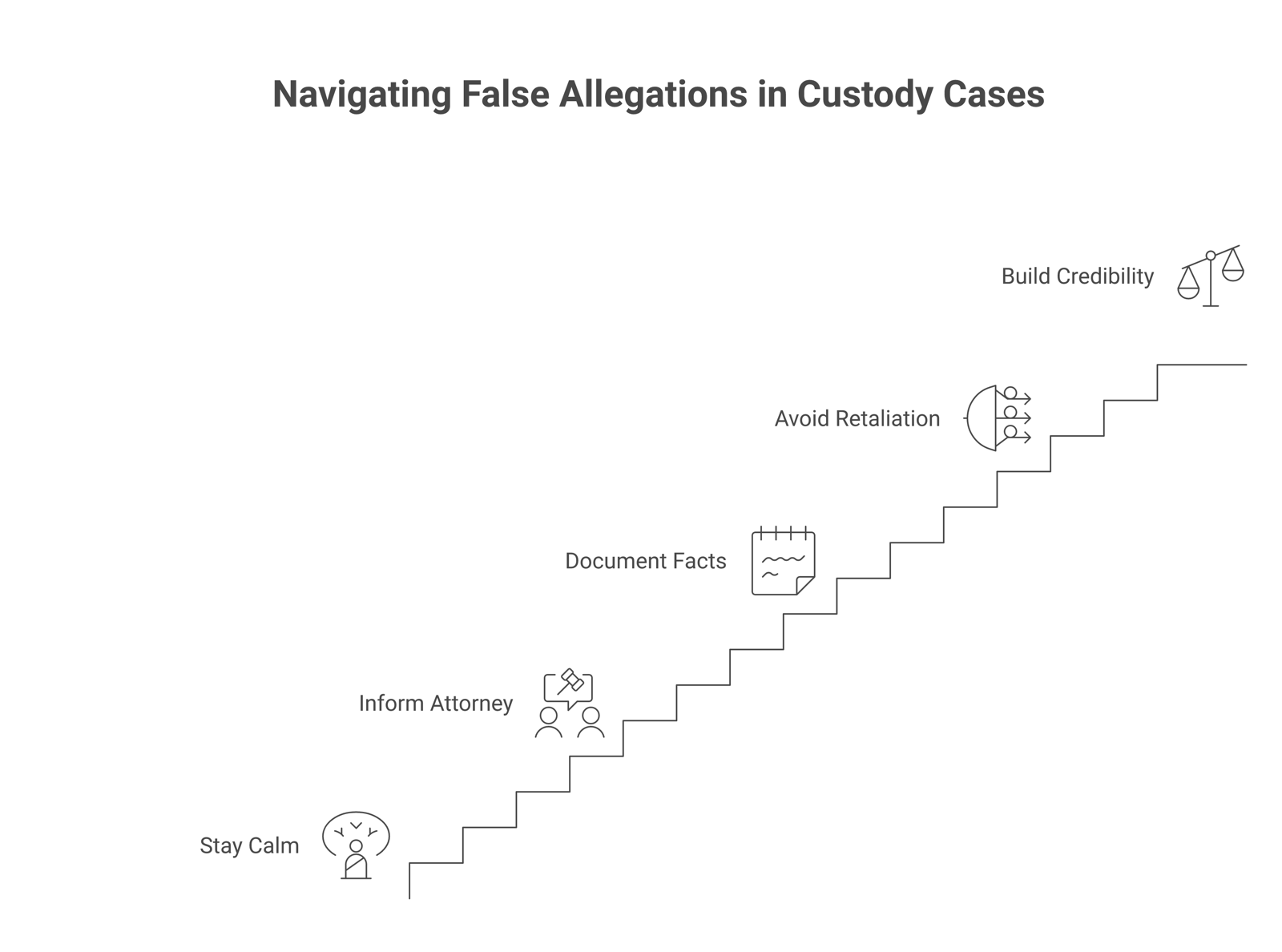
How to fight false allegations in child custody comes down to discipline, not retaliation. The strongest response is to stay calm, obey every order, document everything, and work through your own attorney. Courts decide on documented facts and credibility, not labels. A clear, consistent record protects a falsely accused parent better than any counterattack.
A note on safety
Genuine abuse and domestic violence are real, serious, and must be taken seriously and reported. This page is written for parents facing allegations they know to be false. It is not a tool to discredit a real victim or to help anyone evade accountability. If a child is in danger, contact local law enforcement or a domestic-violence resource first.
How to fight false allegations in child custody, in short
A false allegation in a custody case is frightening, and the instinct to fight back hard is natural. The calmer truth is that the most effective response looks almost boring. Stay law-abiding. Comply with every order. Keep a clean, dated record. Let your attorney drive the strategy. The goal is to respond well, not to “win” against the other parent.
Family courts run on evidence and credibility. A judge cannot read minds, so the judge looks at what each parent does and how each parent presents over time. The Cornell Legal Information Institute keeps a general reference on child custody and how courts weigh these questions. The reader who understands that the record is the real battleground will make better choices than the reader who tries to out-argue the accuser.
This page assumes the allegation is genuinely false. That distinction matters. The same calm, documented approach that protects an innocent parent is also the approach a court trusts, which is exactly why it cannot double as a playbook for hiding real harm.
Why false abuse and domestic violence claims hit so hard
Among false allegations, two are uniquely damaging. Consultant Stan Korosi has described false allegations of child sexual abuse and of domestic violence as a kind of pair of silver bullets, because once either is raised, the accused parent is suddenly asked to prove a negative. Proving that something did not happen is far harder than proving that it did.
These claims also trigger fast, protective responses from courts and agencies, and rightly so when the claim is true. A genuine victim deserves immediate protection. The same urgency, though, means a false claim can reshape a case before anyone has tested it. Temporary orders may limit contact while the matter is investigated.
The honest framing holds both truths at once. Real abuse happens and must be addressed. False abuse claims also happen, and a wrongly accused parent faces a steep climb. None of that is a reason to attack the system or the accuser. It is a reason to respond with extra care, because the stakes and the asymmetry are real. For the boundary between genuine harm and a weaponized claim, see child custody emotional abuse and the cross-silo explainer on parental alienation and false allegations.
Stay calm and comply with every order
The first move is the hardest one emotionally. Obey every order already in place, even an order that feels unjust. If a temporary order limits contact, follow it to the letter. Breaking an order, even out of love or frustration, hands the court a real fact to hold against the accused parent and can make a false claim look more plausible.
Compliance is not surrender. It is the clearest signal a parent can send that they respect the process and the child’s safety. A judge who sees steady, cooperative conduct is watching a parent build credibility in real time. A judge who sees defiance is watching a parent confirm the other side’s story.
This is the practical edge of a principle courts apply every day. As a judicial standard described by professionals in the field puts it, labels do not give a court a basis to rule; the facts do. Calm compliance is a fact, logged in the record, that works in the accused parent’s favor.
Tell your attorney everything, immediately
A false allegation is not a do-it-yourself problem. The single most important step is to retain a licensed family-law attorney and tell that attorney everything, including the facts that feel embarrassing or unhelpful. Surprises in a courtroom hurt the person who created them. An attorney who knows the whole picture can prepare for it.
Working through counsel also keeps a parent from making the situation worse. Tempting moves, a sharp text to the accuser, a public post, a recorded confrontation, almost always backfire. The American Bar Association’s Section of Family Law publishes general consumer information on custody disputes and the value of qualified representation.
Counsel is also the right filter for every decision about contact, evidence, and timing. A parent who routes choices through their attorney gains a calm, strategic buffer between fear and action. For what to share and how to frame it, see what to tell your lawyer about parental alienation.
Document facts, timelines, and witnesses
Documentation is the quiet engine of a strong defense. Courts act on documented behaviors, not on adjectives. A parent who can produce a clear, dated timeline, who was where, when, and with whom, gives the court something solid to weigh against an unsupported claim.
The raw material is ordinary. Save messages and emails. Note the dates and locations of exchanges and visits. Keep names of people who were present and could confirm what happened. Preserve records that establish whereabouts. None of this needs to be dramatic to be useful; consistency over time is what carries weight.
The discipline of building a record is the same one that supports any custody matter. The page on how to document parental alienation walks through the mechanics, and how to prove parental alienation shows how documented behavior, not a label, persuades a court.
Do not retaliate, and protect against repeat allegations
There is a clear list of things not to do. Do not retaliate against the accuser. Do not contact them outside the channels your attorney approves. Do not violate any order. Do not vent about the case online, where words can be screenshotted and reframed. Retaliation does not clear a false allegation; it gives the allegation company.
A parent who has survived one false claim should also expect the possibility of another and arrange life to make the next one hard to manufacture. Attorney Brian Ludmer has emphasized a protective discipline that some call hypervigilance: keep witnesses present during exchanges, conduct contact in documented ways, and avoid being alone in situations where an accusation could be made without anyone to confirm what actually happened.
This is not paranoia; it is base-rate protection. When a pattern of unsupported reports emerges, a court can begin to weigh that pattern, and a documented history, including police submissions that went nowhere, can show the pattern plainly. The parent who calmly records each episode gives the court the evidence it needs to see a serial false reporter for what they are.
How courts weigh credibility and the “four A’s”
Credibility decides many custody disputes, and it is built or lost in small moments. Courts compare each parent’s account against the record and against the other parent’s account, looking for consistency. A story that stays steady and matches the documents is believable. A story that shifts is not.
Presentation matters more than parents expect. A falsely accused parent often arrives at court angry, anxious, agitated, and afraid. Those four reactions are understandable, yet they can read badly to a judge or an evaluator, who may register the heat without knowing its cause. A clinician helping with the emotional load can make a real difference; the American Psychological Association’s resources on divorce and child custody speak to managing that stress.
The lesson is not to suppress real feeling but to channel it. Calm, factual, consistent testimony serves an innocent parent. The same composure helps when an evaluation is ordered; see preparing for a custody evaluation for how to approach that process.
How false allegations can unravel
A measured word of hope belongs here, carefully stated. Unsupported claims often weaken over time. An allegation with no corroboration, contradicted by a clean record, tends to lose force as a case proceeds. Children sometimes recant claims they were coached to make; in one documented matter, a child later took back a false allegation, and the truth came through.
That is an illustration, not a promise. No parent should count on a recantation or assume a false claim will simply collapse. The point is the opposite of complacency. The reason a false allegation can unravel is that the accused parent stayed calm, complied, and built a record that the truth could rest on. The discipline creates the conditions for the truth to surface.
Frequently asked questions
How do you fight false allegations in a custody case?
Stay calm and obey every existing order. Retain a licensed family-law attorney and tell them everything. Document facts, timelines, and witnesses. Avoid retaliation, contact outside counsel, and online venting. Then let your clear, consistent record and your credibility do the work. The goal is a strong, honest response, not a counterattack on the accuser.
What happens if someone makes false accusations in family court?
The claim is typically investigated, and a court may enter temporary orders while it is examined. Courts then weigh credibility, corroboration, and the documented record from both parents. An unsupported allegation tends to weaken over time, especially against a parent who complied with every order and kept a clear, consistent account. Outcomes vary by jurisdiction.
How do courts handle false abuse allegations?
Courts take all abuse allegations seriously, because genuine abuse must be protected against. They then decide on documented facts and credibility, not on labels. A parent who stays calm, complies, and produces a consistent record is in a stronger position than one who reacts with anger. Genuine abuse claims and false ones are tested the same careful way.
Can you lose custody over false allegations?
A false allegation can affect interim arrangements while a matter is investigated, which is one reason to respond carefully from the start. A clear, consistent record and steady compliance protect a falsely accused parent as the case develops. Final outcomes depend on the full evidence and vary by jurisdiction, so a licensed attorney should advise on any specific case.
What should you NOT do when falsely accused?
Do not violate any order, even one that feels unfair. Do not retaliate against or contact the accuser outside the channels your attorney approves. Do not vent about the case online. Do not try to handle it without counsel. Each of these reactions can make a false allegation look more believable and damage the credibility an innocent parent needs.
What this page does not do
This page is not legal advice, and it does not name any one state’s statutes or penalties as if they applied everywhere. Choices about how to respond to an allegation belong to a licensed attorney working with the real facts. The page also does not frame the response as a way to win, beat, or punish the accuser, and it offers nothing to a person trying to hide genuine harm or discredit a real victim. The right response is the calm, documented, child-centered one.
For the underlying dynamic, see parental alienation and false allegations. For building an affirmative record, see how to prove parental alienation. The full Court silo covers the rest.
Sources and further reading
- Cornell Legal Information Institute (Wex). Child custody. law.cornell.edu/wex/child_custody
- American Bar Association, Section of Family Law. americanbar.org/groups/family_law
- American Psychological Association. Divorce and child custody. apa.org/topics/divorce-child-custody
If you or your child are in crisis
Free and confidential help is available right now.
- 988 Suicide and Crisis Lifeline. Call or text 988. 988lifeline.org
- Childhelp National Child Abuse Hotline. 1-800-422-4453. childhelp.org
- NAMI HelpLine. 1-800-950-6264. nami.org/help
Last reviewed: 2026-06-08. Author: Alex Buckles (PAC Founder).