

How to prove parental alienation in family court comes down to one disciplined idea: document observable behaviors over time, organize them under an established identification framework, and escalate each fact to the strongest available form of proof. Courts evaluate behaviors, not labels. The frameworks are clinical and forensic tools a court may weigh, not legal elements, and the scientific status of parental alienation is contested; this page covers both the evidence work and the counter-arguments a parent should expect. It explains what the evidence shows, never how to guarantee an outcome.
This page is general, US-national education. It is not legal advice, it does not create an attorney-client relationship, and it does not address any particular state’s statutes. State laws and procedures vary. Anyone considering action should consult a licensed family-law attorney in their own jurisdiction.
A note on safety
A child’s rejection of a parent is not always alienation. If the rejected parent has been abusive, neglectful, or genuinely dangerous, the child’s distancing is justifiable estrangement, not parental alienation, and it is a different legal and safety matter. Screening for abuse comes first, in every framework discussed on this page. If safety is at risk, contact local law enforcement or a crisis resource first.
What proving parental alienation actually means
Proving parental alienation is not winning a personality contest. It is establishing a pattern of conduct on the record. The pattern is one parent’s behavior that undermines a child’s relationship with the other parent, shown through documented facts rather than accusations or labels.
Veteran litigators stress a reframe before any evidence is gathered. Texas family-law attorney Robert Hoffman argues that a parental alienation case is a clinical, medical, and child-abuse case, not a high-conflict custody case with the volume turned up. In his framing, it should be built and tried the way a medical-malpractice case is built: with experts, a clear theory, and a record. The reason matters. In these cases one parent often presents in distress while the other presents calmly, so the distressed parent can look like the problem. A behavioral record is what corrects that impression.
The practical version of the reframe is the behaviors-not-labels standard described by attorney Ashish Joshi and Judge Jon Van Allsburg. As Van Allsburg puts it, “Labels divide us, stories unite us.” A court does not need to be told the other parent is a narcissist. It needs to see what the other parent did. That distinction shapes everything that follows. For the difference between the behaviors and the symptom cluster, see parental alienation syndrome.
The identification frameworks: Baker’s four factors and the Five-Factor Model
Two closely related frameworks dominate identification work in this field. The first is the four-factor model from developmental psychologist Dr. Amy J.L. Baker, tested in a 2020 reliability and validity study in the Journal of Family Therapy. In Baker’s coding, all four factors must be present to distinguish an alienated child from an estranged one. The second is the Five-Factor Model from child psychiatrists William Bernet and Laurence Greenhill, published in 2022 in the Journal of the American Academy of Child and Adolescent Psychiatry. The Five-Factor Model is Baker’s four factors with the child’s contact refusal added as factor one: factor one establishes that there is a problem to explain, and factors two through five distinguish alienation from justified estrangement.
Two cautions frame everything below. First, these are clinical and forensic frameworks that a court may weigh; they are not statutory elements of any legal claim, and parental alienation is not a standalone diagnosis in the DSM-5-TR. Second, the frameworks themselves are contested: critics such as William O’Donohue and Madelyn Milchman regard the Five-Factor Model as a premature diagnostic framework, a debate covered in the counter-arguments section below. With those cautions in place, Joshi applies the same factor structure as the second of his three courtroom goals: establishing that alienation is occurring in this specific case. The four shared factors are these.
A prior positive relationship
The first factor asks whether the now-rejected parent once had a loving relationship with the child. The relationship does not need to have been perfect. The question is whether the parent was capable of forming a warm attachment. Photographs with dates, coaching records, school forms, and parent-teacher conference records all speak to this factor.
No bona fide abuse by the rejected parent
The second factor is the absence of genuine abuse or neglect by the rejected parent. Not allegations. Not “he is strict.” Actual, substantiated harm. If abuse or neglect is present, the correct term is estrangement, not alienation, and screening for abuse comes first. Clinicians in this field, including Baker, observe that even children who have been abused often do not vehemently reject the abusive parent; that is a clinical observation, not a rule a court applies. Closed investigations and unsubstantiated findings document this factor.
Alienating behaviors by the favored parent
The third factor is evidence that the favored parent has engaged in alienating strategies. Baker catalogued seventeen, including badmouthing, limiting contact, interfering with communication, telling the child the other parent does not love them, creating the impression the other parent is dangerous, confiding adult matters in the child, and undermining the other parent’s authority. Real cases typically show a subset of these, not all seventeen. The behaviors, captured in messages, voicemails, and records, are the documentable heart of the case. The full behavioral inventory lives in signs.
Behavioral signs in the child
The fourth factor is the cluster of eight behavioral signs in the child, first described by Richard Gardner and now used descriptively rather than as a freestanding diagnosis: a campaign of denigration, weak or absurd reasons for the rejection, lack of ambivalence, the independent-thinker claim, borrowed scenarios, absence of guilt, reflexive support for the favored parent, and the spread of animosity to the rejected parent’s wider family.
Types of evidence and the levels-of-evidence ladder
Not all evidence carries the same weight. Baker’s court-prep method ranks proof on a five-rung ladder, from weakest to strongest. The goal for every claim is to push it as high up the ladder as the facts allow.
- The parent’s own belief: “I think my co-parent is badmouthing me.” This is the weakest rung.
- The parent’s direct observation: “I heard the statement myself.”
- A friend or family member willing to testify they saw or heard it.
- A neutral third party (a teacher, coach, or doctor) willing to testify.
- A recording, a contemporaneous written record, or court-admissible documentary evidence. This is the strongest rung.
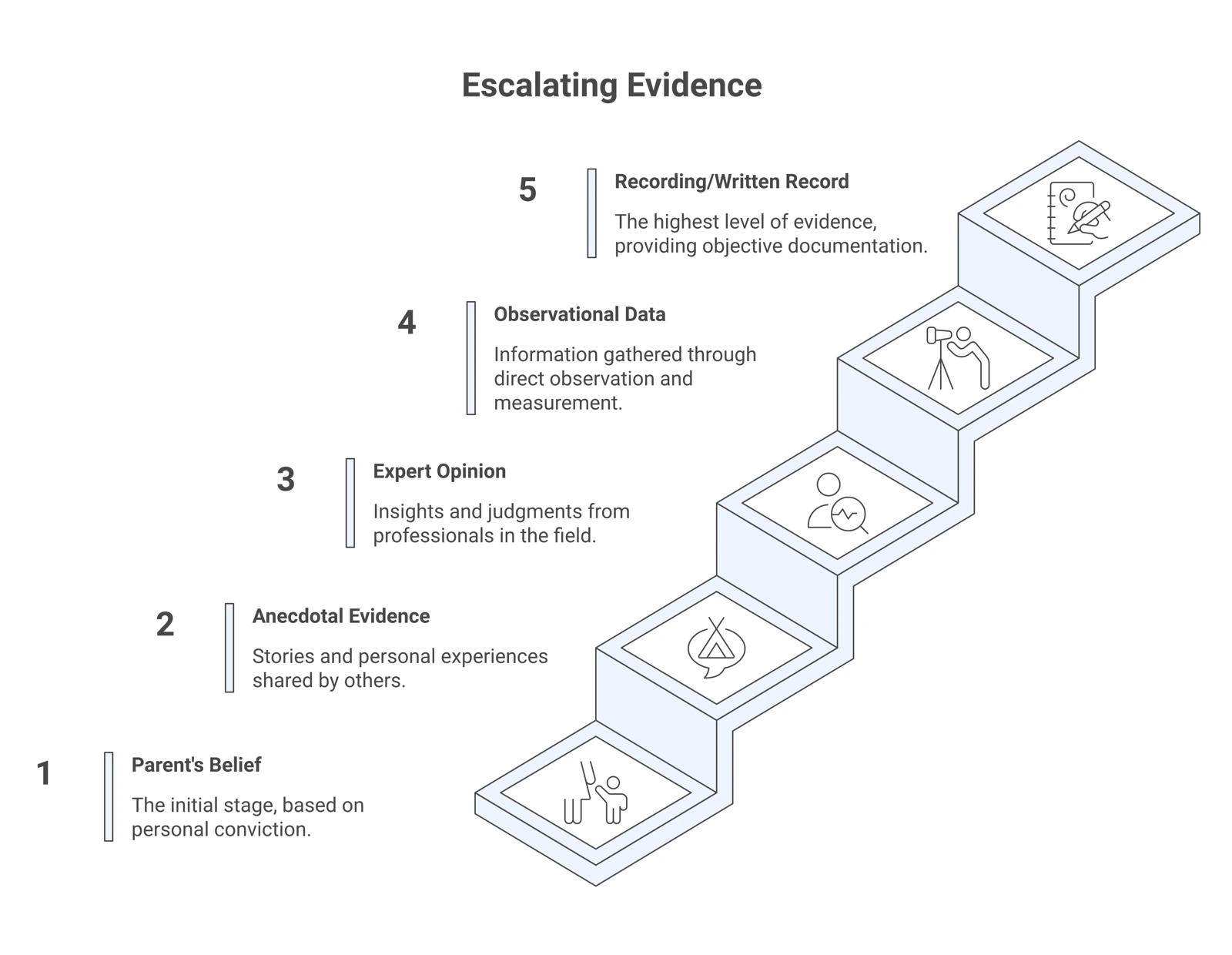
Where a recording or a dated record exists, it leads. Where only self-report exists, the claim is fragile. The same fact (a denied exchange, a screened phone call, a withheld school notice) can sit at rung one or rung five depending entirely on how it was preserved. Researchers including Jennifer Harman argue that many of these behaviors function as coercive control and family violence (Harman, Kruk and Hines, 2018, Psychological Bulletin); that is a framing argument rather than a settled finding, but it helps explain why a contemporaneous record carries such weight.
How to document parental alienation
Documentation is the work that turns a felt pattern into a provable one. The sequence below is educational and procedural, not a filing instruction.
- Keep a dated, factual incident log. Record what happened, when, who was present, and what was said, in neutral language. Opinion and venting weaken a log; facts strengthen it.
- Preserve the artifacts. Save text messages, emails, voicemails, calendars, and school or medical records in their original form. Screenshots with visible dates are better than retyped summaries.
- Gather neutral observations. Note which teachers, coaches, or clinicians witnessed relevant events, since a neutral third party sits high on the evidence ladder.
- Organize by factor. Baker’s binder method uses four tabs, one per factor, with the best available evidence filed under each. This is the structure an evaluator or attorney can read quickly.
Done steadily, this record is what a court, an evaluator, or counsel actually works from. It also protects against the late-emerging-allegation problem discussed below.
The courtroom framework: three things a court must be persuaded of
Joshi’s litigation architecture describes three sequential goals. Each is a precondition for the next, and the page presents them as an educational map rather than a script.
First, that parental alienation is a real, studied phenomenon. Some judges have never been trained on it, so the foundation has to be laid before the facts of the case are argued. Second, that alienation is occurring in this case, shown by applying the identification factors to the documented behaviors. Third, that the children need timely, appropriate intervention, because the window for help narrows as children age.
A recurring trap Joshi names is the premature “hybrid” finding, where a court treats both parents as equally at fault. The proper analysis separates causation from reaction: a targeted parent’s frustration that follows the alienating conduct is a reaction, not a cause. For the legal tools a court can apply once a pattern is established, see is parental alienation illegal.
The counter-arguments you will face
Anyone bringing an alienation claim should expect the concept itself to be challenged, because its scientific status is genuinely contested. Understanding the critique is case preparation, not concession. A parent or attorney who can answer these points calmly, with documentation, is in a far stronger position than one who hears them for the first time in a courtroom.
Start with the diagnostic point. Parental alienation is not a standalone diagnosis in the DSM-5-TR. Related concepts appear under parent-child relational problem and child affected by parental relationship distress, and child psychological abuse covers the underlying acts, but opposing counsel can accurately say that no diagnostic manual recognizes “parental alienation” as a disorder. That is one reason the behaviors-not-labels approach on this page matters: documented conduct does not depend on a contested label.
Next, the empirical critique. Law professor Joan Meier and colleagues published a 2020 study of published US custody decisions (Meier et al., 2020, Journal of Social Welfare and Family Law) finding that courts credited mothers’ abuse claims in 41 percent of cases overall and child sexual abuse claims in only 15 percent, that mothers alleging abuse lost custody 26 percent of the time, and that a father’s alienation cross-claim roughly doubled that rate to 50 percent and made courts about 3.9 times more likely to disbelieve the mother’s child-abuse claim. In alienation cases with no abuse allegations, outcomes were roughly gender-equal. Meier concedes the study cannot show that any individual ruling was wrong, and proponent researchers Jennifer Harman and Demosthenes Lorandos have challenged its methods, with Meier publishing a rebuttal in 2022. That methodological exchange is unresolved. A parent should expect Meier’s findings to be raised whenever alienation is claimed alongside abuse allegations.
Third, the policy critique. The UN Special Rapporteur on violence against women and girls, Reem Alsalem, issued a 2023 report (UN Doc A/HRC/53/36) calling parental alienation a “discredited and unscientific pseudo-concept” and urging states to bar its use in custody proceedings. It is an advocacy and policy report rather than a study, and proponent scholars published organized rebuttals, but courts and legislators have read it.
Finally, the legislative trend. Title XV of the Violence Against Women Act Reauthorization Act of 2022, known as Kayden’s Law (Pub. L. 117-103, codified at 34 U.S.C. 10446(k)), created grant incentives for states that adopt judicial training standards, limits on reunification treatment, and stricter expert-qualification requirements in custody cases involving abuse allegations. As of mid-2026, Colorado, California (Piqui’s Law), Pennsylvania, and Utah (Om’s Law) have enacted conforming legislation. None of this prevents a court from finding alienation on documented behaviors, but it does raise the bar for the experts and remedies a court will accept, and a well-prepared case accounts for that.
Proving alienation without an expert
Most parental alienation cases have no expert and no guardian ad litem. Often there is only a judge and two parents. That reality is exactly why the behaviors-not-labels standard matters.
Joshi and Van Allsburg describe how a trial court can find alienation on behaviors alone, without an expert diagnosing a syndrome. In their account, appellate courts have recognized that high-conflict custody disputes frequently involve acts by one parent designed to sabotage the child’s relationship with the other parent. Courts have always evaluated bad behavior without needing it to carry a clinical label. For a pro-se reader, the lesson is to arrive with a clean fact pattern (the specific strategies, the dated incidents, the preserved records) rather than with diagnostic terms and no supporting facts. When a case genuinely needs an expert, a parental alienation lawyer can advise on that decision.
The custody evaluation
A custody evaluation is a court-ordered assessment in which a qualified evaluator reviews the parents, the child, and collateral records, then reports to the court. It can be a strong source of evidence, but it is not required in every case, and it is expensive and slow.
Evaluations also carry a known risk. Hoffman cautions that evaluators sometimes confuse a pathologically enmeshed parent-child bond with a healthy one, because the enmeshed relationship can look highly bonded from the outside. An evaluation is therefore one input, not a verdict. The American Psychological Association publishes general consumer information on divorce and child custody that helps parents understand what these assessments do.
How you present matters: the four A’s and the four C’s
Courts are decided by people, and people respond to credibility. Hoffman names a pattern he calls the four A’s and the four C’s. Targeted parents often present as Angry, Anxious, Agitated, and Afraid, which is understandable after a long ordeal but corrosive on a witness stand. Favored parents often present as Cool, Calm, Charming, and Convincing.
There is a related effect Hoffman borrows from Dr. Steve Miller, called spontaneous trait transference: when a person says only negative things about someone else, listeners begin attributing those negative traits to the speaker. A parent who does nothing but attack the other side can end up wearing the negativity. The constructive discipline is to stay factual and measured, to acknowledge nuance, and to let the documented behaviors carry the weight. This is a point about credibility, not theater.
Late-emerging allegations and memory science
Custody disputes sometimes feature accusations that surface suddenly, years after the supposed events, in fully-formed detail. Canadian attorney Brian Ludmer points courts to the British Psychological Society’s memory-science principles as a research-anchored frame for weighing such claims.
The principles, drawn from the memory-research community, hold that memory is reconstructive rather than a recording, that memories of real events are typically incomplete, and that people can sincerely report events they did not experience. As the guidance summarizes the point, there is no room in the science for the assertion that a memory of abuse can be entirely suppressed and then return as a complete accusation. The principles do not resolve any individual case. They simply help a court calibrate how much weight a late-emerging, fully-formed allegation should carry.
Frequently asked questions
What evidence is needed to prove parental alienation?
The evidence is documentation of observable behaviors over time, organized under the identification factors: a prior positive relationship with the rejected parent, the absence of bona fide abuse by that parent, alienating strategies by the favored parent, and the behavioral signs in the child (with the child’s contact refusal added as a fifth element in the Bernet and Greenhill Five-Factor Model). These are clinical frameworks a court may weigh, not statutory elements. Each fact should be escalated to the strongest available proof, with recordings and contemporaneous records outweighing self-report.
Can you prove parental alienation without an expert?
Often, yes. Courts can find alienation on behaviors alone under a behaviors-not-labels standard, which matters because most cases have no expert and no guardian ad litem. A pro-se parent is better served by a clean, dated fact pattern showing specific alienating strategies than by diagnostic labels with no supporting facts.
How do you document parental alienation for court?
Keep a dated, factual incident log; preserve messages, voicemails, calendars, and school and medical records in their original form; note which neutral third parties witnessed relevant events; and organize everything by factor in an evidence binder. Facts strengthen a record; opinion and venting weaken it.
What is a parental alienation custody evaluation?
It is a court-ordered assessment in which a qualified evaluator reviews the parents, the child, and collateral records and reports to the court. It can be a valuable source of evidence, but it is not required in every case, it is costly and slow, and it is one input rather than a final verdict.
Is parental alienation hard to prove?
It can be, because the favored parent often presents calmly while the targeted parent is in visible distress, and because the most persuasive proof requires careful, contemporaneous documentation. A steady behavioral record, escalated up the evidence ladder, is what makes the pattern visible to a court.
Is parental alienation a recognized diagnosis or settled science?
No. Parental alienation is not a standalone diagnosis in the DSM-5-TR, and its scientific status is contested: Joan Meier’s 2020 custody-outcomes research and the UN Special Rapporteur’s 2023 report (A/HRC/53/36) are the leading critiques, and the methodological exchange between Meier and proponent researchers remains unresolved. Courts, however, evaluate documented behaviors rather than labels, which is why a careful behavioral record matters more than the contested term.
What this page does not do
This page is not legal advice. It does not name any one state’s statutes as if they applied nationally, and it does not tell readers what to file or when. Choices about motions, evaluations, and any complaint belong to a licensed attorney working with the actual facts. The page does not frame evidence as a weapon or promise any outcome, and it does not present the underlying science as settled: the identification frameworks are clinical tools, and the critiques summarized above are real. The right use of documentation is the careful, evidence-based one, oriented to the child’s wellbeing.
Where to go next
- For the legal tools that can apply once a pattern is established, read is parental alienation illegal.
- For vetting counsel and deciding when an expert is needed, see how to choose a parental alienation lawyer.
- For the boundary of civil remedies, see can you sue for parental alienation.
- For the behavioral inventory that becomes evidence, see signs.
- For the full set of court-facing resources, visit the Court pillar.
Two documented cases worth reading
Courts do sometimes treat a documented pattern of alienating conduct as legally significant, and two published opinions show how. In our case study of Sharp v. Keeler, an Arkansas appellate court treated a parent’s dated, behavior-by-behavior record of interference as a material change of circumstances. In Hanson v. Spolnik, an Indiana court weighed one parent’s sustained animosity, tied to harm to the child, in changing custody. Both turned on concrete documentation weighed by a judge, not on the word alienation, and both kept the abuse-not-alienation line in view. They are illustrations from two states, not authority for any other.
Sources and further reading
- Baker, A. J. L. (2020). Reliability and validity of the four-factor model of parental alienation. Journal of Family Therapy, 42(1), 100-118. https://doi.org/10.1111/1467-6427.12253
- Baker, A. J. L. (2007). Adult Children of Parental Alienation Syndrome: Breaking the Ties That Bind. W. W. Norton. (Source of the 17 parental alienation strategies.)
- Bernet, W., & Greenhill, L. L. (2022). The Five-Factor Model for the diagnosis of parental alienation. Journal of the American Academy of Child & Adolescent Psychiatry, 61(5), 591-594. https://doi.org/10.1016/j.jaac.2021.11.026
- Harman, J. J., Kruk, E., & Hines, D. A. (2018). Parental alienating behaviors: An unacknowledged form of family violence. Psychological Bulletin, 144(12), 1275 to 1299. https://doi.org/10.1037/bul0000175
- Meier, J. S., Dickson, S., O’Sullivan, C., Rosen, L., & Hayes, J. (2020). U.S. child custody outcomes in cases involving parental alienation and abuse allegations: What do the data show? Journal of Social Welfare and Family Law, 42(1), 92-105.
- Alsalem, R. (2023). Custody, violence against women and violence against children. Report of the UN Special Rapporteur on violence against women and girls, UN Doc A/HRC/53/36. ohchr.org
- Keeping Children Safe From Family Violence Act (Kayden’s Law), Title XV, Violence Against Women Act Reauthorization Act of 2022, Pub. L. 117-103, codified at 34 U.S.C. 10446(k).
- American Psychological Association. (n.d.). Divorce and child custody. apa.org/topics/divorce-child-custody
- American Bar Association, Section of Family Law. americanbar.org/groups/family_law
- Cornell Legal Information Institute, 18 USC 1204 (International Parental Kidnapping Crime Act). law.cornell.edu/uscode/text/18/1204
- Joshi, A. (2024). Litigating Parental Alienation. American Bar Association.
Crisis resources
If safety, self-harm risk, or a child-welfare concern is at issue, reach out immediately.
- 988 Suicide and Crisis Lifeline. Call or text 988. 988lifeline.org
- Childhelp National Child Abuse Hotline. 1-800-422-4453. childhelp.org/hotline
- NAMI HelpLine. 1-800-950-6264. nami.org/help
Last reviewed: June 17, 2026. Author: Alex Buckles (PAC Founder).