

Parental alienation false allegations run in two directions. Sometimes a false or overblown abuse claim is used to turn a child against a parent. Other times a real abuse report gets wrongly waved off as “just alienation.” Telling these apart is hard, and it calls for a trained, neutral review, not a guess.
A safety note, first
When a child has been harmed, the child’s pulling away from the parent who harmed them is not alienation. It is a safety response, and it must never be recast as a false claim. Labeling a protective parent or a real victim an “alienator” is itself a serious harm. If a child may be unsafe, safety comes first. Contact local police or a child-protection agency before anything else.
This page is general education. It is not clinical or legal advice, and it does not assess any one family. Anyone facing these questions in a real case should work with a trained evaluator and a licensed lawyer.
What “parental alienation false allegations” means
The phrase “parental alienation false allegations” points to where two serious problems overlap. One problem is parental alienation, where one parent works to damage a child’s bond with the other parent. The second is a false abuse claim, where someone reports harm that did not happen. These can meet, but the link is easy to get wrong.
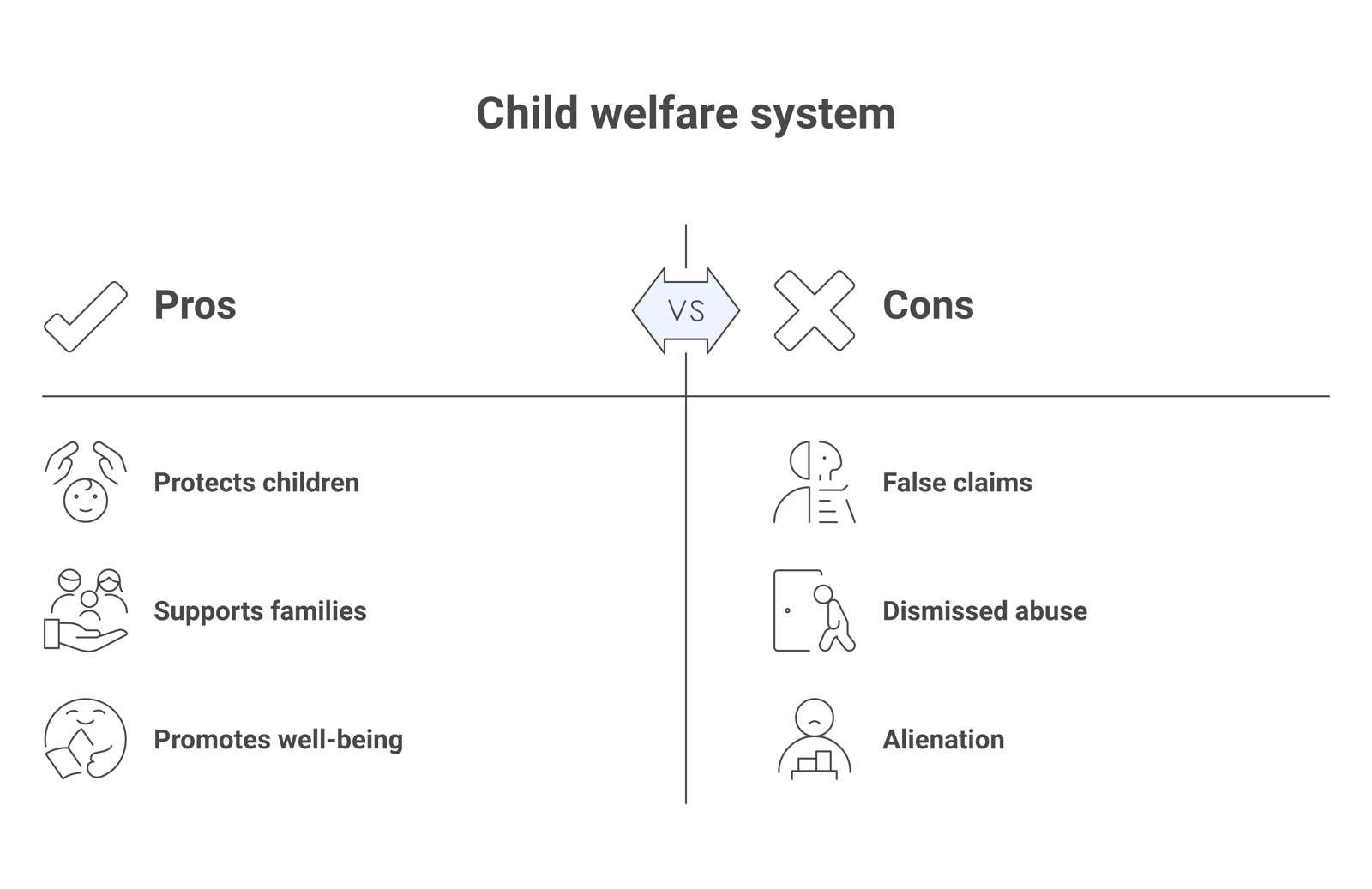
There are two honest failure modes here. A false claim can be a tool of alienation. A true claim can be brushed aside as alienation. Both happen. Both hurt children. This page takes each in turn, then asks the harder question of how anyone tells them apart.
This page is narrow on purpose. For the meaning of the term itself, see parental alienation syndrome. For the family-court angle on abuse in custody disputes, see child custody and emotional abuse. The focus below is only the false-claims overlap.
Direction one: a false claim used as an alienating tactic
A false or overblown abuse claim can become a way to cut a child off from a safe parent. The claim can trigger an inquiry. It can pause parenting time. It can plant fear in a child who was never in danger. Used this way, the claim does the work of separation.
Researchers who study alienation place this inside a wider pattern. Jennifer Harman and colleagues, writing in Psychological Bulletin in 2018, argue that alienating behaviors map onto known patterns of coercive control. Within that frame, a false claim is one tactic among many. It is not what defines alienation, and most cases involve no false report at all.
Naming this risk is not the same as assuming it. A claim is not false just because it is denied. A claim is not false just because it is hard to hear. Most reports of harm deserve to be taken seriously and checked, not waved off. The point here is simple. A false claim can be misused, and that is one reason these cases are so painful to sort out.
Direction two: real abuse wrongly labeled as alienation
The opposite error is just as real. A real abuse report can be dismissed as “just alienation.” A frightened child who pulls away from a parent who hurt them can be called alienated. A parent who reports real harm can be recast as the problem.
This is not a minor risk. When a true report is recast as a false one, a child can be sent back toward danger. A protective parent can lose standing for doing the right thing. The harm grows, because the system meant to protect the child becomes the thing that fails them.
The clinical models themselves guard against this. Amy Baker’s well-known four-factor model includes a clear gate. One of its four factors is no real abuse or neglect by the rejected parent. In plain terms, real proven abuse rules a case out. Ruling out abuse is built in, not added later. A careful evaluator checks that gate first, before the word alienation is ever used.
What the research says about how often claims are founded
People often ask how often abuse claims in these cases turn out to be true. The honest answer is that the data are partial, disputed, and easy to misread. Some figures get passed around a lot. They deserve both a clear source and real caution.
One line of research comes from scholars in the alienation field. A review of 492 United States appellate cases, analyzed by Amanda Sharples, Jennifer Harman, and Demosthenes Lorandos, reported that proven abuse was roughly 4.4 times more likely to be found against the alienating parent than the targeted parent. The same review reported that about 41 percent of these cases involved no abuse claim at all. A separate review of 500 Canadian trial cases, tied to Christine Giancarlo, Lorandos, and Brian Ludmer, reported that roughly 70 percent of abuse claims against the rejected parent were not proven, with no clear gender bias.
These numbers carry heavy caveats. They are offered here as one body of evidence, not the last word. They come from scholars active in the alienation field, and they describe court cases already flagged for alienation, not custody disputes in general. A reader should treat them as findings open to challenge, not as settled facts.
Two cautions matter most. First, “not proven” does not mean “false.” A claim can fail to be proven and still be true, because abuse is hard to prove, and a scared child is a poor witness against a parent. Second, a large body of protective-parent research points the other way. Those scholars find that courts often dismiss real abuse reports once the word alienation comes up. Both errors are on record. Neither one cancels the other.
So the figures above do not show that abuse claims are usually false. They show that in a specific, pre-picked set of cases, many claims were not proven, while serious abuse was sometimes found against the alienating parent instead. The fair takeaway is narrow. False claims exist, true claims are often real and under-believed, and no single number settles any one family’s case.
Unfounded is not the same as a deliberate lie
One distinction runs through this whole topic. An unfounded finding is not the same as a deliberate lie. Dr. Wendy Borg, a forensic psychologist, draws that line clearly. Across full child-protection samples, most abuse reports are either founded or left undetermined. Only a small share are intentionally false. Borg reads the research as putting deliberate fabrication at a few percent of all reports. That share rises somewhat in the divorce context, yet it stays a minority.
So most unfounded reports are not lies. A report can be unfounded because the evidence ran out, because a young child could not explain, or because no one could confirm what happened. None of that means a parent invented it. Treating “unfounded” as “false” inflates the numbers and brands honest, worried parents as liars.
Bill Eddy frames the same point another way. In his rough split, about a third of contested abuse claims are true, about a third are sincerely believed but mistaken, and about a third are knowingly false. The middle group matters most. A sincere but mistaken claim is not a malicious one, and it calls for care, not blame.
Borg also names a clinical-versus-forensic divide that clears up a lot of confusion. A treating therapist accepts a client’s account in good faith and is not there to investigate. A forensic evaluator weighs every source and rates how reliable each one is. Mistaking a therapist’s good-faith belief for forensic proof is a common error, and it can push a court the wrong way.
History adds a caution. Borg points to cycles of panic, from the Salem trials to the 1980s daycare cases, where poor interviewing produced false certainty. The lesson is not that children lie. The lesson is that adults must interview with care, because a leading question can plant a memory that was never there.
Nicholas Bala, a centrist family-law scholar, sets all of this in a balanced frame. Courts face three parallel problems: unfounded domestic-violence claims, unfounded abuse claims, and unfounded alienation claims. Each one needs case-by-case proof. None of them deserves a blanket rule. Both parents can raise an unfounded claim, and an unfounded alienation claim is no more acceptable than an unfounded abuse claim. Bala also notes that a United Nations Special Rapporteur is an individual report-writer, not the United Nations itself, so “the UN says” is often misused in these debates.
A final caution guards the child’s voice. Paul Bensussan warns against treating a child’s words as beyond question, what he calls the sacralization of the child’s word. A child deserves to be heard with respect. Hearing a child, though, is not the same as accepting every statement at face value without any context. A careful evaluator honors the child by listening closely and still checking the wider record, in either direction.
Why telling them apart is genuinely hard
Telling a false claim from a true one is hard work. A child’s distress looks much the same whether it comes from real harm or from coaching. A parent’s anger looks much the same whether it is protective or controlling. Surface reads mislead in both directions.
Good review slows down and looks at patterns. Heleen Koppejan, a Dutch researcher and clinician, lays out a careful method that applies to any parent. Check the records from the time, such as the messages each parent sent. Cross-check what both families actually saw. Check where any injury photos came from, since images can be copied or staged. Watch how each parent acts in neutral meetings.
Koppejan also flags a bias worth naming. A small, soft-spoken, well-schooled parent is rarely suspected of being an abuser, even when they are. Meanwhile a blunt or angry parent is easily cast as the villain, even when they are the protective one. A neutral evaluator has to push past those instincts on purpose. The same care protects a falsely accused parent and a truly abused child alike, because it follows the evidence, not the optics.
None of this is a checklist a parent can run at home. It is the work of trained, neutral experts. That is the main reason these cases need a trained review. The cost of guessing is a child sent the wrong way.
Coercive control sits underneath both errors
Coercive control is a useful lens, as long as it is held even-handedly. Harman and colleagues argue that alienating behaviors and coercive control share the same machinery. The same body of work treats domestic violence as a form of coercive control too.
That balance is the point. The lens does not tell anyone in advance who the controlling party is. A false claim can be a coercive tactic. So can cutting a child off from a loving parent. So can the abuse that a real report describes. The lens names a pattern of control. It does not name a victim or a wrongdoer before the facts are in.
Held this way, coercive control resists misuse. It refuses to assume that the accusing parent is lying. And it refuses to assume that the accused parent is guilty. It asks instead who is really controlling whom, and it waits for evidence to answer.
Who should make this call
The honest takeaway is humbling. No parent should diagnose the other. A blog post cannot settle a real case. No search result can tell a frightened person whether a claim is true. These calls belong to trained, neutral experts working with the full record.
A reader who suspects a false claim, and a reader who fears a real one is being ignored, need the same next step. Both need a skilled forensic and clinical review, and where law is involved, a licensed lawyer. Where a child may be in danger, the first call goes to police or child protection, not to a custody plan.
For related reading, see the Learn pillar for the foundations, parental alienation as emotional abuse for the harm framing, and parental alienation statistics for how to read numbers in this field with care.
Frequently asked questions
What does “parental alienation false allegations” mean?
It describes where two problems overlap. One parent may use a false abuse claim to turn a child against the other parent. Or a real abuse report may be wrongly dismissed as alienation. Both errors happen, both harm children, and telling them apart reliably needs a trained review.
Are abuse allegations in custody cases usually false?
No. There is no sound basis for assuming most abuse claims are false. Some research from the alienation field reports high rates of unproven claims in cases already flagged for alienation. Yet unproven does not mean untrue, and other scholars find that real abuse is often disbelieved. Most reports deserve to be taken seriously and checked.
Can a true abuse report be wrongly called parental alienation?
Yes, and it is a serious harm when it happens. A child who pulls away from a parent who hurt them is showing a safety response, not alienation. Well-known models, including Baker’s four-factor model, require ruling out real abuse before a case is ever called alienation.
How do professionals tell a false allegation from a real one?
They rely on neutral, trained review rather than first reads. That work includes reviewing records from the time, cross-checking accounts from both sides, verifying physical evidence, and watching for bias in both directions. It is not a test a parent can run alone, which is why trained experts are essential.
What should a parent do if a child may be unsafe?
Safety comes first. If a child may be in danger, contact local police or a child-protection agency before pursuing any custody plan. Document concerns factually, and seek a trained evaluator and a licensed lawyer. A child’s safety is never a tactical question.
Sources and further reading
- Harman, J. J., Kruk, E., & Hines, D. A. (2018). Parental alienating behaviors: An unacknowledged form of family violence. Psychological Bulletin, 144(12), 1275 to 1299. https://doi.org/10.1037/bul0000175
- American Psychological Association. Divorce and child custody. apa.org/topics/divorce-child-custody
If you or your child are in crisis
Free and confidential help is available right now.
- 988 Suicide and Crisis Lifeline. Call or text 988. 988lifeline.org
- Childhelp National Child Abuse Hotline. 1-800-422-4453. childhelp.org
- NAMI HelpLine. 1-800-950-6264. nami.org/help
Last reviewed: 2026-06-07. Author: Alex Buckles (PAC Founder).