

This page is general information, not legal or clinical advice. It does not diagnose any child or parent and does not replace care from a licensed professional. Anyone worried about a child should consult a qualified clinician, and anyone weighing legal action should consult a licensed family-law attorney in their own jurisdiction.
Parental alienation manipulation is the set of psychological tactics one parent uses to reshape a child’s feelings and memories about the other parent. It works through emotion, repetition, and loyalty pressure rather than reasoned argument. That is why a child can sincerely believe distorted things. Here is how the process works inside a child’s mind.
A note on safety
Not every child who pulls away has been manipulated. A child’s accurate fear of a parent who is genuinely abusive is not the product of manipulation, and a protective parent should never be labeled an alienator. If a child is reacting to real harm, that is a safety matter, not alienation. If a child’s safety is at risk, contact local law enforcement or a domestic-violence resource first.
What parental alienation manipulation means
The term describes a process, not a single act. One parent slowly changes how a child feels about the other parent. The change does not come from facts or debate. It comes from emotion, from things said over and over, and from pressure to take a side.
That difference matters. A parent who manipulates a child is not usually handing the child a list of complaints to learn. The influence is softer and harder to see. A sigh at the mention of the other parent. One worried look during a phone call. Then a small comment dropped at the right moment. Each one is minor on its own, yet together they teach the child what to feel.
The result is a child who has absorbed a feeling and now treats it as fact. The American Psychological Association notes that high-conflict separation places real strain on children, and you can read its overview of divorce and child custody for context. This page is narrower in focus. It explains the mental machinery that lets the feeling take hold.
Why it works through emotion, not argument
To grasp the process, it helps to know how a child’s brain handles feeling and logic. Author and former therapist Bill Eddy describes a useful split. The feeling part of the brain reacts fast, often before the thinking part can weigh anything. A child feels first and reasons later.
Eddy points to a well-known brain rule: cells that fire together wire together. A parent who pairs an upset feeling with the other parent, again and again, links the two in the child’s mind. Over time the child no longer needs the cue. The other parent’s name alone sparks the upset feeling, which is now wired in.
This is also why argument does not undo it. A targeted parent who calmly presents proof is speaking to the logical brain. The harm sits in the emotional brain, which was reached first and reached harder. One key effect is the loss of ambivalence. Most healthy bonds hold mixed feelings, both love and frustration. A manipulated child loses that balance and is left with one feeling only.
The mechanisms, step by step
Eddy describes several mechanisms of emotional absorption that work together. They form a rough sequence, shown in the diagram below.
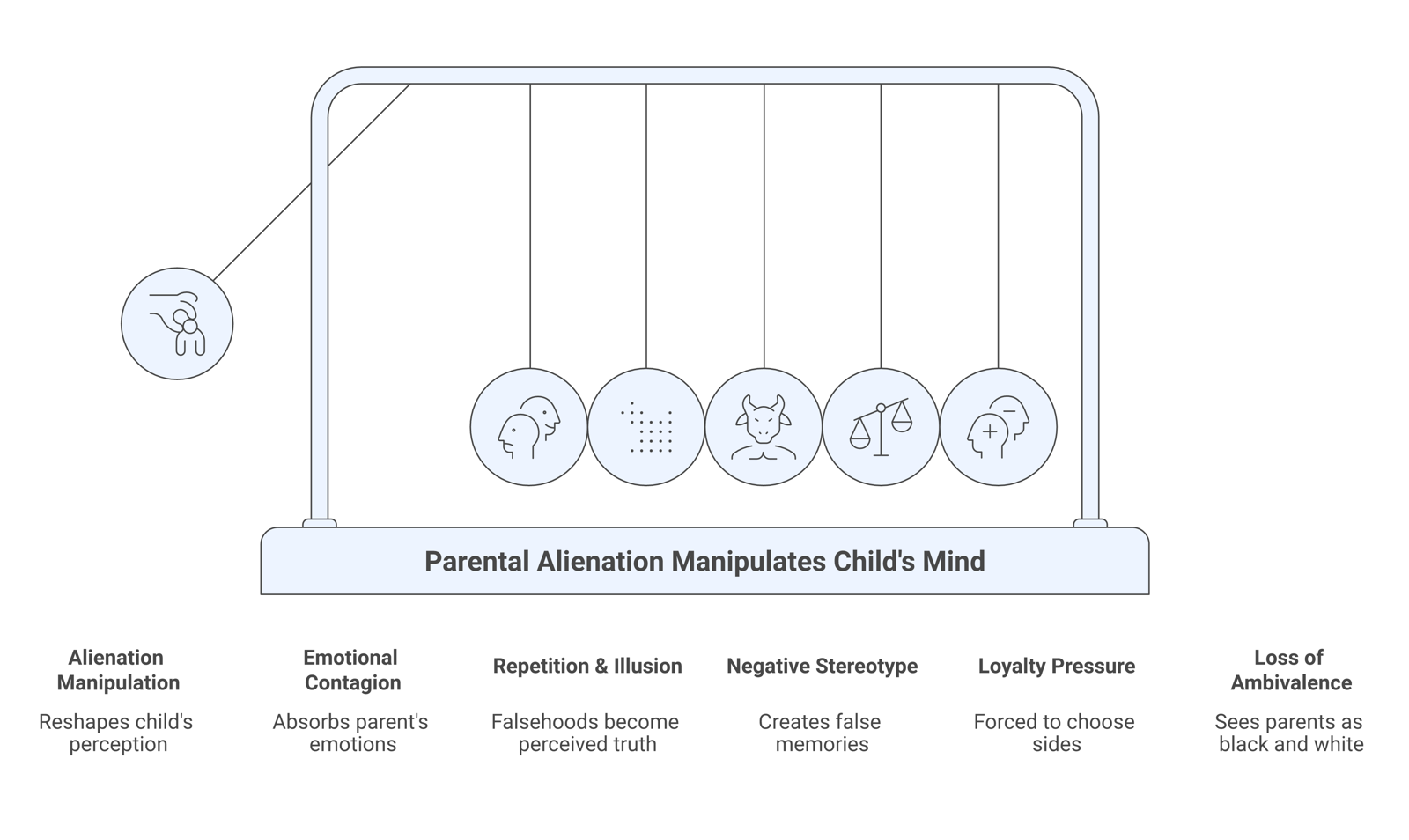
Emotional contagion comes first. Children catch feelings from a parent the way they catch a yawn. Researchers tie this to the amygdala, the brain’s alarm center, and to mirror neurons that copy what another person feels. A scared or angry parent passes that state to the child without a single word of argument.
Intensity makes it stick. Strong emotion during a crisis is absorbed more deeply than calm conversation. A tense exchange or a tearful evening leaves a stronger mark than an ordinary day.
Amplification shapes the memory. People tend to remember the peak of an event and how it ended, not the whole of it. A single bad moment at the end of a good visit can come to stand in for the entire visit.
Repetition makes claims feel true. Experts call this the illusion-of-truth effect. A claim repeated often enough starts to feel true, even with no proof behind it. A child who hears the same complaint many times comes to treat it as settled fact.
Negative stereotypes prime false belief. Once a child has been taught to expect bad things from a parent, the child starts to see them, and sometimes to remember things that never happened. The next section explains this in detail.
Splitting locks it in. The mind simplifies a confusing situation into all good and all bad. One parent becomes the hero, the other the villain, with no middle ground left.
How false memories form
A child can come to recall events that never happened and believe the memory completely. This is one of the hardest parts of the process for a targeted parent to accept, yet it is well documented.
The clearest example comes from a study of preschoolers run by researcher Stephen Ceci and colleagues, often called the Sam Stone study. Children were told ahead of time that a man named Sam Stone was clumsy and broke things. When Sam Stone later visited their classroom and broke nothing, many children afterward described him ripping a book and soiling a toy. They had not seen it happen. The planted stereotype, repeated over weeks, produced a vivid false memory. You can find this line of suggestibility research through the PubMed database.
Clinicians call this confabulation, a false memory formed without any intent to deceive. The child is not lying. Instead, the brain has filled a gap with a detail that fits the expected story, and the child cannot tell the difference. The American Psychological Association has long studied how suggestion can shape what a person sincerely recalls.
Put the pieces together and the picture is clear. A child primed to expect the worst, exposed to repeated negative claims, will sometimes generate memories that match the script. To the child, those memories feel as real as any other.
The loyalty conflict
Underneath the memory work sits a deeper pressure. A child caught between two parents in conflict faces a loyalty conflict, a sense that loving one parent means betraying the other. That is a painful spot for a child, and the mind looks for a way out.
The manipulating parent, knowingly or not, offers the exit. Picking one side eases the tension. Clinicians sometimes describe an unspoken loyalty contract, in which the child wins the present parent’s approval by rejecting the absent one. Therapist Zach Flood and others have shown how this can harden into a closed belief system the child defends on their own.
Family therapy pioneer Salvador Minuchin gave a name to part of this: enmeshment. In an enmeshed bond the line between parent and child collapses. The parent’s feelings become the child’s feelings. A child this fused with a parent does not feel the rejection as someone else’s view. It feels like their own.
Why the child sincerely believes it
All of this leads to the question targeted parents ask most. Why does the child believe things that are not true?
The answer is that the belief was never built from evidence, so evidence cannot easily remove it. It was installed through feeling, repetition, and pressure, and those forces make it feel like the child’s own honest conclusion. A child in this position is not performing and is not lying. The conviction is real.
Loss of ambivalence finishes the work. A child who once held mixed feelings now holds only one, and the splitting described earlier leaves a tidy story: one all-good parent and one all-bad parent. Outward signs of this can include scripted-sounding speech and a lack of guilt, which the page on a child brainwashed against a parent describes in more detail. For the contested clinical label sometimes attached to the pattern, see parental alienation syndrome, and for how it tends to deepen over time, see the stages of parental alienation.
When it is not manipulation
A firm boundary belongs here. Not every child who rejects a parent has been manipulated, and treating all rejection as alienation does real harm.
A child who has been hurt, scared, or neglected by a parent may pull away for sound reasons. That response is protective, not staged. Experts who study these cases stress the line between alienation and a fair estrangement rooted in a parent’s own conduct. A child’s true fear of an abusive parent is not the work of manipulation, and a parent who keeps a child safe from real harm is not an alienator.
This caution cuts both ways. Calling a protective parent manipulative can be its own form of harm, and so can waving off a child’s real fear. The honest path is to look at the facts, to seek qualified help, and to resist the urge to force a scared child. When safety is truly in question, that comes first.
Frequently asked questions
What is parental alienation manipulation?
Parental alienation manipulation is a set of psychological tactics one parent uses to reshape a child’s feelings and memories about the other parent. It works through emotion, repetition, and loyalty pressure rather than reasoned argument. Over time the child absorbs a feeling and treats it as fact, often without realizing where it came from.
How does a parent manipulate a child against the other parent?
Mostly through small, repeated emotional cues rather than direct instructions. A parent may transmit fear or anger through tone and expression, repeat negative claims until they feel true, plant a negative stereotype, and apply quiet loyalty pressure. The child catches the feeling, and the belief follows the feeling.
Can a child have false memories from manipulation?
Yes. Research on children’s suggestibility, including the well-known Sam Stone study, shows that children can sincerely recall events that never happened after a negative stereotype is planted and repeated. Clinicians call this confabulation. The child is not lying; the false memory feels completely real to them.
Why does a child believe lies about a parent?
Because the belief was not built from evidence, so evidence cannot easily undo it. It was installed through emotion, repetition, and loyalty pressure, which make it feel like the child’s own honest conclusion. The child loses the ability to hold mixed feelings and is left with a one-sided view that feels true.
How do you respond to parental alienation manipulation?
Stay calm, steady, and present, and avoid matching pressure with pressure. Keep showing up, document what you observe, and seek help from a qualified clinician familiar with these dynamics. Never force a child who has a genuine safety fear. A licensed professional can help sort manipulation from a child’s accurate reaction to real harm.
What this page does not do
This page does not diagnose any child or parent, and it does not provide legal or clinical advice. It does not offer tactics for influencing a child, and it does not treat every case of a child pulling away as manipulation. Decisions about a real child belong with qualified professionals who know the facts. The aim here is understanding, not a script.
For the personality patterns often involved, see parental alienation and narcissism. For the outward signs, see the signs your child is being manipulated by your ex. To start recording what you observe, see how to document parental alienation. The full Learn section covers the rest.
Sources and further reading
- American Psychological Association. Divorce and child custody. apa.org/topics/divorce-child-custody
- PubMed (National Library of Medicine). Children’s suggestibility and false-memory research, including Stone et al. pubmed.ncbi.nlm.nih.gov
- American Psychological Association. Memory and suggestibility. apa.org
If you or your child are in crisis
Free and confidential help is available right now.
- 988 Suicide and Crisis Lifeline. Call or text 988. 988lifeline.org
- Childhelp National Child Abuse Hotline. 1-800-422-4453. childhelp.org
- NAMI HelpLine. 1-800-950-6264. nami.org/help
Last reviewed: 2026-06-08. Author: Alex Buckles (PAC Founder). Editorial review: held to the PAC Editorial Standards (balance, primary-source citation, reader safety); an independent expert review board will be appointed.