Parental alienation syndrome (PAS) is the eight-symptom cluster psychiatrist Richard Gardner described in 1985 to identify children who reject one parent without legitimate cause. The label was never accepted into the DSM. Today most clinicians and researchers use parental alienating behaviors (PAB) and child psychological abuse instead, because focusing on parent behavior, not just child symptoms, catches harm earlier.
A note before you read
A child’s rejection of a parent is not always alienation. If the rejected parent has been abusive, neglectful, or genuinely dangerous, the child’s distancing is called justifiable estrangement, not parental alienation. The two are clinically distinct and must not be conflated. Pages on this site treat that distinction as a non-negotiable starting point.
What parental alienation syndrome means
Parental alienation syndrome is a child-side construct. It names a pattern of symptoms in the child, not the parental behavior that may have produced them. Gardner introduced the term in a 1985 paper in the Academy Forum and gave its canonical statement in his book The Parental Alienation Syndrome (2nd ed., 1998). He defined PAS as a disorder arising in custody disputes in which a child denigrates a parent without justification and with the active or passive involvement of the other parent.
Gardner listed eight symptoms. A child showing the full pattern typically presents with these features:
- A campaign of denigration against the rejected parent
- Weak, frivolous, or absurd rationalizations for the denigration
- Lack of ambivalence (the rejected parent is all bad, the favored parent all good)
- The independent thinker phenomenon (the child insists the rejection is their own idea)
- Reflexive support for the favored parent in any parental conflict
- Absence of guilt over how the rejected parent is treated
- Borrowed scenarios (the child repeats stories that did not happen to them)
- Spread of animosity to the rejected parent’s extended family and friends
Modern researchers still recognize these features as common in severe cases. What has changed is how clinicians use them. The symptom cluster is now treated as a sign that harm has already occurred, not as the threshold for naming the underlying problem. For a fuller treatment of the downstream presentation in adulthood, see adult children of parental alienation.
Parental alienation syndrome vs. parental alienation
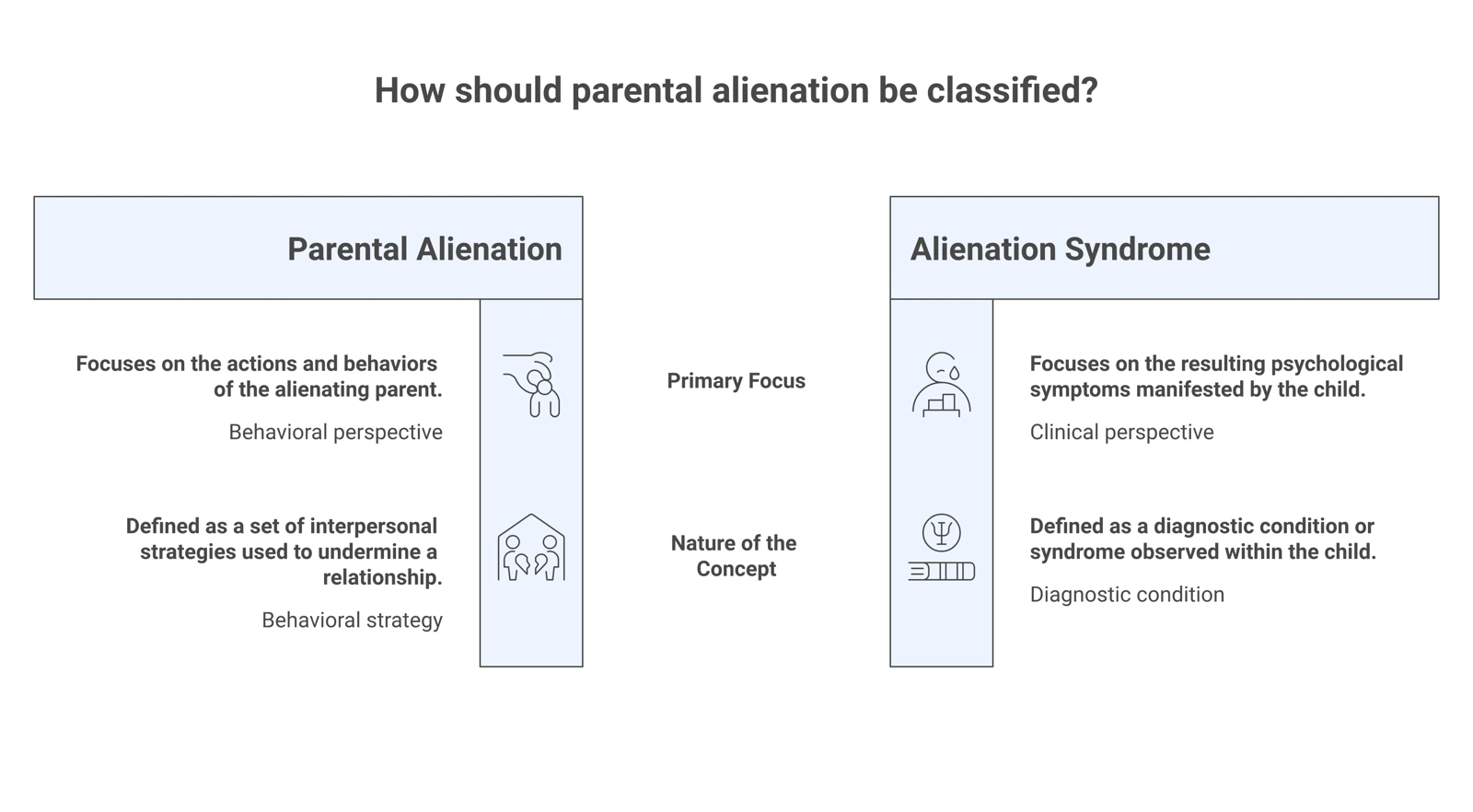
The clearest single-line distinction is this: parental alienation describes what one parent does. Parental alienation syndrome describes what shows up in the child afterward. The behaviors come first; the symptoms come second; the two are related but not interchangeable.
PAS is a symptom cluster
PAS lives in the child. It is identified by observing the child’s words, allegiance patterns, affect, and reasoning. If the eight symptoms appear together, an evaluator can name PAS. If a child is being exposed to alienating behaviors but the symptoms have not yet hardened, the older PAS-only model says the case is not PA yet. That gap is what the modern reframing aimed to close.
PA is a set of behaviors
Parental alienation in current usage names the behaviors performed by the alienating parent. These include badmouthing, interference with contact, false safety narratives, withholding cards and gifts, recruiting the child as confidant against the other parent, and the wider tactic set documented in the field (see signs for the behavioral inventory). PA is the cause. PAS, when it appears, is one possible effect. Custody evaluators trained in current practice assess both: what the parent is doing and whether the child has yet internalized it.
This distinction now anchors the most defensible modern definitions. Current mainstream usage treats parental alienation as a descriptive term for a process, the parental conduct and the child’s response to it, not a diagnostic label and not a DSM category. The process is the parental conduct. The diagnosis is something separate, and not what the construct is doing legal work to name.
Where the term came from: Gardner, 1985
Richard A. Gardner was a child psychiatrist and clinical professor at Columbia University, and a frequent expert witness in custody cases during the 1980s and 1990s. He coined “parental alienation syndrome” after noticing a recurring pattern in cases where children categorically rejected one parent. His 1985 Academy Forum paper introduced the term. His later books expanded it and attempted to differentiate PAS from genuine cases of child sexual abuse.
Gardner’s contribution was to name a real pattern that clinicians and family courts were repeatedly seeing but had no shared vocabulary for. His critics raise three substantial objections that still shape the field.
First, methodological. Gardner’s case-series basis was clinical observation, not controlled research. Independent replication came later, and the methodologically strongest current support (Baker, Harman, Bernet, Verrocchio) postdates Gardner by two decades.
Second, the sex-abuse-differentiation chapter. Critics argue Gardner’s framework was used to dismiss genuine abuse claims as PAS. Defenders argue Gardner explicitly cautioned against that misuse. Both readings exist in the literature, and the misuse risk is one of the editorial reasons this site treats the alienation-versus-estrangement distinction as a non-negotiable line.
Third, weaponization. The PAS label can be wielded as a litigation tactic. So can a counter-claim that any PA allegation is itself weaponization. Modern frameworks aim to reduce both risks by anchoring identification in observable behaviors and primary-source citations rather than syndromic shorthand.
Why the DSM-5 did not include PAS
The Diagnostic and Statistical Manual of Mental Disorders is the standard taxonomy of psychiatric diagnoses in the United States. Inclusion in the DSM means a diagnosis has been judged by the American Psychiatric Association to meet evidentiary thresholds for a discrete clinical entity. Parental alienation syndrome has never been a DSM diagnosis.
In 2010, William Bernet led a proposal to include parental alienation as a diagnosis in the upcoming DSM-5. The proposal was published in the American Journal of Family Therapy and laid out the empirical basis. The APA’s DSM-5 task force declined to include it. The DSM-5-TR, released in 2022, did not add it either.
What the DSM does include is a related concept: child psychological abuse (formerly V-code V995.51, now T74.32XA under ICD-10-CM mapping). The DSM defines child psychological abuse as “non-accidental verbal or symbolic acts by a child’s parent or caregiver that result, or have reasonable potential to result, in significant psychological harm to the child.” Exposure to alienating behaviors meets this threshold whether or not the child has yet developed the PAS symptom cluster. The modern legal and clinical reframing of PA rests on that anchor.
The DSM rejection of PAS is therefore narrower than it sounds in headlines. The APA rejected a specific proposed syndromic label. It did not reject the underlying behaviors, the harm those behaviors cause, or the existing code that already covers exposure to them.
The modern reframe: from PAS to PAB and child psychological abuse
Contemporary research treats parental alienating behaviors (PAB) as the unit of analysis. In a 2018 review in Psychological Bulletin, Jennifer Harman, Edward Kruk, and Denise A. Hines argue that PABs map onto established models of coercive control and should be framed as an unacknowledged form of family violence, not a custody-dispute artifact. A separate 2022 literature review of 213 empirical studies by Harman, Richard Warshak, Demosthenes Lorandos, and Matthew Florian in Developmental Psychology argues the research base now meets the criteria of a maturing field, a conclusion critics dispute. For the wider behavioral inventory, see signs.
A more recent framework from forensic researcher Shawn Wygant pushes the reframing further. Wygant proposes a two-question model that explicitly separates exposure from symptom development:
- Has the child been exposed to parental behaviors likely to cause harm to the child’s relationship with the other parent? If yes, parental alienation is present and the DSM-5 child psychological abuse threshold is met. A protective response is warranted.
- Has the child internalized those behaviors? If yes, parental alienation syndrome is present, and the harm has already manifested.
The model treats both as serious, but does not require the second before naming the first. Wygant and colleagues coded 1,259 of 1,452 appellate cases across all fifty states and the District of Columbia using a three-coder protocol. The headline finding for this page: courts using the PAS-symptoms model took protective action less often than courts using the PA-behaviors-plus-child-psychological-abuse model, and the older model produced roughly a 22% type-II error rate (real PA, missed by the court). These figures come from a presentation at the Parental Alienation Study Group conference in October 2025 and have not yet been published in a peer-reviewed journal; they may change on publication. The quantification appears in fuller form on parental alienation statistics.
| Parental alienation (behaviors model) | Parental alienation syndrome (symptoms model) | |
|---|---|---|
| What it describes | Acts performed by the alienating parent | Symptom cluster observed in the child |
| Where it sits in DSM-5 | Covered by the child psychological abuse code | Not a DSM diagnosis |
| Who does the action | The alienating parent | No one; it is a presentation in the child |
| What an evaluator looks at | Behaviors over time, exposure, intent | The child’s words, affect, and allegiance pattern |
The downstream effects of either framing, including the long-term mental-health and relational consequences, are covered on effects of parental alienation.
What the courts do with the term today
Family courts in the United States and Canada hear PA evidence regularly. How the term is presented in court matters. In Wygant’s coded appellate sample, presented at the Parental Alienation Study Group conference in October 2025 and not yet published in a peer-reviewed journal, courts that found PA divided into two groups: about 72% used the PAS-symptoms model (the older framing) and about 28% used the PA-behaviors-plus-child-abuse model (the modern framing). Courts in the second group took protective action in roughly 99% of found cases. Courts in the first group acted less often and sometimes declined to act because the symptoms were already so entrenched that intervention seemed futile. These figures may change on publication.
Three error patterns recur in the sample. First, “it must be PAS” courts that require the symptom cluster before acting and miss cases where exposure is established but the symptoms have not yet hardened. Second, “too alienated to protect” courts that decline to intervene because PAS is so severe the court doubts any intervention will reach the child. Third, “both parents’ fault” courts that fail to do but-for causation analysis and treat the targeted parent’s reactive distress as equivalent to the alienating parent’s underlying conduct.
For readers preparing evidence in family court, the practical implication is straightforward. Modern presentations frame the case around documented behaviors and the established child psychological abuse threshold rather than a syndrome label. The full treatment of evidence preparation lives in the court silo.
Is parental alienation syndrome real?
Yes as a pattern. No as a current DSM diagnosis. The eight symptoms Gardner identified are still observed in severe cases, but the field has moved away from treating the symptom cluster as the diagnostic threshold. Today the cleaner question is: are the parental alienating behaviors present, and are they causing harm to the child or to the child’s relationship with the other parent? When the answer is yes, the conduct meets the established child psychological abuse standard whether or not the syndrome has yet appeared.
That distinction matters for a second reason. Not every child’s rejection of a parent is parental alienation. Joan Kelly and Janet Johnston’s 2001 reformulation places alienation at one end of a continuum that also includes normal affinity for one parent, alignment in conflict, and realistic estrangement, where the rejected parent was actually abusive or frightening. Their framework keeps a bright line between alienation and abuse-driven cut-offs. So does this site.
For a parallel discussion of a contested adjacent term, see malicious parent syndrome.
Frequently asked questions
Is parental alienation syndrome real?
PAS is a real pattern documented in clinical practice for forty years, but it is not a DSM diagnosis. The American Psychiatric Association declined to include it in DSM-5 (2013) and DSM-5-TR (2022). The behaviors that cause PAS are covered by the DSM’s child psychological abuse code, which most current clinicians and researchers treat as the anchor.
Is parental alienation syndrome in the DSM-5?
No. A 2010 proposal led by William Bernet to include PAS in DSM-5 was published in the American Journal of Family Therapy and reviewed by the APA. The proposal was not adopted. The dynamic the proposal aimed to capture is addressed in the DSM through the child psychological abuse code (T74.32XA under ICD-10-CM mapping), not as PAS.
What is the difference between parental alienation and parental alienation syndrome?
Parental alienation refers to the behaviors performed by the alienating parent. Parental alienation syndrome refers to the symptom cluster that may appear in the child after exposure to those behaviors. PA describes what one parent does. PAS describes what shows up in the child.
Who created the term parental alienation syndrome?
Psychiatrist Richard A. Gardner introduced PAS in a 1985 paper in the Academy Forum and gave the framework its canonical statement in his book The Parental Alienation Syndrome (2nd ed., Creative Therapeutics, 1998).
What are the symptoms of parental alienation syndrome?
Gardner identified eight: a campaign of denigration, weak rationalizations for the rejection, lack of ambivalence, the independent thinker phenomenon, reflexive support for the favored parent, absence of guilt, borrowed scenarios, and spread of animosity to the rejected parent’s family and friends.
Where to go next
- For the broader concept and current definitions, read the Learn pillar.
- For the behaviors-side recognition guide, see signs.
- For the documented downstream consequences, see effects of parental alienation.
- For an adjacent contested term, see malicious parent syndrome.
Citations
- Gardner, R. A. (1985). Recent trends in divorce and custody litigation. Academy Forum, 29(2), 3 to 7.
- Gardner, R. A. (1998). The Parental Alienation Syndrome (2nd ed.). Creative Therapeutics.
- Bernet, W., et al. (2010). Parental alienation, DSM-V, and ICD-11. American Journal of Family Therapy, 38(2).
- American Psychiatric Association. (2022). Diagnostic and Statistical Manual of Mental Disorders, Fifth Edition, Text Revision (DSM-5-TR). psychiatry.org/dsm
- Harman, J. J., Warshak, R. A., Lorandos, D., & Florian, M. J. (2022). Developmental psychology and the scientific status of parental alienation. Developmental Psychology, 58(10), 1887 to 1911. https://doi.org/10.1037/dev0001404
- Harman, J. J., Kruk, E., & Hines, D. A. (2018). Parental alienating behaviors: An unacknowledged form of family violence. Psychological Bulletin, 144(12), 1275 to 1299. https://doi.org/10.1037/bul0000175
- Wygant, S., et al. (2025). Parental alienation child abuse model: appellate case-coding study (1,259 of 1,452 appellate cases). Presented at the Parental Alienation Study Group conference, October 2025. Unpublished conference presentation; not peer reviewed.
- Kelly, J. B., & Johnston, J. R. (2001). The alienated child: A reformulation of parental alienation syndrome. Family Court Review, 39(3), 249 to 266.
If you or your child are in crisis
Free and confidential help is available right now.
- 988 Suicide and Crisis Lifeline. Call or text 988. 988lifeline.org
- Childhelp National Child Abuse Hotline. 1-800-422-4453. childhelp.org
- NAMI HelpLine. 1-800-950-6264. nami.org/help
Last reviewed: 2026-06-05. Author: Alex Buckles (PAC Founder).