

Parental alienation in teenagers happens when one parent’s influence drives a teen to reject the other parent without a justified reason. It can look like normal teen freedom, which makes it hard to spot. Teens have real opinions and minds of their own, so the key task is telling true alienation from ordinary teenage distancing.
A note on safety
A teen’s rejection of a parent is not always alienation. Estrangement caused by genuine abuse, neglect, or danger is not parental alienation, and the two must never be conflated. A teen pulling away from a parent who has hurt them is justified estrangement. That deserves respect and protection, not a label that blames the teen. If a child’s safety is at risk, contact local law enforcement or a domestic-violence resource first.
This article offers general information, not clinical advice. It does not diagnose any child or family, and it does not replace a licensed mental-health professional. A teen in distress should be seen by a qualified clinician who knows the family.
What parental alienation in teenagers means
Parental alienation in teenagers describes a pattern where one parent’s conduct turns a teen against the other parent without a valid reason. The teen rejects a parent they once loved. The rejection is out of proportion to anything that parent actually did.
It helps to place the term in a larger picture. Estrangement is the broad word for any cut-off or strained parent-child bond. Alienation is one path into estrangement, not the only one. Psychologist Joshua Coleman names several routes a young person can take toward rejecting a parent. Some are driven by a controlling parent. Others are driven by real harm, by a teen’s own pull toward independence, or by mental-health struggles. Naming alienation correctly means ruling the other routes out first.
That distinction matters most in the teen years. A six-year-old who suddenly hates a parent raises immediate questions. A fifteen-year-old who wants space, argues more, and prefers one house can look the same whether the cause is healthy or harmful.
Why the teenage years change the picture
Teens are not small children. They reason, debate, and form views of their own. Pulling away from parents is part of normal growing up, not a symptom by itself. This is exactly why alienation is harder to read in this age group.
Research on adults who were alienated as children points to a sensitive window. Identity tends to form between roughly ages nine and fourteen. Harm during that window can shape self-esteem, mood, and later bonds for years. The teen years sit right inside that window, which raises the stakes for getting the read right.
Age also changes how alienation holds. Clinical work on enmeshed family systems notes that younger children often cannot carry a borrowed story from one home to the other. Older children can. A teen has the memory and words to sustain a rejecting story across time and place. That is one reason moderate alienation shows up more clearly in older children than in toddlers.
Parental alienation vs normal teenage autonomy
This is the hardest and most important question for any worried parent. Distancing alone is not proof of alienation. Most teens distance from both parents to some degree, and that is healthy.
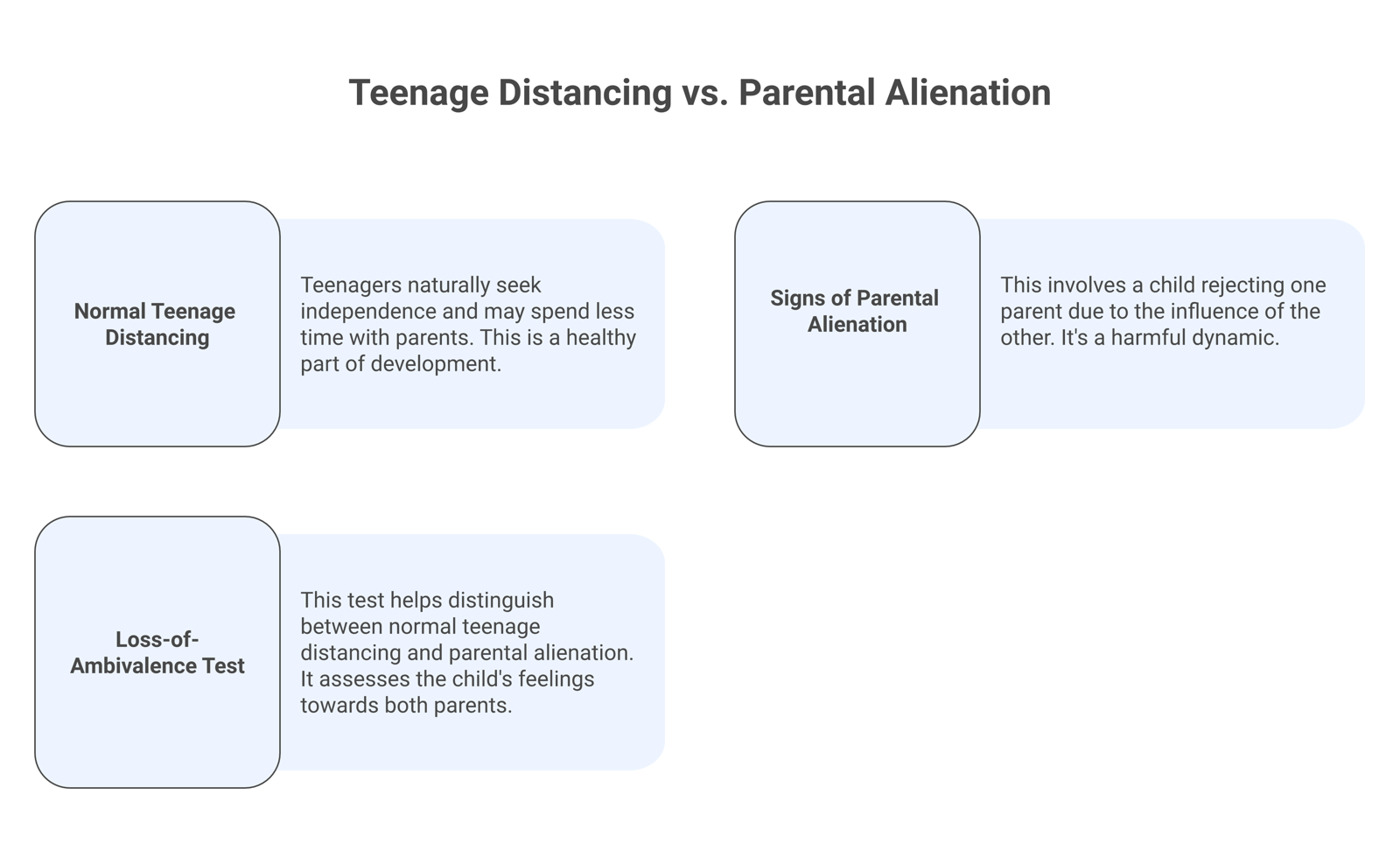
What normal teen distancing looks like
Normal growing up has a clear shape. A teen spends more time with friends and less with family. They guard their privacy and push back on rules. They may prefer one household because it sits closer to school, friends, or a job. After a divorce, a teen often picks a base for plain ease, not loyalty.
Two features stand out in healthy distancing. The teen still holds mixed feelings about both parents. The teen can give concrete, fair reasons for any preference. A complaint like “Dad’s place is far from my friends” is ordinary. It is specific, it is fair, and it does not erase the whole bond.
What tilts the picture toward alienation
Several patterns push the read toward alienation rather than ordinary growing-up. The teen rejects a parent completely, with no warmth and no nuance. Their stated reasons are vague, borrowed, or out of scale with reality. They repeat adult phrases they cannot quite explain. The hostility spreads to that parent’s whole side of the family, including grandparents and cousins who did nothing.
One more sign is telling. Children reacting to real mistreatment usually still manage the feelings of the parent who hurt them. An alienated teen often shows no guilt at all about treating a once-loved parent with cold contempt. That absence of any conflict is itself a clue.
The loss-of-ambivalence test
Of all the quick checks, one stands out for clarity. Mediator and author Bill Eddy frames it simply: “All human relationships are ambivalent and ambiguous.” Real bonds carry mixed feelings. Even children who were genuinely mistreated keep some love for the parent who hurt them. They may feel safer apart, yet the attachment stays.
So a useful test is the level of nuance. When a teen calls one parent all good and the other all bad, that flatness is the signal. There is no gray, and no fond memory anywhere. Total rejection of one parent paired with pure praise of the other is rare on its own. A teen seldom reasons into it alone. It points to influence rather than experience.
A balanced read still pauses here. Real abuse can also produce strong, justified anger. This test is a flag for closer expert review, not a verdict on its own.
When a teen’s distance is justified, not alienation
Some teenage rejection is earned, and calling it alienation would be wrong. Coleman’s taxonomy names justifiable estrangement plainly: the parent was abusive or neglectful and has not made amends. A teen who keeps distance from such a parent is protecting themselves. That is a healthy boundary, not a disorder.
Another honest route is a need for space. Sometimes a teen feels smothered by a parent and uses distance as the only available way to separate and grow. The pull here is toward selfhood, not against a villain. The fix is space and respect, not a push to force contact.
Holding these options open is what keeps the alienation label trustworthy. The term loses meaning if every teen who steps back gets called a victim of it. A careful parent, and a careful clinician, rules out real harm before reaching for the alienation explanation. For the broader pattern of behaviors a controlling parent uses, the page on signs your ex is alienating your child goes deeper.
The loyalty conflict a teenager carries
When alienation is the real driver, a loyalty conflict usually sits underneath it. Clinicians describe an unspoken loyalty contract in enmeshed families. In exchange for love and security, the child takes on one parent’s view of the other. They then repeat it on demand. The teen is not coldly lying. They are paying the price of attachment in a system that has blurred their boundaries.
This explains a puzzle many parents notice. An alienated teen can reject one parent fiercely while doing well at school, with friends, and in sports. The trouble is contained to a single bond. From the outside the favored bond can even look unusually close and loving. Psychologist Craig Childress describes a role reversal here. A struggling parent may lean on a child to steady the parent’s own emotions. It looks like devotion, yet it quietly costs the teen their own sense of self.
For the teen caught in the middle, the pressure is real. Choosing both parents can feel impossible. Rejecting one can feel like the only way to keep peace at home. None of that requires the teen to be weak or foolish. It requires only a loyalty bind that an adult set in motion.
Why teens are both harder to alienate and harder to reach
Teen agency cuts both ways. A teen’s growing independence can make them more resistant to a parent’s campaign. They can test claims, remember events, and push back on a story that does not fit. Many teens see through the pressure and refuse to take sides.
The same agency can also make alienation more stubborn once it sets in. A teen who has adopted a rejecting story can defend it with real skill. They have reasons, memories, and the will to hold the line. Lawyers and clinicians who work these cases note that the window for easy help narrows in the early-to-mid teens. The word “narrows” matters, though. It does not mean closed. Even older teens have rebuilt bonds with structured help and patience.
Time and pressure tend to work against repair. A heavy push for contact can harden a teen’s stance. Steady, low-key presence tends to do better than force. The long arc, including how these wounds can echo into adulthood, is covered in the long-term effects of parental alienation.
A realistic posture for the parent of an alienated teen
A parent who suspects alienation often wants to argue the teen out of it. That rarely works, and it can backfire. A calmer posture protects the relationship better and respects the teen’s real autonomy.
A few principles hold up well. Stay present and reachable, even when contact is cold or one-sided. Keep messages warm, short, and free of pressure. Never bad-mouth the other parent back, since that only deepens the bind the teen is already in. Keep a factual record of missed time and events, calmly and without drama, in case a court or therapist later needs it.
Expert help belongs in the picture early. A family clinician who understands alienation can tell it apart from normal teenage distancing and from justified estrangement. The order in which alienation tends to unfold is mapped in the stages of parental alienation. The wider question of whether a formal syndrome exists is handled on the parental alienation syndrome page. For practical day-to-day footing, the Learn hub and the guide on dealing with parental alienation give a fuller map. National guidance on supporting children through divorce is also available from the American Psychological Association.
Frequently asked questions
How do you tell parental alienation from normal teenage behavior?
Look at proportion and nuance. Normal teens distance from both parents and still hold mixed feelings about each. They give concrete, fair reasons for any preference. Alienation shows up as total, one-sided rejection with vague or borrowed reasons, no warmth, and no guilt. A child who can see any good in a rejected parent is showing the mixed feelings that healthy bonds keep. A licensed clinician should confirm any read.
Can a teenager be alienated from a parent?
Yes. Teens can be alienated. The rejection can last longer than in younger children, because teens have the memory and words to sustain it. Their freedom can also make them resistant to it. The key is whether the rejection fits the parent’s actual conduct. It also matters whether real abuse or neglect has been ruled out first.
Is it alienation if my teenager chooses to live with one parent?
Not by itself. Many teens pick one home for plain reasons like school, friends, or a job, and that is normal. A preference becomes a concern only when more comes with it. Watch for total rejection of the other parent, vague or scripted reasons, and hostility toward that whole side of the family. Preference alone is ordinary teen behavior.
What can the rejected parent of an alienated teen do?
Stay present without pressure, keep contact warm and low-key, and never bad-mouth the other parent. Document missed time calmly in case it is needed later. Seek a clinician who understands alienation and can separate it from normal distancing or justified estrangement. Forcing contact tends to harden a teen’s stance, while steady patience tends to leave the door open.
Sources and further reading
- American Psychological Association. Divorce and child custody. apa.org/topics/divorce-child-custody
- Harman, J. J., Kruk, E., & Hines, D. A. (2018). Parental alienating behaviors: An unacknowledged form of family violence. Psychological Bulletin, 144(12), 1275 to 1299. https://doi.org/10.1037/bul0000175
- American Academy of Child and Adolescent Psychiatry. Resources on teen mental health and family conflict. aacap.org
If you or your teen are in crisis
Free and confidential help is available right now.
- 988 Suicide and Crisis Lifeline. Call or text 988. 988lifeline.org
- Childhelp National Child Abuse Hotline. 1-800-422-4453. childhelp.org
- NAMI HelpLine. 1-800-950-6264. nami.org/help
Last reviewed: 2026-06-06. Author: Alex Buckles (PAC Founder).