

This page is general information, not legal advice. It does not create an attorney-client relationship. Anyone with a parental alienation concern should consult a licensed family-law attorney in their own jurisdiction.
What should you say to your lawyer about parental alienation? Lead with documented behaviors, not the label. Give your family-law attorney a clear, dated timeline of what the other parent did and how the child responded. Facts the court can act on matter far more than the word alienation by itself.
A note on safety
A child protecting themselves from abuse is not alienation. If there is genuine abuse, neglect, or danger, tell the lawyer plainly and prioritize safety first. Estrangement rooted in real harm is a different legal and safety matter, and a lawyer needs to hear that honestly and early.
What to tell your lawyer about parental alienation
A lawyer cannot act on a feeling. A lawyer acts on evidence. So the most useful thing a parent can bring to that first working conversation is a set of specific, documented behaviors, organized so the attorney can see the pattern fast.
This page assumes the reader already has counsel or is about to retain one. Choosing the right attorney is a separate task, covered in how to choose a parental alienation lawyer. The focus here is what to communicate once the working relationship begins.
The single biggest mistake is leading with the label. Many parents open with “the other parent is alienating our child” or “my ex is a narcissist.” Those words feel true. They also give the court almost nothing to rule on. A lawyer needs conduct, dates, and the child’s observable response, because that is what a judge can weigh.
Bring documented behaviors, not the label
Attorney Ashish Joshi, author of the American Bar Association’s practitioner text on these cases, and Judge Jon Van Allsburg describe a “behaviors not labels” standard that courts actually use. Their point is direct. “Labels don’t give us any basis on which to make a ruling. It’s the facts that give us that ability.”
What does that look like in practice? Instead of saying the other parent is alienating, a parent describes the specific strategies. A blocked phone call on a named date. A canceled exchange. A denigrating text the child was shown. A school event the parent was never told about. Joshi and Van Allsburg note that litigants who arrive with diagnostic labels but no fact pattern tend to lose, while litigants who describe concrete behaviors give the court something to act on.
So the working rule for the lawyer conversation is simple. For every concern, name the behavior, the date, and the effect on the child. Let the attorney decide whether and when the word alienation belongs in a filing.
Present a clear, factual timeline
A timeline is the spine of the conversation. It turns scattered grievances into a pattern a court can follow.
A useful timeline is short on adjectives and long on specifics. Each entry names a date, a concrete event, and where the proof lives. A denied weekend, with the text messages saved. A missed call, with the call log. A pediatric appointment the parent learned about afterward, with the email thread. The documentation craft behind this is covered in how to document parental alienation, and it pays off most when the lawyer can read the record without reconstructing it.
The timeline also protects the parent’s credibility. A calm, dated record reads very differently from an angry monologue. It signals that the parent is a reliable narrator, which is exactly the impression a contested custody matter requires.
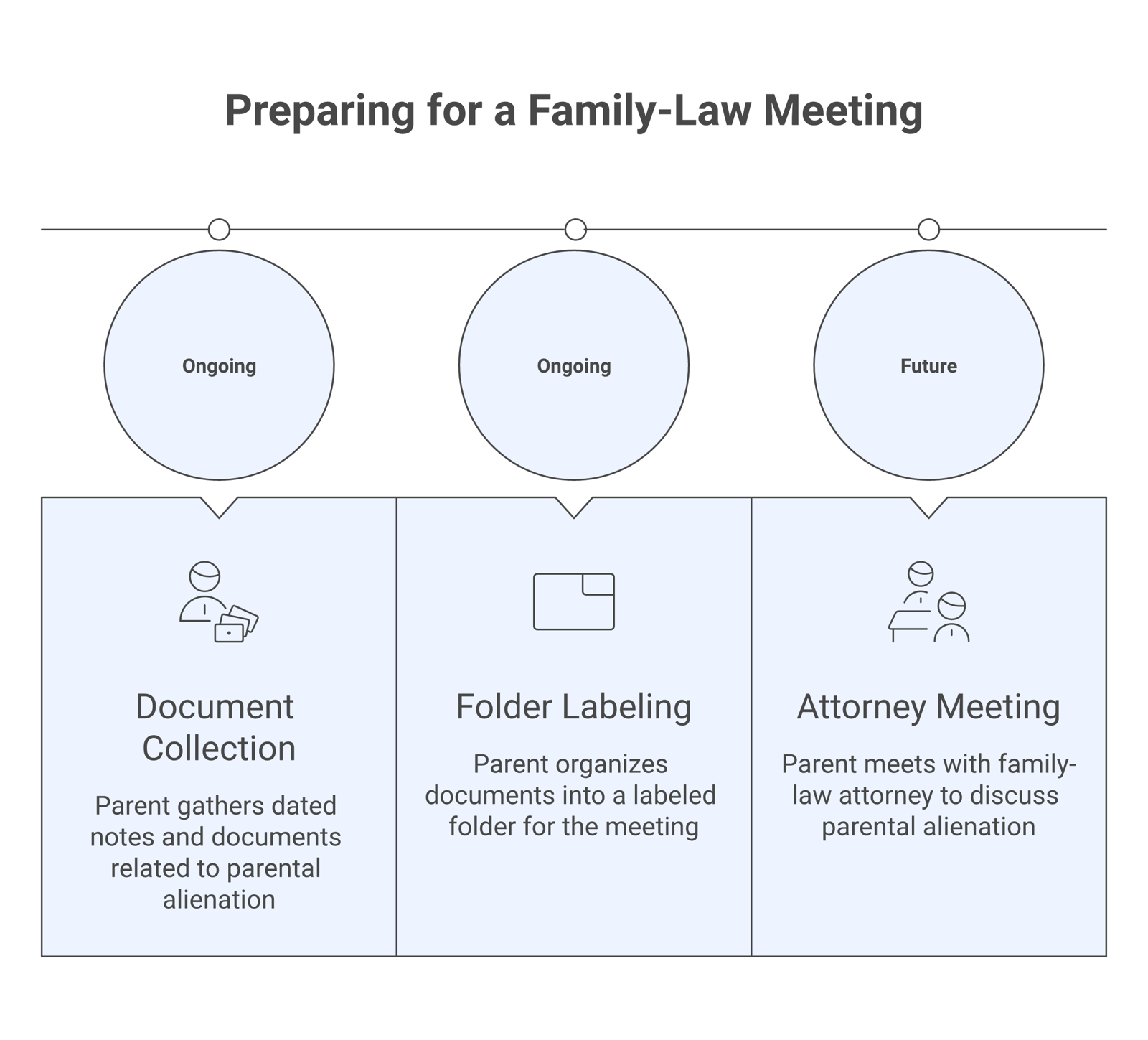
How to prepare for the conversation with your lawyer
A short preparation routine makes the meeting far more productive. The steps below help a parent walk in organized rather than overwhelmed.
- Gather the existing orders. Bring the current parenting plan, custody order, and any prior filings, so the lawyer can see what is already on the books and what may have been violated.
- Build a dated timeline. List specific incidents in order, each with a date, a one-line description, and a note of where the evidence is stored.
- Organize evidence by behavior. Group texts, emails, call logs, and school records under the behavior they show, not by emotion. The lawyer needs the pattern, not a pile.
- Write down the child’s observable changes. Note what changed and when, in plain terms. A child who once looked forward to visits now refuses, with no event to explain it.
- List the questions to ask. Prepare the questions in the next section so the meeting covers strategy, not just venting.
Questions to ask your lawyer
The conversation runs both ways. A few questions help a parent gauge whether the lawyer understands what this kind of case requires.
Do you treat this as a child-welfare issue, not just a custody fight?
Veteran litigators stress that a parental alienation case is built differently from an ordinary custody dispute. Robert Hoffman, a board-certified Texas family-law attorney who served as lead counsel in a 2016 custody trial tried on a parental alienation theory, frames it bluntly. A case like this “is a clinical, medical, scientific case,” and a lawyer who does not understand that “almost has no chance of winning.” A parent can listen for whether the attorney sees the matter as child protection and clinical evidence, or as a routine high-conflict file.
Will you use experts, and which ones?
These cases often turn on expert testimony and a carefully built clinical record. A parent can ask whether the lawyer has worked with custody evaluators, forensic psychologists, or reunification specialists, and in what role. There is no need for the parent to know the science. The point is to learn whether the lawyer has the relationships the case may need.
What does the record have to show?
A parent can ask the lawyer to explain what the case must prove. A strong answer tracks the structure that experienced practitioners use, described in the next section.
Help your lawyer prove what the case must show
Joshi lays out a three-goal framework for trying these cases, and understanding it helps a parent supply the right material. The goals are sequential. Each one builds on the one before it.
First, the case must show the court that parental alienation is a real, studied phenomenon, not a fringe theory. Second, it must show that it is happening in this specific family, using documented behaviors and the child’s response. Third, it must show that the child needs proper and timely intervention.
A parent serves all three goals by bringing organized facts. Evidence of a prior warm relationship sets a baseline. Records of the other parent’s conduct supply the pattern. Notes on the child’s changed behavior show the effect. None of this requires the parent to argue the law. It requires the parent to hand the lawyer a clean, well-sorted record so the attorney can build each goal in turn. The evidence work behind this is detailed in how to prove parental alienation, and the custody questions it feeds are covered in parental alienation and child custody.
Stay calm and child-focused
How a parent presents matters more than many expect. Hoffman describes a pattern he calls the four A’s and the four C’s. Targeted parents often present as angry, anxious, agitated, and afraid, which is understandable after a long ordeal but corrosive in a legal setting. The other parent often presents as cool, calm, charming, and convincing.
There is a related trap worth naming. When a person says only negative things about someone else, listeners start to attribute those negative traits to the speaker. So a parent who does nothing but attack the other side can end up wearing the negativity. The counter-discipline is balance. Name what is going well alongside the concerns, and acknowledge the parent’s own imperfections honestly.
For the lawyer conversation, this means passion is fine, but venting is costly. A meeting spent on raw anger burns time the lawyer needs for strategy. A meeting spent on organized facts, delivered calmly, gives the lawyer room to work and gives the parent a credible posture to carry into court.
When abuse is the real issue
A child’s resistance is not always alienation. Sometimes a child is pulling away from a parent because that parent has been harmful, and that is justifiable estrangement, not alienation. The distinction matters legally and clinically.
A parent should never overstate an alienation claim, and a parent on the receiving end of an abuse allegation should not assume it is automatically a smear. If abuse is part of the picture in any direction, the honest move is to tell the lawyer plainly. The American Psychological Association offers general guidance on divorce and child custody that underscores how central the child’s wellbeing is to these decisions. Safety comes before strategy, every time.
Frequently asked questions
What should I say to my lawyer about parental alienation?
Lead with documented behaviors, not the label. Bring a dated timeline of specific incidents, the evidence that supports each one, and notes on how the child’s behavior changed. Let the lawyer decide when and whether to use the word alienation in a filing. Facts a court can act on are far more useful than the diagnosis.
Should I tell my lawyer my ex is a narcissist?
That label is rarely the most useful thing to lead with. Courts rule on conduct, not diagnoses. Describe the specific behaviors instead, such as blocked communication, denied parenting time, or denigrating messages. A lawyer can build a case on documented strategies far more easily than on a personality label the parent cannot prove.
How do I prove parental alienation to my lawyer?
A parent does not need to prove it to the lawyer so much as supply the raw material. Bring organized evidence: texts, emails, call logs, school and medical records, and a timeline that links each behavior to a date and an effect on the child. The lawyer and any experts assess whether the pattern supports a claim.
What if I get emotional talking about it?
Strong feeling is normal and expected. The goal is not to suppress emotion but to keep the working meeting focused on facts. Bringing a written timeline and a list of questions helps a parent stay on track even on a hard day, and it preserves the lawyer’s time for strategy rather than venting.
What this page does not do
This page does not tell any reader what to file or when. It does not name any state’s statutes or guarantee any outcome. Those choices belong to a licensed attorney working with the real facts of a specific case. The full Court silo covers related topics, and the American Bar Association’s Section of Family Law publishes general consumer information on family-court process.
Sources and further reading
- Joshi, A. Litigating Parental Alienation: A Guide for Family Law Attorneys and Judges. American Bar Association, 2024.
- American Bar Association, Section of Family Law. americanbar.org/groups/family_law
- American Psychological Association. Divorce and child custody. apa.org/topics/divorce-child-custody
If you or your child are in crisis
Free and confidential help is available right now.
- 988 Suicide and Crisis Lifeline. Call or text 988. 988lifeline.org
- Childhelp National Child Abuse Hotline. 1-800-422-4453. childhelp.org/hotline
- NAMI HelpLine. 1-800-950-6264. nami.org/help
Last reviewed: 2026-06-06. Author: Alex Buckles (PAC Founder).