

Surviving parental alienation in the crisis phase is the targeted parent’s own work, not a strategy to win the child back. It means naming an ambiguous loss, treating the trauma response as normal, using anger as a signal, and rebuilding identity. The work is slow, and it is for the parent. For the longer recovery arc after the crisis stabilizes, the Recover hub picks up where this guide ends.
A note on safety
A child’s distancing from a parent is not always alienation. Where a child pulls away because of genuine abuse, neglect, or real danger from the rejected parent, that is justified estrangement, not alienation, and this page is not about that situation. This page is for parents whose loss is alienation driven. If anyone’s safety is at risk, contact local authorities or a crisis resource first.
This page is general information, not clinical advice. It does not create a professional relationship and does not address any one family’s situation. Anyone making decisions for a real case, or struggling with their own mental health, should consult a licensed clinician who knows that case.
What surviving the crisis phase really means
Surviving the crisis phase is the work a targeted parent does on themselves while the situation is raw and unresolved. It is not a plan to win the child back, and it is not the child’s reunification, which is a separate process. Survival here means grief, regulation, identity, and sustainable coping for the parent who is living through the loss.
This focus sets the page apart from two siblings. How to stop parental alienation covers halting the behavior and the practical first steps. How to reverse parental alienation covers repairing the child’s bond. The work below points inward, at the parent’s own survival across a long and uncertain arc.
No honest guide promises a fixed outcome. Recovery does not require the child to come home. It asks the parent to stay alive in their own life, steady enough to be available if and when contact returns.
Naming the loss first
This grief is what researcher Pauline Boss calls ambiguous loss: mourning a child who is still alive, with no funeral, no closure, and no social permission to grieve. The full explanation of ambiguous loss, and how to live with it, is on coping with the grief of parental alienation. One of Boss’s therapeutic goals matters most in the crisis phase: tempering mastery, which means releasing the belief that more effort alone can solve this, a belief that keeps many parents exhausted and stuck.
The trauma response is normal, not weakness
Many alienated parents quietly fear they are falling apart. Faust Ruggiero, a clinical psychologist with decades of practice, explains why their reaction is normal. Alienation rarely arrives as one catastrophic event. It comes as a long string of smaller blows: a blocked call, a returned gift, a hostile text. Over months and years, that pattern can settle into a durable trauma response.
Ruggiero describes a recognizable signature. Fear of the mail. A flinch at the text-notification sound. Hypervigilance, avoidance, broken sleep, and rumination that overrides ordinary daily function. He offers a plain self-test: when a parent keeps thinking “if I could just get my body to calm down, I could think this through,” the body is likely stuck in a trauma loop rather than simple stress.
This is not a character flaw, and it is not permanent. Ruggiero’s point is that the nervous system has failed to reset, which is a treatable condition. Naming the response as trauma, rather than weakness, opens the door to working on it. For the wider picture of how this strain affects health over time, see parental alienation trauma.
Anger is a signal, not the enemy
Anger is the emotion targeted parents report most, and many feel ashamed of it. Lawrence Joss, who founded the peer group Parental Alienation Anonymous, offers a gentler frame. In his working model, anger is a secondary emotion, a protective strategy sitting on top of a primary feeling underneath, usually fear or grief. Anger supplies energy and a sense of control when a parent feels powerless.
The problem is not the anger itself. Trouble comes from acting on it before reaching what sits underneath. Joss describes the same pattern in the child: a child who says “I hate you” or refuses the car is often projecting unmetabolized fear, exactly as the parent does. Seeing that can lower a parent’s shame and soften the way they show up.
Joss suggests a sustainable response rather than suppression. Notice the anger without performing it. Pause instead of firing off a text. Feel the fear or grief beneath the heat, then get support for that feeling from people and community, not from the child. None of this means swallowing anger or turning it inward on oneself. It means reading anger as information about a wound that needs care.
Rebuilding identity and locus of control
A targeted parent often organizes their whole inner life around the case. Andrew Folkler, a formerly alienated child who now coaches alienated parents, calls this an external locus of control: the belief that nothing will be okay until the judge rules, the ex relents, or the child returns. That stance leaves a parent powerless, waiting on people who will not move on cue.
Folkler’s reframe is a shift toward an internal locus of control. The productive question becomes “how do I learn and grow in my own life,” not “when will they change.” He draws on Viktor Frankl’s account of four stages people move through under prolonged trauma: shock, apathy, anger, and finally meaning. The aim is not to skip the hard stages. The aim is to reach meaning, becoming the steadiest version of oneself regardless of outcome.
This connects back to Boss’s goal of reconstructing identity. Alienation blocks the parenting role, so a parent has to rebuild a self that exists apart from it. That work is painful, and it is not a betrayal of the child. A parent with a life worth living has more to offer, not less, if reconnection ever comes.
The recovery quadrant: a daily structure
Recovery holds together better with a structure than with willpower alone. Ruggiero offers a four-domain frame, and Lawrence Joss turns it into daily practice for parents who are not sitting in a therapist’s office. Together they describe a balanced approach across four areas, rather than an attempt to fix the family situation in isolation.
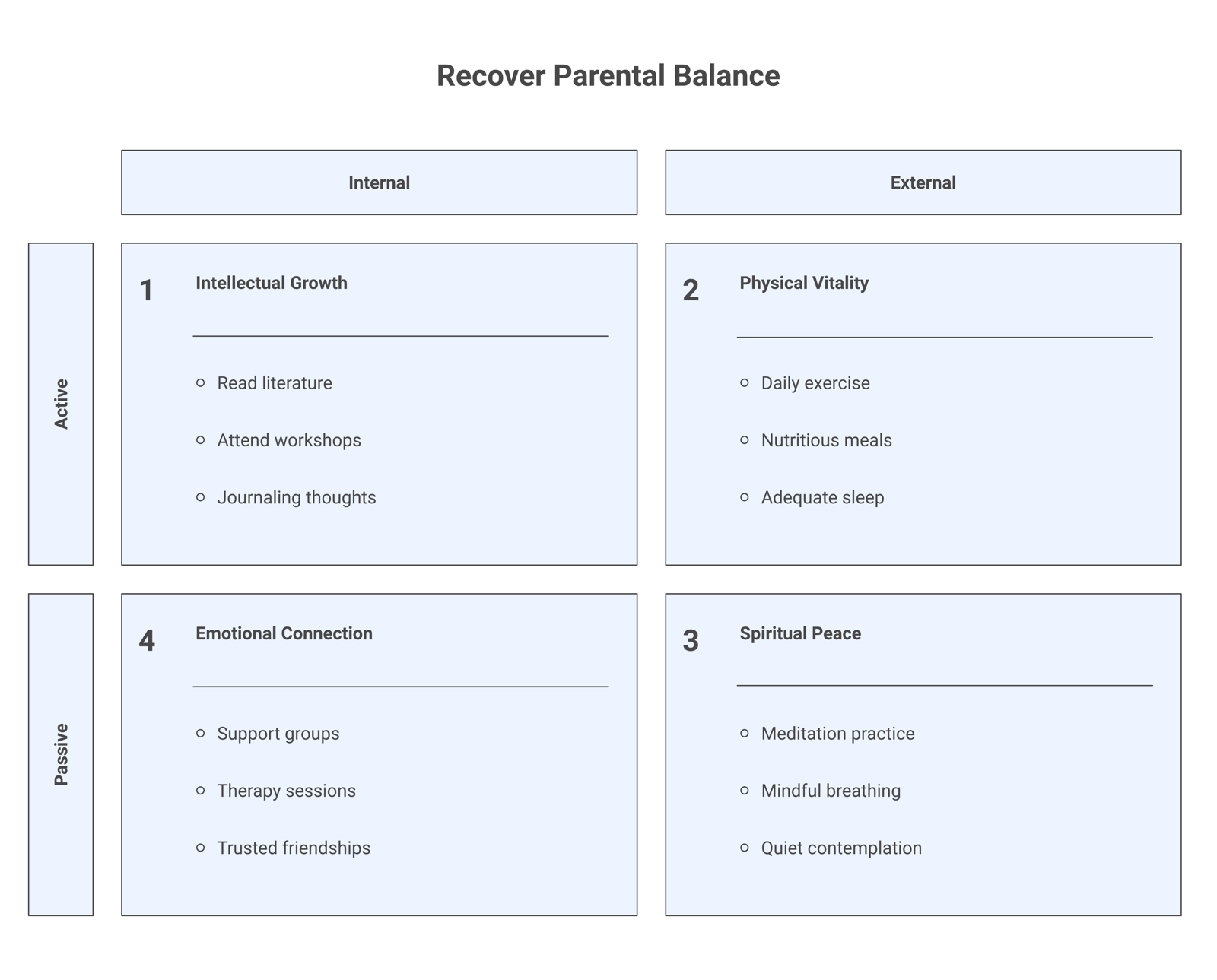
The four domains are physical, intellectual, emotional, and spiritual. Physical care means sleep, nutrition, movement, and easing off the caffeine and substances that worsen the spin. Intellectual care means training fact-based thinking, gathering facts before reacting to the fear of those facts. Emotional care means letting feeling follow the facts rather than leapfrogging them. Spiritual care means grounding in whatever form fits, whether faith, meditation, or a peer program.
Joss adds four operating principles for living it out. Recovery is for the parent, not for the child. A community of imperfect peers is the substrate that makes it stick. Capacity is finite, so saying no during hard stretches counts as recovery, not failure. And showing up for one’s own life comes first. As Joss frames it, relationships with children sit downstream of being genuinely alive in one’s own life.
Community and peer support: isolation is a symptom
Isolation is one of the cruelest features of alienation, and Joss makes a sharp observation about it. Isolation is both a symptom of alienation and a force that keeps it going. A parent who withdraws loses the very mirror that could show them a healthier way to respond, so the old patterns repeat unchecked.
Recovery, in this model, cannot begin by controlling the outside situation. It begins by re-entering a safe community: a peer group, a support group, or a faith community that offers what Joss calls healthy mirroring. Hearing from others that a large part of this was not the parent’s fault, and also not the child’s fault, can lift a self-blame burden carried for years.
Peer support is not a substitute for clinical care, and parents in acute distress should seek a licensed professional. For treatment options, see parental alienation therapy. For relationship support alongside any plan, see co-parenting counseling.
Staying functional for the long arc
These cases do not resolve on a schedule, so recovery has to be sustainable. The goal is not a heroic sprint that ends in collapse. It is a steady pace a parent can hold for years: protecting sleep, keeping one or two supportive people close, and treating health and regulation as assets the alienation cannot touch. General guidance on the stress of divorce and custody is available from the American Psychological Association.
Honest hope is part of that pace. Boss frames hope as something to keep realistic, so it sustains a parent rather than corroding them. A parent does not control whether or when a child returns. A parent does control how they live in the meantime, and that life is worth building for its own sake. For the practical steps against the alienation itself, see how to stop parental alienation, and for the full library, start at the Help pillar.
Research underscores how serious the underlying harm is. Jennifer Harman and colleagues, writing in Psychological Bulletin, describe alienating behaviors as a form of coercive control and family violence. Naming the harm accurately is not self-pity. It is the ground on which sustainable recovery stands.
Frequently asked questions
What does recovering from parental alienation mean for the targeted parent?
It means the parent’s own healing work: grieving the loss, calming the trauma response, rebuilding identity, and finding sustainable coping while the situation is unresolved. It is distinct from reunification, which is the child’s repair process. Recovery does not require the child to return. It focuses on keeping the parent steady, healthy, and available across a long and uncertain arc.
Is it normal to feel traumatized by parental alienation?
Yes. Clinical psychologist Faust Ruggiero notes that alienation often arrives as a long string of smaller blows rather than one event, and that pattern can settle into a trauma response. Common signs include hypervigilance, broken sleep, avoidance, and rumination. This is a normal reaction to chronic stress, not a weakness, and it can improve with support and treatment.
How does a parent cope with the anger of being alienated?
Lawrence Joss frames anger as a signal rather than the enemy: a protective emotion sitting on top of fear or grief. The aim is not to suppress it or turn it inward. It is to pause before acting, notice the feeling underneath, and get support for that feeling from people and community rather than from the child.
Can a parent recover if the child never comes back?
Yes, though it is hard and the grief is real. Pauline Boss’s work on ambiguous loss describes building a meaningful life even when a loss has no closure. Recovery is measured by the parent’s own steadiness and wellbeing, not by the child’s return. Keeping hope realistic, rather than abandoning it, is what lets hope sustain a parent over time.
Where should a parent start?
Start by naming the loss and breaking the isolation. Many parents find that a safe peer or support community, paired with professional help where needed, is the turning point. From there, a simple daily structure across physical, emotional, intellectual, and spiritual care gives recovery something solid to stand on.
Where to go next
- For the broader Help library, start at the Help pillar.
- For the longer recovery arc after the crisis stabilizes, start at the Recover hub.
- For halting the behavior and the practical first steps, see how to stop parental alienation.
- For repairing the child’s bond, see how to reverse parental alienation.
- For the full treatment of the grief itself, see coping with the grief of parental alienation.
- For treatment options, see parental alienation therapy.
- For relationship support alongside any plan, see co-parenting counseling.
- For how this strain affects health, see parental alienation trauma.
Sources and further reading
- Boss, P. Ambiguous loss theory. No closure, no ritual, and six sequenced therapeutic goals. Applied to parental alienation by Kelley Baker, Ph.D., LPC, Parental Alienation Study Group.
- Ruggiero, F. Trauma-to-PTSD pathway for alienated parents and the four-domain recovery frame (physical, intellectual, emotional, spiritual).
- Joss, L. Parental Alienation Anonymous. Recovery quadrant and four operating principles; community-as-catalyst recovery model; anger as a secondary emotion.
- Folkler, A. Internal locus of control and Viktor Frankl’s four trauma stages applied to alienated parents.
- Harman, J. J., Kruk, E., & Hines, D. A. (2018). Parental alienating behaviors: An unacknowledged form of family violence. Psychological Bulletin, 144(12), 1275 to 1299. https://doi.org/10.1037/bul0000175
- American Psychological Association. (n.d.). Divorce and child custody. apa.org/topics/divorce-child-custody
If you or your child are in crisis
Free and confidential help is available right now.
- 988 Suicide and Crisis Lifeline. Call or text 988. 988lifeline.org
- Childhelp National Child Abuse Hotline. 1-800-422-4453. childhelp.org
- NAMI HelpLine. 1-800-950-6264. nami.org/help
Last reviewed: 2026-06-10. Author: Alex Buckles, Founder.