

How to reverse parental alienation starts with a hard truth: there is no fast fix and no guaranteed reunion. Repair begins only after the child is protected from the coercive dynamic. From there, the targeted parent stays available, validates the child, and lets trained help guide a slow, patient process.
A note on safety
A child’s rejection of a parent is not always alienation. If the rejected parent has been abusive, neglectful, or genuinely dangerous, the child’s distancing is justified estrangement, not parental alienation. In that case “reversal” is not the goal, and forcing reunion can re-traumatize the child. Safety comes first, always. If a child is in danger, contact local authorities or a crisis resource before anything else.
This page is general information, not clinical or legal advice. It does not create a professional relationship and does not address any one family’s facts. Anyone making decisions for a real case should consult a licensed clinician or attorney who knows that case.
What reversing parental alienation really means
Reversing parental alienation does not mean winning the child back in a single dramatic moment. It means slowly repairing a bond that another adult has worked to break. The work is closer to healing from an injury than flipping a switch. Some bonds heal in months. Others take years. Some do not fully recover, and an honest guide says so.
This page is about repair after alienation has taken hold. That is a different task from halting the behavior itself and from the first-steps survival work, both of which are covered in how to stop parental alienation. Reversal sits downstream. A parent usually needs to stop the harm and steady themselves before any repair can hold.
One idea shapes everything below. A relationship cannot be rebuilt while it is still being torn down. That is why the first move is not outreach. The first move is protection.
You cannot repair what is still being broken
Clinicians who work these cases agree on the sequence. Linda Gottlieb, a licensed family therapist, frames it as protection first and reunification second. Once a court or clinician confirms that a child is being turned against a safe parent, the primary job is to protect the child from continued exposure. Rebuilding the bond is the secondary goal. It cannot proceed safely while the coercion runs unchecked.
The reasoning is structural, not punitive. A child who returns each week to a parent shaping them against the other parent arrives carrying a fresh load of the absorbed story. No single visit can override what the home reinstalls every day. Craig Childress, a clinical psychologist, puts the rule in a sharp image. A child cannot be fixed in the middle of a battlefield and called healed. The battlefield has to be mapped and quieted first.
This is why “reversal” is not a thing the targeted parent does alone through clever messages. The coercive dynamic has to be interrupted, often through court-ordered structure or protective separation, before therapy or outreach can take root. Research by Jennifer Harman and colleagues, published in Psychological Bulletin, maps alienating behaviors onto coercive control and treats them as a form of family violence. If the behavior is a form of abuse, then shielding the child comes first, exactly as it would with any other harm.
The targeted parent’s own posture comes next
Once protection is in motion, the largest variable a parent controls is themselves. Two clinical frameworks point the same direction here.
Documentary maker and reunification coach Ginger Gentile describes a child’s bond as tied to safety. A child reads which parent feels steady and which feels lost. A parent who presents as frantic, bitter, or consumed by the fight is hard to move toward. So the parent’s own regulation is not a side project. It is a precondition of any later reunion.
Psychologist Sue Cornbluth names the relational habits that do the work: listening, acknowledging, validating, and compassion. She reports never reuniting a family without all four. The core rule is perception over argument. The child’s view, even when it is factually wrong, is the only thing worth working with. Fighting the perception extends the silence. Validating the child’s felt experience, without conceding false abuse claims, keeps the door open. Outreach should lead with acknowledgment of the child’s pain, not with “I love you and miss you,” which the child already knows.
Five mistakes that make repair harder
Targeted parents under this much stress tend to make the same self-defeating moves. Randy Flood, a clinician who treats these families, names five. He calls them mistakes in quotation marks, because they are predictable reactions, not character flaws. Knowing them in advance protects the repair.
- Personalizing the rejection. A parent treats a teenager’s hatred as a verdict on their worth. The rejection is survival behavior under pressure, not a true judgment. Taking it personally multiplies the parent’s anger.
- Escalating discipline. Alienated children look defiant, so a parent reaches for lectures and consequences. These children need understanding, not crackdowns. Harsh responses get repackaged as proof the parent is unfit.
- Enlisting others to lecture the child. Recruiting grandparents, friends, or coaches to correct the child spreads the conflict and pushes the child deeper into the alienating parent’s camp.
- Retaliating against the other parent. Snarky texts, public venting, and blowups feel good and do harm. They are harvested as evidence against the targeted parent.
- Showing up to professionals as angry. Because alienation is counterintuitive, an angry parent confirms a clinician’s bias that the parent caused the rift. The goal is to appear, in Flood’s words, madly in love with the child, not mad.
Advocacy is not the same as recovery
Many parents stall because they confuse two different kinds of effort. Advocacy names the wound: it validates the pain, builds community, and says you are not crazy. Recovery closes the wound: it does the slow relational work in the family system. A parent can consume every video, name every tactic, and find a supportive group while nothing in the actual family changes. Information is not intervention, and reversal lives in the recovery stage. The fuller version of this distinction, and the failure mode of staying in advocacy too long, is unpacked on how to stop parental alienation.
How to reverse parental alienation step by step
This staged approach is a structure, not a promise. Outcomes vary widely, and no step guarantees a reunion. Used in order, these stages give the bond the best honest chance.
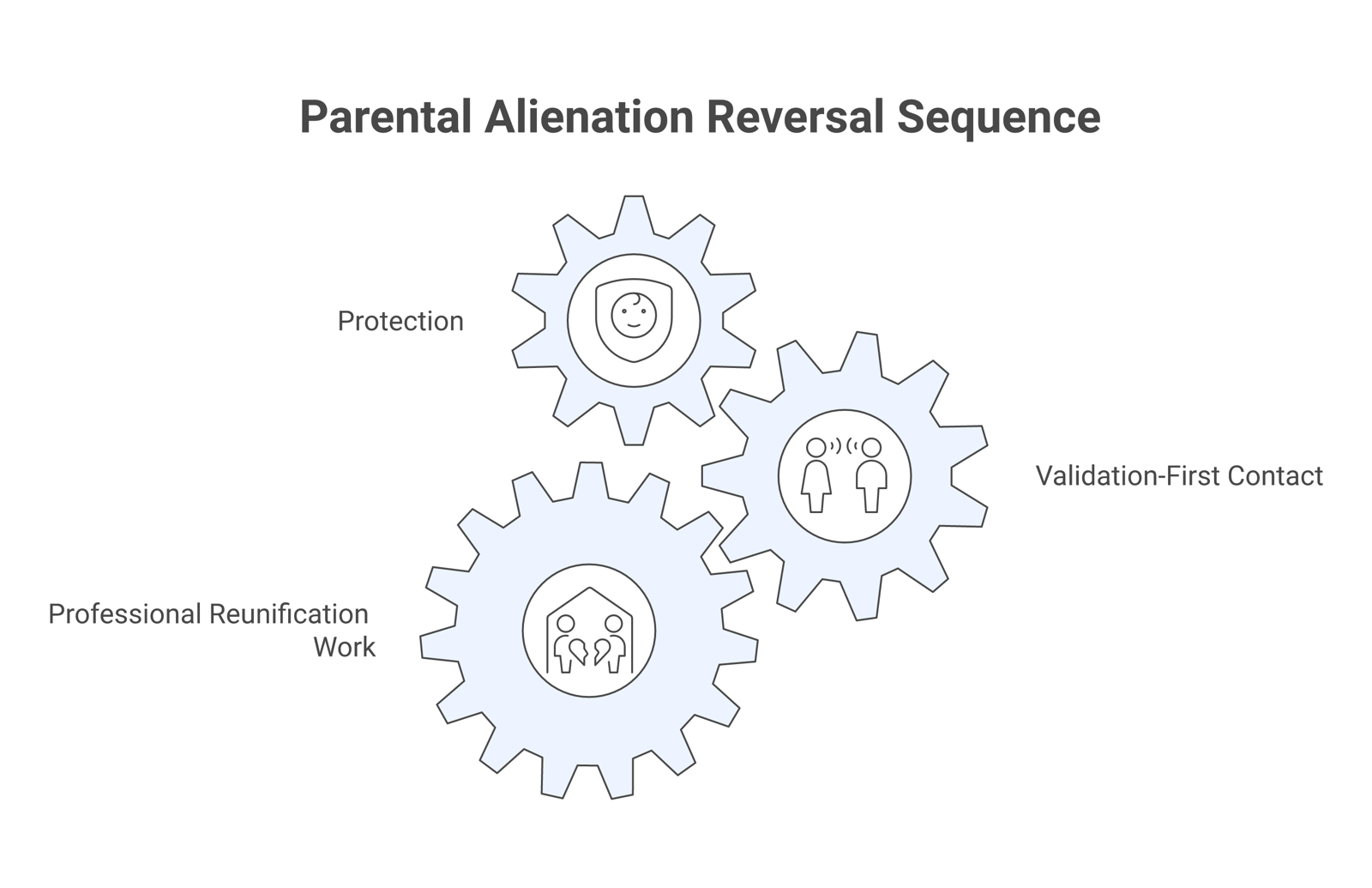
The first three stages are shared with every targeted parent’s playbook, and the full treatment of each lives on how to stop parental alienation: protect the child from the coercive dynamic (repair cannot hold while the behavior continues), stabilize your own baseline (a regulated parent is the one a child can move toward), and stay available with steady, validation-first contact. This page does not repeat that material. What follows is the part specific to reversal.
- Confirm it is alienation, not justified estrangement. Before any repair, rule out genuine abuse or neglect as the cause of the rejection. If the child’s fear is grounded, reunion is not the goal and safety leads. A trained clinician can help distinguish the two.
- Work the shared foundation. Protection, parent stabilization, and low-pressure contact, per the how to stop parental alienation sequence.
- Bring in trained professional help. A clinician who understands alienation can guide reunification work and assessment. The options are mapped in parental alienation therapy, and joint-relationship support is covered in co-parenting counseling.
- Hold a process-over-destination posture. Keep showing up without demanding a timeline. Consistency, not intensity, is the signal that survives the silence.
Where professional reunification work fits
Repair often needs more than a steady parent. Structured reunification programs and trained clinicians do the part a parent cannot do alone. They assess whether a case meets the threshold for child psychological abuse, they hold the child accountable in the room, and they work grievances one at a time rather than rehearsing them.
A trained clinician differs sharply from a kind generalist. A generalist often sides with the child’s stated wishes because siding feels caring, which locks the rejection in place. The strongest programs also follow the protection-first rule, pairing the work with a defined window away from the alienating influence. The full map of modalities, and how to vet a clinician, lives in parental alienation therapy.
Honest hope about outcomes
Hope here has to be truthful. Faust Ruggiero, a clinical psychologist, frames recovery as a process, not a destination. The parent does not control either person’s arrival, only their own daily behavior. So the productive question is not “when will my child come back,” but “what process will I use while I wait.”
Reunion timelines vary enormously. Cornbluth describes a mother who texted her son a kind note every Friday for two and a half years with no reply, until one Friday he wrote back. Other parents reconnect sooner. Some never fully do. None of this is a measure of the parent’s worth. As Ruggiero tells survivors, what happened to you is not who you are. The work is to stay steady, stay available, and let the slow process do what force cannot. For the wider arc of how cases move, see the stages of parental alienation, and for the broader library, start at the Help pillar.
Frequently asked questions
Can parental alienation be reversed?
Sometimes, under the right conditions, though not always and rarely fast. Reversal is most possible when the child is first protected from the coercive dynamic, the targeted parent stays regulated and available, and a clinician trained in alienation guides the work. Outcomes vary widely. Some bonds heal in months, some take years, and some do not fully recover. An honest approach holds hope without promising a result no one can guarantee.
How long does it take to reverse parental alienation?
There is no fixed timeline. Some children reconnect within months once protection and validation-first contact are in place. Others take years of steady, low-pressure outreach before they respond. The variable a parent controls is consistency, not speed. Clinicians describe the work as a process rather than a destination, which means the goal is to keep showing up rather than to hit a deadline.
What is the first step to reverse parental alienation?
The first step is to confirm the rejection is alienation, not justified estrangement caused by real abuse or neglect. If the child’s fear is grounded, reunion is not the goal and safety leads. Once alienation is confirmed, the next step is protection: interrupting the coercive dynamic so repair can hold. Outreach and therapy come after the child is shielded from continued exposure, not before.
Can a targeted parent reverse alienation alone?
Usually not entirely. A parent controls their own regulation, their validation-first contact, and the mistakes they avoid, all of which matter. The coercive dynamic, though, often needs outside structure to interrupt, and reunification work usually needs a trained clinician. Repair is most durable when the parent’s steady posture is paired with protection and professional help, rather than carried on willpower and messages alone.
Where to go next
- For the broader Help library, start at the Help pillar.
- To halt the behavior itself and for the first survival steps, see how to stop parental alienation.
- For treatment options, see parental alienation therapy.
- For the relationship work alongside any plan, see co-parenting counseling.
- For the wider arc of a case, see the stages of parental alienation.
Sources and further reading
- Gottlieb, L. Turning Points for Families. Protection-first, reunification-second treatment sequence; trauma-informed therapy requirement.
- Childress, C. A. (2015). Foundations: An Attachment-Based Model of Parental Alienation. Oaksong Press. Protection-first doctrine and the battlefield metaphor.
- Cornbluth, S. Validation-first reconnection framework: listening, acknowledging, validating, compassion; consistency over frequency.
- Gentile, G. Reversing Parental Alienation Coaching. Erasing Family documentary. A child’s bond tracks the steadier parent.
- Flood, R. Five common mistakes of rejected and targeted parents.
- Ruggiero, F. Process-over-destination recovery model for targeted parents.
- Harman, J. J., Kruk, E., & Hines, D. A. (2018). Parental alienating behaviors: An unacknowledged form of family violence. Psychological Bulletin, 144(12), 1275 to 1299. https://doi.org/10.1037/bul0000175
- American Psychological Association. Divorce and child custody. apa.org/topics/divorce-child-custody
If you or your child are in crisis
Free and confidential help is available right now.
- 988 Suicide and Crisis Lifeline. Call or text 988. 988lifeline.org
- Childhelp National Child Abuse Hotline. 1-800-422-4453. childhelp.org
- NAMI HelpLine. 1-800-950-6264. nami.org/help
Last reviewed: 2026-06-06. Author: Alex Buckles, Founder.