

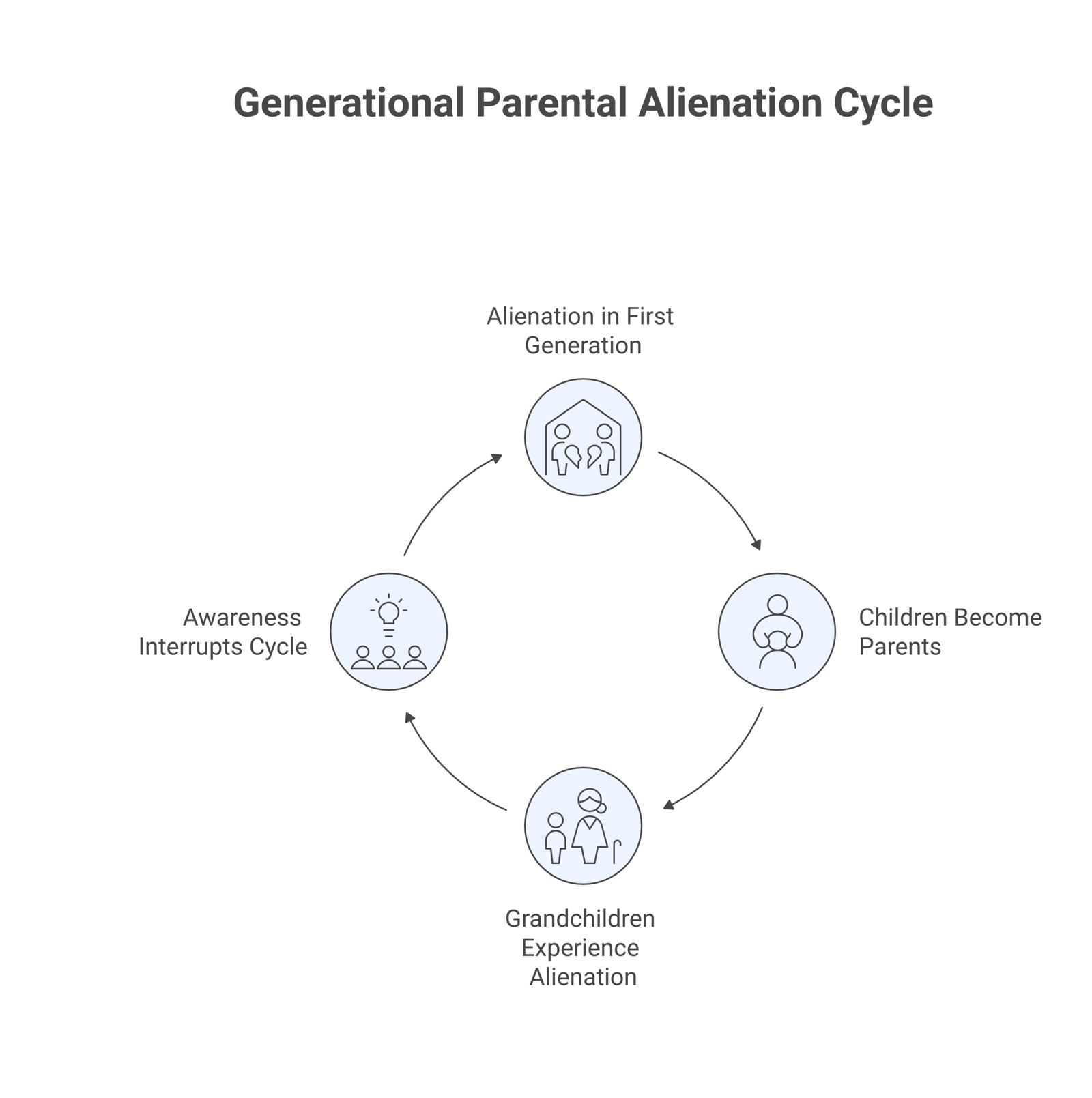
Intergenerational parental alienation is the risk that a child taught to reject one parent carries the same relational patterns into their own family. The cycle is not destiny. It can echo across three generations, yet awareness, repair, and trauma-informed care can interrupt it. This page explains how the pattern forms and what helps.
A note before reading
A child’s rejection of a parent is not always alienation. If the rejected parent was genuinely abusive, neglectful, or dangerous, the child’s distancing is justifiable estrangement, and a family memory that warns later generations away from a harmful relative is protective, not a cycle to break. This page is about engineered alienation patterns, not protective family memory. That line is non-negotiable.
General information, not clinical advice. This page is educational. It does not diagnose any family and does not replace care from a licensed clinician who knows the specific situation.
What intergenerational parental alienation means
Intergenerational parental alienation describes how the alienation pattern can repeat across a family line. One generation pushes a child to reject the other parent. That child grows up. Years later, the same templates can surface in how the adult treats their own co-parent and children.
This page is about transmission, not adult symptoms. For the documented adult outcomes themselves, such as depression, anxiety, and complex trauma, see long-term effects of parental alienation. Here the focus is the trans-generational thread, meaning how the harm can move forward in time.
The clinical literature treats this transmission as real. Dr. Venita Mehta’s model of adult outcomes lists intergenerational trauma among the ways childhood alienation can reach into a survivor’s own marriages and parenting. The reason is not mystery. A child learns relationships from the home they grow up in, and an alienating home teaches distorted lessons.
There is a second layer. Karen Woodall, a therapist who works with these families, frames alienation as inherited trauma re-enactment. Many alienating parents were themselves alienated or hurt as children. Her guiding question is direct: “whose trauma story are we listening to?” The pattern in front of a clinician today may be the echo of a wound from a generation ago.
How the cycle passes from parent to child
A child raised inside alienation absorbs more than a grudge. They absorb a way of relating. Several learned templates can carry forward.
Loyalty becomes conditional. The child learns that love is earned by rejecting someone, not by staying connected. Closeness becomes enmeshment. Woodall’s lens looks for mirrored enmeshment and idealization running up the generations, transmitted through attachment rather than through words alone. A parent and child can become so fused that the child has no separate self to bring to their own future family.
The damage runs deep because alienation corrupts a child’s grip on reality. Researchers Jennifer Harman, Amy Baker, and Mandy Matthewson describe a chain they call corruption of reality leading to a cascade of losses. The child is taught that a loving parent never loved them or was unsafe. Over time the child distrusts their own memories and feelings. That loss of self, left unhealed, can shape how they later parent.
Dr. Mehta’s model names specific carry-forward effects. Adult survivors sometimes re-create the alienating dynamic by choosing partners who resemble the alienator. Many were parentified as children, pulled into an adult confidant role, so they never built an independent identity. Some reach adulthood without a working model of a healthy, lasting relationship. None of these effects is automatic, but each raises the odds that old patterns repeat.
Personality dynamics can feed the cycle too. When a parent splits the world into all-good and all-bad, a child can absorb the same rigid view. The connection between alienation and these traits is explored in parental alienation and narcissism. The trauma side of the same story, including how it lodges in the body and the nervous system, is covered in parental alienation trauma.
The grandparent dimension
Alienation rarely stops at two people. It also severs the bond between grandparents and grandchildren, and it can travel in two directions at once.
Dr. Edward Kruk calls this a double whammy. An alienated child can grow up to alienate their own children from a parent. The same adult can also keep their own parents away from the grandchildren. So one alienated child can produce alienation that runs both downward and upward through the family. Grandparents who were once alienated from their adult child may never meet the next generation at all.
The grief that follows is layered. Dr. Mandy Matthewson studied alienated grandparents and described a multi-layered loss. Grandparents grieve their own lost role. They grieve on behalf of the grandchild who loses a relationship and a family history. They grieve on behalf of the targeted parent, who is often their own adult child. The specific losses are concrete. Family stories, traditions, and knowledge can die with a grandparent who is never allowed to pass them on.
Naming this dimension matters because it shows the true reach of the harm. The behaviors grandparents report, such as blocked contact, returned gifts, and false allegations, mirror what targeted parents face. Multigenerational repair, including family-aware mediation where it is safe, can address the bond at more than one level at the same time.
Why the cycle is a risk, not a certainty
It would be wrong to read all of this as a sentence handed down at birth. Transmission is a risk, not a guarantee. Many people raised inside alienation grow into warm, steady parents who break the pattern on purpose.
The clinical frameworks support that hope. Woodall describes a recovery path in which adult survivors, with support, can re-develop from the point where the original family split occurred. A healthy relationship can help re-parent them toward security. The work is real and sometimes slow, but it is possible.
Awareness is the hinge. Once a survivor recognizes what happened as alienation, the pattern loses much of its hidden power. The same is true for a parent who notices old scripts surfacing in their own home and chooses a different response. Mainstream guidance from the American Psychological Association stresses that how adults handle separation shapes children’s adjustment, which means changed adult behavior can change a child’s path.
What helps break the cycle
Breaking an intergenerational pattern is less about a single decision and more about a set of supported habits. A few approaches recur across the literature.
Name it accurately. Survivors and families often heal faster once the experience is correctly identified as alienation rather than personal failure. Researchers Jennifer Harman, Edward Kruk, and Denise Hines argue in a widely cited review that parental alienating behaviors match the pattern of coercive control and amount to a form of family violence. That framing moves blame off the child and the targeted parent.
Seek trauma-informed care. Dr. Mehta’s model and Woodall’s recovery lens both point to therapy with a clinician who understands alienation specifically, not generic counseling. The aim is to process the original wound so it is not handed on.
Build secure relationships. A bond with a caring, protective person gives a survivor a safe place to feel what happened and to learn what steady love looks like. That experience becomes a template they can offer their own children.
Repair across generations. Where it is safe, rebuilding grandparent and grandchild bonds and using family-aware mediation can mend the line at more than one point. For a practical, step-by-step view of personal recovery, see recovering from parental alienation.
None of these guarantees an outcome. Together they tilt the odds toward a different ending, which is the honest promise the evidence supports.
Frequently asked questions
What is intergenerational parental alienation?
It is the risk that the alienation pattern repeats across a family line. A child raised to reject one parent can carry distorted relational templates, such as conditional loyalty and enmeshment, into their own parenting. Clinicians including Dr. Venita Mehta and Karen Woodall describe this transmission, while stressing it is a risk rather than a fixed outcome.
Is the cycle of parental alienation inevitable?
No. Transmission is documented as a risk, not a certainty. Many people raised inside alienation become steady parents who break the pattern. Woodall describes a recovery path in which survivors can re-develop toward security with support, and awareness of the pattern is itself a turning point.
How does parental alienation affect grandparents?
Dr. Edward Kruk describes a double whammy in which an alienated child can alienate both their own children and their parents from the grandchildren. Dr. Mandy Matthewson found that alienated grandparents carry a multi-layered grief, mourning their own role, the grandchild’s loss, and the loss felt by their adult child.
Can the cycle of parental alienation be broken?
Yes, though never with a guarantee. Naming the experience accurately, seeking trauma-informed therapy that understands alienation, building secure relationships, and repairing bonds across generations can interrupt the pattern. The consistent message across the research is that change in adult behavior can change a child’s trajectory.
Where to go next
- For the broader concept and current definitions, read the Learn pillar.
- For the documented adult outcomes, see long-term effects of parental alienation.
- For how the harm lodges as trauma, see parental alienation trauma.
- For the personality dynamics involved, see parental alienation and narcissism.
- For a recovery road map, see recovering from parental alienation.
Sources and further reading
- Mehta, V. (2024). The lasting impact of parental alienation on adult children. Psychology Today.
- Woodall, K. (2025). Parental alienation as a trans-generational trauma (conference talk).
- Harman, J. J., Baker, A. J. L., & Matthewson, M. (2020). Corruption of reality and the cascade of losses in parental alienation (clinical presentation).
- Matthewson, M. (University of Tasmania). Multi-layered grief in alienated grandparents (qualitative study, n=12, ages 62 to 74).
- Kruk, E. The intergenerational transmission of alienation to grandparents. Video interview (YouTube).
- Harman, J. J., Kruk, E., & Hines, D. A. (2018). Parental alienating behaviors: An unacknowledged form of family violence. Psychological Bulletin, 144(12), 1275 to 1299. https://doi.org/10.1037/bul0000175
- American Psychological Association. (n.d.). Divorce and child custody. apa.org/topics/divorce-child-custody
If you or your child are in crisis
Free and confidential help is available right now.
- 988 Suicide and Crisis Lifeline. Call or text 988. 988lifeline.org
- Childhelp National Child Abuse Hotline. 1-800-422-4453. childhelp.org
- NAMI HelpLine. 1-800-950-6264. nami.org/help
Last reviewed: 2026-06-07. Author: Alex Buckles (PAC Founder).