
Is parental alienation real? The honest answer is layered. To many clinicians and researchers, it names a real pattern in which a child rejects a parent without good cause. To a vocal group of critics, it is a contested construct open to misuse. It is not a formal standalone diagnosis.
A note on safety
A child’s rejection of a parent is not always alienation. When a parent has been abusive, neglectful, or frightening, a child’s distancing can be a healthy, protective response called estrangement, and it must never be relabeled as alienation. Researchers and advocates also warn that alienation claims are sometimes misused to discredit a parent who is reporting real abuse. That concern is documented and serious. If a child’s safety is at risk, contact local law enforcement or a domestic-violence resource first.
This page offers general information for education only. It is not clinical, diagnostic, or legal advice, and it does not create a professional relationship. Anyone facing a custody dispute or a mental-health concern should consult a licensed professional in their own area.
Is parental alienation real? The short answer
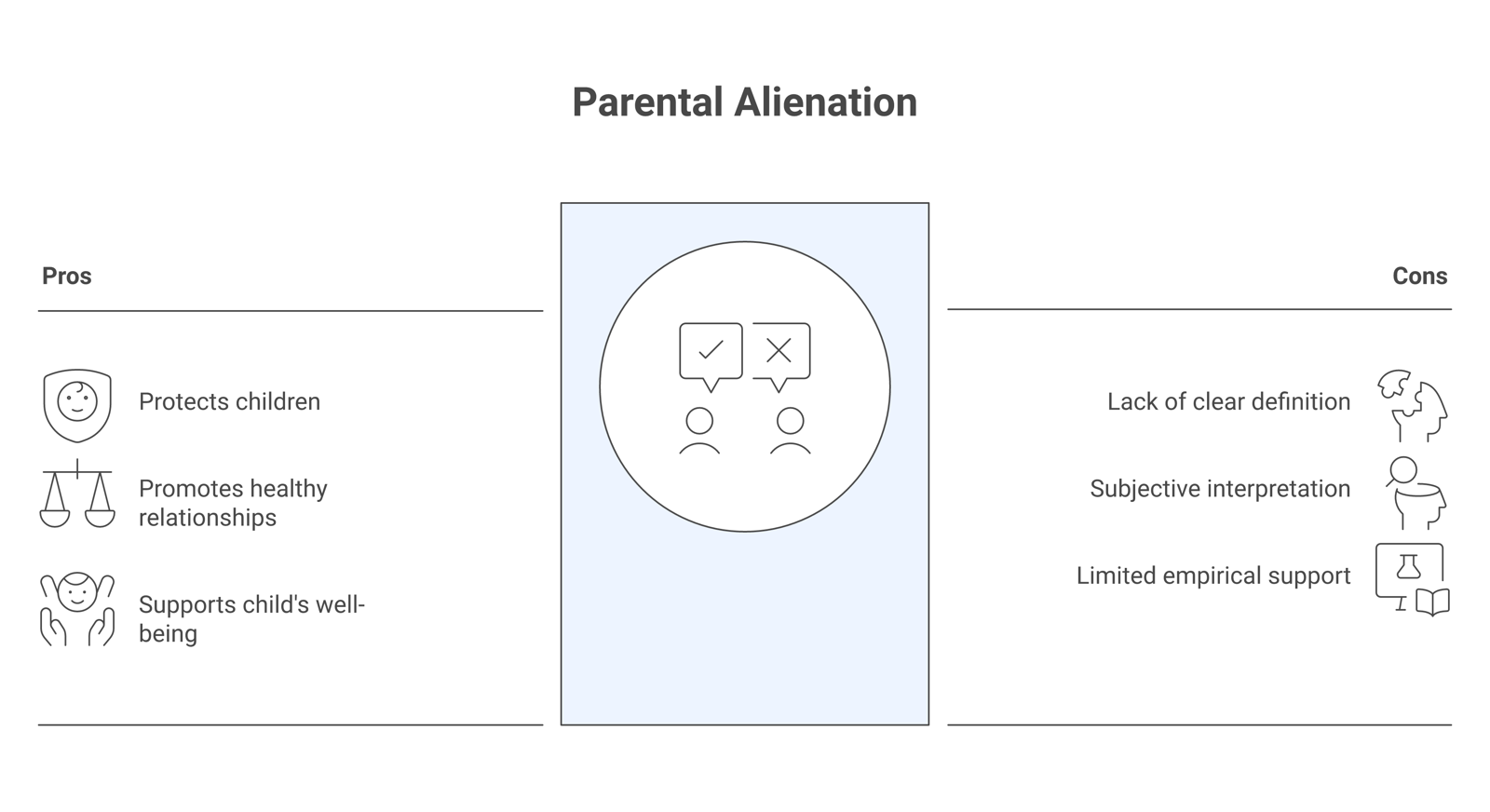
Is parental alienation real? The answer depends on what the question is really asking. Among many clinicians who work with high-conflict separation, the pattern is observed, measured, and described across decades, so for them the phenomenon is real. Among a set of critics, the doubt centers on its scientific footing and its potential for misuse, so for them the construct is shaky. Both camps agree on one narrow fact. There is no standalone diagnosis named parental alienation in the major diagnostic manuals.
A useful way to hold all three points at once is this. The behavior pattern that the term tries to capture appears genuine to a large body of researchers. The label itself remains contested. And the formal diagnostic status is limited. None of these statements cancels the others.
What people mean by parental alienation
The term describes a situation in which a child resists or refuses contact with one parent, and that rejection looks out of proportion to anything that parent has done. Supporters of the concept say the cause is the influence of the other parent, whether through direct denigration or subtler signals. The child then adopts hostility that does not fit the prior relationship.
Two features matter for any fair reading. First, proponents do not claim that every contact refusal is alienation. Careful clinicians treat alienation as one possible explanation among several, including a child’s own temperament, anxiety, normal developmental shifts, and genuine fear of an unsafe parent. Second, the modern research literature has largely moved away from the older “parental alienation syndrome” framing, which the field traces to psychiatrist Richard Gardner in the 1980s. For that history, see the page on parental alienation syndrome.
Proponents also point to a recognizable cluster of behaviors that researchers such as Amy Baker have catalogued, including badmouthing the other parent, limiting contact, and pressing the child to take sides. Whether those behaviors are present, and whether the child’s reaction actually fits them, is what a careful evaluation tries to establish.
The case that parental alienation is real
Proponents point to several lines of evidence. Taken together, they argue, the pattern is too consistent and too well documented to dismiss.
One argument is historical. Psychiatrist William Bernet notes that descriptions of a child being turned against a parent predate Gardner by more than a century. He cites an 1827 court case, Ball v. Ball, that spoke of a parent who “endeavored to alienate the affections” of a child, and a 1943 work by David Levy describing a similar family triad. The point of this history is that the underlying pattern was noticed independently, long before any single author coined a name.
A second argument is prevalence. Researcher Jennifer Harman and colleagues estimate, from national polls, that roughly 22 million US adults report being targets of parental alienating behaviors, and that moderate-to-severe alienation affects at least 1.3 percent of US children. Bernet offers a separate, transparent arithmetic estimate that lands near 1 percent of US children. The figures come from different methods, yet they point in a similar direction, and all are estimates. The deeper numbers and their limits are covered in parental alienation statistics.
A third argument concerns abuse and gender. Critics often charge that alienation claims are mainly a weapon abusive fathers use against protective mothers. Proponents answer with case-file studies. One review of 492 US appellate cases reported that substantiated abuse was several times more likely to be found against the alienating parent than the targeted parent. A separate study of 500 Canadian cases found no consistent gender bias, and noted that many identified alienating parents were mothers. Supporters read these datasets as evidence that the simple “abuser’s tool” story does not match the full record.
A fourth argument is about research quality. Defenders such as Bernet and a 2018 family-violence review by Harman, Kruk, and Hines argue that the concept connects to recognized patterns of coercive control. The Harman, Kruk, and Hines paper, published in the journal Psychological Bulletin, frames alienating behaviors as a form of family violence. A 2022 literature review of 213 empirical studies by Harman, Warshak, Lorandos, and Florian in Developmental Psychology argues the research base now meets the criteria of a maturing field, a conclusion critics dispute.
The critics’ case
Critics raise objections that deserve a fair hearing, not a quick rebuttal.
The first objection is scientific. Developmental psychologist Jean Mercer and others argue that the concept, especially in its “syndrome” form, lacks the reliability, falsifiability, and validation that a clinical construct should have. They note that mainstream bodies never adopted Gardner’s syndrome as a formal diagnosis, and they caution that a label can sound scientific without being so.
The second objection is about safety. Law professor Joan Meier of George Washington University led a large empirical study of US custody outcomes. Her team reported that when a parent accused of abuse countered with an alienation claim, courts were less likely to credit the abuse and more likely to move custody away from the reporting parent. For Meier, the worry is concrete. An alienation argument can function, in practice, to discount a genuine abuse report.
The third objection is about policy. In a 2023 report, the United Nations Special Rapporteur on violence against women and girls, Reem Alsalem, recommended that states prohibit the use of parental alienation in family courts, citing risks to survivors and children. Several jurisdictions have moved in that direction. Critics treat this as a sign that the construct’s harms outweigh its value in legal settings.
The fourth objection is definitional. Skeptics argue that because the term has no fixed clinical meaning and no diagnostic code of its own, it invites loose use. A vague label, they say, can be stretched to fit almost any contested custody case. The diagnostic status question is unpacked in parental alienation diagnosis.
Where the evidence actually stands
The field is not split into two tidy camps. Law professor Nicholas Bala, a centrist scholar, maps three broad positions. One group treats alienation as a child disorder and pushes for formal recognition. A second group views it as a pseudoscience that endangers abuse survivors. A middle group, including researchers such as Janet Johnston and Joan Kelly, treats alienation as one real concept among several, often appearing alongside, not instead of, genuine abuse.
Bala makes a point that cuts across the debate. Courts already face unfounded domestic-violence allegations, unfounded child-abuse allegations, and unfounded alienation allegations. Each requires case-by-case fact-finding, and none, in his view, justifies a blanket ban. He also notes that a UN Special Rapporteur is an individually appointed expert, not a vote of the United Nations as a whole, a distinction he says is often blurred in advocacy.
Proponents push back on the critics’ core claims, and those rebuttals belong in the record too. Harman argues that studies showing alienating behavior “backfires” used non-clinical samples and circular methods. Harman and colleagues also argue that the “abuser’s tool” narrative rests on a small number of vivid cases rather than the broad data, an example, they say, of an illusory correlation. Bernet contends that a large share of the most hostile literature traces back to a small, self-citing cluster of journals. Critics dispute each of these responses, which is exactly why the debate remains open.
On formal status, the picture is specific. Parental alienation is not a named diagnosis in the DSM-5-TR or the ICD-11. Both manuals do contain related, broader categories, such as parent-child relational problem and a child affected by parental relationship distress, that clinicians can use. So the concept sits near the diagnostic system without being a formal entry in it. Major professional bodies have also stopped short of adopting one official definition, a fact both camps cite for opposite reasons.
Abuse-driven estrangement is real and must stay separate
One area draws agreement from almost everyone. A child who pulls away from a parent who hurt them is not displaying alienation. That child is showing estrangement, a reasonable response to real harm. Collapsing the two ideas is dangerous, because it can turn a protective instinct into evidence against the child or the safe parent.
This is the heart of the critics’ strongest concern, and proponents who work carefully share it. Treating every rejection as alienation produces false positives. Treating every alienation claim as a cover story produces the opposite error. The responsible path assesses each family on its facts. The distinction itself is explained in parental alienation versus estrangement, and the broader topic map lives in the Learn center.
So, is parental alienation real? A fair summary
A balanced reading supports a measured statement, not a verdict. A large body of clinicians and researchers find that the pattern of unjustified parental rejection is real, measurable, and harmful to children, and they have decades of observation behind them. A serious group of critics hold that the label is scientifically weak and, worse, that it can be used to silence parents and children reporting abuse. Their concern is supported by real cases and real research.
Both things can be true at once. A pattern can be real and a label can still be misused. The fair conclusion is that the phenomenon many people call parental alienation appears genuine to most researchers who study it, that it is not a formal diagnosis, and that any use of the term must never override a child’s safety or a credible abuse report. Readers weighing their own situation are best served by a qualified, neutral professional rather than by either side’s strongest slogan.
Frequently asked questions
Is parental alienation real?
To many clinicians and researchers, yes. They describe a real pattern in which a child rejects a parent without adequate cause, often under the influence of the other parent. A group of critics disagree, questioning the concept’s scientific validity and warning that it can be misused against abuse survivors. There is no standalone diagnosis named parental alienation in the major manuals, so the most accurate answer is that the underlying pattern is widely recognized while the label remains contested.
Is parental alienation a recognized mental health diagnosis?
No, not as a standalone entry. Neither the DSM-5-TR nor the ICD-11 lists “parental alienation” as its own diagnosis. Both include broader related categories, such as parent-child relational problem, that clinicians may apply. The older “parental alienation syndrome” was never adopted as a formal diagnosis either.
Why do some experts say parental alienation is not real or is junk science?
Critics such as Jean Mercer argue the concept lacks reliability and falsifiability and that its “syndrome” version was never validated. Others, including law professor Joan Meier, focus on harm, citing research that alienation claims can lead courts to discount genuine abuse reports. A 2023 United Nations Special Rapporteur report recommended barring the term from custody cases. These concerns are serious and remain unresolved.
Can parental alienation claims be misused against abuse survivors?
Yes, and this is a documented concern, not a hypothetical one. Research and advocacy groups have shown cases where an alienation claim was used to counter and discount a credible abuse report. A child distancing from a parent who harmed them is showing estrangement, not alienation. Any responsible assessment screens carefully for abuse before reaching an alienation conclusion.
What is the difference between parental alienation and estrangement?
Estrangement is a child’s reasonable distancing from a parent who was abusive, neglectful, or frightening. Alienation, by contrast, refers to rejection that does not fit the targeted parent’s actual behavior and is attributed to the other parent’s influence. The two can look similar from the outside, which is why a neutral, abuse-aware evaluation matters.
Sources and further reading
- Harman, J. J., Kruk, E., and Hines, D. A. (2018). Parental alienating behaviors: An unacknowledged form of family violence. Psychological Bulletin, 144(12), 1275 to 1299. https://doi.org/10.1037/bul0000175
- Harman, J. J., Warshak, R. A., Lorandos, D., and Florian, M. J. (2022). Developmental psychology and the scientific status of parental alienation. Developmental Psychology, 58(10), 1887 to 1911. https://doi.org/10.1037/dev0001404
- Harman, J. J., Leder-Elder, S., and Biringen, Z. (2016, 2019). Prevalence polls on parental alienating behaviors. Children and Youth Services Review, 66, 62 to 66; 106, article 104471.
- Bernet, W. (2010). Parental Alienation, DSM-5, and ICD-11. (Source of the approximately 1 percent arithmetic estimate.)
- Sharples, A. D., Harman, J. J., and Lorandos, D. (2023). Findings of abuse in families affected by parental alienation. Journal of Family Violence. https://doi.org/10.1007/s10896-023-00575-x
- Harman, J. J., Giancarlo, C., Lorandos, D., and Ludmer, B. (2023). Gender and child custody outcomes across 16 years of judicial decisions regarding abuse and parental alienation. Children and Youth Services Review, 155.
- Meier, J. S., Dickson, S., O’Sullivan, C., Rosen, L., and Hayes, J. (2020). U.S. child custody outcomes in cases involving parental alienation and abuse allegations: What do the data show? Journal of Social Welfare and Family Law, 42(1), 92 to 105.
- Mercer, J. (2019). Examining parental alienation treatments: Problems of principles and practices. Child and Adolescent Social Work Journal, 36(4), 351 to 363.
- Alsalem, R. (2023). Custody, violence against women and violence against children. Report of the UN Special Rapporteur on violence against women and girls, UN Doc A/HRC/53/36. ohchr.org report page
- American Psychiatric Association. Diagnostic and Statistical Manual of Mental Disorders, Fifth Edition, Text Revision (DSM-5-TR). Parent-child relational problem and related codes (consult the manual directly).
If you or your child are in crisis
Free and confidential help is available right now.
- 988 Suicide and Crisis Lifeline. Call or text 988. 988lifeline.org
- Childhelp National Child Abuse Hotline. 1-800-422-4453. childhelp.org
- NAMI HelpLine. 1-800-950-6264. nami.org/help
Last reviewed: 2026-06-07. Author: Alex Buckles (PAC Founder).