

An appeal asks a higher court to find legal error in how a custody decision was made, not to rehear the facts. Most custody rulings are reviewed for abuse of discretion, a deferential standard, so reversals are uncommon. For many families, a modification case built on changed circumstances is the more realistic path.
A caveat before anything else
Losing a custody ruling is painful, and in alienation cases it can feel like the court rewarded the very conduct that caused the harm. But an appeal is not a do-over, and it is not a tool for prolonging conflict or punishing the other parent. Where a child’s rejection of a parent traces to genuine abuse or neglect, that is estrangement, not alienation, and a trial court that protected the child did its job. If a child’s safety is at risk, contact local law enforcement or a domestic-violence resource first.
This page is general US-national education about how appeals work. It is not legal advice, it does not create an attorney-client relationship, and it does not address any one state’s appellate rules, deadlines, or standards. Appellate deadlines are short and unforgiving, and they vary by state. Anyone considering an appeal should speak with a licensed appellate or family-law attorney in their own state immediately, because waiting can end the option entirely.
The short answer
A custody appeal is a request that a higher court review the trial court’s decision for legal error. Appellate courts in the United States generally do not retry cases: no new witnesses, no new evidence, no second chance to tell the story better. The federal judiciary’s own explanation of appeals describes the model most state systems share: review on the existing record, focused on whether the law was applied correctly and the process was fair.
Custody decisions are among the hardest rulings to overturn, because they are entrusted to the trial judge’s discretion and reviewed deferentially. That does not make appeals pointless. It makes them a narrow tool for a specific kind of problem: a legal mistake, not a factual disagreement.
What an appeal is, and what it is not
An appeal reviews the record that already exists: the transcripts, the exhibits admitted at trial, and the rulings the judge made. The appellate court asks whether the trial court applied the right law, followed required procedure, and reached a decision within the range the law allows. It does not ask whether the appellate judges would have decided the case the same way.
This is the single most common misunderstanding among parents. An appeal is not a chance to introduce the texts that were never offered, the witness who was never called, or the expert who was never retained. If the evidence is not in the trial record, the appellate court generally cannot consider it. That is also why trial preparation matters so much in alienation litigation: the record made at trial is the only record an appellate court will ever see. The trial-side work is covered in how to prove parental alienation and, for counsel, litigating parental alienation.
The standard of review: abuse of discretion, generally
Appellate courts apply different levels of scrutiny to different kinds of rulings, a framework lawyers call the standard of review. Pure questions of law are typically reviewed fresh, with no deference. Findings of fact are typically reviewed with heavy deference, because the trial judge saw the witnesses and the appellate court did not. And discretionary calls, which include most custody and parenting-time determinations, are generally reviewed for abuse of discretion: the question is not whether the decision was right, but whether it was within the range of reasonable decisions the law permits.
In practice, that means a custody appeal usually succeeds only when the appellant can point to something structural: the trial court applied the wrong legal standard, ignored a statutory requirement, made findings with no evidentiary support at all, excluded or admitted evidence in a way that mattered, or denied a fair hearing. “The judge believed the wrong parent” is almost never a winning appellate argument, because credibility calls belong to the trial court. In alienation cases this cuts both ways: a judge who credited an alienation claim and a judge who rejected one are both protected by the same deference.
Preservation of error: the appeal is built at trial
Appellate courts generally review only issues that were raised in the trial court, a doctrine lawyers call preservation of error. If an objection was never made, a report never challenged, or a legal argument never presented to the trial judge, the appellate court will usually treat the point as waived, outside narrow exceptions that vary by jurisdiction.
The practical consequence is counterintuitive but important: the time to think about an appeal is before and during trial, not after the ruling. Objections need to be made and ruled on. Offers of proof need to be placed on the record when evidence is excluded. Proposed findings and legal arguments need to be in writing where the rules allow. Requests for required statutory findings need to be made. A parent who is unhappy with a ruling cannot retroactively create preservation, which is one more reason the choice of trial counsel matters; see choosing a parental alienation lawyer.
Timelines and costs: the realistic frame
Appellate deadlines are short, strict, and jurisdiction-specific. In many systems the notice of appeal must be filed within roughly thirty days of the final judgment, and missing the deadline typically ends the right to appeal. Nothing on this page substitutes for checking the actual deadline in the actual jurisdiction, immediately.
The process that follows is slow. Ordering transcripts, assembling the record, briefing by both sides, possible oral argument, and the wait for a decision commonly stretch across many months, and a year or more is not unusual. Costs are real: transcript preparation, filing fees, and appellate attorney time, which is brief-writing-intensive. During that time, the trial court’s order usually remains in effect unless a court stays it, which is itself uncommon in custody matters. For a child living under the challenged order, and for a parent-child relationship that is deteriorating, appellate time is not neutral. Any honest appellate consultation weighs that.
And the most common outcomes are sobering. Many appeals are affirmed. Many “successful” appeals end not in a reversed custody decision but in a remand: the case goes back to the same trial court to redo the flawed step, after which the court may reach the same result through a proper route.
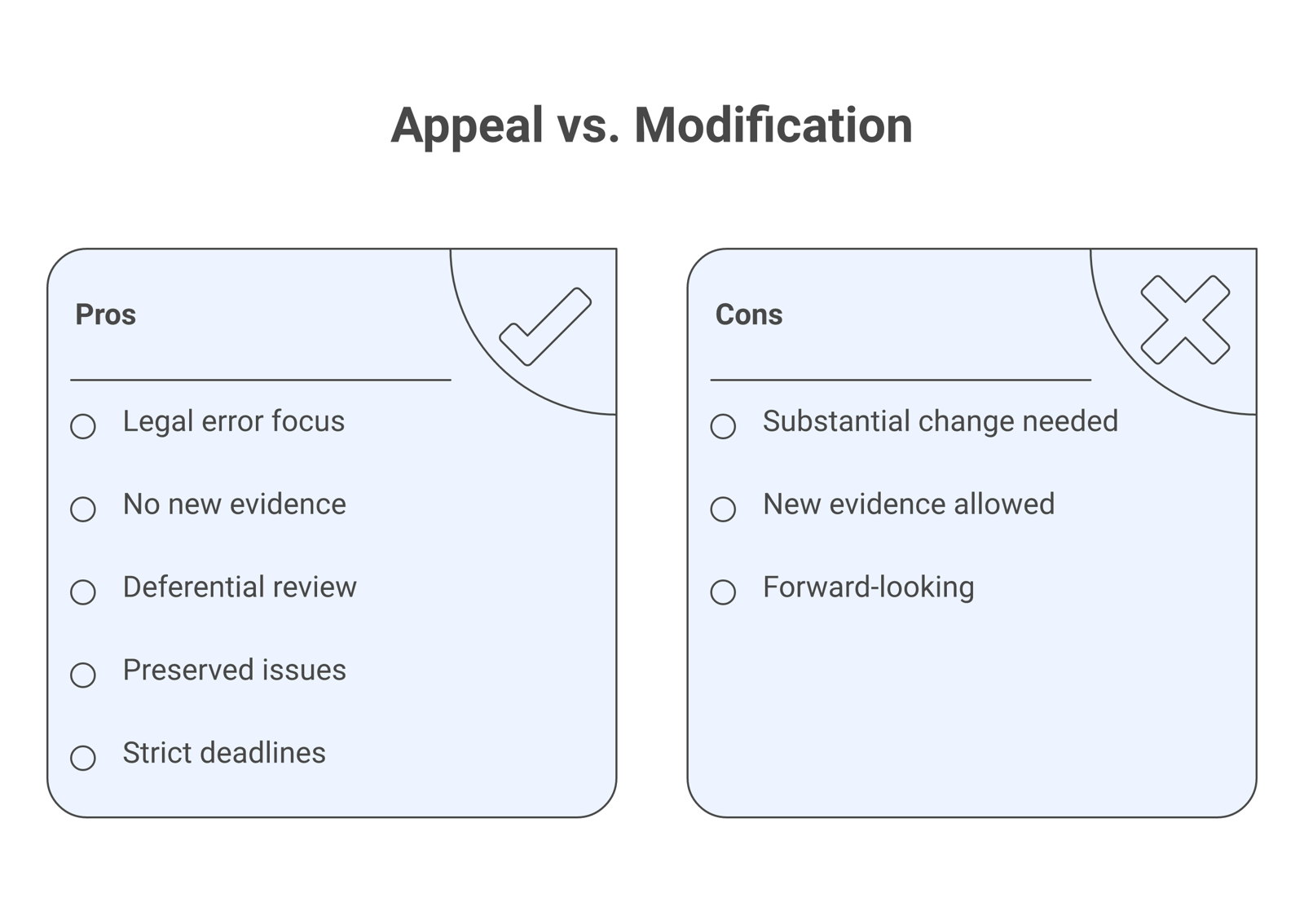
Appeal versus modification: two different tools
A custody appeal says the court got the law wrong on the record it had. A modification case says the facts have materially changed since the order. Most states allow a parent to seek modification of custody or parenting time on a showing of a substantial change in circumstances bearing on the child’s best interests, with the specifics varying by state.
In alienation dynamics, modification is often the more useful frame, because alienation is rarely a single frozen event. Continued interference with parenting time, escalating contact refusal, violations of the existing order, or new evidence of coaching are forward-looking facts, and a modification court can hear them as evidence, where an appellate court cannot. That path, and its own discipline, is covered in custody modification in parental alienation cases. Enforcement tools for outright violations, such as contempt, are a third and separate track; see contempt for parental alienation.
The two tracks are not mutually exclusive, and the choice between them is exactly the kind of judgment a licensed attorney has to make on real facts. Professional resources from bodies like the American Bar Association’s Section of Family Law reflect how routinely family lawyers weigh this fork.
When an appeal can make sense
Generalizing carefully, an appeal is worth serious evaluation when the claimed error is legal and visible on the record: the court applied the wrong standard, skipped findings a statute requires, relied on evidence that was never admitted, refused to admit clearly admissible and material evidence, or denied a party a meaningful opportunity to be heard. It can also make sense when a ruling rests on a legal interpretation that matters beyond the single case and the record cleanly presents it.
An appeal is usually a poor fit when the real complaint is that the judge weighed the evidence wrongly, believed the wrong witnesses, or gave too little weight to an expert. Those are discretion and credibility complaints, and the deferential standard absorbs them. It is also a poor fit as an emotional outlet or a pressure tactic; appellate courts see those appeals constantly, and children pay for the extra year of conflict. A parent weighing the fork should bring the trial record, the deadline, and the modification alternative to a qualified attorney at once, and should keep building the kind of contemporaneous record described in the PA case is not a custody case regardless of which track is chosen.
Frequently asked questions
Can you appeal a custody decision?
Generally yes. A party can usually appeal a final custody judgment to a higher court, subject to short, strict deadlines that vary by state. But the appeal reviews the existing record for legal error; it is not a retrial, and new evidence generally cannot be added. Interim or temporary orders are often harder to appeal, with rules that vary by jurisdiction.
What does abuse of discretion mean in a custody appeal?
It is the deferential standard appellate courts generally apply to discretionary rulings such as custody determinations. The appellate court asks whether the trial court’s decision fell within the range the law allows, not whether the appellate judges agree with it. A decision can be one the reviewing court dislikes and still stand, as long as it rests on the right law and record support.
Why do custody appeals rarely succeed?
Because the standard is deferential, credibility and fact-weighing belong to the trial judge, and only preserved legal errors are reviewable. Many appeals fail on preservation alone: the issue was never raised below. Even successful appeals often end in a remand for a redo rather than a different custody outcome.
How long does a custody appeal take, and what does it cost?
It varies widely, but many months to over a year is a realistic frame once transcripts, record assembly, briefing, and decision time are counted. Costs include transcripts, filing fees, and brief-intensive attorney time. The existing order usually stays in effect during the appeal unless a court orders otherwise.
Should I appeal or file for modification?
They answer different questions. Appeal argues the court made a legal error on the existing record. Modification argues circumstances have substantially changed since the order, and it lets a court hear new evidence, including ongoing interference or contact refusal. Many alienation situations fit modification better, but the choice depends on the record, the deadlines, and the facts, which is a judgment for a licensed attorney.
What this page does not do
This page does not evaluate any reader’s case, predict any outcome, or recommend filing or not filing an appeal. It does not state any state’s deadline or standard, because they differ. And it does not present appeals as leverage; an appeal pursued to punish or exhaust the other parent prolongs the conflict the child is already paying for. The right use of this information is to walk into a consultation with a licensed attorney understanding what an appeal can and cannot do, and to ask about the modification alternative in the same conversation.
For the surrounding decisions, see how judges view parental alienation, custody modification in parental alienation cases, and what to tell your lawyer about parental alienation. The full Court silo covers the rest.
Sources and further reading
- Administrative Office of the U.S. Courts. Appeals: how appellate review works. uscourts.gov
- Legal Information Institute, Cornell Law School. Abuse of discretion. law.cornell.edu
- Legal Information Institute, Cornell Law School. Standard of review. law.cornell.edu
- American Bar Association, Section of Family Law. Resources on family law practice. americanbar.org
If you or your child are in crisis
Free and confidential help is available right now.
- 988 Suicide and Crisis Lifeline. Call or text 988. 988lifeline.org
- Childhelp National Child Abuse Hotline. 1-800-422-4453. childhelp.org
- NAMI HelpLine. 1-800-950-6264. nami.org/help
Last reviewed: 2026-06-10. Author: Alex Buckles (PAC Founder).