

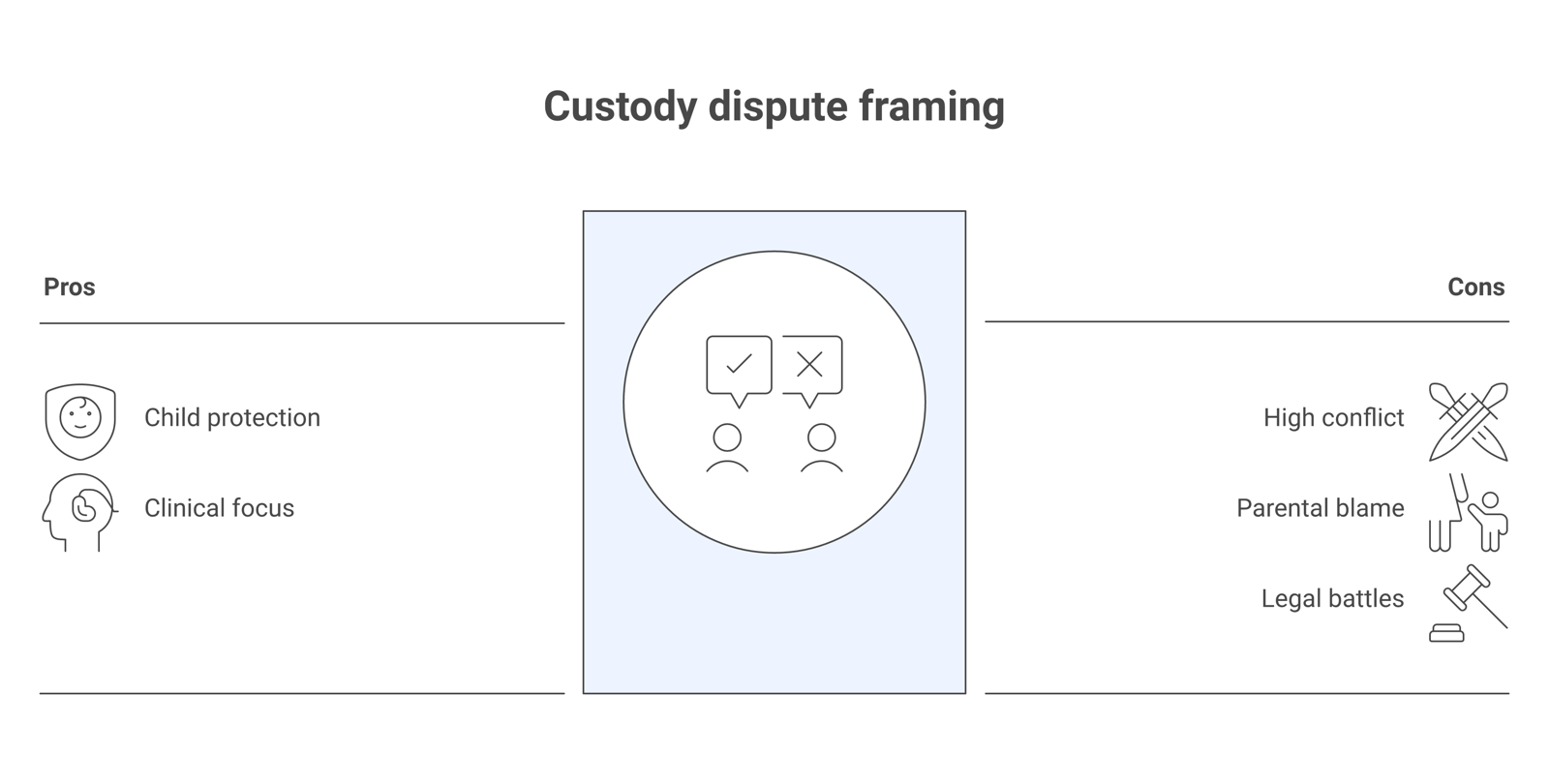
“The PA case is not a custody case” is a litigation frame common among parental-alienation-affirming litigators. It holds that a severe alienation case is better understood as a clinical or child-protection matter than a high-conflict custody fight. It is an influential, attributed professional view, not settled law, and critics warn it can be misused to bypass abuse scrutiny.
A note on safety
A child’s rejection of a parent is not always alienation. If the rejected parent has been abusive, neglectful, or genuinely dangerous, the child’s distancing is justifiable estrangement, not parental alienation, and it is a different legal and safety matter. Any court, and any honest use of this frame, must screen for abuse first. If a child’s safety is at risk, contact local law enforcement or a domestic-violence resource.
This page is general US-national education. It is not legal advice, does not create an attorney-client relationship, and does not address any one state’s law. It describes a professional frame and its critics; it does not endorse the frame as settled doctrine. Anyone in a real case should consult a licensed family-law attorney in their own jurisdiction.
What the frame claims
The frame makes a simple claim with large implications. A severe parental alienation case, its proponents say, should not be treated as an ordinary high-conflict custody dispute between two flawed parents. Instead, it should be treated as a question about a child’s welfare and a documented pattern of harm, closer to a clinical or child-protection matter.
But the difference is more than vocabulary. In a high-conflict custody frame, a court tends to weigh two competing parents and split the difference. By contrast, in a clinical or child-protection frame, the central question shifts to whether a child is being harmed and what intervention the child needs. Proponents argue that severe cases get mishandled when courts default to the custody-fight frame, because the targeted parent in crisis can look like half of a mutual mess rather than the person the child has been turned against.
That is the claim. The rest of this page lays out who makes it, the reasoning behind it, why it is a frame rather than settled law, and the serious critique that the same frame can be misused. The cross-silo discussion of parental alienation as child abuse covers the contested clinical side in more depth.
Where the frame comes from
This is an attributed position, advanced by specific PA-affirming litigators. It is worth naming them, because that is part of what marks it as a professional viewpoint rather than established doctrine.
Hoffman’s clinical-case argument
Robert Hoffman is a board-certified Texas family-law attorney who served as lead counsel in a 2016 custody trial tried on a parental alienation theory. He argues that a parental alienation case is, in his words, a clinical, medical, and child-abuse case, and that it must be built and tried more like a medical-malpractice case than a custody fight. The American Bar Association’s Section of Family Law publishes general consumer material on how custody and abuse matters are handled, which is useful background for readers new to the distinction.
Hoffman’s reasoning runs through the child. So in a severe case, he contends, the focus belongs on the documented pattern of behavior and its effect on the child, not on which parent presents better in the courtroom. As a result, he treats the matter as a child-welfare question first.
Ludmer and Gomery’s child-protection principle
A second strand comes from Canadian attorney Brian Ludmer, who anchors his approach on a 1991 decision by Justice John Gomery of the Quebec Superior Court. The Gomery principle, as Ludmer presents it, is that severe alienation should be treated as a child-protection matter rather than a custody dispute. In that decision, the court reasoned that it could not remain indifferent to the danger that the behavior posed to a child’s future emotional stability.
The Ludmer and Gomery framing adds a timing point. Once a case is identified as severe, proponents say, the speed and thoroughness of intervention should match a child-protection standard, not the slower pace of a routine custody modification.
The logic behind the frame
Proponents give several reasons for treating a severe case differently. These are arguments, not proven facts, and the page presents them as the frame’s internal logic.
The first reason is about appearances. In a severe case, proponents argue, the targeted parent is often in visible distress, while the favored parent may present as calm and reasonable. So a court working from a custody-fight frame can read the distressed parent as the source of the problem. For that reason, the frame asks courts to look past presentation to the documented pattern.
A second reason is about therapy. Proponents argue that conventional individual therapy for the child often fails in these cases, and can entrench the rejection, because it treats a relational problem as if it lived inside the child alone. They read repeated therapeutic failure as a signal worth examining, not as proof of anything by itself.
A third reason draws on the work of researchers who argue that severe alienating behavior maps onto patterns of coercive control. Jennifer Harman and colleagues, writing in the journal Psychological Bulletin, make the case that some alienating behavior amounts to a form of family violence. Proponents use that research to argue the harm is serious enough to warrant a protective frame. Whether the research supports a courtroom rule is exactly what critics dispute, which the next sections take up. The sibling page on how to prove parental alienation covers what a court actually weighs.
The clinical-remedy variant: treatment, not custody
A related reframe pushes the same instinct one step further: some clinicians argue that a severe alienation case is fundamentally a treatment issue, not a custody issue, a clinical problem wearing legal clothes. The argument is associated with the clinical psychologist Craig Childress, whose attachment-based model is an influential minority position, contested within the parental alienation field itself and not adopted in mainstream professional guidelines, so this variant should be read as one clinical argument inside the affirming camp, not as the field’s view.
The core of the variant is a point about roles. A judge’s job is to resolve disputes and apply the law. As the clinicians advancing this view put it, judges do not diagnose pathology or develop treatment plans, because that is not their training or their function. When a case that is really about a child’s disrupted attachment is run as a pure custody contest, everyone is asked to do a job they are not equipped for. The treatment frame asks the court to order a proper clinical assessment, to consider a treatment plan, and to use its authority to support that plan. The court still runs the case. It simply leans on clinical expertise for the parts that are clinical.
In this variant, the case opens with assessment rather than accusation. That means a careful screen for genuine abuse first, because if abuse is present the whole analysis changes and protection takes over, followed by a differential diagnosis: a structured look at what is actually driving the child’s rejection, considering each parent and the family system rather than assuming the answer. The page on differential diagnosis of contact refusal covers that clinical work in depth. If the assessment points to alienation rather than abuse, the pathway turns to a treatment plan aimed at restoring a healthy relationship with both safe parents, sometimes including structured reunification; see what is reunification therapy, the evidence discussion in does reunification therapy work, and the contraindications in when reunification therapy is not recommended.
The limits of the clinical-remedy variant mirror the limits of the broader frame. It explicitly excludes domestic violence and child abuse, where the priority is protection, not a plan aimed at restoring contact. Calling a case a treatment issue does not remove it from the court, because a judge still controls what is ordered and how the case proceeds. And a treatment plan can be ordered and still not work, so presenting the clinical pathway as a guaranteed fix would be its own kind of overpromising. For a parent, the most useful part is the mindset, not a motion to file. It moves the goal from beating the other parent to getting the child a proper assessment and, if warranted, real help, raised with the attorney and a qualified clinician as a question worth exploring rather than a demand.
Why this is a frame, not settled law
It is important to be clear about the status of this idea. The clinical or child-protection frame is one influential position in a contested field. It is not a settled legal rule, and it is not a recognized diagnosis.
Researchers map the field into camps. A traditional camp treats alienation as a child disorder and pushes for formal recognition. The critical camp argues that alienation claims are often a pseudo-concept used to mask abuse. A middle group, including scholars such as Nicholas Bala, Janet Johnston, and Joan Kelly, holds that alienation is one concept among several, that most cases are grey rather than clear, and that the answer is careful case-by-case judgment rather than any single rule. The clinical or child-protection frame sits within the affirming side of that debate.
That placement matters for a reader. So a litigator presenting this frame is offering a professional argument, not citing a law that binds the court. As a result, courts vary in how much weight they give it. How judges actually treat the construct is covered on the sibling page about how judges view parental alienation, and the Court silo maps the rest.
The critical counter: it can bypass abuse scrutiny
But the frame has a serious problem, and this page gives it equal standing. The same framing that proponents use to protect a child can be misused to deflect attention from a parent’s own abusive conduct. This is not a fringe worry. Rather, it is the central critique from researchers and advocates focused on family violence.
The empirical anchor for the concern is a 2020 study led by Joan Meier for the National Institute of Justice. Reviewing US custody cases, the Family Court Outcomes Study found that when a parent alleging abuse faced a cross-claim of alienation, the abuse-alleging parent, often a mother, was significantly more likely to lose custody. In the study’s framing, a father’s alienation cross-claim roughly doubled a mother’s risk of losing custody. The study has its own limits, which its author acknowledges, and affirming scholars contest its sample. The concern it raises, though, is real: an alienation frame can be turned into a shield for an abuser.
A broader policy critique comes from a 2023 report by the UN Special Rapporteur on violence against women and girls, which described parental alienation as a pseudo-concept and warned that it is used in custody courts to discredit protective parents. That report is one appointed rapporteur’s thematic position rather than a binding rule, and it is itself contested. It belongs here because it states the critical case at its strongest, and the page does not exist to defeat it. Where the frame goes wrong in practice is illustrated in the clinical failure stories collection.
The shared gate: screen for abuse first
Here is the point both sides can meet on. Whatever frame a court uses, it must screen for genuine abuse and for justified estrangement before treating a case as alienation. The abuse screen comes first. That is the non-negotiable gate beneath every honest version of this frame.
The reason is in the boundary itself. A child who pulls away from a parent because that parent was abusive, neglectful, or frightening is not alienated. Instead, the child is reacting to real harm, and the distancing is justified. So to call that alienation, and to apply a protective-reunification frame to it, would put a child back toward danger. Responsible proponents of the clinical frame and its sharpest critics agree on this much.
Researchers in the middle group stress that most real cases are grey. Some involve both alienating behavior and intimate-partner violence at once. Some involve a child’s normal, temporary preference for one parent during a stage of development, which is affinity, not alienation. Misreading any of these as a clean alienation case produces errors that can hurt a child. The screen for abuse and justified estrangement is what keeps the frame honest. The boundary between alienation and genuine harm is covered on the sibling page about child custody and emotional abuse.
What the frame means for a real case
A reader who has been told that their case is “not a custody case” should hold the idea carefully. It is a frame a litigator might use, with a real argument behind it and a real critique against it. It is not a verdict, and it is not a strategy for winning.
The honest takeaway is modest. In genuinely severe cases, where abuse has been ruled out and a documented pattern of harm remains, some experienced litigators and clinicians argue for a child-welfare frame over a custody-fight frame. In most cases, which are grey, the better course is careful screening and case-by-case judgment, which researchers like Bala argue courts are generally positioned to do. Either way, the frame is a lens for understanding a case, not a tool for gaining an edge. For a self-represented parent weighing all of this, the paired page on pro se parental alienation covers the practical ground.
Frequently asked questions
Why do some lawyers say a parental alienation case is not a custody case?
Some parental-alienation-affirming litigators argue that a severe case is better understood as a clinical or child-protection matter, where the focus is the child’s welfare and a documented pattern of harm, rather than a contest between two parents. It is an influential professional frame advanced by named litigators such as Robert Hoffman and Brian Ludmer. It is not settled law, and critics contest it.
Is parental alienation a custody issue or a treatment issue?
Legally, it arises inside custody cases. Some clinicians, in a contested minority view associated with Craig Childress, argue it is better understood as a treatment issue, because it involves a clinical problem that calls for assessment and a treatment plan rather than only a judge deciding a dispute. That is a clinical position, not settled law, and it applies only to cases where genuine abuse has been screened out.
Is parental alienation child abuse?
Some clinicians and litigators argue that severe alienating behavior is a form of psychological harm to a child, and some researchers link it to coercive control. The claim is contested. It is not a settled legal or diagnostic category, courts treat it with care, and a child’s distancing rooted in genuine abuse is not alienation at all.
Can the child-protection frame be misused?
Yes, and this is the central critique. Critics, including the researcher Joan Meier and a UN Special Rapporteur, warn that an alienation frame can be used to deflect from a parent’s own abusive conduct. Meier’s 2020 study found that alienation cross-claims raised the odds that an abuse-alleging parent would lose custody. That is why abuse screening must come first.
What does abuse-screen-first mean?
It means a court must rule out genuine abuse and justified estrangement before treating a case as alienation. A child who pulls away because a parent was abusive or frightening is reacting to real harm, not being alienated. Applying a reunification frame to that child could put the child back toward danger, so the screen comes first.
Who advances the clinical or child-protection frame?
Named parental-alienation-affirming litigators advance it, including Robert Hoffman, who tried a 2016 case on a parental alienation theory, and Brian Ludmer, who anchors on Justice John Gomery’s 1991 Quebec decision. Researchers and advocates focused on family violence, including some who call alienation a pseudo-concept, contest it.
What this page does not do
This page is not legal advice, and it does not endorse the clinical or child-protection frame as settled doctrine. The page describes an attributed professional position and gives its critics equal standing. It does not present the frame as a way to win a case or to avoid abuse review, and it does not name any one state’s law as if it applied nationally or give litigation tactics. The abuse screen comes first, on this page and in any real case.
For how courts treat the construct, see how judges view parental alienation. On the abuse boundary, see child custody and emotional abuse and parental alienation as child abuse. For the practical self-represented view, see pro se parental alienation. The full Court silo covers the rest.
Sources and further reading
- American Bar Association, Section of Family Law. americanbar.org/groups/family_law
- Harman, J. J., Kruk, E., & Hines, D. A. (2018). Parental alienating behaviors: An unacknowledged form of family violence. Psychological Bulletin, 144(12), 1275 to 1299. https://doi.org/10.1037/bul0000175
- Meier, J. S., et al. (2020). U.S. child custody outcomes in cases involving parental alienation and abuse allegations. National Institute of Justice, Family Court Outcomes Study. nij.ojp.gov
- American Psychological Association. Divorce and child custody. apa.org/topics/divorce-child-custody
- Association of Family and Conciliation Courts. afccnet.org
- Cornell Legal Information Institute (Wex). Best interests of the child. law.cornell.edu/wex/best_interests_of_the_child
If you or your child are in crisis
Free and confidential help is available right now.
- 988 Suicide and Crisis Lifeline. Call or text 988. 988lifeline.org
- Childhelp National Child Abuse Hotline. 1-800-422-4453. childhelp.org
- NAMI HelpLine. 1-800-950-6264. nami.org/help
Last reviewed: 2026-06-10. Author: Alex Buckles (PAC Founder).