

This page is general information, not legal or clinical advice. It does not create an attorney-client or therapist-client relationship, and it does not address any one state’s law or any one child’s situation. Anyone weighing reunification therapy should consult a qualified clinician and a licensed family-law attorney in their own jurisdiction.
Reunification therapy is not recommended when a child’s rejection is rooted in genuine abuse or a safety risk from the rejected parent, when a program is unlicensed or coercive, or when the basic conditions for safe, qualified, court-overseen treatment are missing. This page walks through each contraindication and presents the field’s competing views fairly.
Safety comes first
A child’s rejection of a parent is not always alienation. When a child resists contact because of genuine abuse or family violence by that parent, the resistance is justified estrangement, not alienation, and forcing contact through therapy can re-traumatize the child. Reunification work assumes the rejected parent is safe. Where that is in doubt, a thorough safety screen comes before any reunification question. If a child is in danger, contact local law enforcement or a domestic-violence resource first.
When reunification therapy is not recommended, in short
Reunification therapy aims to rebuild a damaged relationship between a child and a parent the child resists. It can help when a child’s rejection is disproportionate to anything the rejected parent has done. It is the wrong tool, and sometimes a harmful one, in several situations that responsible clinicians and courts screen for.
The short list looks like this. The intervention is not recommended where the child’s resistance reflects genuine abuse or a real safety risk from the rejected parent. It is not recommended when the program is unlicensed, coercive, or run without accountability. It is not recommended when the basic conditions for safe treatment are absent: no clear court order or oversight, the wrong pacing, an unqualified clinician, or only one parent willing to take part. The American Psychological Association treats the child’s wellbeing as the governing standard in custody-related care, and each of these limits flows from that standard.
The rest of this page takes the contraindications one at a time, then presents the genuine debate over whether courts should require this kind of therapy at all.
Safety comes first: genuine abuse and justified estrangement
The first and most important screen is for abuse. Before anyone asks whether a child’s rejection is alienation, the question is whether the child has a real reason to resist. A child who pulls away from a parent who has hurt them is not exhibiting a disorder. That child is responding to danger.
This distinction has a name. Estrangement that flows from genuine abuse or family violence is justified estrangement, and it is not parental alienation. Researchers and clinicians who work in this area, including forensic researcher Shawn Wygant, whose screening model was presented at the Parental Alienation Study Group conference in October 2025 and has not yet been published in a peer-reviewed journal, stress that a careful evaluation has to rule out genuine maltreatment before a resistant relationship is framed as alienation at all. Reunification specialists make the same point from the treatment side: the safety screen comes first, and reunification is contraindicated where the resistance reflects real harm.
The reason is concrete. Forcing contact with a parent a child has genuine cause to fear can re-traumatize the child. A therapy designed to overcome resistance becomes, in that situation, a tool that overrides a protective instinct the child formed for good reason. That is the opposite of treatment. The clinical and protective consensus is that estrangement from real abuse must not be “treated” by pushing the child back toward the source of the harm.
None of this means every claim of abuse is true, and the page does not assume that. Allegations are sometimes contested, sometimes investigated and not substantiated, and sometimes weaponized in custody fights. The point is narrower and harder to argue with. Where a credible abuse or safety concern exists, that concern must be resolved before reunification therapy is even on the table, and a qualified evaluator, not a reunification provider alone, should make that call.
When the program is unlicensed or coercive
The second contraindication is about the program itself rather than the child. Reunification has drawn attention because of a handful of intensive private programs that remove children from one parent and place them, sometimes for days, in a setting designed to break down resistance. Some of these programs operate without clinical licensing and without meaningful outside oversight.
Practitioners who support sensible regulation of reunification work have been direct about the danger here. Social psychology has long documented that ordinary people placed in unchecked positions of power over others can drift into coercion and harm. A program with no license, no oversight, and total control over a child is exactly the structure that risk describes. Regulation matters precisely so that legitimate work can be told apart from unlicensed, sequestering programs, the kind that prompted California’s Piqui’s Law.
For a reader weighing a specific program, the warning signs are practical. Is the provider a licensed mental-health professional? Is there a court order and a judge with eyes on the case? Can the child and parents ask questions, raise concerns, and stop? A program that isolates a child, resists outside scrutiny, or treats coercion as a feature rather than a failure is a strong contraindication, whatever it promises about results. Legitimate court-involved therapy is accountable, and the Association of Family and Conciliation Courts publishes guidelines on what that accountability should look like.
When the basics for safe treatment are missing
The third group of contraindications is about whether the conditions for safe, effective work are in place at all. Even when there is no abuse and no coercive program, reunification therapy can fail or do harm when the basics are missing.
Pacing is one. Attorney Brian Ludmer, drawing on foundational systemic-therapy principles traced to a 1991 court decision by Justice Gomery, argues that severe cases need intensive, well-structured directive work. A schedule of, say, twice a month is not enough to move an entrenched dynamic and can entrench it further. Ludmer also makes a point that surprises people: in directive systemic work, building a comfortable therapeutic alliance with a resistant child can be counterproductive, because the child can use the alliance to avoid the work. That is the reverse of how most talk therapy operates, which is part of why the right clinician matters so much.
Qualification is another. Ludmer is blunt that there are no worldwide standards for systemic family therapy, so quality varies enormously from one provider to the next. A clinician trained in general counseling is not automatically equipped for this specialized, high-conflict work. Failed conventional therapy is sometimes treated as diagnostic, a sign the case needed a different approach rather than more of the same.
Oversight and participation round out the list. Reunification work generally assumes a clear court order, judicial oversight, and the involvement of both parents, because a favored parent who undermines the process from outside can defeat it. The AFCC guidelines on court-involved therapy describe these structural conditions. Where there is no order, no oversight, an unqualified provider, the wrong pace, or only one cooperating parent, the intervention is on weak footing. Readers comparing timelines may also find the cross-silo page on how long reunification therapy takes useful for understanding why pacing is not a detail.
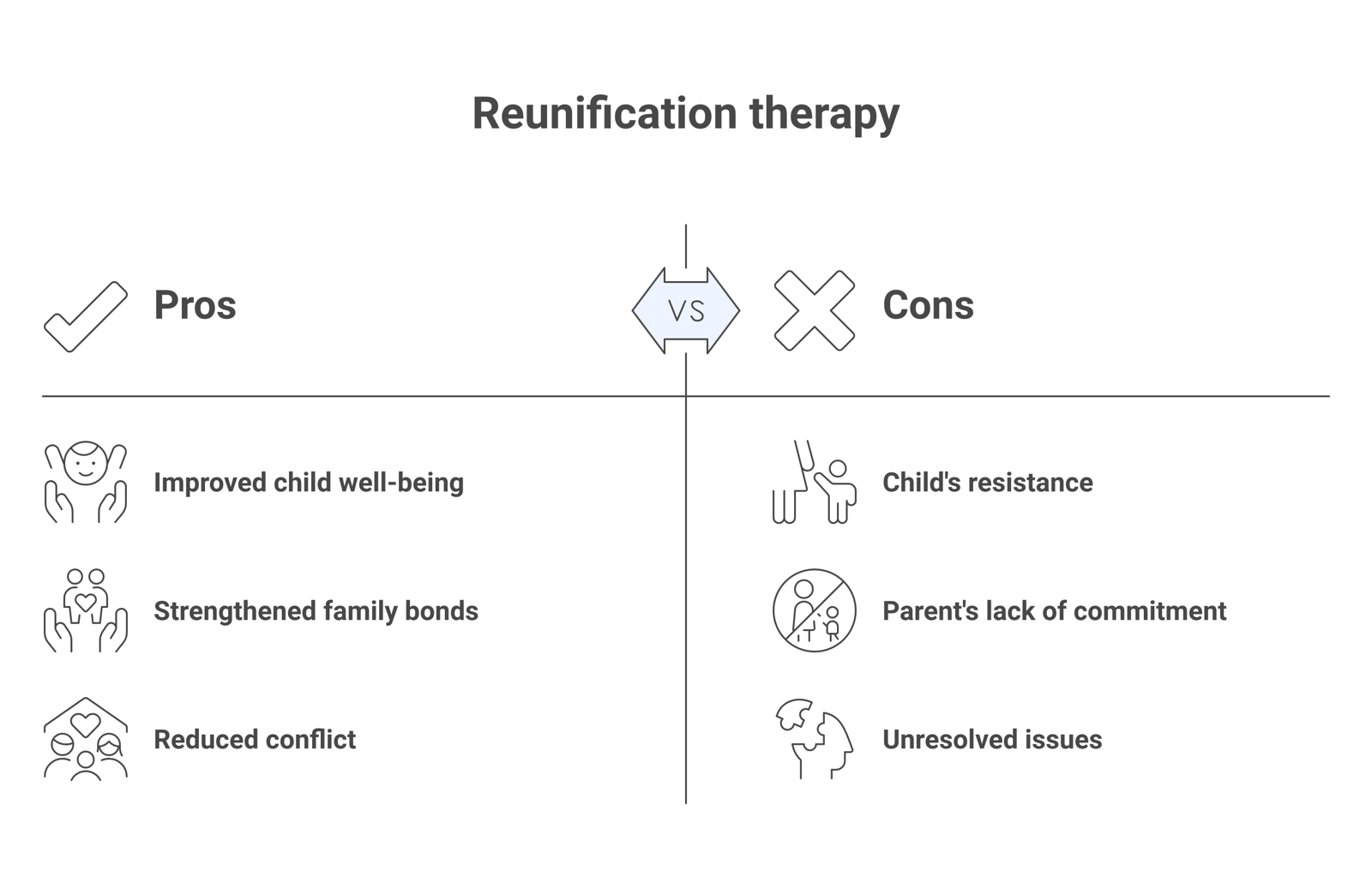
The debate over whether courts should require it
Beyond the case-by-case contraindications sits a genuine, unresolved dispute about reunification therapy as a practice. Legal scholar Nicholas Bala has described the field as roughly three camps, and an honest page presents all of them.
One camp is critical. Scholars including Joan Meier, along with critical-feminist commentators and the United Nations Special Rapporteur on violence against women and girls, argue that some reunification practices have been used to override children’s credible reports of abuse and to discount protective parents, usually mothers. In this view, courts have at times treated a child’s well-founded resistance as alienation and ordered contact that put the child at risk. These concerns have driven real policy change. Under Kayden’s Law, the federal Keeping Children Safe From Family Violence Act enacted as Title XV of the Violence Against Women Act Reauthorization of 2022, states receive grant incentives to limit court-ordered reunification treatment and to train judges on family violence, and Colorado, California (Piqui’s Law), Pennsylvania, and Utah had adopted conforming laws as of mid-2026. The details are covered on the Kayden’s Law page.
A second camp is clinical and protective in the other direction. Practitioners such as Linda Gottlieb, the family therapist who developed the Turning Points for Families program, argue that when parental alienation is genuine and severe, leaving a child in the grip of an alienating parent is itself a form of harm, and that structured intervention is child protection, not an attack on the child. In this view, refusing all reunification work can abandon children who are being manipulated into rejecting a safe and loving parent.
A third camp sits between them, accepting that both genuine alienation and genuine abuse exist, that the two can be hard to tell apart, and that the answer is careful, individualized evaluation rather than a blanket rule in either direction. The practical lesson from all three camps is the same one this page started with: the safety screen and the quality of the work decide whether the intervention helps or harms.
Policy reflects the same tension. California’s Piqui’s Law (SB 331, 2023), for example, bans court orders that place children in coercive reunification camps or rely on forcible transport, and adds judicial-training requirements. Supporters see this as a needed brake against coercion. Critics worry that broad limits can let an alienating parent entrench a child’s refusal. The point here is not to endorse either reading but to show that the rules are contested and vary by state. For how these questions land in court, see how judges view parental alienation, and for the custody frame, see parental alienation and child custody. For how a court actually orders this therapy when it does, see court-ordered reunification therapy and the broader Court silo.
Is reunification therapy harmful? The honest answer
The honest answer is that it depends, and that the question is genuinely contested. Reunification therapy can help a child whose rejection is disproportionate and not rooted in abuse, and it can harm a child when it is misapplied, coercive, or aimed at the wrong target. The research base on reunification and contact problems is still developing, and readers can survey the peer-reviewed literature through PubMed rather than relying on advocacy claims from any side.
What tips the balance is exactly what the contraindications describe. A licensed clinician, proper pacing, court oversight, both parents involved, and a verified absence of abuse make harm far less likely. Their absence makes harm far more likely. That is why “is it harmful” is the wrong first question. The better question is the one in this page’s title: in this situation, with these conditions, is reunification therapy recommended at all?
Frequently asked questions
When is reunification therapy not recommended?
It is not recommended when a child’s resistance reflects genuine abuse or a safety risk from the rejected parent, when the program is unlicensed or coercive, or when the basic conditions for safe treatment are missing. Those conditions include a clear court order, judicial oversight, a qualified licensed clinician, appropriate pacing, and the involvement of both parents.
Is reunification therapy harmful?
It can be when it is misapplied. Forcing contact where a child has genuine cause to resist, or using an unlicensed coercive program, can re-traumatize a child. Done well, with a qualified clinician, proper oversight, and a verified absence of abuse, it can help a child whose rejection is disproportionate. The field is genuinely divided, and the evidence base is still developing.
Can a court force a child into reunification therapy?
A court can order reunification therapy, but practice and policy vary widely. Some jurisdictions and clinicians weigh the child’s willingness heavily, and California’s Piqui’s Law bars coercive reunification camps and forcible transport. Other approaches treat severe alienation as a child-protection matter. Whether and how a court can compel participation depends on the jurisdiction and the facts, and that is a question for a licensed attorney.
When should reunification therapy stop?
It should be paused or stopped when a credible safety or abuse concern surfaces, when the program turns out to be unlicensed or coercive, or when the conditions for safe treatment are not actually in place. A child showing signs of re-traumatization, rather than gradual progress, is a serious warning sign that the work should be reassessed by a qualified clinician.
Is reunification therapy appropriate in abuse cases?
Generally not where the child’s resistance reflects genuine abuse by the rejected parent. Estrangement from real abuse is not alienation, and forcing contact can re-traumatize the child. A credible abuse or safety concern must be evaluated and resolved by a qualified evaluator before reunification therapy is considered at all. Safety comes first.
What this page does not do
This page is not legal or clinical advice. It does not tell any reader whether their own child should or should not be in reunification therapy, and it does not name any one state’s rule as if it applied everywhere. California’s Piqui’s Law, mentioned above, is one example of policy variation, not a universal rule. Those decisions belong to qualified clinicians and licensed attorneys working with the real facts of a particular case.
The page also takes no side in the broader dispute and frames no intervention as a way to win, block, or weaponize a custody conflict. For the definition of the intervention, see what is reunification therapy. For how a court orders it, see court-ordered reunification therapy. The full Court silo covers the rest.
Sources and further reading
- American Psychological Association. Divorce and child custody. apa.org/topics/divorce-child-custody
- Association of Family and Conciliation Courts (AFCC). afccnet.org
- PubMed (National Library of Medicine). Reunification and parent-child contact research. pubmed.ncbi.nlm.nih.gov
- Meier, J. S., Dickson, S., O’Sullivan, C., Rosen, L., & Hayes, J. (2020). U.S. child custody outcomes in cases involving parental alienation and abuse allegations: What do the data show? Journal of Social Welfare and Family Law, 42(1), 92 to 105.
- Alsalem, R. (2023). Custody, violence against women and violence against children. Report of the UN Special Rapporteur on violence against women and girls, UN Doc A/HRC/53/36. ohchr.org
- Keeping Children Safe From Family Violence Act (Kayden’s Law), Title XV, Violence Against Women Act Reauthorization Act of 2022, Pub. L. 117-103, codified at 34 U.S.C. 10446(k).
If you or your child are in crisis
Free and confidential help is available right now.
- 988 Suicide and Crisis Lifeline. Call or text 988. 988lifeline.org
- Childhelp National Child Abuse Hotline. 1-800-422-4453. childhelp.org
- NAMI HelpLine. 1-800-950-6264. nami.org/help
Last reviewed: 2026-06-08. Author: Alex Buckles (PAC Founder). Reviewers: the future expert review board.