

How to get court-ordered reunification therapy usually starts with a motion asking the family court to order it. The court weighs evidence, the child’s safety, and expert input. A sound order names a qualified provider, sets defined goals, and protects the child first. It is requested, never guaranteed.
This page is general education. It is not legal or clinical advice, it does not create an attorney-client relationship, and it does not address any one state’s law. State laws and procedures vary widely. Anyone considering a filing should consult a licensed family-law attorney in their own jurisdiction.
A note on safety
A child’s rejection of a parent is not always alienation. When a child is distancing because of real abuse or neglect, that is justifiable estrangement, not alienation, and it is a different legal and safety matter. Forcing reunification with a genuinely abusive parent can seriously harm a child. Courts and clinicians must screen for abuse first. If a child’s safety is at risk, contact local law enforcement or a domestic-violence resource right away.
What court-ordered reunification therapy is
Court-ordered reunification therapy is treatment a family court directs to help rebuild a damaged parent-child bond. A judge writes it into an order, sets goals, and often names the provider. It is not one fixed method. The label covers weekly office sessions at one end and structured, multi-day intensive programs at the other.
The aim is the child’s wellbeing, not a parent’s win. Clinicians who work these cases treat severe alienation as a child-protection and clinical problem, not as an ordinary custody fight. A Quebec court framework cited by attorney Brian Ludmer puts it plainly: once a court identifies severe alienation, the speed and thoroughness of intervention should match a child-protection standard.
Court-ordered work differs from voluntary therapy in one respect. A judge holds authority over whether it happens, who provides it, and what it must address. That authority is also why the precise wording of the order matters so much.
How to get court-ordered reunification therapy
How to get court-ordered reunification therapy comes down to asking the court, in writing, to order it, and supporting that request with evidence. There is no nationwide form, and no outcome is guaranteed. The general process below is educational. It is not legal advice, and it does not describe any one state’s procedure.
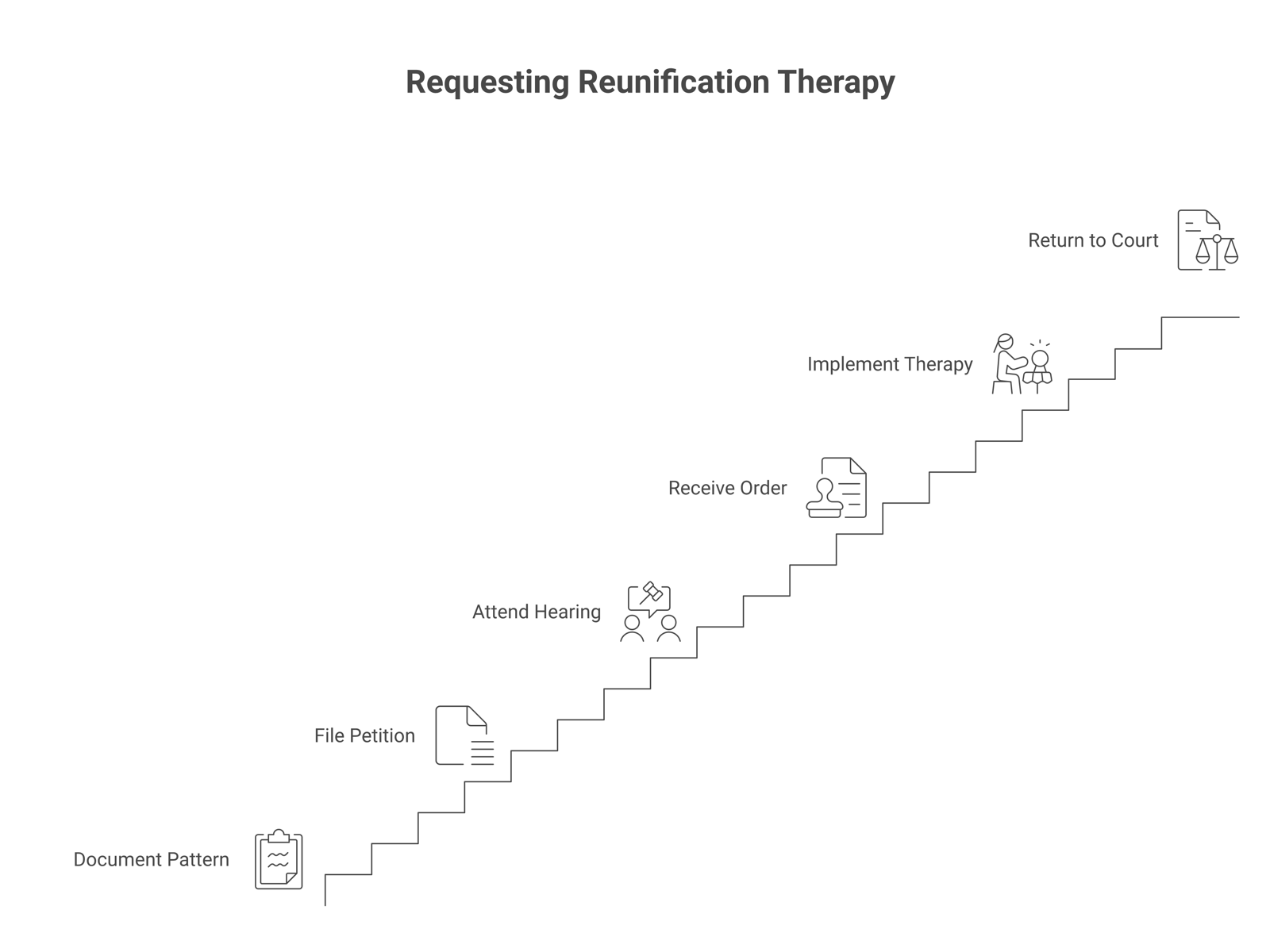
- Document the pattern first. Keep a dated record of missed exchanges, blocked calls, and the child’s shifting behavior. Courts rule on documented facts, not on the label “parental alienation.” The record is what later supports a request. For the evidence work this takes, see how to prove parental alienation.
- Consult a licensed family-law attorney. Reunification therapy is usually sought through a motion in an existing custody case. An attorney in the relevant jurisdiction can identify the right filing and the local standard.
- File the request with the family court. The motion asks the judge to order reunification therapy and explains how it serves the child. It can ride alongside a request to enforce or modify an existing order. See parental alienation court order for how these orders are structured.
- Support the request with evidence and, where ordered, an evaluation. Judges often rely on a custody evaluator or a forensic expert to assess the family before ordering treatment. The evaluation helps the court separate alienation from a child’s justified fear of an unsafe parent.
- Propose a qualified provider and defined goals. A strong request names a provider trained in this specific work and states what the therapy should accomplish. Vague orders tend to stall. Defined goals give the provider and the family something to measure.
- Ask the court to screen for abuse and build protection into the order. A protective screen comes first. If the evidence shows a child is reacting to real abuse, reunification is not the answer, and a careful court will say so.
- Attend, comply, and return to court if the order is obstructed. Orders only work when followed. When one parent blocks the therapy, the documented obstruction can support a return to court. The structured-order frameworks in the field expect the provider to report roadblocks back to the judge.
What courts weigh before ordering it
A court does not order reunification therapy automatically. Judges weigh the child’s safety, the evidence of what caused the rupture, and what serves the child’s best interests. Several questions tend to drive the decision.
Is the rejection out of proportion to anything the rejected parent did? Complete rejection of a loving parent is rare. Even children of abusive parents usually resist being separated from them. When a child wholly rejects a parent who is trying to connect, courts and clinicians treat that pattern as a signal worth examining, not as proof by itself.
Has conventional therapy already failed? In the structured frameworks, repeated failed therapy is itself diagnostic. A child placed in individual therapy for a relationship problem, without the rejected parent in the room, may not improve and can get worse.
How much weight should the child’s stated wishes carry? A child embedded in one parent’s home may not be expressing a free choice. Courts try to weigh the child’s voice without treating a coached preference as the final word.
The role of evaluators and experts
Evaluators and experts give the court an independent read. A custody evaluator interviews the family, reviews records, and reports on what is happening and why. A forensic mental-health expert may testify about whether the case fits alienation, justified estrangement, or something else.
This step is also the main safeguard against the worst error. A careful evaluation is how a court distinguishes a child manipulated into rejecting a safe parent from a child protecting themselves from a dangerous one. The American Psychological Association publishes general guidance on divorce and child-custody issues, and the American Bar Association Section of Family Law offers consumer information on how custody matters proceed.
What a sound order looks like
A sound reunification order shares three features. It protects the child first, it names a qualified provider, and it sets defined goals.
Protection first, reunification second. Linda Gottlieb, a licensed family therapist who developed one of the intensive reunification programs, frames the priority clearly. Once a court finds alienation, the primary job is protecting the child from continued harm. Reunification with the rejected parent is the secondary, downstream goal. Reversing that order, by forcing reunification while the harmful behavior continues, tends to re-traumatize the child and predicts failure.
This sequence is not unique to one clinician. Dr. Craig Childress’s attachment-based model makes the same ordering explicit: assessment and protection come before therapy, because therapy aimed at a child still inside a harmful environment can make things worse. Childress’s model is an influential minority position that remains contested even within the field that accepts parental alienation, and courts and mainstream professional guidelines have not adopted it, but on this sequencing point it matches the wider protection-first view. The shared principle is simple. Stabilize and protect, then treat.
A qualified, specifically trained provider. General counseling training is not enough for this work. The structured court-order template developed by attorney Brian Ludmer, anchored in a 1991 Quebec decision, calls for a directive provider, a defined session cadence, the named family members in the room, and reports back to the court when the case hits a roadblock. The order, not vague hope, drives the process.
Defined, measurable goals. A good order states what therapy is for and how the parties and the court will know it is working. It also leaves room for the long timeline these cases usually require, which is covered in how long reunification therapy takes.
The serious controversy and cautions
Reunification therapy is genuinely contested, and an honest page has to say so. The disagreement is sharpest over intensive programs.
Intensive models compress the work into a few structured days. Programs in this lineage, such as Family Bridges, report high success rates, but those figures are program and developer self-report without control groups. Richard Warshak’s 2010 outcome study of Family Bridges, for example, reported 22 of 23 children restoring the relationship in the initial case series, and Warshak is the program-affiliated author; independent evaluation of these programs does not exist. Supporters see a humane alternative when weekly therapy has failed for years. Critics, including researcher Jean Mercer, question the evidence base, point to documented reports of harm, and object to the removal of a child from a preferred parent and the lack of independent regulation. Both concerns are real, so a parent should weigh them with counsel and a qualified clinician rather than assume any program is right.
Legislatures have started to respond. The federal Keeping Children Safe From Family Violence Act, known as Kayden’s Law and enacted as Title XV of the Violence Against Women Act Reauthorization of 2022, gives states grant incentives to limit court-ordered reunification treatment, raise expert-qualification standards, and train judges on family violence. As of mid-2026, Colorado (2023), California (SB 331, Piqui’s Law, 2023), Pennsylvania (Act 8 of 2024), and Utah (Om’s Law, 2024) have adopted conforming laws; California’s version bans coercive reunification camps and forcible transport outright. Any parent requesting a reunification order should know whether their state has adopted these limits. See Kayden’s Law for the details.
The most serious caution involves abuse. Forcing reunification with a genuinely abusive parent can seriously harm a child. When a child’s distancing is a response to real abuse or neglect, that is justifiable estrangement, not alienation, and it calls for protection, not reunification. Courts and clinicians have a duty to screen for abuse first. A program or order that skips that screen is unsafe, regardless of its name or its marketing.
Reunification also cannot be forced into being. Advocates and clinicians who guide rejected parents consistently describe reconnection as a multi-year arc that depends on the rejected parent’s own steadiness, not on pressure. A court can order sessions. It cannot order a child to feel.
What this page does not do
This page is general education. It is not legal or clinical advice, it does not create any professional relationship, and it does not address any one state’s law or any single case. It does not tell a reader what to file or predict any result. It does not frame therapy as a way to win against the other parent. Decisions about a motion, a provider, or a child’s safety belong to the reader together with a licensed family-law attorney and a qualified clinician in their own jurisdiction. For related options, see parental alienation and child custody, the Court silo, and the broader parental alienation therapy overview.
Frequently asked questions
How do you get a court to order reunification therapy?
A parent usually asks through a written motion in a custody case, supported by documented evidence and, in many cases, a custody evaluation. The court weighs the child’s safety and best interests before deciding. No filing guarantees an order. A licensed family-law attorney in the relevant jurisdiction can advise on the right request.
Can a parent request court-ordered reunification therapy?
Yes. A parent can ask the family court to order it, often alongside a request to enforce or modify a parenting plan. The court decides whether to grant it. The strength of the documented record and any evaluation matters a great deal, and the decision always turns on the child’s wellbeing rather than either parent’s preference.
What should a reunification therapy order include?
A sound order protects the child first, names a provider trained in this specific work, and sets defined, measurable goals. Many structured orders also state the session cadence, name who attends, and require the provider to report problems back to the court. Vague orders without protection or clear goals tend to stall.
Can a court force reunification therapy with an abusive parent?
It should not. When a child’s rejection reflects real abuse or neglect, that is justifiable estrangement, not alienation, and protection comes first. Courts and clinicians are expected to screen for abuse before ordering reunification. Forcing contact with a genuinely abusive parent can seriously harm a child, which is why the screen matters.
How long does court-ordered reunification therapy take?
It varies widely, from a few structured days in an intensive model to a multi-year arc in severe cases. Duration depends on severity, the order’s design, and whether the harmful behavior stops. The timeline question is covered in more depth in how long reunification therapy takes.
For a structured, both-parents method a court can order, see New Ways for Families.
Sources and further reading
- American Bar Association, Section of Family Law. americanbar.org/groups/family_law
- American Psychological Association. Divorce and child custody. apa.org/topics/divorce-child-custody
- Harman, J. J., Kruk, E., & Hines, D. A. (2018). Parental alienating behaviors: An unacknowledged form of family violence. Psychological Bulletin, 144(12), 1275 to 1299. https://doi.org/10.1037/bul0000175
- Warshak, R. A. (2010). Family Bridges: Using insights from social science to reconnect parents and alienated children. Family Court Review, 48(1), 48 to 80. https://doi.org/10.1111/j.1744-1617.2009.01288.x
- Mercer, J. (2019). Examining parental alienation treatments: Problems of principles and practices. Child and Adolescent Social Work Journal, 36(4), 351 to 363.
- Keeping Children Safe From Family Violence Act (Kayden’s Law), Title XV, Violence Against Women Act Reauthorization Act of 2022, Pub. L. 117-103, codified at 34 U.S.C. 10446(k).
If you or your child are in crisis
Free and confidential help is available right now.
- 988 Suicide and Crisis Lifeline. Call or text 988. 988lifeline.org
- Childhelp National Child Abuse Hotline. 1-800-422-4453. childhelp.org
- NAMI HelpLine. 1-800-950-6264. nami.org/help
Last reviewed: 2026-06-06. Author: Alex Buckles (PAC Founder).