

A guardian ad litem, or GAL, is a court-appointed adult who investigates and reports on a child’s best interests. The GAL works for the court, not for either parent. In parental alienation cases, the GAL’s interviews and records review can surface coaching and contact interference, or miss them. Knowing the role and its limits matters on every side.
A caveat before anything else
A child’s resistance to a parent is not always alienation. Where a child’s distancing is driven by genuine abuse, neglect, or frightening behavior, it is justified estrangement, and a GAL’s first job is to screen for that. Nothing on this page is a script for steering a GAL toward a preferred conclusion. A GAL process only helps children when it is allowed to look at everything. If a child’s safety is at risk, contact local law enforcement or a domestic-violence resource first.
This page is general US-national education. It is not legal advice, it does not create an attorney-client relationship, and it does not address any one state’s law. GAL roles, titles, and powers vary widely by state and even by county. Anyone with a GAL question should consult a licensed family-law attorney in their own state.
The short answer
A guardian ad litem is appointed by a judge to be the court’s independent eyes on a child’s situation. The GAL typically interviews both parents, the child, and people around the family, reviews records, and reports findings or recommendations to the court. Judges often give that report real weight, though the judge always decides.
In alienation cases, the GAL sits at a hard junction. A child may repeat one parent’s script with full conviction. A favored parent may present as calm and cooperative while quietly blocking contact. A targeted parent may present as angry and desperate while telling the truth. A careful GAL process can untangle that. A rushed or one-sided one can entrench it.
What a guardian ad litem is, and is not
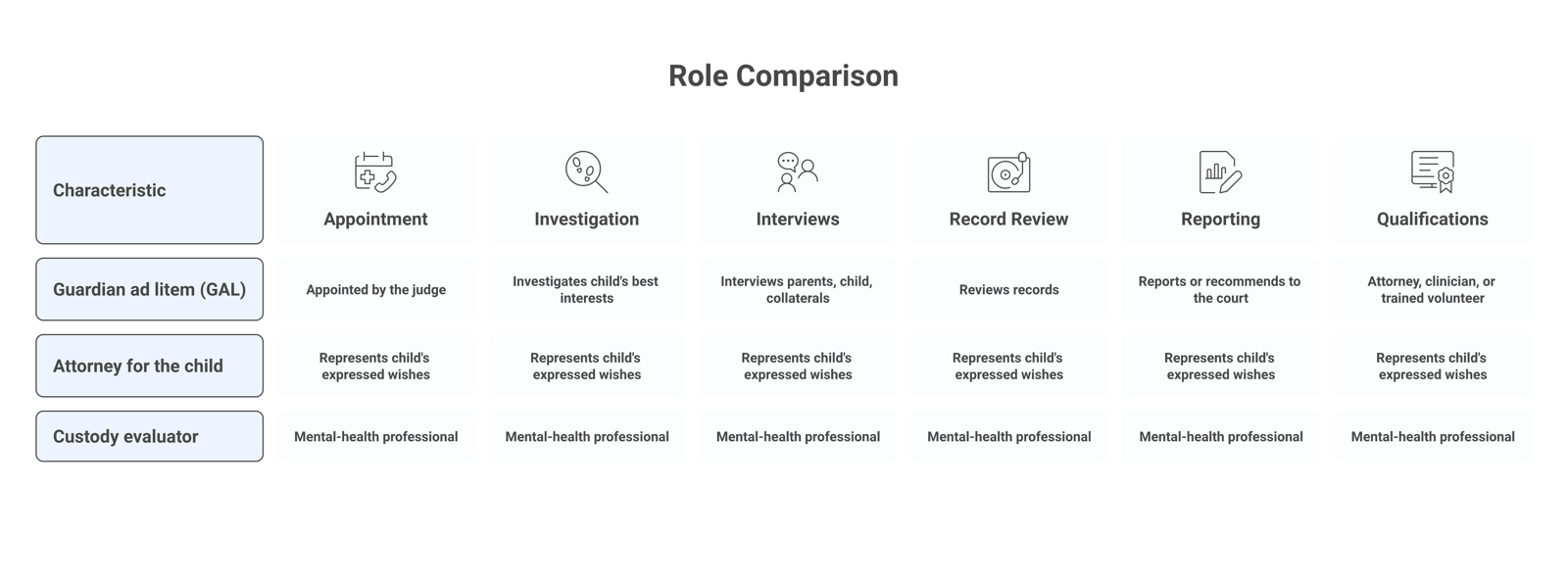
The label “guardian ad litem” covers different jobs in different states, so the first task in any case is to read the appointment order. It defines what this GAL, in this case, is allowed and required to do. That said, three roles are worth distinguishing in general terms.
A best-interests GAL investigates and reports on what arrangement would serve the child. Depending on the state, the GAL may be an attorney, a mental-health professional, or a trained volunteer. In the child-welfare context, many courts use trained volunteers through Court Appointed Special Advocate programs; the National CASA/GAL Association describes that best-interests model. In private custody disputes, GALs are more often attorneys or clinicians appointed under state statute or court rule.
An attorney for the child is different. That lawyer represents the child’s expressed wishes, the way any lawyer represents a client, even when the lawyer privately doubts those wishes. The distinction matters enormously in alienation cases, because an alienated child’s stated wishes may be the product of the very dynamic the court is trying to assess. Some states blend these roles or use hybrid titles, which is why the appointment order controls.
A custody evaluator is different again. An evaluator is a mental-health professional who conducts a formal forensic assessment, often with psychological testing, and produces a detailed report. A GAL investigation is usually shorter, less clinical, and less expensive. Courts sometimes appoint both. The evaluation process is covered in preparing for a custody evaluation, and the professional-side view sits at the custody evaluation.
What GALs investigate
Most GAL investigations draw on the same basic sources. The GAL interviews each parent, usually more than once, and observes the child with each parent where possible. The GAL talks to the child in an age-appropriate way, often at each home. Collateral interviews reach teachers, pediatricians, therapists, coaches, relatives, and anyone else with firsthand knowledge. Records review can cover school files, medical and therapy records where lawfully available, court filings, and communications between the parents.
From all of that, the GAL builds a picture: how the child functions in each household, how each parent supports or undermines the child’s relationship with the other, whether there are safety concerns, and what the child’s daily life actually looks like. The report then goes to the court, and in many states the GAL can be questioned at trial about its basis. What judges tend to do with that material is covered in what judges look for in custody cases.
How alienation dynamics complicate GAL work
Alienation cases strain the standard GAL toolkit in specific ways, and honest professionals on every side of the research debate acknowledge the difficulty.
First, the child’s own statements cannot be taken at face value in either direction. A child may voice intense, rehearsed-sounding rejection of one parent, insist the views are entirely their own, and use adult phrasing about events they could not have witnessed. Richard Gardner described patterns like these decades ago in his list of behavioral manifestations, and the modern field still uses them descriptively while rejecting his syndrome framing. But the same surface behavior can also come from a child who has good reasons to be afraid. Distinguishing a coached script from an earned fear is the core of the task, and it cannot be done from one interview. It takes history: what the parent-child relationship looked like before the conflict, whether abuse or neglect has been screened and ruled out, and whether one parent’s documented conduct maps onto known alienating behaviors. The reasoning behind that screen-first sequence is laid out in how to prove parental alienation.
Second, presentation cuts against the truth in both directions. Favored parents in alienation cases can be composed, charming, and fluent in best-interests language. Targeted parents, after months or years of losing a child, often present as exactly what the other side calls them: angry, reactive, obsessed with documentation. A GAL who reads demeanor as character will be systematically misled. A GAL who tracks verifiable conduct over time is much harder to mislead.
Third, time pressure is real. Many GALs carry heavy caseloads and limited budgets. A thorough alienation assessment needs multiple contacts spread over time, because a single snapshot tends to capture the script rather than the dynamic.
How to work productively with a GAL
For a parent on either side of an alienation allegation, the productive posture is the same, and it is not a tactic. It is cooperation with an investigation whose job is the child, not the parent.
That means responding promptly and completely to the GAL’s requests, making the child available without editorializing before or after visits, and providing organized, dated documentation rather than commentary. A contemporaneous record of schedules, exchanges, communications, and missed contact, kept the way building a parental alienation case file describes, lets the GAL verify claims instead of weighing one parent’s word against the other’s.
It also means naming the other parent’s strengths honestly. A parent who can say what the other parent does well, and who supports the child’s relationship with the other parent wherever it is safe, demonstrates exactly the capacity courts are looking for. A parent who cannot say one good thing invites the GAL to wonder where the child’s all-or-nothing view came from.
What it never means is coaching. Rehearsing the child for GAL interviews, drilling talking points, or quizzing the child afterward are alienating behaviors in themselves, they are frequently transparent to experienced interviewers, and they harm the child the process exists to protect. The same goes for attempts to flood, flatter, or steer the GAL. The American Bar Association’s Section of Family Law publishes professional material on children’s representation that makes the independence of these roles plain.
Red flags of a poor GAL process
GAL quality varies, and it is fair to say so. Concerns worth raising with counsel, through proper channels, include a GAL who has spoken to only one parent or only one side’s collaterals by the time conclusions form; conclusions announced before the investigation is substantially complete; refusal to review readily available records that bear on the central dispute; reliance on a single child interview conducted in one parent’s presence or home only; demeaning or visibly partisan conduct; and a report whose factual assertions cannot be traced to any identified source.
None of those, alone, proves bias, and disagreeing with a GAL’s conclusion is not evidence of a bad process. The remedy for a flawed process is procedural and runs through counsel: a motion to clarify or expand the investigation, cross-examination of the GAL on the report’s basis, a request for a full custody evaluation, or, in serious cases, a motion concerning the appointment itself. Professional-practice standards, such as those collected by the Association of Family and Conciliation Courts, give counsel a vocabulary for what a sound process looks like. Self-help attacks on the GAL, in front of the child or in writing, reliably backfire and usually hurt the child. For the courtroom context around all of this, see working with a skeptical court, and for the adjacent post-decree role, see parenting coordinators in parental alienation cases.
Frequently asked questions
What does a guardian ad litem do in a parental alienation case?
The GAL investigates the child’s situation for the court: interviews with both parents and the child, collateral interviews with teachers and therapists, and records review. In an alienation case the central task is distinguishing a coached or pressured rejection from estrangement justified by a parent’s own conduct, which requires screening for abuse first and tracking documented behavior over time.
Is a guardian ad litem the same as a custody evaluator?
No. A custody evaluator is a mental-health professional who performs a formal forensic assessment, often with testing, and writes a detailed clinical report. A GAL conducts a usually shorter, less clinical best-interests investigation. An attorney for the child is different from both, because that lawyer advocates the child’s expressed wishes. Titles and powers vary by state, so the appointment order controls.
Can a GAL detect coaching of a child?
Sometimes. Experienced interviewers look for rehearsed phrasing, adult language, borrowed scenarios the child could not have witnessed, and stories that shift when explored gently. But no interviewer is infallible, and a single interview is a weak basis either way. Multiple contacts over time, collateral information, and documented parental conduct are what make coaching visible.
Do judges have to follow the GAL’s recommendation?
No. The GAL reports or recommends; the judge decides. In practice many judges give GAL reports significant weight, which is why the quality of the underlying investigation matters and why parties can usually test the report through cross-examination.
What should I do if I believe the GAL is biased?
Raise it through counsel and through process, not through confrontation. Options vary by state but can include asking the GAL to complete specific interviews or review specific records, cross-examining the GAL on the report’s basis, requesting a full custody evaluation, or moving the court regarding the appointment. Attacking the GAL informally, or in front of the child, tends to damage the complaining parent’s case.
What this page does not do
This page does not tell any reader how to win over a GAL, and it does not treat the GAL process as a contest to be managed. It does not diagnose alienation in any family, and it does not assume that a child’s rejection of a parent is alienation rather than a justified response to that parent’s conduct. The right use of this information is to understand the role, cooperate with the investigation honestly, document accurately, and bring procedural concerns to a licensed attorney.
For the wider courtroom picture, see what judges look for in custody cases, how to prove parental alienation, and preparing for a custody evaluation. The full Court silo covers the rest.
Sources and further reading
- National CASA/GAL Association for Children. The CASA/GAL model: best-interests advocacy for children. nationalcasagal.org
- American Bar Association, Section of Family Law. Resources on family law practice and the representation of children. americanbar.org
- Association of Family and Conciliation Courts. Practice guidelines and standards. afccnet.org
- Bernet, W., and Greenhill, L. L. (2022). The Five-Factor Model for the diagnosis of parental alienation. Journal of the American Academy of Child and Adolescent Psychiatry, 61(5), 591 to 594. https://doi.org/10.1016/j.jaac.2021.11.026
- Kelly, J. B., and Johnston, J. R. (2001). The alienated child: A reformulation of parental alienation syndrome. Family Court Review, 39(3), 249 to 266.
If you or your child are in crisis
Free and confidential help is available right now.
- 988 Suicide and Crisis Lifeline. Call or text 988. 988lifeline.org
- Childhelp National Child Abuse Hotline. 1-800-422-4453. childhelp.org
- NAMI HelpLine. 1-800-950-6264. nami.org/help
Last reviewed: 2026-06-10. Author: Alex Buckles (PAC Founder).