

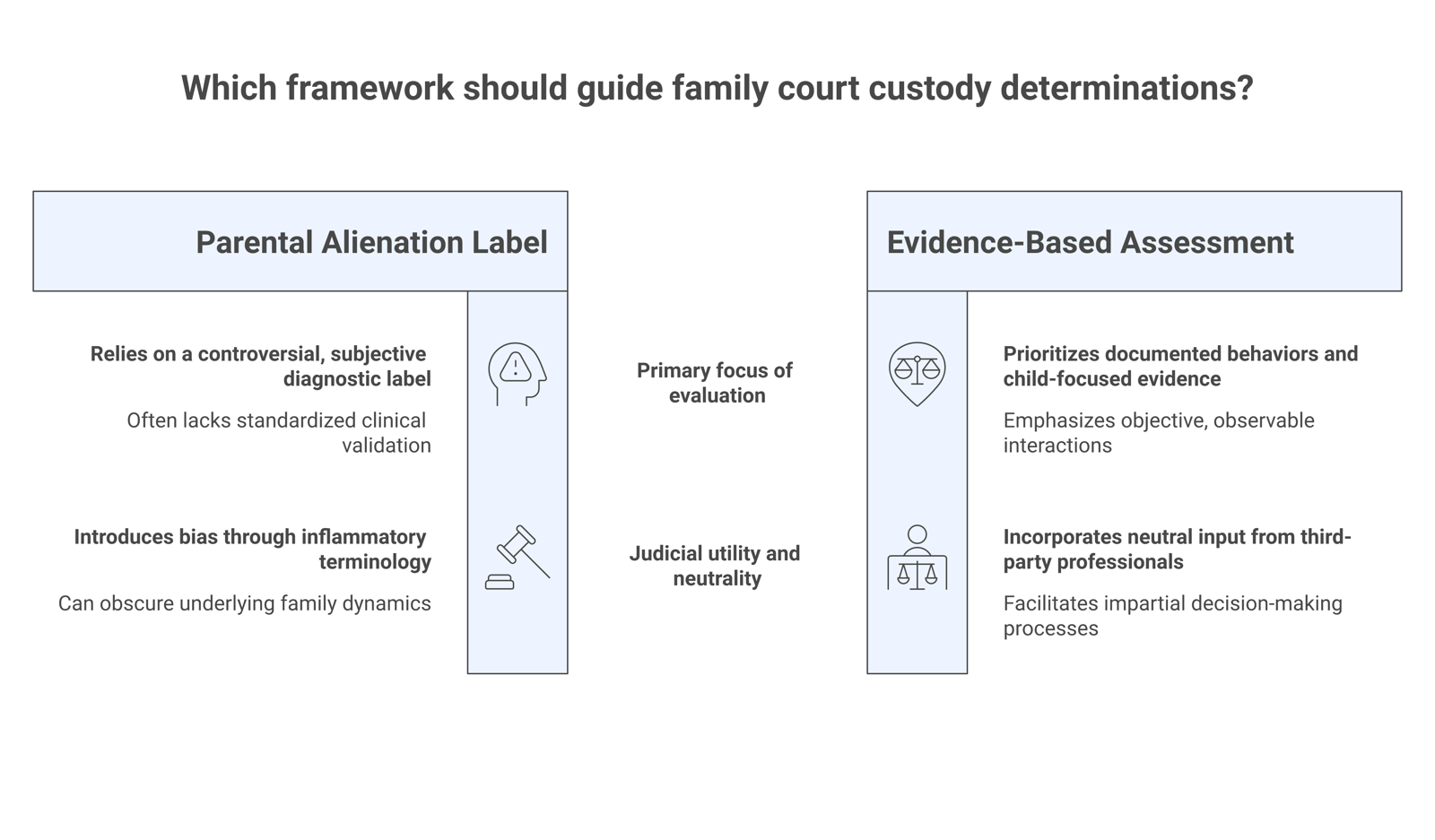
How do judges view parental alienation? Most family-court judges are cautious about the label and focused on conduct. They want a documented record of behaviors, evidence of the effect on the child, and credible, neutral input. Courts act on what a parent did, not on a diagnosis or an accusation alone.
This page is general, US-national education. It is not legal advice, it does not create an attorney-client relationship, and it does not address any one state’s law. State laws and procedures vary. Anyone considering action should consult a licensed family-law attorney in their own jurisdiction.
A note on safety
Courts must, and do, separate alienation from a child’s justified estrangement from an abusive parent. If the rejected parent has been abusive, neglectful, or genuinely dangerous, the child’s distancing is justifiable estrangement, not parental alienation, and it is a different legal and safety matter. The “behaviors not labels” standard cuts both ways: it protects a falsely accused protective parent just as it protects a falsely accused targeted parent. If a child’s safety is at risk, contact local law enforcement or a crisis resource first.
How do judges view parental alienation in practice
Most parents picture a judge who hears the words “parental alienation,” recognizes the pattern, and rules. The reality is more guarded. A careful judge treats the phrase itself with caution, because it is contested and because it surfaces on both sides of many high-conflict cases. What earns a ruling is not the label but the record beneath it.
Family courts act on documented behaviors, not on diagnostic terms. As one judicial framework puts it, “labels don’t give us any basis on which to make a ruling. It’s the facts that give us that ability.” A judge does not need to be told a parent is a narcissist or an alienator. The court needs to see what that parent actually did, when, and how it affected the child. That distinction shapes everything a parent should understand about the bench.
Why judges are wary of the term
The skepticism is not hostility toward targeted parents. It is a response to how the term gets used. In contested custody, both parents often reach for the strongest available word, and “alienation” is a strong word. A parent raising a genuine safety concern can be wrongly accused of alienating. A parent engaged in alienating conduct can hide behind a counter-accusation. So a careful judge distrusts the term on its own and asks what happened in the home.
This caution protects children in both directions. Courts have to keep a bright line between alienation and justified estrangement, since a child who distances from an abusive parent is responding to real harm, not to manipulation. The behaviors-not-labels approach is what lets a court draw that line on evidence rather than on whoever says the word first. For the meaning of the term and why behavioral framing tends to win, see parental alienation syndrome.
Behaviors, not labels: the standard that moves a court
The practical doctrine behind judicial skepticism is the behaviors-not-labels standard described by attorney Ashish Joshi and Judge Jon Van Allsburg. Their core point is that a trial court can find alienation on behaviors alone, without an expert diagnosing a syndrome. Courts have always evaluated bad behavior, and alienating conduct is, in Joshi and Van Allsburg’s framing, bad behavior a court can name and act on.
Two consequences follow. The first is what a parent should bring: specific, dated conduct rather than clinical vocabulary. A parent who arrives with strategies the court can see (interfering with parenting time, denigrating the other parent, blocking communication) is in a stronger position than one who arrives with a label and no facts. The second consequence is what a court can sanction. Nobody is sanctioned for “parental alienation” by name. A parent is sanctioned for violating a parenting-time order or a reunification-therapy order. Many state best-interest tests also weigh each parent’s willingness to support the child’s bond with the other parent, which is where a behavioral record carries real weight. The documentation work this requires is covered in how to prove parental alienation.
What a judge weighs when alienation is alleged
This page stays in its lane: it covers how the bench thinks about the alienation question itself. The general best-interests factors that govern every custody case, stability, caregiving, the child’s needs, and the rest, have their own page at what judges look for in custody cases. When alienation is alleged, what a judge weighs tends to fall into a few recurring categories. None of them is the label.
- A clear behavioral record. Dated, factual, and specific. Neutral language beats venting. A pattern over time persuades more than a single dramatic incident.
- Effect on the child. Courts care about what the conduct did to the child, not only that it happened. Evidence that ties a behavior to a change in the child is stronger than the behavior alone.
- Credibility and demeanor. Cases are decided by people, and people weigh how a parent presents. A targeted parent in visible distress can look like the problem next to a calm favored parent, which is one reason a measured, factual presentation matters.
- Each parent’s willingness to support the other bond. A parent who actively facilitates the child’s relationship with the other parent reads very differently from one who obstructs it.
The American Bar Association’s Section of Family Law publishes general consumer information on how custody and best-interest analysis work. The throughline across all of it is documented conduct measured against the child’s interests. For the remedies a court can order once a pattern is established, see parental alienation and child custody.
How gatekeepers shape what a judge sees
A judge rarely observes the family directly. Much of what reaches the bench is filtered through a guardian ad litem (GAL) or a custody evaluator, and that filter shapes the ruling. Understanding the filter explains why a case that feels obvious to a parent can land flat in court.
Ryan Thomas, who was an alienated child for decades before reconnecting with his father, describes several reasons a GAL can miss alienation even when a parent believes it is clear. (He states plainly that his account is lived experience, not legal advice.) A low-experience GAL may accept a narrative at face value rather than investigate it. The favored parent often tells the GAL the same story told to the child, which can poison the GAL against the targeted parent and turn the GAL into a third-party endorsement of the alienator. Natural emotion from the targeted parent, the tears and frustration of a family being torn apart, can be read back as instability. The child, meanwhile, may simply relay the favored parent’s script. A judge who receives that report inherits its blind spots.
The custody evaluator carries similar weight and similar risk. An evaluation is one input, not a verdict, and a skilled evaluator can mistake a pathologically enmeshed parent-child bond for a healthy one because enmeshment can look like closeness from the outside. A parent who understands how these roles work can present facts that survive a face-value reading rather than relying on the gatekeeper to uncover the truth unprompted.
What credible experts add for a skeptical judge
When a case genuinely needs experts, their job is to orient a judge who may never have been trained on the subject. Texas family-law attorney Robert Hoffman describes a two-expert model for serious cases: a generic educating expert who teaches the court what parental alienation is and how to rule it in or out, plus a case-specific forensic expert who reviews the records and maps the facts to a mild, moderate, or severe determination. The educating expert addresses the court’s skepticism directly, and the forensic expert ties the science to this family.
Written materials can do similar work. The Parental Alienation Study Group authored an “official synopsis,” a roughly 140-page consensus document built to be read by a judge, GAL, or attorney in about two hours and designed to answer the three recurring objections a court hears: that there is no research, that the concept does not belong in court, and that no professional organization recognizes it. Whether a case uses live experts, documents like that, or neither, the function is the same, which is to convert a contested label into something a court can evaluate on evidence. For how to vet and use these witnesses, see parental alienation expert witness.
The assumptions a judge brings to the bench
Judges are people, and people carry priors into a courtroom. Some widely held custody assumptions are not well supported by current research. Dr. Don Hubin and the National Parents Organization, describing their work as child-focused and research-based, borrow a line from Mark Twain: “it ain’t what you don’t know that gets you in trouble, it’s what you know for sure that just ain’t so.” The point is not to attack the bench. It is that a calm, child-centered, research-grounded presentation tends to move a court further than parents’-rights rhetoric or heated accusation.
This is also why measured advocacy matters more than intensity. A judge weighing two parents is reading credibility constantly, and a presentation organized around the child’s interests, rather than around grievance, fits how most courts prefer to reason. For help building that kind of case with counsel, see how to choose a parental alienation lawyer, and for the broader set of court-facing resources, visit the Court pillar.
Frequently asked questions
How do judges view parental alienation?
Most family-court judges are cautious about the label and focused on conduct. They generally will not act on the phrase “parental alienation” by itself, because it is contested and appears on both sides of many cases. What moves a court is a documented record of specific behaviors, evidence of the effect on the child, and credible, neutral input. Courts act on facts, not on diagnoses or accusations alone.
What does a judge weigh when parental alienation is alleged?
A clear, dated behavioral record; evidence of how the conduct affected the child; each parent’s credibility and demeanor; and each parent’s willingness to support the child’s relationship with the other parent. Many best-interest tests weigh that last factor directly. A pattern documented over time persuades more than a single incident or a strong label. The general best-interests factors are covered separately on what judges look for in custody cases.
Do judges believe in parental alienation?
Many judges accept that one parent can undermine a child’s relationship with the other, and courts can find alienation on documented behaviors alone, without an expert diagnosing a syndrome. Belief in the term as a label matters less than the evidence. A judge can act on the conduct whether or not the word “alienation” is used.
Why are judges skeptical of parental alienation claims?
Because the term is contested and can be misused by either parent in a high-conflict case. A protective parent can be wrongly accused of alienating, and a genuinely alienating parent can hide behind a counter-accusation. Skepticism toward the label is how a careful court keeps the line between alienation and a child’s justified estrangement from an abusive parent.
What evidence convinces a judge of parental alienation?
Specific, contemporaneous documentation of conduct, escalated to the strongest available proof, paired with evidence of the effect on the child and, where the case needs it, credible expert testimony. Recordings, dated records, and neutral third-party observations carry more weight than a parent’s belief or a clinical label offered without facts.
What this page does not do
This page is not legal advice. It does not name any one state’s statutes as if they applied nationally, and it does not tell readers what to file or when. It does not coach anyone to manage or game a judge. Choices about motions, evaluations, experts, and any filing belong to a licensed attorney working with the actual facts. The page does not frame court as a contest to win. The right use of this material is to understand how courts reason so that a parent can present honest, child-focused evidence.
Where to go next
- For the documentation that becomes evidence, read how to prove parental alienation.
- For the remedies a court can order, see parental alienation and child custody.
- For vetting and using experts, see parental alienation expert witness.
- For choosing counsel, see how to choose a parental alienation lawyer.
- For the full set of court-facing resources, visit the Court pillar.
For documented examples of how courts have weighed alienating conduct, see our case studies of Sharp v. Keeler and Hanson v. Spolnik.
Sources and further reading
- American Bar Association, Section of Family Law. americanbar.org/groups/family_law
- Harman, J. J., Kruk, E., & Hines, D. A. (2018). Parental alienating behaviors: An unacknowledged form of family violence. Psychological Bulletin, 144(12), 1275 to 1299. https://doi.org/10.1037/bul0000175
- American Psychological Association. Divorce and child custody. apa.org/topics/divorce-child-custody
- Joshi, A. S. (2021). Litigating Parental Alienation: Evaluating and Presenting an Effective Case in Court. American Bar Association.
If you or your child are in crisis
Free and confidential help is available right now.
- 988 Suicide and Crisis Lifeline. Call or text 988. 988lifeline.org
- Childhelp National Child Abuse Hotline. 1-800-422-4453. childhelp.org/hotline
- NAMI HelpLine. 1-800-950-6264. nami.org/help
Last reviewed: 2026-06-06. Author: Alex Buckles (PAC Founder).