
Is parental alienation child abuse? A growing group of researchers argues that severe alienating behavior meets the clinical definition of child psychological abuse. Critics counter that the label is contested, is not a formal diagnosis, and can be misused against protective parents. This page lays out both cases fairly.
A note on safety
A child pulling away from a parent is not always alienation. When the rejected parent has been abusive, neglectful, or frightening, the child’s distancing is justified estrangement, and it must never be relabeled as alienation. The “child abuse” framing on this page describes a contested argument, not proof about any one family. If a child is in danger, contact local law enforcement or a domestic-violence resource first.
This page is general education. It is not legal advice or clinical advice, and it does not diagnose any person or family. It describes how experts disagree about whether parental alienation should be classed as child abuse. Anyone facing a real situation should consult a licensed clinician or attorney.
The short answer
Whether parental alienation is child abuse is a genuine, unresolved debate. One camp says yes: severe alienating behavior fits the recognized pattern of child psychological abuse and a related form of family violence. Another camp says the question is not that simple, because “child abuse” is a serious legal and clinical label that is easy to weaponize and hard to prove case by case.
Both camps agree on one thing. A child’s rejection of a parent can have many causes, and only some of them point to alienation. Affinity, a developmental phase, or a real response to harm can all look similar from the outside. So the honest answer is that the argument is strong on paper, contested in practice, and never a substitute for a careful look at the actual family.
A second point matters before going further. “Child abuse” describes the alleged behavior of an alienating parent. It is not a verdict about the targeted parent, and it is not automatic. Calling alienation a form of abuse raises the stakes of getting the assessment right, in both directions.
The argument that alienation is child psychological abuse
The affirming case rests on a simple claim. When a parent works to destroy a child’s relationship with the other parent, that conduct harms the child, not only the rejected adult. Several researchers have built this claim into formal frameworks.
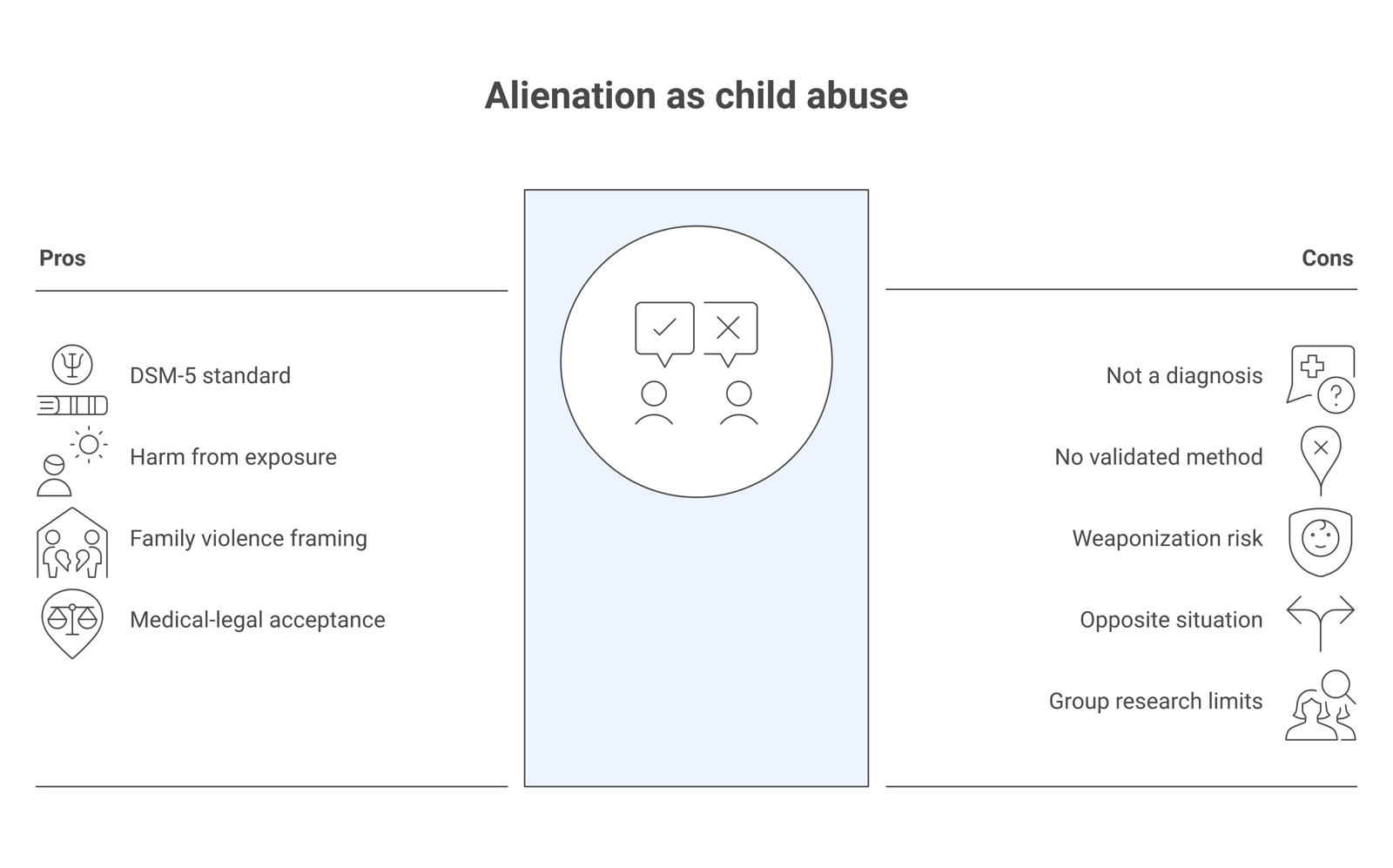
The DSM-5 child psychological abuse argument
The most direct version of the argument runs through the DSM-5. The DSM-5, the diagnostic manual published by the American Psychiatric Association, defines child psychological abuse as nonaccidental verbal or symbolic acts by a parent or caregiver that result in, or have reasonable potential to result in, significant psychological harm to the child. The manual carries a code for it, listed as 995.51, child psychological abuse, confirmed.
Forensic researcher Shawn Wygant and colleagues argue that exposure to alienating behavior already meets this threshold. Their reasoning is that the DSM-5 standard turns on the parent’s harmful acts and their potential to harm, not on whether symptoms have yet appeared in the child. By this logic, a child does not have to be visibly rejecting a parent for the underlying conduct to qualify as psychological abuse. Wygant’s team coded more than 1,200 appellate cases and reported that courts split on how they framed the issue, with some treating it as a symptom question and others as a child-abuse question. That case-coding work was presented at the Parental Alienation Study Group conference in October 2025 and has not yet been published in a peer-reviewed journal, so its figures may change on publication.
This framing is contested, and the page treats it as one position rather than settled fact. Its appeal to proponents is that it shifts attention from the child’s loyalty to the parent’s behavior, which they see as the actual harm.
The family violence framing
A parallel argument comes from Jennifer Harman and colleagues. In a 2018 review in the journal Psychological Bulletin, they argue that parental alienating behaviors map onto recognized patterns of family violence. They describe the conduct as a form of aggression against both the child and the targeted parent, comparable in structure to coercive control. The harm to the child, in this view, is the manufactured fear and the pressure to reject a loved parent.
Edward Kruk and Harman extended this line in a 2024 paper, answering common objections and arguing that alienation should be classed as family violence and child abuse. Both papers are written by scholars who openly hold the affirming position, so the work is best read as a strong statement of one side, not a neutral referee. The framework lens itself, including the point-for-point mapping of alienating behaviors onto the power-and-control wheel and the criticism of that mapping, lives on parental alienation and coercive control; this page stays with the classification question.
The medical-legal review
A more cautious affirming voice comes from a 2022 medical-legal review by Isaila and Hostiuc, published in the journal Healthcare and indexed as PMC9223241. The authors describe parental alienation as a form of psychological abuse and contextual neglect. They draw a clear line between alienation and estrangement, noting that estrangement is a child’s reaction to real abuse by the rejected parent. Their central caution is procedural. They argue the distinction requires careful forensic and psychiatric expertise, precisely to avoid false-positive findings of alienation that could mask genuine abuse.
That review is useful because it holds two ideas at once. It accepts the abuse framing in principle while insisting on safeguards that the critical camp also demands.
What “child psychological abuse” actually means
It helps to separate two things that often blur together. There is the clinical concept of child psychological abuse, and there is a formal diagnosis. The DSM-5 lists child psychological abuse as a condition that can be a focus of clinical attention. It is not a diagnosis of the child in the usual sense, and “parental alienation” itself is not a DSM-5 or ICD-11 diagnosis at all.
This gap is where much of the disagreement lives. Proponents say the alienating behavior fits the existing abuse definition, so a separate diagnosis is unnecessary. Skeptics say that without a validated way to identify alienation, attaching the abuse label risks labeling the wrong parent. The concept and the proof are not the same thing.
The critical counterpoint
The cautionary camp does not deny that children can be harmed by a parent’s manipulation. Its objection is narrower and sharper. It says the “child abuse” label is contested, carries heavy consequences, and is easy to misuse.
Psychologist Jean Mercer, a longstanding critic, has argued that the broader parental alienation framework lacks the validation that a child-protection label should require. Her work focuses on the treatments built around the construct, which she argues have not been shown to be safe or effective. Her concern extends to the labeling itself. If “alienation equals abuse” becomes a reflex, a parent who is protecting a child from a genuinely harmful ex can be recast as an abuser for keeping the child away.
This is the weaponization risk the charter of this site takes seriously. A 2020 study by Joan Meier and colleagues, published through the National Institute of Justice, found that when fathers cross-claimed alienation, courts roughly doubled the rate at which mothers alleging abuse lost custody. The study has its own critics and limits: Jennifer Harman and Demosthenes Lorandos published a methodological critique, Meier published a rebuttal, and the exchange remains unresolved, a back-and-forth covered on the companion research page. The point here is that the abuse framing cuts both ways. It can describe a real harm, and it can be turned into a tool against a protective parent.
The critical camp adds three further cautions. First, a contested label is not a diagnosis, so it cannot replace a case-by-case assessment. Second, group research about alienation cannot establish what is happening in any single family. Third, abuse-driven estrangement is the opposite situation, and relabeling it as alienation is itself a harm to the child.
Why the abuse-vs-alienation boundary holds
Across every camp, one principle survives the disagreement. Centrist scholars, critical scholars, and even many affirming clinicians all insist that abuse-driven estrangement must be kept separate from alienation, and that the two can sometimes co-occur. This shared boundary is the most validated idea in the whole field.
The practical version is straightforward. Before anyone calls a child’s rejection “alienation,” the obvious alternatives have to be ruled out, starting with whether the rejected parent did something that would reasonably make a child afraid. If the child is responding to real harm, the situation is estrangement, and treating it as abuse-by-the-other-parent gets it exactly backward. The abuse argument only applies where genuine alienating behavior, not a protective response, is driving the rejection.
For how courts weigh these competing readings, see how judges view parental alienation. For the clinical work of telling the patterns apart, see the professional guide to differential diagnosis of contact refusal.
How this differs from the emotional-abuse overview
This page is the deeper argument page. It asks whether alienation can be formally classified as child abuse, and it weighs the affirming and critical cases against each other. The consumer-facing overview, is parental alienation emotional abuse, answers a more immediate question for a parent in distress: does what I am seeing look like emotional abuse, and what does that mean for my child. Read that page first if you are trying to make sense of your own situation. Read this page if you want the formal classification debate.
For the wider map of where experts stand, see the three camps in parental alienation and the validity debate on whether parental alienation is junk science. The companion to this page, research on parental alienation and abuse, covers what the empirical studies actually show about how the two relate.
Frequently asked questions
Is parental alienation child abuse?
Some researchers argue yes, that severe alienating behavior fits the DSM-5 definition of child psychological abuse. Critics argue the label is contested, is not a formal diagnosis, and can be misused against protective parents. The honest answer is that it is a real argument, not a settled fact, and it never replaces a careful look at the specific family.
Is parental alienation in the DSM-5?
Parental alienation is not a standalone diagnosis in the DSM-5 or in the ICD-11. The DSM-5 does recognize child psychological abuse as a condition that can be a focus of clinical attention, coded 995.51 when confirmed. Proponents argue alienating behavior fits that existing category; skeptics say that fit is not proven.
What is the difference between alienation and estrangement?
Estrangement is a child’s understandable response to real abuse, neglect, or frightening behavior by the rejected parent. Alienation describes rejection driven by another parent’s manipulation, without a justified cause. The two are opposites, they can occasionally co-occur, and the difference must be assessed case by case rather than assumed.
Can the child abuse label be misused?
Yes. Research on custody cases shows that alienation claims can be used to discredit a parent who is protecting a child from genuine harm. That risk is why responsible clinicians and courts rule out abuse first and avoid treating any label as proof.
Does calling alienation abuse help a child?
It can sharpen attention on harmful adult behavior, but only when the assessment is accurate. A wrong label harms a child in either direction, by missing real abuse or by punishing a protective parent. The label raises the stakes of getting the assessment right.
What this page does not do
This page does not diagnose anyone. It does not tell a reader whether their situation is abuse, alienation, or estrangement. It does not take a side on whether the “child abuse” classification should win, because that question is genuinely unsettled among qualified experts. And it does not offer the label as a tactic. The framing is meant to describe a debate and protect children, not to give one parent an edge in a dispute.
For related reading, see the Learn hub, the emotional abuse overview, the three camps in parental alienation, and research on parental alienation and abuse.
Sources and further reading
- Harman, J. J., Kruk, E., & Hines, D. A. (2018). Parental alienating behaviors: An unacknowledged form of family violence. Psychological Bulletin, 144(12), 1275 to 1299. https://doi.org/10.1037/bul0000175
- American Psychological Association. Divorce and child custody. apa.org/topics/divorce-child-custody
- Isaila, C., & Hostiuc, S. (2022). Medical-legal and psychosocial considerations on parental alienation as a form of child abuse: A brief review. Healthcare, 10(6), 1134. PMC9223241. https://doi.org/10.3390/healthcare10061134
- Kruk, E., & Harman, J. J. (2024). Countering arguments against parental alienation as a form of family violence and child abuse. The American Journal of Family Therapy. https://doi.org/10.1080/01926187.2024.2396279
- Mercer, J. (2019). Examining parental alienation treatments: Problems of principles and practices. Child and Adolescent Social Work Journal, 36(4), 351 to 363. https://doi.org/10.1007/s10560-019-00625-8
- American Psychiatric Association. (2013). Diagnostic and Statistical Manual of Mental Disorders (DSM-5), child psychological abuse (995.51).
If you or your child are in crisis
Free and confidential help is available right now.
- 988 Suicide and Crisis Lifeline. Call or text 988. 988lifeline.org
- Childhelp National Child Abuse Hotline. 1-800-422-4453. childhelp.org
- NAMI HelpLine. 1-800-950-6264. nami.org/help
Last reviewed: 2026-06-07. Author: Alex Buckles (PAC Founder). General education, not legal or clinical advice.