

This page is general information, not legal or clinical advice. It describes a research debate and does not diagnose any reader’s situation. Anyone weighing legal or therapeutic steps should consult a licensed professional in their own jurisdiction.
A growing body of research argues parental alienation is a form of coercive control, because alienating behaviors mirror the power-and-control tactics seen in intimate-partner abuse. Some scholars go further and call it family violence. The framing is gaining ground, yet it remains contested. Here is the case, the evidence, and the criticism.
A note on safety
Genuine abuse by a rejected parent is a separate matter. A child who pulls away from a parent who has hurt them is not being alienated, and the coercive-control framing must never be used to recast a real abuse victim as an alienator. Where a child’s safety is at risk, contact local law enforcement or a domestic-violence resource first.
What coercive control means
Coercive control is a pattern, not a single act. It describes the way one person gradually dominates another through tactics that limit freedom, choice, and connection. The National Domestic Violence Hotline describes coercive control as a web of behaviors, isolation, intimidation, monitoring, and emotional pressure, that traps a person over time.
Researchers often picture this pattern as a wheel. The power-and-control wheel, developed in the 1980s, places power at the center and arranges the common tactics around it as spokes. Each spoke names a way one partner asserts control: isolation, threats, emotional abuse, economic pressure, and the use of children. The wheel was built to explain intimate-partner abuse, where the tactics work together rather than alone.
That last spoke matters here. The wheel has always recognized that an abuser can reach a partner through the children, by passing messages, by monitoring through them, or by using contact as leverage. Several researchers argue that parental alienation lives almost entirely inside that spoke.
The research case that alienation is coercive control
The strongest version of the argument comes from social psychologist Jennifer Harman and her colleagues. In a 2018 review published in the journal Psychological Bulletin, Harman, Edward Kruk, and Denise A. Hines argued that parental alienating behaviors are an unacknowledged form of family violence, and that the behaviors and coercively controlling abuse are not merely similar but the same phenomenon under different labels.
The argument walks through parallel after parallel. Perpetrators tend to share a personality profile and a drive to obtain and keep control. Children of an alienating parent respond much as children of an abusive parent do, with reflexive support and minimizing. Targeted parents report the same trauma, anxiety, and elevated distress that survivors of coercive control report. The pattern, in this reading, repeats across both.
Harman’s central claim is concrete. The behaviors used in alienation map onto the power-and-control wheel, point for point. A parent who relays hostile messages through a child, who uses scheduled time to harass, or who threatens to take the child away is using the wheel’s recognized tactics. To Harman, the label “alienation” simply renames what abuse researchers already named decades ago. For the perpetrator-profile overlap, see parental alienation and narcissism.
How alienating behaviors map onto the power-and-control wheel
The clearest way to weigh the argument is to lay the behaviors beside the wheel and look. Five categories carry most of the mapping.
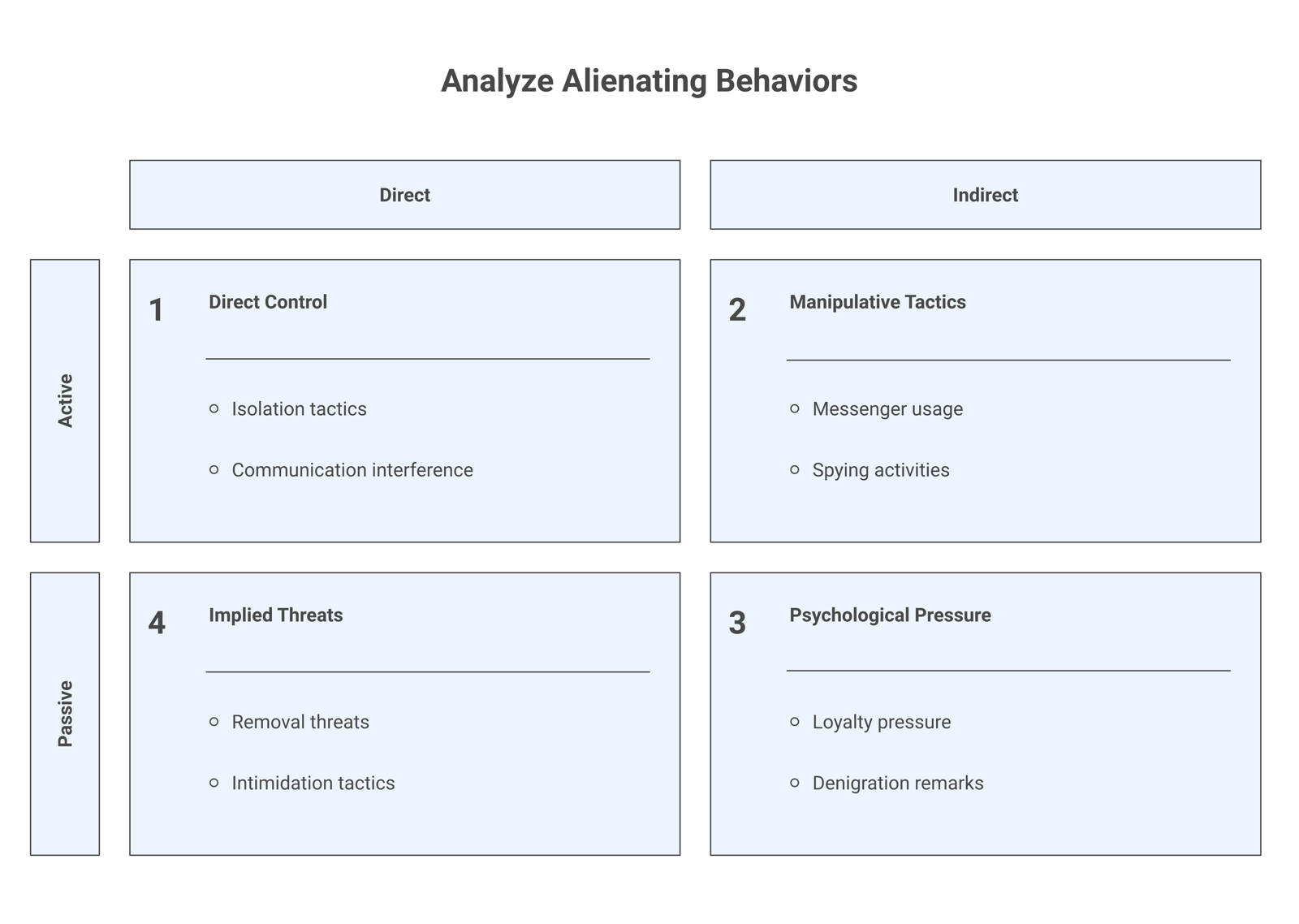
- Isolation. In coercive control, the abuser cuts a partner off from support. In alienation, a parent limits the child’s contact with the other parent and with that parent’s wider family, shrinking the child’s world to a single trusted adult.
- Using the children. The wheel names this directly. A parent may turn the child into a messenger, a spy, or a weapon, relaying complaints, reporting back, or being deployed to punish. This is the spoke Harman places at the center of the mapping.
- Intimidation and threats. Coercive control runs on fear. In alienation, this can surface as threats to remove the child, to cut off contact, or to involve authorities without cause. The threat does its work whether or not it is carried out.
- Emotional abuse. Both patterns lean on denigration. A parent who repeatedly belittles the other parent to the child, or who pressures the child to choose a side, applies the loyalty pressure that the wheel describes as emotional abuse.
- Monitoring and control. Surveillance is a wheel staple. A parent may interfere with calls, read messages, or block communication between the child and the other parent, controlling the flow of contact.
Laid out this way, the overlap is hard to miss. The conduct that one field calls alienating, another field already calls controlling. For the practical, day-to-day version of these behaviors, see what is considered harassment by a co-parent.
Why some researchers call it family violence
If the behaviors are the same, some scholars argue, the classification should be the same too. The claim follows from the mapping: tactics recognized as abuse between partners do not stop being abuse when a child is the channel.
Case-level data has tested part of this argument. Amanda Sharples, with Harman and Demosthenes Lorandos, examined 492 US appellate cases and found that where a record contained substantiated abuse, it was several times more likely to be attributed to the alienating parent than to the rejected parent. A separate review of 500 Canadian trial decisions across 16 years, by Harman, Christine Giancarlo, Lorandos, and Brian Ludmer, reported a similar pattern, with about 70 percent of abuse allegations against targeted parents unsubstantiated. That pattern fits the coercive-control reading. Both studies are proponent-authored, and their case-selection limits mirror the critiques aimed at the other side: Joan Meier’s 2020 study of US custody outcomes reads court data the opposite way, and the methodological exchange between the camps remains unresolved.
Findings like these are why some researchers treat alienation as a child-protection concern. The classification question, whether alienation is child abuse and who recognizes it, is covered in parental alienation as child abuse, and the mechanism of harm in parental alienation as emotional abuse.
The gender-neutral evidence
A common assumption is that this kind of control is something men do to women. The data on parental alienation does not support that picture. Studies of who engages in alienating behaviors find no significant link to gender. Mothers and fathers both alienate, and mothers and fathers are both targeted.
The reciprocity data points the same way. Harman’s work, building on earlier family-violence research, found that roughly half of severe cases were reciprocal, with neither party a pure perpetrator or pure victim. That finding sits awkwardly with any model that treats this control as one-directional by sex.
Researcher Heleen Koppejan, who studies coercive control in the Netherlands, puts the point plainly. Her data shows a slight female-victim majority in self-report, but the difference is not statistically significant. As she frames it, coercive control “is a human thing. It’s not a gender thing.” General research on family violence and gender is indexed through PubMed. The gender-neutral reading is one reason this resource describes alienation without assigning it to either parent.
The contested view
The coercive-control framing is gaining ground, but it is not settled, and a careful page has to say so. Some scholars and many domestic-violence advocates push back, and their concerns deserve a fair hearing.
The central worry is misuse. Critics note that a genuine abuser can accuse a protective parent of alienation, recasting the victim as the controller and the controller as the victim. In that scenario, the framing does real harm. Where a parent limits contact to keep a child safe, calling that limitation “coercive control” inverts the truth. This concern is not hypothetical, and it is the reason the boundary with genuine abuse is drawn so firmly.
A second concern is evidentiary. Some experts argue the science is still maturing and caution against treating any single framework as proven. The American Psychological Association’s guidance on divorce and child custody reflects this measured posture, emphasizing the child’s best interests over any one label.
Legal scholars describe a field split into roughly three camps: those who accept alienation readily, those who reject the concept, and a middle group, including Canadian scholar Nicholas Bala, who urge courts to decide each case on its facts rather than on a label or a ban. That middle position, deciding case by case on the evidence, captures where the mainstream sits. Readers who want the underlying debate over whether alienation is real can see is parental alienation real.
Why the distinction from genuine abuse matters
Holding both ideas at once is the hard part, and it is essential. The research case can be taken seriously, and the risk of misuse can be taken seriously, at the same time. Neither cancels the other.
A child’s rejection of a parent has more than one possible cause. Sometimes it reflects coercive pressure from the other parent. Sometimes it reflects the child’s own well-founded fear of a parent who has caused harm. These look different on close examination, and treating them as the same is a serious error in either direction. Labeling real protective behavior as alienation can endanger a child, and dismissing real alienation as a mere custody spat can do the same.
The honest standard is to look at behavior and evidence, not at the label a parent arrives with. That is the standard courts and clinicians aim for, and it is the standard this resource follows. For coping with a high-conflict co-parent without overclaiming, see how to deal with a narcissistic co-parent.
Frequently asked questions
Is parental alienation a form of coercive control?
A growing body of research argues that it is. Scholars such as Jennifer Harman contend that alienating behaviors map onto the same power-and-control tactics seen in intimate-partner abuse, especially the use of the children. The framing is gaining acceptance in the research, though it remains contested and is not universally adopted.
Is parental alienation domestic violence?
Some researchers, including Harman, Kruk, and Hines, argue that parental alienation is a form of family violence, because the controlling tactics are the same whether the target is a partner or a child’s relationship with a parent. Other scholars and advocates dispute this classification. There is no single settled answer.
How do alienating behaviors relate to the power-and-control wheel?
They map onto its spokes. Isolating the child from the other parent, using the child as a messenger or spy, threatening to remove the child, denigrating the other parent, and monitoring or blocking contact all match recognized spokes of the wheel. The “use of children” spoke is the one researchers emphasize most.
Is the coercive-control framing of parental alienation accepted?
It is gaining ground in research but remains contested. Many scholars find the mapping persuasive. Others, including domestic-violence advocates, warn it can be misused to recast a protective parent as a controller. Most mainstream voices favor weighing each case on its evidence rather than applying the framing automatically.
Is parental alienation gendered?
The data on perpetration is broadly gender-neutral. Studies find no significant link between gender and alienating behavior, and reciprocity research suggests many severe cases involve both parties. As one researcher puts it, coercive control is a human pattern rather than a gendered one.
What this page does not do
This page does not declare the coercive-control framing settled, and it does not tell any reader that their own situation is or is not coercive control. Only a qualified professional working with the full facts can reach that conclusion. The page also does not frame the research as a tool to win a custody fight, and it does not treat the conduct as something one sex does to the other. Genuine abuse by a rejected parent remains a separate matter that this framing must never obscure.
For the classification question, whether alienation should be classed as child abuse and who recognizes the label, see parental alienation as child abuse. For the mechanism and developmental harms behind the label, see parental alienation as emotional abuse. For the validity debate, see is parental alienation real. The full Learn hub covers the rest.
Sources and further reading
- Harman, J. J., Kruk, E., & Hines, D. A. (2018). Parental alienating behaviors: An unacknowledged form of family violence. Psychological Bulletin, 144(12), 1275 to 1299. https://doi.org/10.1037/bul0000175
- Sharples, A. D., Harman, J. J., & Lorandos, D. (2023). Findings of abuse in families affected by parental alienation. Journal of Family Violence. https://doi.org/10.1007/s10896-023-00575-x
- Harman, J. J., Giancarlo, C., Lorandos, D., & Ludmer, B. (2023). Gender and child custody outcomes across 16 years of judicial decisions regarding abuse and parental alienation. Children and Youth Services Review, 155.
- Meier, J. S., Dickson, S., O’Sullivan, C., Rosen, L., & Hayes, J. (2020). U.S. child custody outcomes in cases involving parental alienation and abuse allegations: What do the data show? Journal of Social Welfare and Family Law, 42(1), 92 to 105.
- National Domestic Violence Hotline. Coercive control. thehotline.org
- PubMed / National Center for Biotechnology Information. Family-violence research (general index). pubmed.ncbi.nlm.nih.gov
- American Psychological Association. Divorce and child custody. apa.org/topics/divorce-child-custody
If you or your child are in crisis
Free and confidential help is available right now.
- 988 Suicide and Crisis Lifeline. Call or text 988. 988lifeline.org
- Childhelp National Child Abuse Hotline. 1-800-422-4453. childhelp.org
- NAMI HelpLine. 1-800-950-6264. nami.org/help
Last reviewed: 2026-06-08. Author: Alex Buckles (PAC Founder). Editorial review: held to the PAC Editorial Standards (balance, primary-source citation, reader safety); an independent expert review board will be appointed.