

Can a parent lose custody for alienating a child? Yes, it is possible, but only in serious, well-documented cases, and it is never automatic. Courts act on proven behavior rather than the parental alienation label, and a custody change is a cautious, child-protective remedy that judges reach for rarely.
A note on safety
A child’s rejection of a parent is not always alienation. If the rejected parent has been abusive, neglectful, or genuinely frightening, the child’s distancing is justified estrangement, not parental alienation, and it is a different legal and safety matter. A protective parent must never be punished as an alienator. If a child’s safety is at risk, contact local law enforcement or a domestic-violence resource first.
This page is general information, not legal advice. It does not create an attorney-client relationship and does not address any one state’s law. State laws vary widely. Anyone considering legal action should consult a licensed family-law attorney in their own jurisdiction.
Can a parent lose custody for alienating a child? The short answer
Yes, a parent can lose custody for alienating a child, though the honest picture is narrower than the question suggests. Losing custody becomes possible when one parent runs a sustained, documented campaign to damage the child’s bond with the other parent and lesser measures have already failed. The outcome is uncommon, it is never automatic, and no court orders it simply because someone says the words parental alienation.
Can a parent lose custody for alienation in everyday, lower-level conflict? Almost never. A court treats a major custody change as a serious step, so it looks for severe conduct, real harm to the child, and a clear record before it acts. The sections below explain what a court weighs, why severe documented cases can lead to a change, and why this is framed as protecting a child, never as winning a fight.
Courts rule on documented behavior, not the label
Family courts decide custody on facts, not on diagnostic terms. Attorney Ashish Joshi, author of an American Bar Association book on litigating these cases, and Judge Jon Van Allsburg, who spent more than two decades on the bench, describe this as a behaviors-not-labels standard. As Van Allsburg frames it, “Labels don’t give us any basis on which to make a ruling. It’s the facts that give us that ability.”
The practical effect is large. A parent who walks into court with the term parental alienation but no fact pattern tends to lose ground. A parent who can show specific conduct, such as blocked phone calls, denied exchanges, and messages that run down the other parent, gives the court something it can act on. So the real question is rarely whether a behavior counts as alienation. It is whether the record proves what one parent actually did. The work of building that record is covered in how to prove parental alienation.
How alienating behavior factors into a custody decision
Every state decides custody under some version of the best interests of the child standard. The factors differ by jurisdiction, yet most lists include one that matters here directly: each parent’s willingness to support the child’s relationship with the other parent. A documented pattern of undermining that relationship speaks straight to that factor.
This is the doorway through which alienating behavior reaches a custody ruling. The court is not asked to diagnose a condition. It weighs whether one parent fosters or sabotages the child’s bond with the other parent. Conduct that sabotages the bond counts against the parent doing it. The American Bar Association’s Section of Family Law publishes general consumer information on how custody and best-interest analysis work. Because the factors and their weight vary by state, only a licensed attorney in the relevant jurisdiction can say how a particular court applies them.
What makes losing custody possible: severity and a record
A parent is far more likely to lose custody when the alienating behavior is severe and the record documents it clearly. Specialists draw a firm line between ordinary friction and the kind of conduct that drives a child to reject a once-loved parent entirely.
Canadian attorney Brian Ludmer, drawing on a 1991 decision by Justice John Gomery, argues that a child’s complete rejection of a loving parent is rare, because children generally seek connection even with parents who treat them poorly. When a child completely rejects a parent who is doing everything to show love, that pattern points toward outside influence on the child. In Ludmer’s reading of the Gomery principles, severe alienation should be treated as a child-protection matter rather than an ordinary custody dispute, because a court cannot stay indifferent to the danger such conduct poses to a child’s future emotional stability.
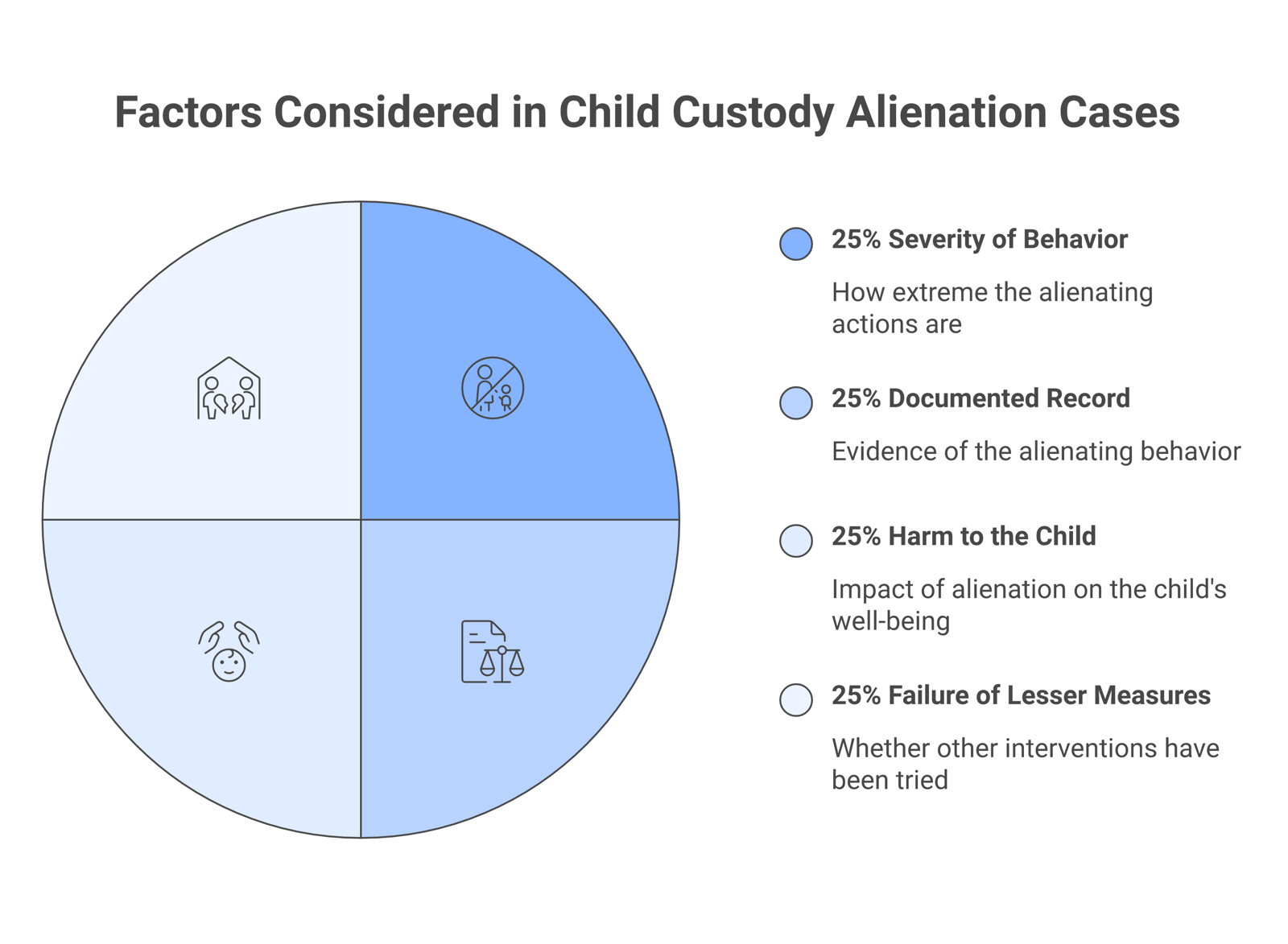
That framing matters for the custody question. A single missed exchange or one angry remark will not cost a parent custody. A sustained pattern that is hurting the child, proven on the record, can move a court toward a serious change. Severity, documentation, and harm to the child are the elements that separate the rare custody-loss case from the ordinary high-conflict file.
Modification and reversal: two ways custody can change
When a court does act on alienating behavior, the change usually takes one of two forms. Both are demanding, and the full remedy spectrum, from parenting-time enforcement up to reversal, is mapped in parental alienation and child custody.
A custody modification adjusts the existing arrangement. Most state custody laws let a parent seek a change when there has been a substantial and material change in circumstances, and a documented pattern of alienating behavior can support that showing. A modification is evidence-heavy. It usually needs proof of the conduct, proof of its effect on the child, and a proposed arrangement that serves the child better.
A custody reversal is the rarer and more drastic step, in which primary custody shifts from the favored parent to the rejected parent. Reversal is reserved for severe, well-documented cases where lesser measures have already failed. Specialists frame it as a protective intervention paired with structured reunification work, not as a punishment and never as a prize. A formal court order usually drives both paths, and what such an order can require is covered in parental alienation court order.
Why losing custody is uncommon and left to the court
Custody loss is rare for good reasons, and the decision belongs to the court, not to either parent. A change this large can be as disruptive as the alienation it aims to correct if a judge gets it wrong, so courts move carefully and demand a strong record.
Law professor Nicholas Bala, who studies how these cases resolve, notes that the most common judicial response to alienation is not a custody change at all. It is more time with the rejected parent paired with community-based, family-systems counseling. Reversal sits at the far end of a long spectrum, used only when the conduct is severe and other tools have failed.
The follow-up evidence is cautiously encouraging but small. Bala and a colleague tracked six children for more than ten years after a court-ordered custody reversal. All six were doing well, and all said the judge had been right to force the change even though they had resisted it at the time. One striking finding was that many of the formerly favored parents drifted out of the children’s lives afterward by their own choice, not by court order, while the formerly rejected parents supported continued contact. The sample is small, so the study informs rather than proves. Bala’s broader argument is to trust trained judges to weigh each case on its evidence rather than apply any blanket rule.
When the conflict escalates after a ruling
A custody ruling does not always settle the conflict. Counselors who work with these families warn that alienating behavior can intensify after a decision, in either direction. When the favored parent gains what they sought, the behavior can feel validated and continue. When that parent loses ground, they may conclude they did not push hard enough and escalate, sometimes by working to make the child appear more distressed so the order can be relitigated.
For the targeted parent, this is the moment to stay measured rather than reactive. A child may arrive for parenting time angry and coached to make the visit difficult. Continuing to document conduct, keeping communication calm, and refusing to take the bait all preserve the record a court relies on. How these patterns build over time is traced in the stages of parental alienation.
When a child’s rejection is justified, not alienation
Not every rejected parent is a victim of alienation. A child who pulls away from a parent who has been abusive, neglectful, or frightening is showing justified estrangement, and that is a different legal and safety matter entirely. The same custody consequences that can follow alienating behavior become dangerous when aimed at a protective parent who is responding to real harm.
This is why courts must separate alienation from estrangement before reaching any custody decision, and why responsible advocates insist on it. Affinity, where a child simply prefers one parent during a developmental stage, is also not alienation. A custody case built on the alienation label without a clean, documented record risks punishing the wrong parent. When abuse or danger is part of the picture, that issue comes first, a point covered in child custody and emotional abuse.
Frequently asked questions
Can a parent lose custody for alienating a child?
Yes, but it is uncommon and never automatic. A parent can lose custody when the record documents a sustained pattern of alienating behavior, shows harm to the child, and establishes that lesser measures have failed. Courts act on the documented conduct, not on the parental alienation label, and a custody change is treated as a child-protective remedy rather than a penalty. Outcomes still vary by jurisdiction and by the strength of the evidence.
Does alienation automatically change custody?
No. No court changes custody simply because one parent uses the term parental alienation. A parent usually must show a substantial and material change in circumstances, prove the alienating conduct and its effect on the child, and propose an arrangement that serves the child better. Courts more often respond with parenting-time enforcement or additional time for the rejected parent than with a full custody change.
What evidence does a court need to act on alienation?
Under a behaviors-not-labels standard, a court looks at documented conduct, such as blocked contact, denigration, and interference with the other parent’s time, along with the child’s response. Contemporaneous records, messages, and similar proof carry more weight than self-report, and a diagnosis is not required. The documentation process is covered in how to prove parental alienation.
Is losing custody a goal a parent should pursue?
No. Specialists frame a custody change in a severe alienation case as a protective step a court orders to safeguard a child, never as a prize to chase or a way to win against the other parent. The goal that matters is the child’s wellbeing and the repair of a damaged relationship, which is treated as a clinical and protective process rather than a punitive one.
What if the child’s rejection is justified?
If a child is pulling away from a parent who has been abusive, neglectful, or genuinely frightening, that is justified estrangement, not parental alienation, and it is a separate legal and safety matter. Custody consequences designed for alienation can cause harm if applied to a protective parent. Courts must distinguish the two, and any safety concern should be addressed first.
What this page does not do
This page is not legal advice. It does not name any one state’s statutes or custody factors as if they applied nationally, and it does not tell readers what to file or when. Choices about a modification, a custody change, or any court filing belong to a licensed family-law attorney working with the real facts. The page also does not frame custody as a weapon or a contest to win. A custody change in a severe alienation case is presented here as a rare, court-driven step taken to protect a child, never as an outcome to chase. For the full range of court remedies, see parental alienation and child custody, and for the wider set of court resources, see the Court silo.
For documented examples of how courts have weighed alienating conduct, see our case studies of Sharp v. Keeler and Hanson v. Spolnik.
Sources and further reading
- Harman, J. J., Kruk, E., & Hines, D. A. (2018). Parental alienating behaviors: An unacknowledged form of family violence. Psychological Bulletin, 144(12), 1275 to 1299. https://doi.org/10.1037/bul0000175
- American Bar Association, Section of Family Law. americanbar.org/groups/family_law
- American Psychological Association. Divorce and child custody. apa.org/topics/divorce-child-custody
If you or your child are in crisis
Free and confidential help is available right now.
- 988 Suicide and Crisis Lifeline. Call or text 988. 988lifeline.org
- Childhelp National Child Abuse Hotline. 1-800-422-4453. childhelp.org
- NAMI HelpLine. 1-800-950-6264. nami.org/help
Last reviewed: 2026-06-06. Author: Alex Buckles (PAC Founder).