

This page is general information, not legal advice. It does not create an attorney-client relationship, and it does not address any one state’s law. CPS processes vary by jurisdiction. Anyone weighing a report or legal action should consult a licensed family-law attorney in their own jurisdiction.
Can you call CPS for parental alienation? You can call about a child’s safety, but parental alienation by itself is usually a family-court matter, not a CPS matter. Child Protective Services investigates abuse and neglect. Reports should be made only in good faith about real harm. Here is the honest answer and the better-fit path.
Safety comes first
If a child is being abused or neglected, or is in immediate danger, contact Child Protective Services or local law enforcement right away. This page is about ordinary parental alienation, where there is no genuine abuse. Abuse-driven estrangement is not parental alienation, and a real safety concern is always worth reporting in good faith.
Can you call CPS for parental alienation?
Anyone can call Child Protective Services when they are genuinely worried about a child’s safety. That door is always open, and it should be. The harder question is whether parental alienation is the kind of concern CPS is built to handle, and the honest answer is usually no.
Child Protective Services exists to investigate child abuse and neglect. Parental alienation, on its own, is a relationship problem inside a custody dispute. One parent is working to damage the child’s bond with the other parent. That harm is real, and courts take it seriously, but it is generally addressed by the family court rather than by a child-protection agency. The Childhelp National Child Abuse Hotline is the right place to start when the worry is genuine abuse or neglect, and trained counselors there can help a caller decide whether a situation rises to that level.
So the practical answer has two parts. If a child is being harmed through abuse or neglect, report it, in good faith, without delay. If the concern is alienation alone, with no genuine safety issue, the family court is almost always the correct forum.
What CPS does, and what it does not do
CPS agencies investigate allegations that a parent or caregiver has abused or neglected a child. A report typically goes through an intake screening first. A worker decides whether the information, taken as true, describes abuse or neglect within the agency’s authority. If it does, the agency may open an investigation or assessment. If the investigation finds enough evidence, the report is substantiated. If it does not, the report is closed as unsubstantiated. The Child Welfare Information Gateway, a federal clearinghouse, explains how this screening and response process works.
What CPS does not do is referee custody. Agencies are not set up to decide which parent the child should live with, to enforce a parenting plan, or to settle a dispute about visitation. Those are family-court questions. A custody fight, however bitter, does not become a child-protection case simply because one parent is behaving badly toward the other.
This boundary matters for alienation. A useful diagnostic point in the field, sometimes framed as the absence of bona fide abuse, separates two situations that can look similar from the outside. A child who rejects a parent because that parent genuinely mistreated them is estranged for a real reason. A child who rejects a parent without any such cause, under pressure from the other parent, is showing signs of alienation. CPS is designed for the first situation, not the second.
Why parental alienation reports are often screened out
Parents who report alienation to CPS are frequently surprised by what happens next, which is often very little. When a report describes a parent saying unkind things about the other parent, interfering with calls, or turning a child’s affection, intake screeners commonly conclude that no abuse or neglect has been alleged. The report is screened out before any investigation begins.
Even reports that pass intake often close as unsubstantiated. Without genuine abuse or neglect to find, an investigator has nothing within the agency’s authority to act on. This is the pattern the literature describes for alienation-driven reports made in the absence of real maltreatment. They consume the family’s energy and the agency’s time, and they rarely produce the outcome the reporting parent hoped for.
A screen-out or an unsubstantiated finding is not proof that nothing is wrong. It usually means the concern, real as it may be, is the wrong shape for the agency. The damage from alienation is genuine. It simply lives in a different system, the family court, which has tools designed for exactly this kind of harm.
When alienation can rise to reportable harm
There is a narrow and serious exception, and it has to be handled with care. Some clinicians and scholars argue that severe alienation can meet the definition of child psychological abuse. The Wygant parental alienation child-abuse model draws on the DSM-5 standard for child psychological abuse, which describes nonaccidental verbal or symbolic acts by a caregiver that cause, or carry reasonable potential to cause, significant psychological harm to a child. On this view, a campaign to destroy a child’s relationship with a loving parent can, at its most severe, cross from custody conflict into emotional maltreatment.
That argument is real, but the threshold is high and contested. It describes the most extreme cases, not the everyday friction of a high-conflict separation. It is not a reason to treat ordinary alienation as a CPS matter, and it is not a checklist for getting a report accepted. A clinician’s view that conduct meets a diagnostic standard is not the same as a CPS finding that abuse occurred. The two systems use different definitions and different evidence.
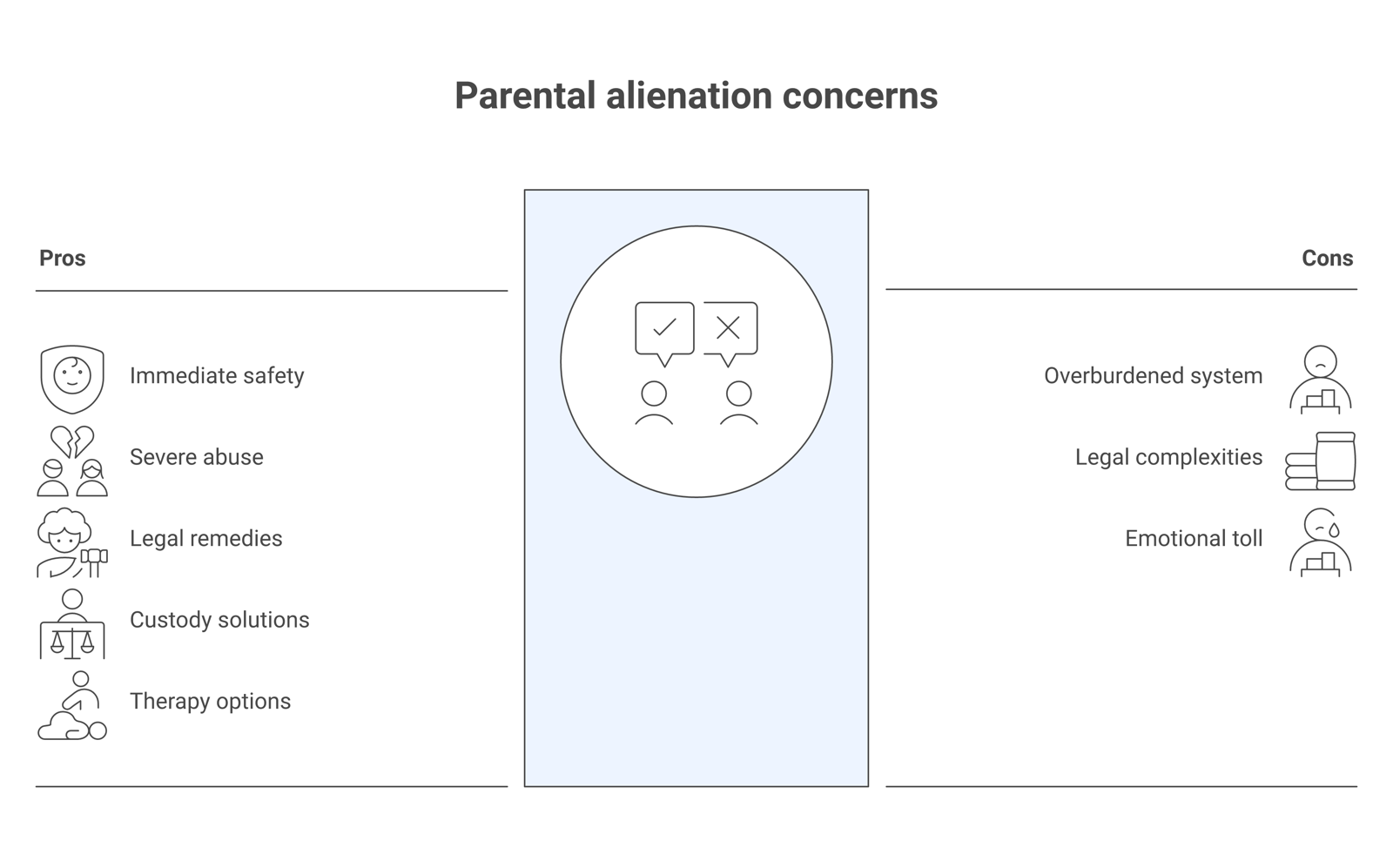
Where genuine abuse or neglect is present, the calculus changes completely. A child who is being hurt, exposed to danger, or denied basic care should be reported, in good faith, whatever else is happening in the custody case. Safety always comes first. For the deeper clinical and legal discussion of when alienation is framed as abuse, see parental alienation as child abuse. When the danger is immediate, family courts also offer urgent options, covered in emergency custody for parental alienation.
The serious risk of a false or tactical report
This part deserves blunt honesty. A CPS report made not out of genuine concern, but as a move in a custody fight, is wrong, and it tends to backfire. False allegations of abuse are among the most damaging weapons in family conflict, and reporting one as a tactic harms the very child it claims to protect.
A child pulled into a needless investigation can be questioned, examined, and frightened. The family is destabilized. The targeted parent lives under a cloud until the report clears. None of that repairs a relationship, and all of it can deepen the conflict the child is already trapped inside. Courts have seen this pattern. In one illustrative case, Hanson v. Spolnik, a parent filed repeated unfounded abuse reports against the other parent, and those reports were closed unsubstantiated. The lasting effect was not on the accused parent’s fitness. It was on the credibility of the parent who kept making the reports.
That credibility cost is the practical heart of the warning. A judge who sees a parent weaponizing the child-protection system reads it as a sign of who is driving the conflict. A parent who genuinely wants to help their child is far better served by documenting real behaviors and presenting them to the family court than by filing a report that will not stick. This page does not teach tactical reporting, and it warns against it without reservation. Reports to CPS exist to protect children, not to win cases.
The better-fit path, family court
The harm of alienation is real, and there is a system designed to address it. That system is the family court, and its tools fit the problem far better than a child-protection investigation does.
When a parent violates a parenting plan or custody order, by denying time, blocking exchanges, or refusing court-ordered therapy, the court can enforce its own order. That mechanism is explained in contempt for parental alienation. Where a pattern of alienating behavior is harming the child, a court can revisit the custody arrangement itself, which is covered in parental alienation and child custody. Courts can also order family therapy and structured reunification work, which target the damaged bond directly in a way no agency can.
The foundation for all of these is a clear record. Dates, messages, missed exchanges, and the exact terms of the order are what give a judge something to act on. The guide on how to document parental alienation walks through building that record. For the broader picture of what the law treats as wrongdoing, see is parental alienation illegal, and use the Court silo as the hub. The American Psychological Association’s overview of divorce and child custody offers a clinical frame for the high-conflict dynamics underneath these cases.
Frequently asked questions
Can I call CPS for parental alienation?
You can call CPS any time you genuinely fear for a child’s safety. But parental alienation on its own is usually a family-court matter, not a CPS matter, because Child Protective Services investigates abuse and neglect rather than custody disputes. If there is genuine abuse or neglect, report it in good faith. If the concern is alienation alone, the family court is the better-fit forum.
Does CPS investigate parental alienation?
Generally no. CPS investigates abuse and neglect, and reports describing alienation alone are often screened out at intake or closed as unsubstantiated, because there is no maltreatment to find. A custody dispute does not become a child-protection case just because one parent is acting badly. Severe documented psychological abuse can be an exception, but that is a high and contested threshold.
What happens if you make a false CPS report?
A false or tactical report can harm the child, who may be questioned or examined needlessly, and can destabilize the family. It damages the targeted parent and, importantly, the credibility of the parent who made it. Courts notice the pattern. In many places, knowingly false reports also carry legal consequences. Reports should only ever be made in good faith about real harm.
Is parental alienation considered child abuse?
Some clinicians and scholars argue that severe alienation can meet the DSM-5 definition of child psychological abuse, that is, acts that cause or risk significant psychological harm to a child. That view is serious but the threshold is high and contested, and a clinical opinion is not the same as a CPS finding. Ordinary alienation is not automatically a child-protection matter.
Who do you report parental alienation to?
Genuine abuse or neglect goes to Child Protective Services or local law enforcement, in good faith and without delay. Parental alienation itself, where there is no genuine safety concern, is addressed through the family court, using tools such as enforcement of the parenting order, custody modification, and court-ordered therapy. A licensed family-law attorney can advise on the right path in a specific jurisdiction.
What this page does not do
This page is not legal advice. It does not describe any one state’s CPS procedures, screening thresholds, or hotline numbers as if they applied everywhere, because those vary by jurisdiction. It does not tell readers to file anything. It does not encourage or teach making a CPS report as a tactic, and it warns clearly against false or tactical reports. The right use of the child-protection system is the honest, good-faith one, made only about real harm to a child.
For the legal-status question, see is parental alienation illegal. For enforcing a violated order, see contempt for parental alienation. For the custody path, see parental alienation and child custody. The full Court silo covers the rest.
Sources and further reading
- Childhelp National Child Abuse Hotline. childhelp.org
- Child Welfare Information Gateway. childwelfare.gov
- American Psychological Association. Divorce and child custody. apa.org/topics/divorce-child-custody
If you or your child are in crisis
Free and confidential help is available right now.
- 988 Suicide and Crisis Lifeline. Call or text 988. 988lifeline.org
- Childhelp National Child Abuse Hotline. 1-800-422-4453. childhelp.org
- NAMI HelpLine. 1-800-950-6264. nami.org/help
Last reviewed: 2026-06-08. Author: Alex Buckles (PAC Founder).