

Can text messages prove parental alienation? Rarely on their own. Texts can be powerful evidence of a pattern (denied exchanges, disparaging messages, blocked contact, scheduling sabotage), but courts weigh that pattern alongside the child’s response and, often, expert input, not any single screenshot.
A note on safety
A child’s distance from a parent is not always alienation. If a parent has been abusive, neglectful, or genuinely dangerous, a child’s distancing is justifiable estrangement, not parental alienation. A protective parent’s messages, written to keep a child safe, are not evidence of alienation. If a child’s safety is at risk, contact local law enforcement or a domestic-violence resource first.
This page is general US-national education. It is not legal advice, does not create an attorney-client relationship, and does not address any one state’s law. Evidence and recording rules vary by state. Anyone handling evidence should consult a licensed family-law attorney in their own jurisdiction.
The short answer
Text messages can matter a great deal, but the honest answer is that they rarely “prove” parental alienation by themselves. They are evidence, and good evidence, but proof of alienation almost always rests on more than one source. Courts look at a documented pattern of behavior, the child’s response to that behavior, and frequently the input of an expert who can interpret what the pattern means.
Family courts tend to act on documented behaviors, not on the label “alienation.” As one judicial framing puts it, “labels don’t give us any basis on which to make a ruling. It’s the facts that give us that ability.” Well-kept texts are useful precisely because they are facts: dated, specific, and hard to argue away. So the goal is not a single damning screenshot. The goal is a clear, honest record that helps a court see the pattern. For the wider proof picture, see how to prove parental alienation.
What text messages can show
Used carefully, text messages can document a pattern over time. That pattern is where their power lies. A few categories come up again and again:
- Denied or sabotaged exchanges, where scheduled parenting time is canceled, cut short, or quietly blocked.
- Disparaging messages about the other parent, sent to the co-parent or, more troublingly, forwarded to the child.
- Blocked or cut-off contact, where calls, video chats, and messages to the child go unanswered or are prevented.
- Scheduling interference, where activities, trips, or appointments are repeatedly arranged to crowd out the other parent’s time.
Researcher Jennifer Harman and colleagues, writing in the journal Psychological Bulletin, describe how this kind of disparagement and contact-blocking maps onto recognized patterns of coercive control. The important word is pattern. One sharp message during a hard week proves little. A months-long thread showing the same conduct, over and over, can show a court something real.
What text messages cannot show on their own
It helps to be just as clear about the limits. Texts alone cannot answer some of the questions that matter most.
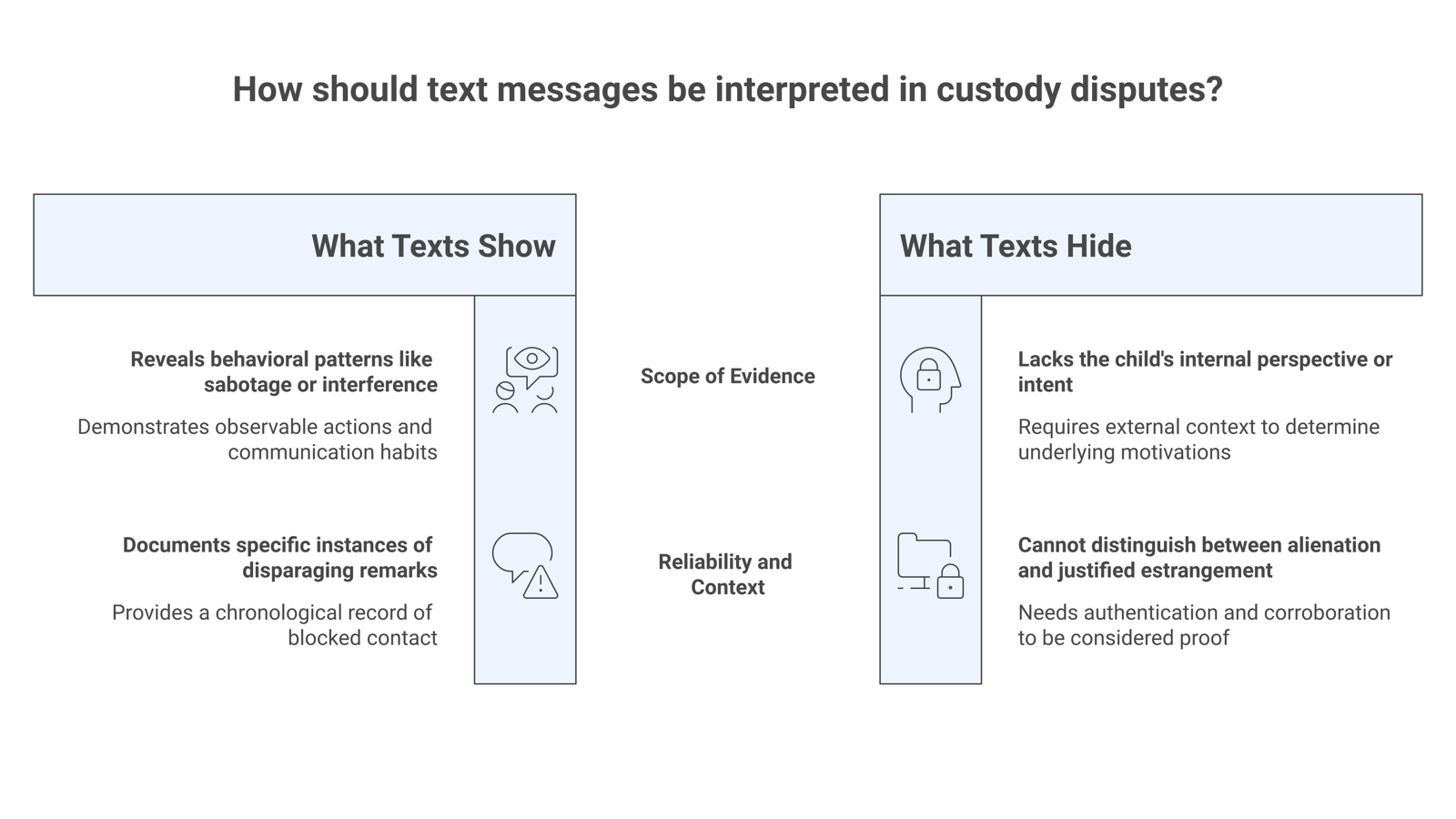
A thread cannot tell a court whether it is looking at alienation or at a protective parent responding to genuine harm. The same firm message (“the children do not want to see you this weekend”) can mean very different things depending on the facts behind it. Texts also cannot show the child’s inner experience, which is why a court weighs the child’s actual response alongside the messages. They cannot prove intent without context. And a screenshot is not “proof” until it is authenticated and supported by other evidence. So the right way to think about texts is as one strong strand in a larger record, not the whole rope.
Save the originals and back them up
Before worrying about anything else, preserve what you have. Keep the original messages on the original device, and do not delete the thread. Back it up in more than one place, such as a secure cloud account and an exported file, so a lost or damaged phone does not erase the record.
Screenshots are useful for quick reference, but originals are stronger. An original message carries metadata (timestamps, sender information) that a screenshot can lose, and that extra information makes the message easier to authenticate later. When you eventually hand material to a lawyer, organized originals save time and carry more weight. The practical how-to for building that record lives in how to document parental alienation, and the question of what to share with counsel is covered in what to tell your lawyer about parental alienation.
Authentication: showing a message is genuine
Authentication is the legal step of showing that a message is genuine and unaltered. Before a court relies on a text, someone has to establish that it really is what it claims to be: that this person sent it, on this date, and that it has not been edited. The Cornell Legal Information Institute keeps a general reference on authentication, and the federal standard, Federal Rule of Evidence 901, requires evidence sufficient to support a finding that the item is what its proponent says it is. Many states follow similar rules.
In practice, this is why originals and clean records matter. A text is easier to authenticate when its source and timeline are clear and when nothing about it looks altered. The detailed legal mechanics of getting digital evidence admitted are an attorney’s job, and they are covered for professionals in digital evidence in custody disputes. For a parent, the takeaway is simpler: keep the record genuine and complete so authentication is straightforward.
Do not edit, crop selectively, or bait
The fastest way to weaken good evidence is to tamper with it. Do not edit messages. Do not crop a screenshot to hide the parts that add context, because selective cropping reads as dishonesty the moment the full thread surfaces. A court that catches one altered or misleading exhibit may distrust the entire record.
Just as important, do not bait or provoke. Sending needling messages designed to trigger an angry reply, then offering that reply as proof, is manufacturing evidence, and it tends to backfire. Litigators who handle these cases stress that credibility is everything: no venting, no staged exchanges, no public document-sharing. A calm, honest record from a calm, honest parent is far more persuasive than a thread the other side can paint as a setup.
Recording and consent
Many parents also wonder about recording calls or conversations. The rules here vary by state, and the differences matter. Some states allow recording with one party’s consent, while others require everyone on the call to consent. Recording a child, or recording an exchange unlawfully, can create legal problems and can damage credibility even when no law is broken.
Because the rules are not uniform, this is a question for a licensed attorney in your own state. Do not assume that a method you read about online is lawful where you live. The safe default is to document what already exists (the messages you legitimately received) rather than to create new recordings whose legality is uncertain.
Document to inform the court, not to win
The purpose of all of this is worth stating plainly. Documentation exists to help a court understand what is actually happening, so the court can protect the child. It is not a weapon for beating an ex, and it is not a shortcut to a particular outcome. A parent who approaches evidence that way usually undercuts their own credibility.
The strongest position is the honest one. A clear, complete, unaltered record, handed to a competent attorney, lets the court act on facts rather than labels. The pattern in the messages, the child’s response, and expert interpretation work together; no single piece carries the case. For how documented violations can support enforcement, see contempt for parental alienation, and for how courts weigh the larger picture, see what judges look for in custody cases. The broader proof framework sits in how to prove parental alienation, and the full Court silo maps the rest.
Frequently asked questions
Can text messages prove parental alienation?
Texts can be powerful evidence of a pattern, such as denied exchanges, disparaging messages, blocked contact, and scheduling sabotage, but they rarely prove parental alienation on their own. Courts weigh a documented pattern of behavior alongside the child’s response and, often, expert input. The strongest cases use texts as one strand of a larger record, not as a single decisive screenshot.
Are text messages admissible in family court?
Often yes, when they are relevant and properly authenticated. Whether a specific message comes in, and how much weight it carries, is decided by the court under the applicable rules of evidence. Those rules vary by jurisdiction, so an attorney in your state can tell you how the local court is likely to treat your messages.
How do you authenticate text messages in court?
Authentication means showing the message is genuine and unaltered: who sent it, when, and that it has not been edited. The federal standard (Rule 901) and many state analogs require evidence sufficient to support that the item is what it claims to be. Keeping originals with their metadata, rather than only screenshots, makes this far easier.
Can I record my co-parent or child to get evidence?
It depends on where you live. Recording laws vary by state, and some require all-party consent, so a recording that is legal in one state can be unlawful in another. Baiting or provoking messages to manufacture evidence can also backfire. Ask a licensed attorney in your jurisdiction before recording anyone.
Should I keep original texts or are screenshots enough?
Keep the originals and back them up in more than one place. Screenshots are fine for quick reference, but originals carry metadata that makes messages stronger and easier to authenticate. Do not edit or selectively crop, because altered exhibits can sink your credibility with the court.
What this page does not do
This page is not legal advice, and it does not name any one state’s evidence or recording rules as if they applied nationally. It does not tell readers what to file or how to “win” anything. It also does not coach anyone to bait, provoke, or manufacture messages. Documentation is for informing a court honestly, in service of a child’s wellbeing, and nothing more.
For the legal mechanics of digital evidence, attorneys can see digital evidence in custody disputes. For the broader proof picture, see how to prove parental alienation. For enforcement, see contempt for parental alienation. For handing evidence to counsel, see what to tell your lawyer about parental alienation. For building the record, see how to document parental alienation. The full Court silo covers the rest.
Sources and further reading
- Cornell Legal Information Institute (Wex). Authentication. law.cornell.edu/wex/authentication
- Cornell Legal Information Institute. Federal Rule of Evidence 901 (authenticating or identifying evidence). law.cornell.edu/rules/fre/rule_901
- American Bar Association, Section of Family Law. americanbar.org/groups/family_law
- Harman, J. J., Kruk, E., & Hines, D. A. (2018). Parental alienating behaviors: An unacknowledged form of family violence. Psychological Bulletin, 144(12), 1275 to 1299. https://doi.org/10.1037/bul0000175
If you or your child are in crisis
Free and confidential help is available right now.
- 988 Suicide and Crisis Lifeline. Call or text 988. 988lifeline.org
- Childhelp National Child Abuse Hotline. 1-800-422-4453. childhelp.org
- NAMI HelpLine. 1-800-950-6264. nami.org/help
Last reviewed: 2026-06-07. Author: Alex Buckles (PAC Founder).