

Find your values first: when you cannot control the outcome with your child, you can still act in line with what matters most to you. Values-based action, an idea from acceptance and commitment therapy, steadies you and shapes the parent your child may one day return to, whatever the other parent does.
A note on safety
These recovery pages address a child’s rejection that is driven by alienating behavior, not by a parent’s own abuse or neglect. Where a child’s distancing is a justified response to a parent’s harmful behavior, the path is accountability and change, not values technique. A reader unsure which applies should work with a qualified professional.
This page is general education, not clinical advice. It does not diagnose any reader or replace care from a licensed mental-health professional. A parent who is struggling should reach out to a qualified clinician.
Why values come first
When the outcome you want most, your child back in your life, sits outside your control, the mind reaches for anything solid to stand on. Values are that solid ground. They do not depend on what the other parent does, on what a court rules, or on how your child feels today. They are yours, and you can act on them now.
The coach Craig Childress, writing about recovery, suggests that survivors find their values first, because the self can feel scrambled and uncertain after this kind of harm, and values give the path forward its shape. That is one practitioner’s framing, offered here as a starting orientation rather than as the underlying science. The science it rhymes with is older and well studied, and it comes from a form of therapy described below.
So the first move is not to fix the outcome. It is to get clear on who you want to be while the outcome is still unknown, and to let that guide your next small action.
What values-based action means
Values-based action is the practice of acting in line with what matters most to you, regardless of how you feel in the moment or how others respond. The idea sits at the center of acceptance and commitment therapy, usually shortened to ACT, an evidence-based approach developed by psychologist Steven Hayes and colleagues. The American Psychological Association describes ACT and its core processes in its professional materials.
ACT teaches a skill it calls psychological flexibility: staying present, opening up to hard feelings instead of fighting them, and steering behavior by chosen values even under stress. Two of its processes matter most here. The first is values. The second is committed action.
Values are directions, not goals
A value is a direction you want your life to head, not a box you check off. “Be a loving, present parent” is a value. “Have my child text me back this week” is a goal, and goals can be blocked by other people. A direction cannot be blocked. You can keep heading toward “loving and present” no matter what today brings, which is exactly why values hold up when outcomes do not.
Committed action means acting even when it is hard
Committed action, in ACT, means choosing behavior guided by your values and continuing even when it is difficult or the result is uncertain. Research summarizing the ACT model describes this as building larger and larger patterns of effective, values-linked behavior over time. For a targeted parent, that can be as small as one warm, low-pressure message, or as steady as keeping yourself well so you are ready.
How to identify your core values
Naming your values takes a little quiet reflection, not a personality quiz. Here is one general way to do it.
- Picture the parent you want to be. Imagine your child, years from now, describing the kind of parent you were through this time. What words would you want them to use?
- List the words. Write down five to eight, plain ones: patient, honest, steady, warm, dependable, fair.
- Cut to the core. Circle the three or four that feel most truly yours, not the ones you think you should pick.
- Define each in a sentence. Write what each value looks like in action, so it guides real choices.
- Keep the list visible. Put it somewhere you will see it on a hard day, when reaction wants to take the wheel.
Translate values into small committed actions
A value only steadies you when it shows up in behavior. The bridge from value to action is small and repeatable, never grand.
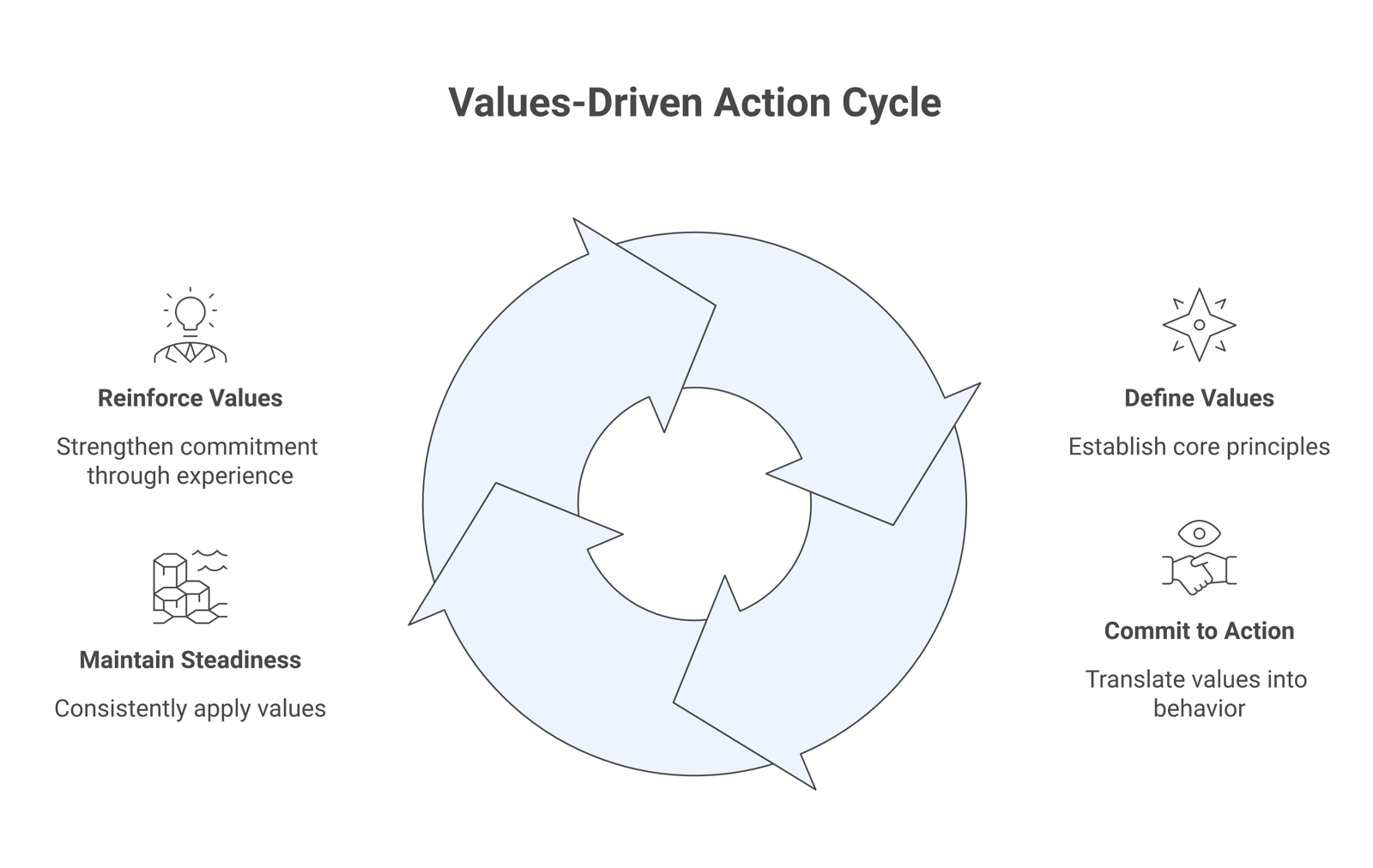
- Pick one value. Start with a single value from your short list.
- Name one action. Ask what a person with that value would do today, in a way that does not depend on your child’s response.
- Make it small. A grand gesture is fragile. A small, repeatable one holds. A brief message, a saved keepsake, a calm reply, a walk that keeps you well.
- Do it regardless. Take the action whether or not it is acknowledged. The point is alignment with who you are, not a reaction from anyone else.
- Notice the steadiness. Acting in line with your values tends to settle the nervous system, even when nothing external changes. That steadiness is the reward you can count on.
For sorting what is yours to act on from what is not, the companion page on an internal locus of control pairs closely with this one.
Values as compass, not the other parent’s behavior
Under this kind of stress, it is easy to let the other parent become your compass. They do something unfair, and your whole day bends around reacting to it. Anger sets the course. The trouble is that a reaction-compass always points wherever they aim it, which means they, not you, are steering your life.
Values offer a different compass, one that points the same way no matter what anyone else does. When a provoking message arrives, the question shifts from “how do I hit back” to “what would a steady, loving parent do here.” Sometimes the values-aligned action is to pause, to not respond, to protect your own calm. The compass is internal, so no one can spin it for you.
We act this way because of who we are
There is a line worth carrying through all of this: we act this way because of who we are, not because of who they are, and not to win a reaction. Childress puts the recovery version of it plainly, that we are kind because of who we are, not because of who the other person is. Used carefully, that reframe protects you from being pulled into cruelty or despair as a default response.
It also matters for the long view. If a child does one day reconsider what they were told, the parent they find is the parent you are becoming now, through these small, values-aligned choices. Research reviewing ACT links values-based living with better psychological well-being. You are not performing for an audience that may never watch. You are becoming someone, steadily, for your own sake first. The companion work in becoming the anchor and the long view in adult children of parental alienation both build on this.
When to bring in support
Values work is steadying, but it is not a substitute for care when the weight is heavy. If grief, anger, or hopelessness is filling most of your days, that is a signal to bring in a professional, not a sign of weakness. A therapist trained in ACT or in high-conflict separation can help you do this work with support rather than alone. The American Psychological Association’s guidance on divorce and custody stress points the same way. Reaching for help is itself a values-aligned action for a parent who wants to stay well. See therapy for alienated parents for what that can look like. None of this is toxic positivity. The loss is real, and you are allowed to grieve it fully while still acting on what matters to you.
Frequently asked questions
What is values-based action?
Values-based action is acting in line with what matters most to you, regardless of how you feel in the moment or how others respond. It is a core idea in acceptance and commitment therapy, where chosen values guide behavior. For a targeted parent, it means letting your values, not the outcome with your child, direct your next small step.
How do you find your core values?
Picture the parent you want to be, list five to eight plain words that describe that person, then cut to the three or four that feel most truly yours. Define each in a sentence about what it looks like in action, and keep the list visible for hard days when reaction wants to take over.
What is committed action in acceptance and commitment therapy?
Committed action means choosing behavior guided by your values and continuing even when it is difficult or the result is uncertain. In ACT it is one of six processes that build psychological flexibility. The goal is to grow steady, values-linked patterns of behavior over time, rather than to control feelings or force a particular outcome.
Can values-based action help with parental alienation?
It can steady the parent and shape the person their child may one day return to, which is worthwhile in its own right. It is not a guaranteed route back to the child, and any page promising reunion is not being honest. The value of the work does not depend on the outcome, which is part of why it holds.
Why act on your values when your child is rejecting you?
Because we act this way because of who we are, not because of who anyone else is, and not to win a reaction. Acting on your values keeps you steady, protects you from being pulled into anger or despair, and keeps you becoming the parent you want to be, whether or not it is seen right now.
A note on hope
Hope and honesty belong together. Finding your values first will not, by itself, bring your child home, and no one can promise that it will. What it offers is a way to stand steady on ground no one can take from you, and to keep becoming a parent worth returning to. That is a real and worthwhile thing, whatever the outcome. For the wider path, see the Recover silo and recovering from parental alienation.
Sources and further reading
- American Psychological Association. Acceptance and Commitment Therapy as a Unified Model of Behavior Change (continuing-education materials). apa.org/education-career/ce/acceptance-commitment.pdf
- Hayes, S. C., Luoma, J. B., Bond, F. W., Masuda, A., & Lillis, J. (2006). Acceptance and commitment therapy: Model, processes and outcomes. PubMed. pubmed.ncbi.nlm.nih.gov/16300724
- Acceptance and Commitment Therapy and Psychological Well-Being: A Narrative Review. PMC11837766. pmc.ncbi.nlm.nih.gov/articles/PMC11837766
- American Psychological Association. Divorce and child custody. apa.org/topics/divorce-child-custody
If you or your child are in crisis
Free and confidential help is available right now.
- 988 Suicide and Crisis Lifeline. Call or text 988. 988lifeline.org
- Childhelp National Child Abuse Hotline. 1-800-422-4453. childhelp.org
- NAMI HelpLine. 1-800-950-6264. nami.org/help
Last reviewed: 2026-06-07. Author: Organization.