

Therapy for alienated parents is care for the targeted parent’s own trauma and grief, not for fixing the child relationship. The parent’s pain is a real injury, and it can be treated. The right therapy can ease the trauma, name the grief, and help a parent build a steady life.
A note on safety
A child’s rejection is not always alienation. When a child pulls away because of real abuse, neglect, or danger, that is justified estrangement, and the case is different. A parent dealing with a child’s justified estrangement also deserves support, though the framing differs. If anyone’s safety is at risk, contact local authorities or a crisis line first.
This page is general information, not clinical advice. It does not diagnose, does not create a professional relationship, and does not speak to any one person’s case. Anyone struggling with their mental health should talk to a licensed clinician who can assess their needs.
What therapy for alienated parents is, and what it is not
Therapy for alienated parents treats the parent. It centers on the targeted parent’s own mental health: the trauma, grief, fear, and burnout that build up while a child stays out of reach. The goal is the parent’s healing, whether or not the child comes back.
That focus sets this page apart from two close topics. Family therapy and reunion work aim to fix the bond with the child. That question lives on its own page, can therapy help parental alienation. Self-help, peer support, and the rawest early stretch are covered in surviving the crisis phase. This page is about the care a parent gets for themselves.
Here is a useful way to hold it. The alienated parent is a patient with a real injury. The wound does not show on a scan, yet it is real, and trained clinicians know how to treat it. For the wider library, start at the Help pillar.
Why an alienated parent’s trauma deserves treatment
Many alienated parents quietly fear they are weak or unstable. Faust Ruggiero, a clinical psychologist with decades of practice, explains why that fear misreads things. Alienation rarely lands as one big blow. It comes as a long string of smaller ones: a blocked call, a returned gift, a cold handoff in a parking lot. Over months and years, that pattern can turn into a lasting trauma response.
Ruggiero names a clear set of signs. A parent may dread the mail or flinch at a text alert. Sleep breaks down. Small noises spark big reactions. Looping thoughts crowd out daily life. He offers a plain self-test. When a parent keeps thinking “if I could just get my body to calm down, I think I could think this through,” the body is likely stuck in a trauma loop, not simple stress.
This is not a flaw, and it is not forever. Ruggiero’s point is that the nervous system has not reset, and that can be treated. The harm itself is serious. Researcher Jennifer Harman and colleagues, writing in Psychological Bulletin, describe alienating behaviors as a form of coercive control and family violence. Naming the harm is not self-pity. It is the honest ground that treatment stands on. For how this strain affects health over time, see parental alienation trauma.
Naming the grief: ambiguous loss
Much of this pain is what researcher Pauline Boss calls ambiguous loss: grieving a child who is still alive, with no funeral, no closure, and no social permission to mourn. A therapist who understands this closure-less grief helps a parent carry it rather than fight it. The full explanation of ambiguous loss lives on coping with the grief of parental alienation; this page stays focused on finding and working with the right clinician.
Kinds of therapy that help
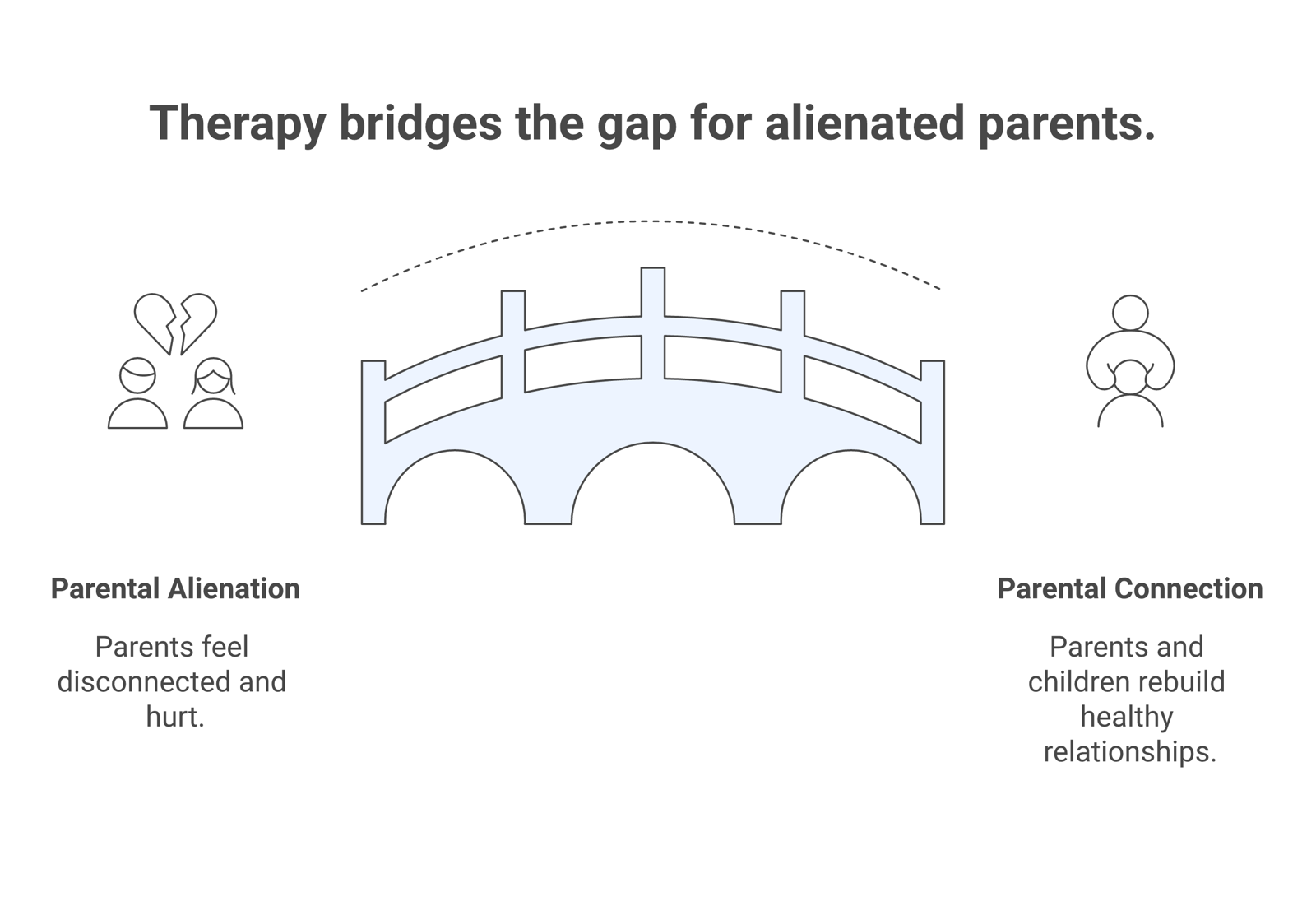
Several approaches fit an alienated parent’s needs. The right mix depends on the person, and a licensed clinician picks the methods. Three broad kinds come up most often.
Trauma-informed care. Alienation often brings on a trauma response, so care that knows trauma tends to fit best. Ruggiero frames the work across four areas. Physical care covers sleep, food, movement, and easing off the substances that worsen the spin. Mental care trains fact-based thinking, so a parent gathers facts before reacting to the fear of them. Emotional care lets feeling follow the facts, not jump ahead of them. Spiritual care means grounding in whatever form fits the person.
Grief-focused therapy. Work built around ambiguous loss gives the grief a shape. Boss laid out goals a clinician can guide a parent through, such as finding meaning, easing the grip of control, and keeping hope real. This work does not need the child to return to have value.
Support around uncertainty. Living with an open loss is its own skill. A therapist can help a parent sit with not knowing, hold love and anger at once, and stay steady across a long, unsettled stretch. General guidance on the stress of divorce and custody comes from the American Psychological Association.
How to find a therapist who understands alienation
Finding the right clinician takes a little vetting, and the effort pays off. A few simple steps help.
First, ask about their work with trauma and grief, not just general counseling. A therapist who treats trauma will know the body patterns above. Second, ask whether they understand high-conflict separation. A clinician need not be an alienation expert. They should grasp that a parent can be in real pain without being the cause of the family’s trouble.
Watch for a warning sign. A therapist who jumps to blame the targeted parent for the rejection may miss the picture. The parent in crisis often looks like the problem because they are the one in pain. A good clinician holds that tension instead of rushing to judge.
Access matters too. Many therapists offer sliding-scale fees, and directories let a person filter by focus, cost, and format. The National Alliance on Mental Illness keeps general guidance on finding help and support. A first session is also a fit check. A parent is allowed to try someone else if the match is wrong.
What to expect in therapy
Early sessions tend to focus on the story and the symptoms. A parent describes what has happened and how it has hit their sleep, mood, work, and bonds. From there, the work is steady more than dramatic. This is slow repair, not a quick fix.
Andrew Folkler, a formerly alienated child who now coaches alienated parents, names a shift many parents make. Early on, a parent often works from an external locus of control. Nothing will be okay until the judge rules, the ex relents, or the child returns. That stance leaves a person powerless, waiting on people who will not move on cue. The healthier shift is toward an internal locus of control, where the question becomes how to learn and grow in one’s own life.
Folkler draws on Viktor Frankl’s account of four stages people pass through under long trauma: shock, apathy, anger, and meaning. Therapy does not skip the hard stages. It helps a parent move through them toward meaning. He also offers a blunt image for why self-care cannot wait. A parent with a broken arm who refuses care until the child returns simply stays hurt, sometimes for years. Tending the wound now is not a betrayal of the child. It keeps the parent whole.
Sessions may include practical tools. A trauma-informed clinician might teach calming habits, such as breathing or grounding, so a parent does not start each day already near the edge. Therapy gives those tools a shape and someone to practice them with.
Therapy works best alongside other support
Therapy is powerful, and it is not the only support a parent needs. Lawrence Joss, who founded the peer group Parental Alienation Anonymous, sums up recovery in one line: recovery is for the parent, not for the child. A parent becomes the steadiest version of themselves, whether or not reconnection comes.
Joss stresses community too. Isolation is both a sign of alienation and a force that keeps it going. Hearing from others who get it can lift a self-blame load carried for years. Energy is also finite, so saying no during hard stretches counts as care, not failure.
Peer support and therapy work together, not against each other. Many parents pair a clinician with a peer group and find each one makes the other stronger. For the self-help side, see surviving the crisis phase. For peer connection, see parental alienation support groups.
Frequently asked questions
What is therapy for alienated parents?
It is care focused on the targeted parent’s own trauma, grief, and stress, not on fixing the child relationship. The work can include trauma-informed care, grief-focused therapy, and support for living with an open loss. The goal is the parent’s healing and stability, whether or not the child returns.
Can therapy help an alienated parent if the child never comes back?
Yes. Therapy for the parent is not judged by the child’s return. It helps a parent ease the trauma response, grieve a loss with no closure, and build a life worth living. Pauline Boss’s work on ambiguous loss describes finding meaning even when a loss stays open. A parent’s wellbeing is a worthy goal on its own.
How does a parent find a therapist who understands parental alienation?
Look for a clinician skilled in trauma and grief, and ask whether they understand high-conflict separation. The therapist need not be an alienation expert, but should see that a parent can be in real pain without being the cause. Directories and sliding-scale options widen access, and a first session is a fair time to test the fit.
Is it normal to feel traumatized by parental alienation?
Yes. Clinical psychologist Faust Ruggiero notes that alienation often comes as a long series of smaller blows, not one event, and that pattern can turn into a trauma response. Common signs include broken sleep, being on edge, avoiding people, and looping thoughts. This is a normal reaction to long stress, not a weakness, and it can improve with treatment.
Does a parent need therapy or a support group?
Often both help, and they do different jobs. A licensed therapist gives clinical care for trauma and grief. A peer group offers connection, shared experience, and a break from isolation. Many parents use both. Anyone in acute distress should see a licensed professional rather than lean on peer support alone.
Where to go next
- For the broader library, start at the Help pillar.
- To learn whether therapy can repair the child relationship, see can therapy help parental alienation.
- For self-directed survival work and community, see surviving the crisis phase.
- For the full treatment of the grief itself, see coping with the grief of parental alienation.
- Looking for peer connection? Try parental alienation support groups.
- On how this strain affects health, see parental alienation trauma.
A free, peer-run option many parents use alongside therapy is Parental Alienation Anonymous, a 12-step fellowship for recovering your own footing.
Sources and further reading
- Ruggiero, F. Trauma-to-PTSD pathway for alienated parents and the four-domain treatment frame (physical, intellectual, emotional, spiritual).
- Boss, P. Ambiguous loss theory. No closure, no ritual, and six sequenced therapeutic goals. Applied to parental alienation by Kelley Baker, Ph.D., LPC, Parental Alienation Study Group.
- Joss, L. Parental Alienation Anonymous. Recovery is for the parent; community as catalyst; capacity is finite.
- Folkler, A. Internal locus of control and Viktor Frankl’s four trauma stages applied to alienated parents.
- Harman, J. J., Kruk, E., & Hines, D. A. (2018). Parental alienating behaviors: An unacknowledged form of family violence. Psychological Bulletin, 144(12), 1275 to 1299. https://doi.org/10.1037/bul0000175
- American Psychological Association. (n.d.). Divorce and child custody. apa.org/topics/divorce-child-custody
- National Alliance on Mental Illness. Help and support. nami.org/help
If you or your child are in crisis
Free and confidential help is available right now.
- 988 Suicide and Crisis Lifeline. Call or text 988. 988lifeline.org
- Childhelp National Child Abuse Hotline. 1-800-422-4453. childhelp.org
- NAMI HelpLine. 1-800-950-6264. nami.org/help
Last reviewed: 2026-06-06. Author: Alex Buckles, Founder.