

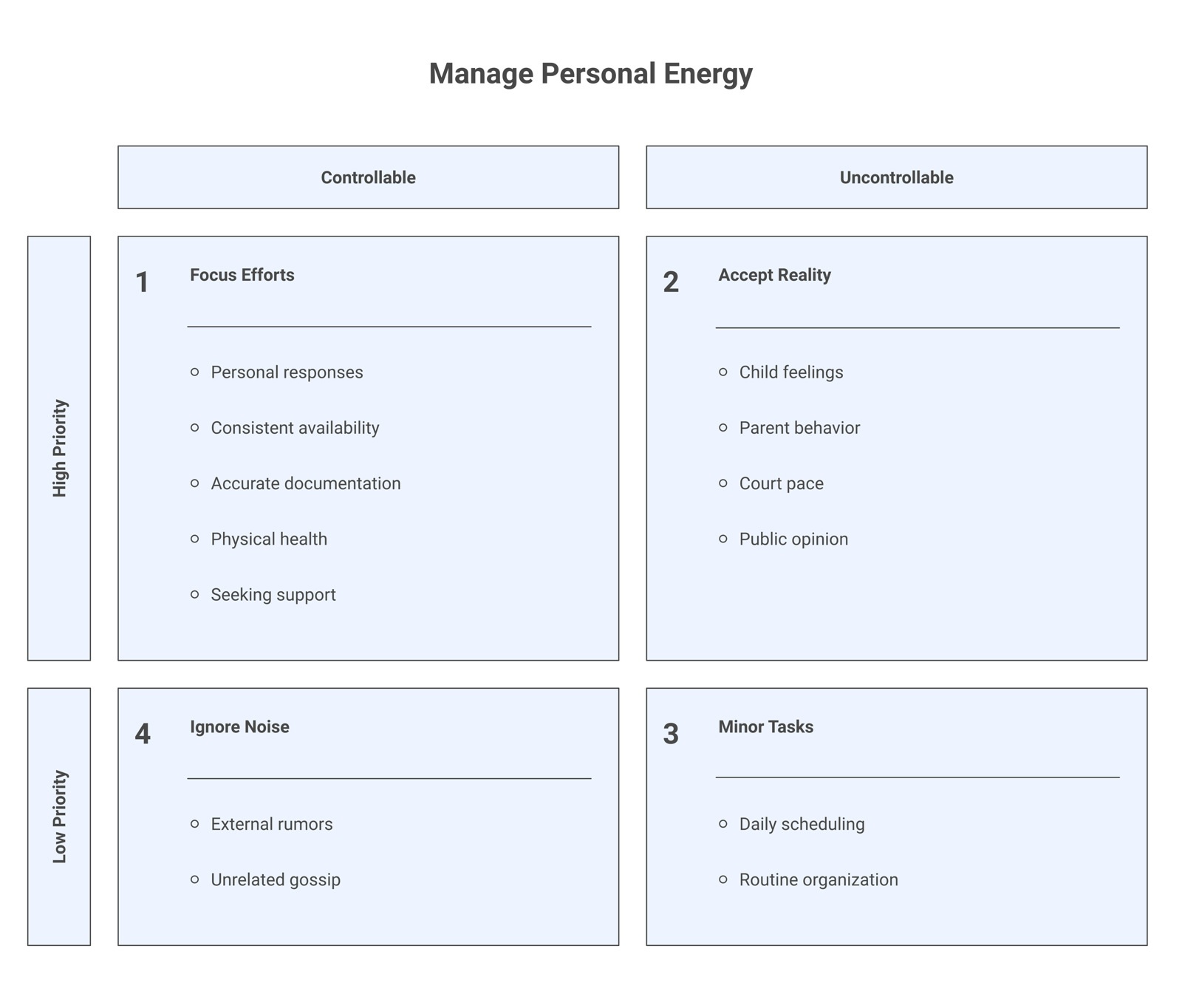
An internal locus of control for alienated parents means putting your limited energy into what you can actually influence, your own steadiness, consistency, documentation, health, and the open door you keep, rather than what you cannot, your child’s current feelings, the other parent, or the pace of the case.
A note on safety
These recovery pages address a child’s rejection that is driven by alienating behavior, not by a parent’s own abuse or neglect. Where a child’s distancing is a justified response to a parent’s harmful behavior, the path is accountability and change, not coping technique. A reader unsure which applies should work with a qualified professional.
This page is general education, not clinical advice. It does not diagnose any reader or replace care from a licensed mental-health professional. A parent who is struggling should reach out to a qualified clinician.
What an internal locus of control means
Locus of control is a psychology term for where a person believes the power over their life sits. The construct comes from psychologist Julian Rotter, who described it in 1966. A person with an internal locus of control believes their own choices and responses shape much of what happens to them. A person with an external locus believes outside forces, luck, fate, or other people, mostly run the show. The American Psychological Association keeps a plain-language definition in its dictionary.
Most people sit somewhere on a spectrum, and the same person can shift depending on the situation. For an alienated parent, the situation pulls hard toward the external end. So much really is outside your hands right now. That pull is understandable. The work of this page is not to deny it but to find the narrow band where your choices still matter, and to invest there.
An internal locus of control is not a belief that you control everything. It is the practice of locating the part you can influence and acting on it.
Why this orientation protects an alienated parent
When energy pours into things you cannot change, it drains away and nothing moves. You replay the last exchange with the other parent. You imagine what your child is being told. You refresh the case for news that does not come. Hours pass, the situation is unchanged, and you are more depleted than before.
Research on coping describes this gap. The American Psychological Association notes that healthy coping tends to combine emotion-focused steps, which soothe the distress, with problem-focused steps, which act on the parts of a problem a person can actually move. Energy spent on the movable parts produces something. Energy spent on the immovable parts mostly produces exhaustion.
There is also a wellbeing cost to a fully external outlook. Peer-reviewed work has linked a strongly external locus of control with higher risk of depression. That is not a reason to blame yourself for how you feel. It is a reason to protect your outlook on purpose, the way you would protect your sleep or your blood pressure. Shifting even part of your attention toward what you can influence is a health practice, not a personality test you pass or fail.
What you can actually control
The list of what an alienated parent can influence is shorter than anyone would like. It is not empty. These are the places your effort returns something.
Your own steadiness and regulation
You can influence how regulated you are when you communicate, when you wait, and when you are provoked. A calm, even reply to a hostile message is a choice. Stepping away before you send something you will regret is a choice. None of this is easy, and a clinician can help you build the skill. A parent who works at staying steady is also, not by coincidence, a parent who is easier to reconnect with later. The work covered in becoming the anchor builds on this.
Consistency and the open door
You can control whether you keep showing up in small, low-pressure ways. Coaching voices in this field stress consistency over frequency, a brief, warm, regular signal that the door is open rather than a flood of messages. You can save the letters that come back unopened and the gifts that are refused, holding them as a record of continuing love rather than proof of failure. You can keep a calm, factual record of missed exchanges and blocked contact. Treat these as one practitioner’s framing rather than settled science, and adjust them to your own situation and any court order.
What you cannot control (and why naming it helps)
Some things sit fully outside your reach, and pretending otherwise only hurts. You cannot control your child’s current feelings, which are forming under pressure you did not create. You cannot control the other parent’s behavior or choices. You cannot control how fast a court moves, or what a relative believes, or whether an apology ever comes.
Naming these honestly is not giving up. It is the opposite. When you set down the weight of things you were never able to lift, you free up the strength to carry the things you can. Acceptance here means accepting reality as it is right now, not accepting that it will stay this way forever.
How to build your controllables list
A controllables list is a short, written page that sorts your worries into what you can act on and what you cannot. Writing it down turns a swirling feeling into something you can see and use. Here is one general way to build it.
- Write the worry. Put the thing on your mind into one plain sentence.
- Ask one question. Can I directly influence this by something I do today? Answer yes or no.
- Sort it. Put the yes items in a column headed “I can influence this.” Put the no items in a column headed “Outside my control.”
- Pick one. From the can-influence column, choose a single small action for today.
- Park the rest. For the outside-my-control items, write one line of how you will care for yourself when they intrude, then set the list down.
- Revisit gently. Look again in a week. Items move between columns as circumstances change, and that is fine.
The companion practice, choosing actions that fit your values rather than reactions that fit the moment, is covered in find your values first.
The rumination trap
Rumination is the loop where the same painful thought runs again and again without resolving anything. For alienated parents it usually fastens onto the uncontrollable column, the other parent, the unfair ruling, the imagined conversation. The loop feels like problem-solving, but it solves nothing and leaves you worse.
You do not break the loop by force or by scolding yourself for being in it. A gentler move works better. Notice the loop and name it, quietly: this is rumination. Then redirect to one small controllable action, a walk, a glass of water, one line in your record, a text to a friend. The point is not to win the thought. It is to step out of it and do one real thing. If rumination is taking over your days or nights, that is a strong signal to bring in professional help, which is what therapy for alienated parents is for. For the grief underneath the loops, coping with the grief of parental alienation goes deeper.
Healthy practices that hold you steady
Steadiness is built from ordinary, repeatable things, not from a single breakthrough. The American Psychological Association’s guidance on handling stressors points to the basics, and the basics matter most when everything else is in chaos.
Keep a routine, even a small one, so your days have shape when the case does not. Protect sleep, movement, and food, because a depleted body makes every feeling louder. Stay connected to people who steady you, and let them help. Limit the doom-scrolling through old messages and case documents to set times, not all hours. Consider working with a therapist who understands high-conflict separation. Looking after yourself is not selfishness or a betrayal of your child. A steadier parent copes better today and is easier to reconnect with later, so self-care is part of the work, not a distraction from it. This is not toxic positivity. The grief is real, the situation may be unjust, and you are allowed to feel all of it while still doing the small things that keep you upright.
Frequently asked questions
What is an internal locus of control?
An internal locus of control is the belief that your own choices and responses shape much of what happens to you, rather than outside forces alone. It is a standard psychology construct described by Julian Rotter and defined by the American Psychological Association. Most people fall on a spectrum, and the orientation can be strengthened with practice.
What can an alienated parent actually control?
You can control your own steadiness and regulation, whether you keep showing up in small consistent ways, the records you keep, your physical health, and who you ask for support. You cannot control your child’s current feelings, the other parent’s behavior, or how fast a court moves. Putting energy into the first list protects you.
How do you stop ruminating about the other parent?
You do not stop it by force. Notice the loop and name it quietly as rumination, then redirect to one small action you can actually take, a walk, a glass of water, a message to a friend. If the loops dominate your days or nights, that is a signal to seek professional help from a therapist who understands high-conflict separation.
Does focusing on what you can control help reunite with your child?
There is no guarantee of reunion, and any page promising one is not being honest. Focusing on your controllables protects your wellbeing in its own right. As a side effect, a steadier, more regulated parent tends to be easier to reconnect with if and when the chance comes, so the work is worthwhile either way.
Is self-care selfish when your child is gone?
No. Caring for your sleep, health, support, and steadiness is not a betrayal of your child. A depleted parent copes worse and is harder to reconnect with. Looking after yourself is part of the work of recovery, not a turning away from it, and it is allowed even while you grieve.
A note on hope
Hope and honesty can sit together. Nothing on this page promises that focusing on what you can control will bring your child back, because no one can promise that. What an internal locus of control offers is steadier ground under your own feet right now, and a parent who stays steady and keeps the door open is a parent for whom reconnection remains more possible. You deserve to be cared for through this, whatever the outcome. For the wider path, see the Recover silo and the third way in parental alienation.
Sources and further reading
- American Psychological Association. Locus of control. APA Dictionary of Psychology. dictionary.apa.org/locus-of-control
- American Psychological Association. Stress (stress and coping). apa.org/topics/stress
- American Psychological Association. Divorce and child custody. apa.org/topics/divorce-child-custody
- Culpin, I., et al. (2015). Exposure to socioeconomic adversity in early life and risk of depression at 18 years: The mediating role of locus of control. PMC4504028. pmc.ncbi.nlm.nih.gov/articles/PMC4504028
If you or your child are in crisis
Free and confidential help is available right now.
- 988 Suicide and Crisis Lifeline. Call or text 988. 988lifeline.org
- Childhelp National Child Abuse Hotline. 1-800-422-4453. childhelp.org
- NAMI HelpLine. 1-800-950-6264. nami.org/help
Last reviewed: 2026-06-07. Author: Organization.