

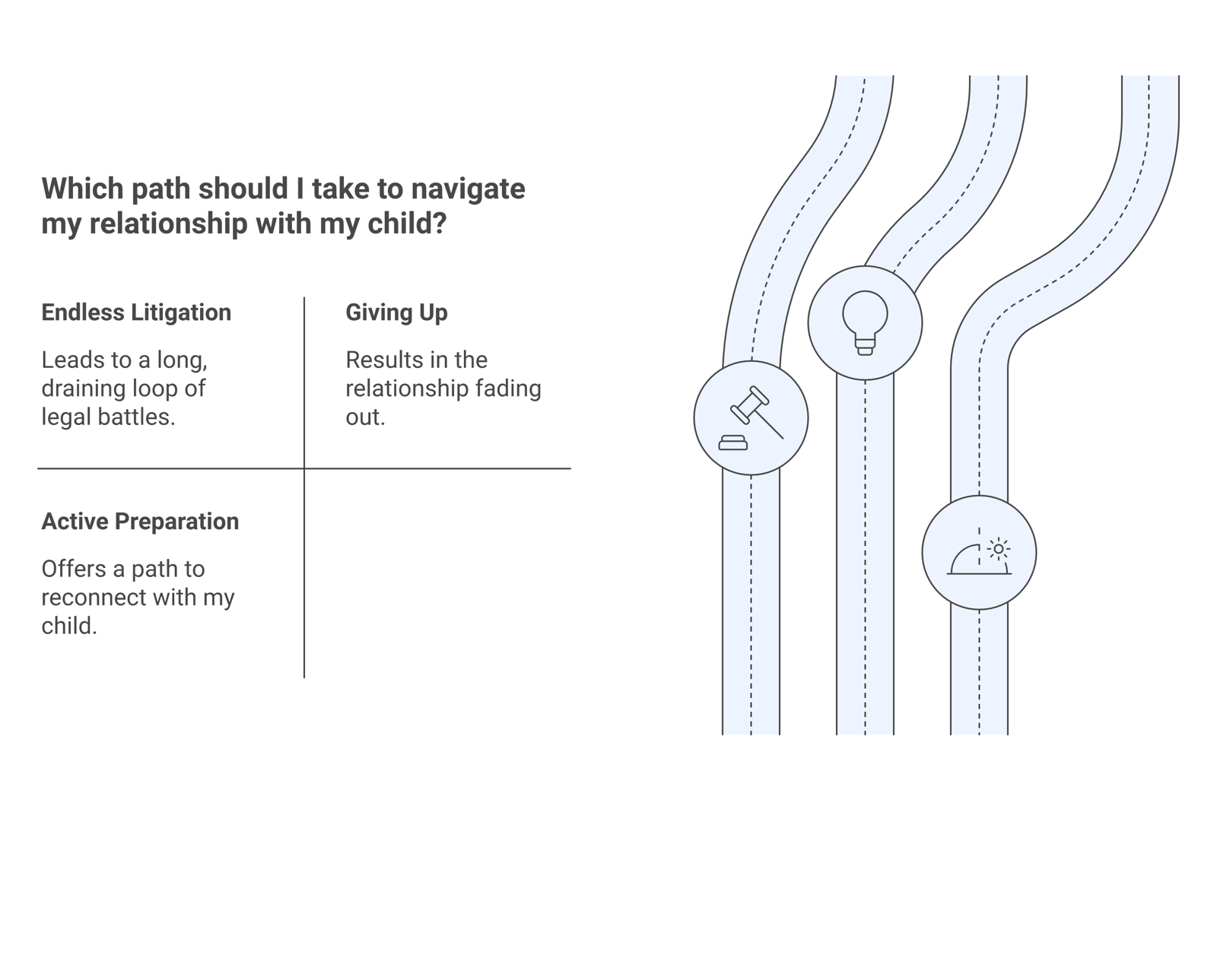
The third way in parental alienation is an active, relationship-first path between two exhausting extremes: endless litigation and giving up. Coach Ginger Gentile describes it as preparing for reconnection by becoming a steady parent, doing inner work, and keeping the door open, with or without the court. It is one framework, not a guarantee.
A note on safety
These recovery pages address situations where a child’s rejection is driven by alienating behavior, not by the reader’s own abuse or neglect. Where a child’s estrangement is a justified response to a parent’s harmful behavior, the path is accountability and change, not reconnection technique. A reader unsure which applies should work with a qualified professional.
This page is general education, not clinical or legal advice. Some of the ideas here come from coaching practice and are presented as one practitioner’s view, not settled science. Anyone in distress, or facing a custody decision, should work with a licensed clinician or attorney.
The third way, in plain terms
Many targeted parents feel boxed into two options. The first is to fight in court, sometimes for years, at great cost. The second is to give up, because the fighting is unbearable and nothing seems to change. Both feel like dead ends. The third way is a different stance, and it starts with what the parent can actually control.
Coach Ginger Gentile, who has worked with many alienated families, calls this the third or middle way. In her framework, it means active preparation for reconnection that does not depend on the other parent or on a courtroom win. A parent becomes steadier, keeps showing up in low-pressure ways, does inner work, and stays ready to reconnect when an opening appears. This is one practitioner’s view, not settled science, so it helps to hold it as a useful lens rather than a proven cure.
The point is not that court never matters. For some families, court intervention is necessary, and this page links to the Court silo for that reason. The point is that a parent does not have to wait for a judge to start doing meaningful, healthy work today.
The two extremes that exhaust parents
It helps to name the two extremes honestly, because most parents have lived in both. The litigation track can be important and sometimes essential. It can also drain savings, sleep, and hope while the relationship with the child stays frozen. Many parents describe a cycle of filings and hearings that consumes everything and still leaves the child out of reach.
The giving-up track is the other extreme. After enough disappointment, withdrawing can feel like the only way to stop the pain. The trouble is that a child watching from a distance may read silence as confirmation that the parent stopped caring. Withdrawal, even when it comes from exhaustion, can deepen the very wound the parent wants to heal.
Neither extreme is a moral failure. Both are understandable responses to a genuinely hard situation. The third way simply offers a place to stand between them, so a parent can act without burning out and can stay present without losing themselves.
The abuse screen comes first
Before any of this, one question has to come first. Is the child’s distance the result of alienating behavior, or is it a justified response to the reader’s own conduct? These are different situations and they call for different paths.
Where a child is pulling away because a parent has been abusive, neglectful, or frightening, the child’s distancing is not alienation. It is a reasonable protective response, and the right path is accountability, change, and professional help, not reconnection technique. A reader who is unsure which situation they are in should work with a qualified clinician who can look at the specifics. The third way described here assumes the first situation, not the second.
What the third way actually is
The third way is less a method and more a set of habits a parent builds in themselves. Gentile groups them around active, relationship-first preparation. Four elements show up again and again, and each one is supported by established psychology, not only by coaching.
Becoming a steady parent
A great deal of the work is about the parent’s own steadiness. The idea, in Gentile’s framing, is that a child finds it easier to reconnect with a parent who feels calm and reliable than with a parent who is visibly falling apart. That is a coaching claim, so it is worth stating gently and without any shame: a regulated, non-anxious parent is simply easier to come back to.
Established psychology supports the underlying point. Emotion regulation, the ability to notice and steady strong feelings, is linked in research to healthier parent-child attachment. A 2025 longitudinal study in Applied Research in Quality of Life traced how alienating behaviors first weaken attachment, then disrupt a young person’s emotion regulation. Strengthening the parent’s own steadiness is one of the few levers that sits fully within their control.
Self-care, then, is not selfishness or a distraction from the child. It is part of the work. Sleep, therapy, movement, and a calmer nervous system are not luxuries here. They are the ground the rest of the third way stands on. For more on this, see becoming the anchor and internal locus of control for alienated parents.
Keeping the door open
The second element is staying gently present. Keeping the door open means low-pressure, consistent contact attempts that do not corner the child or demand a response. A short message on a birthday. A card that asks nothing. A gift saved in a closet rather than forced on a child who is not ready.
Many parents save returned letters and unopened gifts during the alienation years. These become a quiet record of continuity, proof that love did not stop even when contact did. The goal is not to flood the child or to keep score. It is to make sure that, whenever the child is ready, the door is unlocked. The companion page reconnection as rebuilding trust goes deeper on pace and pressure.
Doing the inner work
The third element is internal. Gentile frames it as releasing the energetic conflict a child can sense, even when a parent thinks they are hiding it. In plainer terms, children often pick up on a parent’s ongoing anger toward the other parent, and that tension can make reconnection harder.
This is not the same as forgiveness, and no one is owed forgiveness they have not asked for. It is closer to a values-based discipline: choosing how to act based on the kind of parent one wants to be, rather than letting the other parent’s behavior set the tone. Acceptance and commitment therapy, a recognized clinical approach, calls this committed action guided by values. The inner work is hard, and it is reasonable to do it with a therapist rather than alone.
Being ready when the opening comes
The fourth element is readiness. Openings can be small and unexpected, a text, a question, a brief willingness to talk. A parent who has been steadying themselves and keeping the door open is positioned to meet that moment calmly rather than with a flood of grief or pressure.
What reconnection looks like is rarely a clean reunion. A 2023 qualitative study in Frontiers in Psychology explored reunification after alienation and found a gradual, uneven process rather than a single dramatic turning point. Readiness means accepting that pace. The paired page rupture and repair in reconnection explains why setbacks are normal and repairable.
Where the corpus claims come from, and their limits
It is worth being clear about evidence. Gentile reports that roughly 95 percent of her coaching cases use the third-way path. That figure is her own number, drawn from her own practice, and it is offered here as her claim rather than as independent research. It has not been tested in a controlled study, and a coach’s caseload is not a representative sample.
This matters because hope works best when it is honest. The third way describes a stance that many parents find steadying and worthwhile. It does not come with a success rate that anyone can promise. Holding both of those truths at once is exactly the kind of balanced thinking the path itself asks for.
The third way and the courtroom are not enemies
A common worry is that choosing the third way means abandoning a court case. It does not. For some families, court intervention is genuinely necessary, whether to enforce a parenting order or to set up court-ordered reunification therapy. The third way can run alongside legal action rather than replacing it.
The difference is where a parent places their energy. Litigation, where it is needed, becomes one tool among several rather than the entire identity of the situation. A parent can pursue a necessary motion and still spend their evenings becoming steadier, keeping the door open, and doing inner work. To understand the clinical side of the legal path, see what is reunification therapy.
Looking after yourself is worthwhile on its own
There is one more reframe that keeps the third way healthy. Active preparation and self-care are worthwhile in their own right, not only as a route back to the child. A parent who rebuilds a steady life has gained something real even if the timeline of reconnection stays uncertain.
This framing protects against two traps. One is despair, where a parent concludes that nothing they do matters. The other is a brittle, all-or-nothing hope that treats every effort as worthless unless the child returns quickly. A steadier middle holds that the work is good for the parent now, and that it also keeps the door open for later. If the weight of all this feels like too much, that is a signal to bring in a therapist or a support group, not a sign of weakness. Practical guidance on first contact lives at how to reconnect with an alienated child.
Frequently asked questions
What is the third way in parental alienation?
The third way is an active, relationship-first path between endless litigation and giving up. Coach Ginger Gentile describes it as preparing for reconnection by becoming a steady parent, doing inner work, and keeping the door open, with or without the court. It is one practitioner’s framework rather than settled science, and outcomes vary from family to family.
Can you reconnect with an alienated child without going to court?
Sometimes. The third way focuses on what a parent can control, such as their own steadiness and consistent low-pressure presence, which does not require a court order. For some families, though, court intervention is necessary, and the third way can run alongside it rather than replacing it.
Is the third way a guaranteed method?
No. It is one coach’s framework, not a proven cure. The often-quoted figure that about 95 percent of her cases use this path is the coach’s own number from her own practice, not independent research. The path can be steadying and worthwhile even though no one can promise a reunion.
Why does self-care matter for an alienated parent?
A calm, regulated parent is easier to reconnect with, and steadiness sits within the parent’s own control. Self-care is part of the work rather than a distraction from it. It is also worthwhile on its own, because rebuilding a steady life is a real gain regardless of the timeline of reconnection.
When is the third way not the right path?
Where a child’s estrangement is a justified response to a parent’s abuse or neglect, the third way is the wrong frame. There the path is accountability, change, and professional help, not reconnection technique. A reader unsure which situation applies should work with a qualified clinician.
What this page does not do
This page does not promise reunion, and it does not present coaching claims as proven science. It does not tell a reader to drop a necessary court case, and it does not apply where a child’s distance is a justified response to harm. It offers a balanced description of one practitioner’s framework, grounded where possible in established psychology, so a parent can choose a healthier stance.
For the steadiness work, see becoming the anchor and internal locus of control for alienated parents. For pace and trust, see reconnection as rebuilding trust and rupture and repair in reconnection. The full Recover silo holds the rest.
Sources and further reading
- American Psychological Association. Divorce and child custody. apa.org/topics/divorce-child-custody
- American Psychological Association. Locus of control (APA Dictionary of Psychology). dictionary.apa.org/locus-of-control
- Frontiers in Psychology (2023). A qualitative exploration of reunification post alienation. frontiersin.org
If you or your child are in crisis
Free and confidential help is available right now.
- 988 Suicide and Crisis Lifeline. Call or text 988. 988lifeline.org
- Childhelp National Child Abuse Hotline. 1-800-422-4453. childhelp.org
- NAMI HelpLine. 1-800-950-6264. nami.org/help
Last reviewed: 2026-06-07. Author: Organization (Alex Buckles (PAC Founder)).