

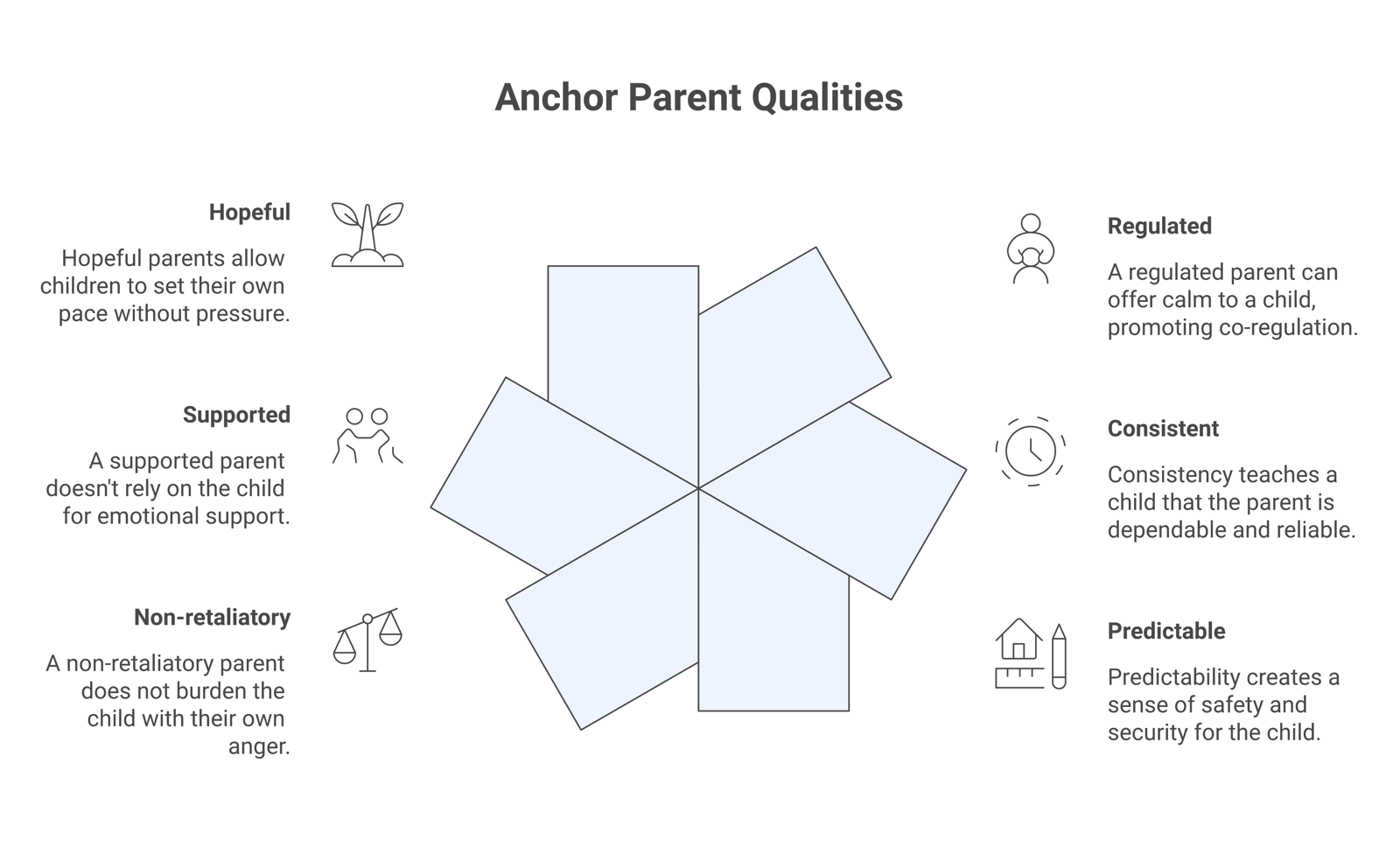
Becoming the anchor means becoming a calm, consistent, emotionally regulated parent. A steady parent is easier and safer for a hurting child to reconnect with, so self-regulation and self-care are part of the recovery work, not weakness and not the cause of the alienation. This page explains how that steadiness is built.
A note on safety
These recovery pages address a child’s rejection that is driven by alienating behavior, not by a parent’s own abuse or neglect. Where a child’s distancing is a justified response to real harm, the honest path is accountability and change, not reconnection technique. A reader who is unsure which situation applies should work with a qualified professional.
This page is general education, not clinical advice. It does not diagnose any family, and it does not replace care from a licensed professional.
What becoming the anchor really means
An anchor holds steady while the water moves. For a targeted parent, becoming the anchor means staying calm and consistent even while a child pulls away, even while the other home sends a different story, and even while the grief is heavy. A child caught in alienation is carrying a storm. A parent who can stay grounded gives that child something solid to find their way back to, whenever they are ready.
This is the healthy core of a popular coaching idea. Some coaches, the filmmaker and advocate Ginger Gentile among them, tell targeted parents that a child will not reconnect with a parent who seems unstable or frightened. That claim can land as a slap. Read it carefully, though, and a kinder truth sits inside it. A regulated parent is simply easier and safer to come home to. So the work of getting steady is not about blame. It is about becoming a place of safety.
Where the weak parent idea comes from, and how to hold it
The phrase that stings is some version of “children will not reunite with a weak parent.” That framing comes from the coaching world, not from settled science, and it is worth treating as one practitioner’s view. Held loosely, it points at something real about regulation and safety. Held as a verdict on your worth, it becomes a weapon you turn on yourself.
So hold it loosely. A parent in acute distress did not cause the alienation by being distressed. Alienating behavior is driven by the other parent’s choices, not by the targeted parent’s tears. The reason to build steadiness is forward-looking, not accusing. You are not fixing a flaw that broke the bond. You are growing a capacity that helps the bond heal.
The attachment reason a steady parent helps
Children settle their feelings by borrowing an adult’s calm. Psychologists call this co-regulation, and it is one of the oldest findings in attachment research. A young nervous system is not yet able to soothe big feelings alone, so it reaches for a steady adult and tunes to that adult’s state. A calm voice, an unhurried pace, and a relaxed body tell a child’s body that the moment is safe.
Alienation does not switch this wiring off. A rejecting child still reads the room. When contact does come, a parent who is visibly anxious or angry asks the child’s nervous system to manage two storms at once. A parent who is steady offers the opposite. The American Psychological Association describes emotion regulation as a learnable skill that shapes how stress moves through the body, which is exactly the skill the anchor is building.
Why your steadiness is felt, not just seen
Children sense tension long before they can name it. A bright smile stretched over panic rarely fools them, because tone, breath, and timing leak the truth underneath. This is why the goal is real regulation rather than a performance of calm. You are not acting steady for an audience. You are becoming steady so that the safety a child feels around you is genuine.
Self-care is part of the work, not selfishness
Many targeted parents flinch at the word self-care. It can feel obscene to tend to yourself while your child is gone. The recovery community that grew out of Parental Alienation Anonymous puts the point plainly through founder Lawrence Joss: recovery is for you, not as a trick to win the child back, but because a whole parent is the only kind who can show up well when the chance arrives.
Capacity is finite, and that is not a moral failing. Joss frames saying no to extra obligations during hard stretches as part of recovery rather than a lapse in it. Rest, food, sleep, movement, and connection are not rewards you earn after the child returns. They are the maintenance that keeps the anchor from rusting. Building an internal sense of agency belongs here too, which the page on an internal locus of control for alienated parents explores in depth.
The psychologist Faust Ruggiero offers a four-part frame for this upkeep: tend the physical, the intellectual, the emotional, and the spiritual sides of yourself, rather than pouring everything into the legal fight. As Ruggiero puts it, happy people are the people who work the process of being happy every day. The reserves you build on calm days are what you draw on when a hard day hits.
Practices that build the anchor
Steadiness is grown through small, repeatable habits. None of these guarantees a reunion, because outcomes vary and much sits outside any parent’s control. Each one, though, makes you a calmer and safer presence, which is worth doing for its own sake.
Regulate before contact
Before a call, an exchange, or a visit, give your own nervous system a few minutes first. Slow breathing, a short walk, a glass of water, or a grounding phrase can bring your body down a notch. If you arrive already settled, you have something steady to offer rather than a second storm.
Be predictable
Children trust what repeats. A message that arrives every Friday, a tone that stays warm whatever the reply, and promises you keep all tell a watching child that you are safe and dependable. Predictability is quieter than a grand gesture, and it lasts far longer.
Do not leak anxiety or anger onto the child
The clinical psychologist Sue Cornbluth stresses that a parent should do the inner work first, so that anger at the other parent does not spill into contact with the child. A child should never be asked to hold your fear or carry your case. Process those feelings with a therapist, a support group, or a trusted friend, and keep the child’s space free of them.
Build your own support
No one stays steady alone. A good therapist, a peer support group, and people who understand the situation all widen the base you stand on. Reaching out for help is a sign of strength, not weakness, and it is often the single most stabilizing move a targeted parent can make. For the wider relationship with the other home, the page on how to communicate with a toxic ex offers practical guardrails.
When steadiness is hard, and that is normal
No parent is an anchor every day, and pretending otherwise is its own kind of harm. Grief comes in waves. Worse, even good moments can shake you, because a nervous system trained by long stress can read a hopeful surprise as a threat. Ruggiero and Joss both describe how a first contact or a small breakthrough can leave a parent oddly rattled rather than purely glad. Knowing this in advance keeps a wobble from feeling like a failure.
Steadiness is a practice, not a personality you either have or lack. Some days you will manage it, and some days you will not, and both are part of being human inside a painful situation. The grief underneath deserves real care, which the page on coping with the grief of parental alienation addresses directly. If the weight ever turns into thoughts of self-harm, please use the crisis resources at the foot of this page right away. A path that holds room for honest limits is described in the third way in parental alienation.
When the time comes to rebuild contact, the steadiness you have grown becomes the ground you do it from, which the page on reconnection as rebuilding trust walks through step by step. The full Recover section holds the rest of the healing and reunification material.
Frequently asked questions
What does it mean to be the anchor for an alienated child?
Being the anchor means becoming a calm, consistent, emotionally regulated parent who stays steady even while a child pulls away. The idea is that a grounded parent gives a hurting child a place of safety to return to whenever the child is ready. It is about being dependable and regulated, not about being perfect or hiding your real feelings.
Why does staying calm matter when reconnecting with an alienated child?
Children settle their own feelings by borrowing a steady adult’s calm, a process psychologists call co-regulation. A parent who is visibly anxious or angry asks a child to manage two storms at once, while a calm parent offers safety. Staying regulated makes contact feel safer, which makes a child more able to engage.
Is self-care selfish when your child is rejecting you?
No. Self-care is the maintenance that keeps a parent steady enough to show up well, so it is part of the recovery work rather than a betrayal of the child. Rest, support, and treatment are not rewards earned after a reunion. They are what make a calm, dependable presence possible in the first place.
How do you regulate your emotions before contact with an alienated child?
Give your own nervous system a few minutes before any call, exchange, or visit. Slow breathing, a short walk, water, or a grounding phrase can bring your body down a notch so you arrive settled. Processing anger and fear with a therapist or support group beforehand keeps those feelings out of the child’s space.
Did my anxiety or distress cause the parental alienation?
No. Alienating behavior is driven by the other parent’s choices, not by a targeted parent’s distress. Building steadiness is forward-looking work that helps a relationship heal, not a fix for a flaw that broke it. A parent in pain did not cause the rejection by being in pain.
What this page does not do
This page does not promise that becoming steady will bring a child home, because reunion depends on many things outside any parent’s control. It does not blame a struggling parent for the alienation, and it does not present coaching frameworks as proven science. It is general education, written to help a targeted parent care for themselves and become a safer presence, whatever the path ahead holds.
The inner-agency side of this work is covered in an internal locus of control for alienated parents. To rebuild contact, see reconnection as rebuilding trust. For a measured overall path, read the third way in parental alienation. The Recover section covers the rest.
Sources and further reading
- American Psychological Association. Emotion regulation and stress. apa.org/topics/stress
- American Psychological Association. Resilience. apa.org/topics/resilience
- Van Niekerk, L., et al. (2023). A qualitative exploration of reunification post alienation. Frontiers in Psychology, 14, 1189840. https://doi.org/10.3389/fpsyg.2023.1189840
If you or your child are in crisis
Free and confidential help is available right now.
- 988 Suicide and Crisis Lifeline. Call or text 988. 988lifeline.org
- Childhelp National Child Abuse Hotline. 1-800-422-4453. childhelp.org
- NAMI HelpLine. 1-800-950-6264. nami.org/help
Last reviewed: 2026-06-07. Author: Parental Alienation Center (Organization). Editorial review: held to the PAC Editorial Standards (balance, primary-source citation, reader safety); an independent expert review board will be appointed.