

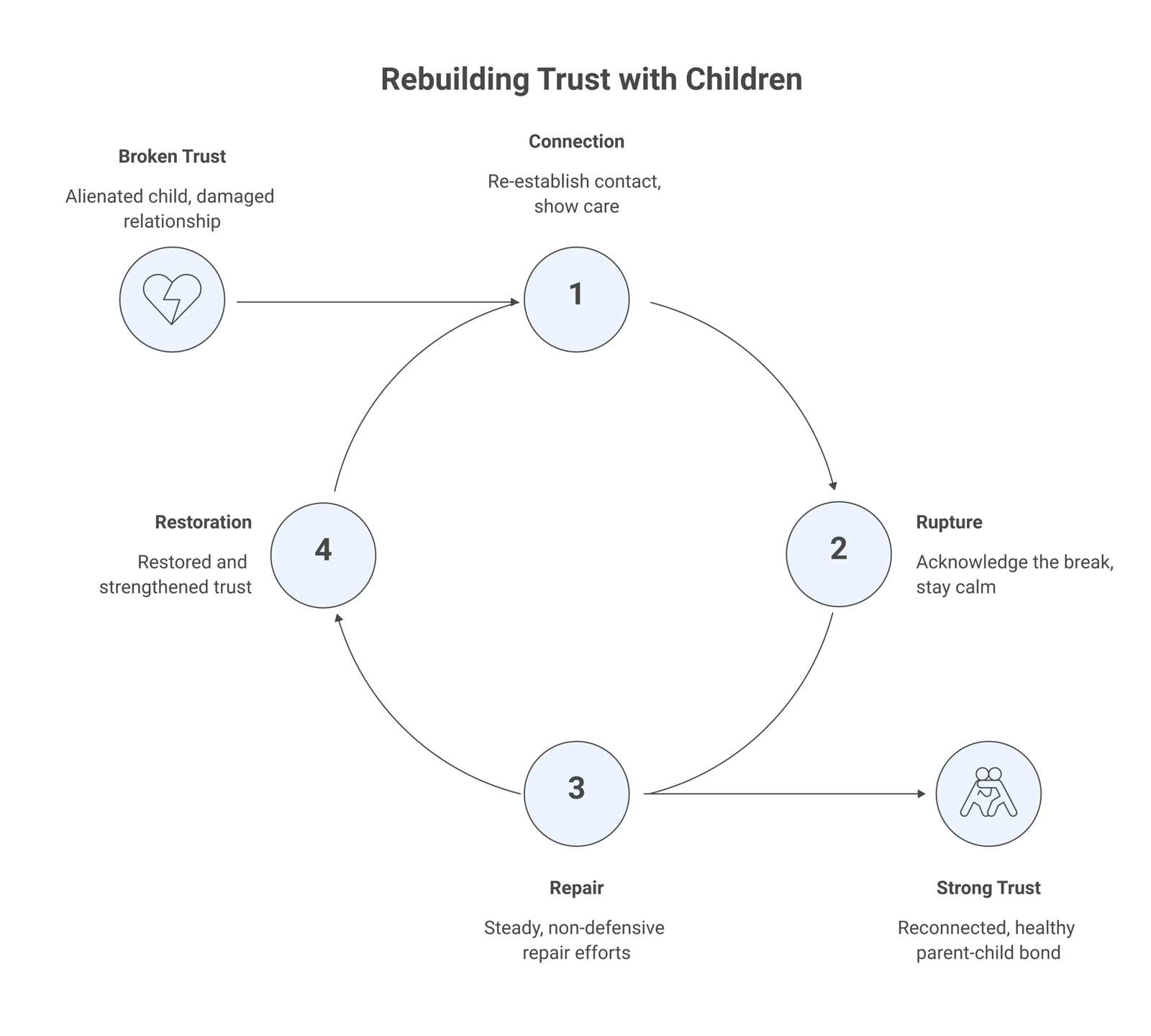
Rupture and repair is the heart of how reconnection works: relationships are built and rebuilt through repairing the small breaks, not avoiding them. Edward Tronick’s still-face research shows children re-engage when a parent returns warmly. With an alienated child, one hard contact is a rupture, and steady, non-defensive repair can restore trust over time.
A note on safety
These recovery pages address situations where a child’s rejection is driven by alienating behavior, not by the reader’s own abuse or neglect. Where a child’s estrangement is a justified response to a parent’s harmful behavior, the path is accountability and change, not repair technique. A reader unsure which applies should work with a qualified professional.
This page is general education, not clinical advice. It describes attachment research and applies it gently to reconnection. Anyone in distress, or working through a difficult reconnection, may benefit from a licensed clinician’s support.
What rupture and repair means
Rupture and repair is the normal cycle in every close relationship where connection breaks for a moment and is then restored. A rupture is any small break in attunement: a misunderstanding, a sharp word, a missed cue, a visit that goes flat. Repair is the return to warmth and connection afterward.
The key idea from attachment research can surprise parents. Trust is not built by avoiding ruptures. It is built by repairing them. A relationship where breaks are noticed and mended teaches a child something durable: that closeness can survive a bump, and that the bond is stronger than any single bad moment. The repair is the lesson, not the rupture.
This reframe matters for a parent who is reconnecting with an alienated child. Perfect, smooth contact is not the goal, and it would not even be the most trust-building outcome if it were possible. The goal is to become a parent who returns, steadily and without defensiveness, after the inevitable rough patches.
The still-face experiment
The clearest illustration comes from developmental psychologist Edward Tronick. In his still-face experiment, a parent and infant play warmly face to face. Then the parent is asked to hold a blank, unresponsive expression for a short time. The infant quickly notices, protests, tries hard to win the parent back, and grows distressed when the parent stays unreachable.
The important part comes next. When the parent re-engages with a warm, responsive face, the infant settles and reconnects, often within moments. The distress of the rupture gives way to relief in the repair. Tronick’s work helped show that the rupture itself is not the damaging event. What protects a child is the reliable return.
Applied carefully, the lesson scales far beyond infancy. Across the attachment literature, the steady availability of a caregiver after a break is what builds a secure sense that the relationship will hold. The still face is brief. The repair is what the child remembers.
Why this matters for reconnection with an alienated child
A parent reconnecting after alienation often lives in dread of a single bad contact. A visit goes quiet, a text lands wrong, a child seems cold, and the parent concludes the whole effort has failed. The rupture-and-repair principle offers a steadier reading. That hard moment is a rupture, and a rupture is not the end of a relationship. It is an ordinary part of how relationships move.
What turns a rupture into lasting damage is not the break itself but the absence of repair. A child who watches a parent withdraw after every difficult moment learns that the bond is fragile. A child who watches a parent return, calmly and without blame, learns the opposite. The parent cannot control the child’s reaction. The parent can control the quality of the return.
Two cautions belong here. This page assumes the distance comes from alienating dynamics, not from the reader’s own harmful behavior; where a child is protecting themselves from genuine harm, repair technique is the wrong tool and accountability is the right one. And the work is gentle by design, because a child under pressure cannot be hurried into trust.
How to repair after a setback
Repair is simpler than it feels in the moment, though it is rarely easy. Four moves carry most of the weight.
Acknowledge simply
A repair often starts with naming the rupture briefly and without drama. Something small does the job: “I think our last call felt tense, and I am glad to talk again.” There is no need for a long explanation or a confession. A simple acknowledgment tells the child the parent noticed and is not pretending the moment did not happen. For first-contact wording, see how to reconnect with an alienated child.
Stay regulated
The parent’s calm is the actual repair. A steady, regulated parent communicates safety more powerfully than any words. Research on parent-child attachment underlines this point. A 2025 longitudinal study in Applied Research in Quality of Life traced how a young person’s emotion regulation depends in part on the steadiness of the attachment around them. Regulating your own nervous system first, then reaching out, is not a delay. It is the work.
Do not over-apologize or collapse
Repair is not the same as collapsing into guilt. An over-apology, especially a tearful one, can quietly shift the burden onto the child, who then feels responsible for the parent’s feelings. A child who has already been pulled between two parents does not need another emotional job. A brief, grounded acknowledgment repairs. A flood of apology asks the child to do the comforting.
Keep showing up
Consistency matters more than intensity. The most powerful repair is simply continuing to be present after a hard moment, in low-pressure, predictable ways. Withdrawal, even when it comes from hurt, can read to a child as abandonment. Showing up again, without making the child account for the last setback, is often the whole repair. The companion page reconnection as rebuilding trust covers pacing in more depth, and becoming the anchor covers the steadiness that makes it possible.
Holding realistic expectations
Honesty matters here as much as hope. Repair takes time, and it is not always reciprocated right away. A parent can make a clean, warm repair attempt and still meet silence. That does not mean the attempt failed or that the principle is wrong. It means the child is not ready yet, which is different from the door being closed.
This is where realistic expectations protect a parent’s wellbeing. Each steady return is worthwhile on its own, because it keeps the relationship open and keeps the parent acting like the person they want to be. Counting on instant reciprocation sets a parent up for repeated crashes. Trusting the slow logic of repair lets them keep going. If the waiting becomes overwhelming, that is a reason to lean on a therapist or a support group, and the reminder that an alienated child’s love is not gone can help on the hard days.
Frequently asked questions
What is rupture and repair in a relationship?
Rupture and repair is the normal cycle where connection briefly breaks and is then restored. A rupture is a small break in attunement, such as a misunderstanding or a tense moment. Repair is the return to warmth afterward. Attachment research finds that repairing ruptures, rather than avoiding them, is what builds lasting trust.
What is the still-face experiment?
The still-face experiment is a study by developmental psychologist Edward Tronick. A parent holds a blank, unresponsive face with their infant, who protests and grows distressed, then settles and reconnects once the parent re-engages warmly. It illustrates that the reliable return, not the brief rupture, is what protects the bond.
Does one bad visit ruin reconnection?
Usually not. A single difficult contact is a rupture, and ruptures are an ordinary part of every relationship. What matters is the repair that follows. A steady, non-defensive return after a hard visit can restore trust and, over time, even strengthen it.
How do you repair after a setback with your child?
Acknowledge the rough moment simply, stay regulated rather than reactive, avoid over-apologizing or collapsing into guilt, and keep showing up in low-pressure ways. The parent’s calm, consistent return is the active part of repair, more than any perfect words.
Is repair always reciprocated?
No. Repair takes time, and a child may not respond right away. A warm repair attempt that meets silence has not failed; it means the child is not ready yet. Each steady return is still worthwhile, because it keeps the relationship open and supports the parent’s own wellbeing.
What this page does not do
This page does not promise that repair always works or that a child will reciprocate. It does not encourage over-apologizing, flooding the child, or treating one hard contact as proof of failure. It does not apply where a child’s distance is a justified response to harm. It offers an attachment-grounded way to understand setbacks so a parent can respond with steadiness instead of panic.
For the broader stance, see the third way in parental alienation recovery. For pacing, see reconnection as rebuilding trust. For first contact, see how to reconnect with an alienated child. Clinicians can find role-specific guidance at trauma therapy and parental alienation. The full Recover silo holds the rest.
Sources and further reading
- American Psychological Association. Parenting. apa.org/topics/parenting
- American Psychological Association. Divorce and child custody. apa.org/topics/divorce-child-custody
- Applied Research in Quality of Life (2025). Parental alienation behaviors and adolescent mental health: a two-year longitudinal investigation of parent-child attachment and emotion regulation. doi.org/10.1007/s11482-025-10474-6
If you or your child are in crisis
Free and confidential help is available right now.
- 988 Suicide and Crisis Lifeline. Call or text 988. 988lifeline.org
- Childhelp National Child Abuse Hotline. 1-800-422-4453. childhelp.org
- NAMI HelpLine. 1-800-950-6264. nami.org/help
Last reviewed: 2026-06-07. Author: Organization (Alex Buckles (PAC Founder)).