

Recovering from parental alienation starts with what you can control: your own steadiness and actions, not your child’s current feelings or the other parent. This section is for rejected parents and adults alienated as children. It offers healing, steadiness, and realistic paths toward reconnection, with honesty that reunion is hopeful but never guaranteed.
A note on safety
These recovery pages assume a child’s rejection is driven by alienating behavior, not the reader’s own abuse or neglect. Where a child’s estrangement is a justified response to a parent’s harmful behavior, the path is accountability and change, not reconnection technique. A reader unsure which applies should work with a qualified professional.
This page is general education, not clinical advice. It is an orienting map for a hard journey. It cannot assess any family or replace care from a licensed mental-health professional. A reader who is struggling should reach out to a qualified clinician.
What recovery here actually means
Recovery from parental alienation is the work of healing yourself and, where it becomes possible, rebuilding a relationship with a child who was turned away. Two groups of people land on this page. One is parents whose child has pulled back under pressure from the other parent. The other is adults who were alienated from a parent in childhood and carry it still.
The effects on both groups are real and well documented. Researcher Amy Baker, writing in the American Journal of Family Therapy in 2005, interviewed adults who had been alienated as children. She reported lasting costs: low self-esteem, depression, trouble trusting, and more. Later work by Maria Cristina Verrocchio and colleagues found higher depression and lower quality of life in adults who recalled these experiences. So recovery is not a soft idea. It addresses a real injury, and naming that injury is often where healing begins.
Recovery here has two honest halves. One half is healing your own wellbeing. The other half is preparing, gently, for a reconnection that may or may not come. Both halves matter, and the rest of this section walks through each one.
The posture that makes recovery possible
One stance sits under everything on these pages. You can steady yourself and choose your own actions. You cannot make a child feel differently today, and you cannot control the other parent. Recovery starts where your real influence starts.
You can only steady yourself
Psychologists describe an internal locus of control as the belief that your own choices shape much of what happens to you. The American Psychological Association keeps a plain definition of the idea. For a parent in this situation, the pull runs hard toward the opposite feeling, because so much really is out of your hands. The work is to find the narrow band where your choices still count, and to put your energy there.
Healing is worth it on its own, and it helps
Looking after yourself is not selfish, and it is not a trick to win the child back. A calmer, healthier parent lives a better life regardless of what the child decides. That alone makes the work worth doing. As a quieter bonus, a steady parent is also easier and safer for a hurting child to reconnect with later. So self-care is part of the work, not a distraction from it.
Reunion is hopeful, not promised
This section holds hope without dressing it up. Reconnection does happen, and many families rebuild over time. Reunion is also never guaranteed, and some children take years. Because of that, healing and preparation are framed as worthwhile in their own right, not as a guaranteed route back to the child. Hope that admits the truth is sturdier than hope that does not.
How this section is organized
The pages here fall into three groups, and you can read them in order or jump to the one you need. First comes understanding what happened. Next comes steadying yourself. After that comes rebuilding connection. A single thread runs under all three: look after your wellbeing the whole way through.
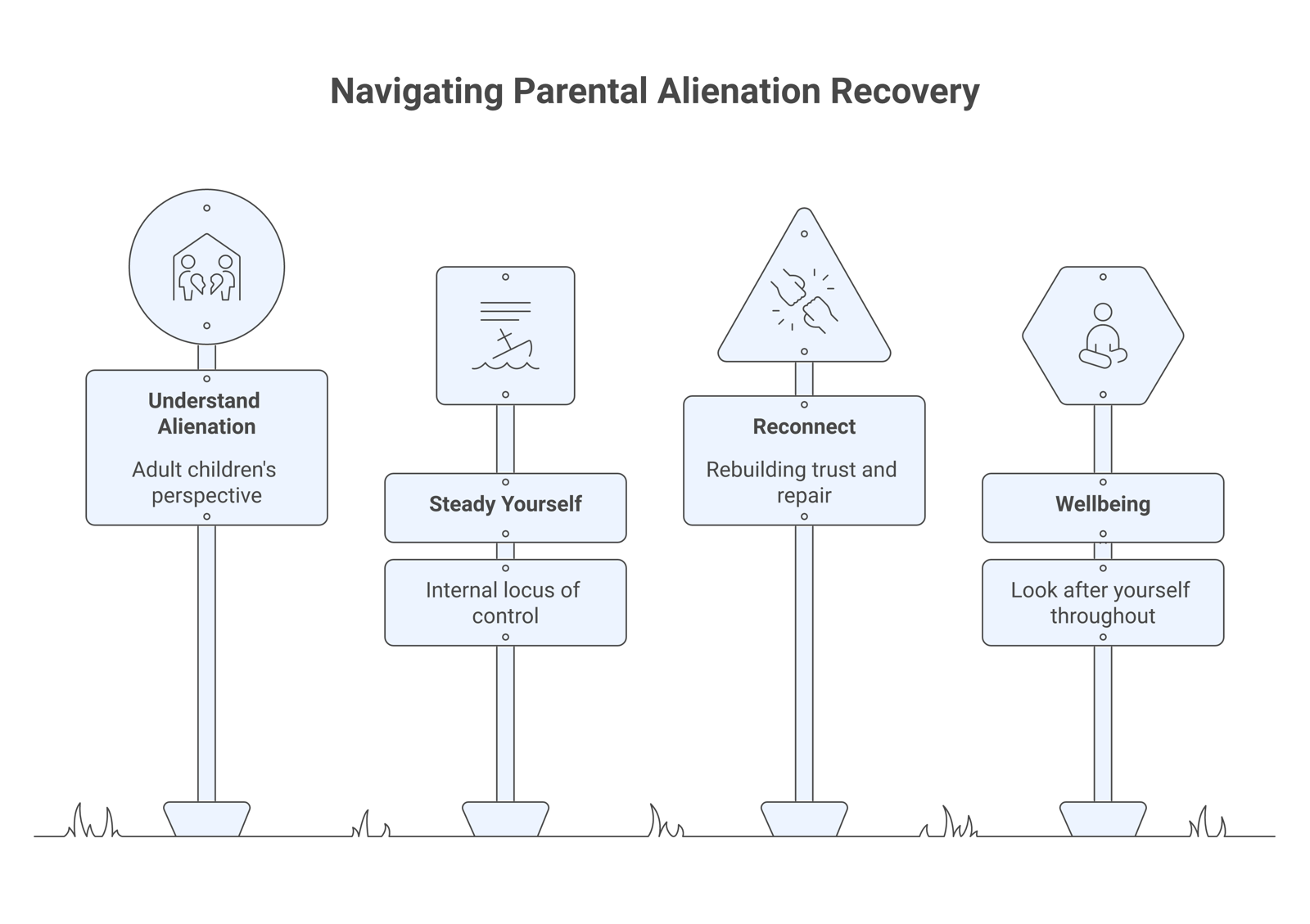
Start by understanding what happened
Understanding comes first, because a clear picture lowers fear and steadies the ground under you. Two pages do this work.
Adult children of parental alienation is for adults who were turned against a parent in childhood, mapping the documented effects and a real recovery path. Why an alienated child’s love is not gone offers an honest reframe for a rejected parent: a child’s outward coldness under loyalty pressure is weak evidence that the underlying bond has ended.
Steady yourself first
Steadiness is the heart of the work, and it is the part you can start today. Three pages build it, one layer at a time.
Internal locus of control for alienated parents helps you aim your limited energy at what you can actually influence. Find your values first draws on acceptance and commitment therapy, so you can act in line with what matters even when the outcome stays out of reach. Becoming the anchor reframes a coaching idea kindly: a calm, regulated parent is simply easier and safer to come home to, so getting steady is part of the work and never a cause of the alienation.
Rebuild connection at the child’s pace
Reconnection is the third track, and it moves slowly and on the child’s clock. Three pages cover it without overpromising.
The third way in parental alienation presents Ginger Gentile’s active, relationship-first path between endless litigation and giving up, offered as one practitioner’s framework rather than settled science. Reconnection as rebuilding trust shows why consistency beats frequency and why a child needs to set the pace. Rupture and repair in reconnection draws on Edward Tronick’s attachment research to show that trust is built by repairing small breaks, not by avoiding them.
Recover or Help: which section do you need
Recover and Help sit next to each other, and many readers use both. The line between them is simple. Recover is for healing and reunification, the long, steady work of getting well and rebuilding a relationship over time. Help is for active situations happening right now.
If you are in the thick of it today, the Help silo may fit better first. Recovering from parental alienation covers the practical ground for parents in motion. Coping with the grief of parental alienation meets the loss head on. How to reconnect with an alienated child walks the concrete steps. And if you want the research on what this experience does over the long term, see long-term effects of parental alienation in the Learn silo.
Look after yourself while you do this
One reminder threads through every page here. This is heavy work, and you do not have to carry it alone. The research is clear that alienation can take a toll on mental health, so professional support is a strength, not a failure. A licensed therapist can help you grieve, steady yourself, and decide what healthy preparation looks like for your situation.
The American Psychological Association offers general guidance on divorce and child custody, and a clinician can tailor it to you. If the grief turns into thoughts of harming yourself, please reach out to one of the crisis lines near the bottom of this page right away. Recovery is real, and you deserve support while you do it.
Frequently asked questions
Can you recover from parental alienation?
Yes. Recovery is a genuine process for both rejected parents and adults alienated as children. It means healing your own wellbeing and, where possible, preparing for reconnection. Recovery is worthwhile in its own right, and reunion, while never guaranteed, becomes more possible when a parent is steady.
What is the first step in recovering from parental alienation?
Shift your energy toward what you can control: your own steadiness, consistency, health, and the open door you keep. You cannot control your child’s current feelings or the other parent. Starting where your real influence starts protects your wellbeing and lays the groundwork for any future reconnection.
Is reunification with an alienated child guaranteed?
No. Outcomes vary, and some children take years. Healing and preparation are worthwhile on their own, not just as a route back to the child. A steady, regulated parent is simply easier and safer to reconnect with if and when an opening appears.
What is the difference between the Recover and Help sections?
Recover is for healing and reunification, the long-term work of getting well and rebuilding connection. Help is for active situations happening now, like coping with grief, finding support, and the practical steps of reconnecting. Many readers move between both.
Does recovery mean the alienation was the parent’s fault?
No. These recovery pages assume a child’s rejection is driven by alienating behavior, not the reader’s own abuse or neglect. Where estrangement is a justified response to a parent’s harmful behavior, the honest path is accountability and change, not reconnection technique.
Sources and further reading
- Baker, A. J. L. (2005). The long-term effects of parental alienation on adult children: A qualitative research study. American Journal of Family Therapy, 33(4), 289 to 302.
- Verrocchio, M. C., Marchetti, D., Carrozzino, D., Compare, A., & Fulcheri, M. (2019). Depression and quality of life in adults perceiving exposure to parental alienation behaviors. Health and Quality of Life Outcomes, 17, 14. https://doi.org/10.1186/s12955-019-1080-6
- American Psychological Association. Divorce and child custody. apa.org/topics/divorce-child-custody
If you or your child are in crisis
Free and confidential help is available right now.
- 988 Suicide and Crisis Lifeline. Call or text 988. 988lifeline.org
- Childhelp National Child Abuse Hotline. 1-800-422-4453. childhelp.org
- NAMI HelpLine. 1-800-950-6264. nami.org/help
Last reviewed: 2026-06-07. Author: Organization (Alex Buckles (PAC Founder)). Editorial review: held to the PAC Editorial Standards (balance, primary-source citation, reader safety); an independent expert review board will be appointed.