
Parental alienation trauma is the toxic stress a child absorbs when one parent’s chronic pressure and denigration of the other parent overwhelms the developing brain. It works like an adverse childhood experience, reshaping how a child regulates stress and forms identity. Brains stay plastic, so recovery is possible, though outcomes vary.
A note on safety
Trauma from genuine abuse is real, and it is not parental alienation. A child protecting themselves from an abusive parent is not showing alienation trauma, and the two must never be conflated. Abused children often cling to the parent who hurt them, so a child’s safety concerns must always be taken seriously first.
This page is general information, not clinical advice. It does not diagnose any child and does not replace assessment by a qualified clinician. Anyone worried about a child’s mental health or safety should consult a licensed professional in their own area.
What parental alienation trauma is
Parental alienation trauma describes the psychological injury a child sustains when one parent works to turn them against the other parent. The harm is rarely a single event. It builds through repeated denigration, loyalty pressure, and the steady erasure of a once-loved parent. Clinicians increasingly frame this pattern as toxic stress and as a form of child psychological abuse, not as the ordinary friction of divorce.
The injury is relational and developmental. It lands on a brain that is still being built, during years when a child learns to trust, to regulate emotion, and to form a sense of self. That timing is what makes the harm distinctive. A child does not simply feel sad about conflict. Their nervous system adapts to a chronic threat, and those adaptations can outlast the conflict that caused them.
This page explains the mechanism. The sections below cover how alienating pressure acts as toxic stress, how it maps onto the Adverse Childhood Experiences framework, what it does to the developing brain, and the identity injury researchers call “part mom, part dad.” For the broader adult outcomes across survivors, parents, and families, see the long-term effects of parental alienation.
How alienating pressure becomes toxic stress
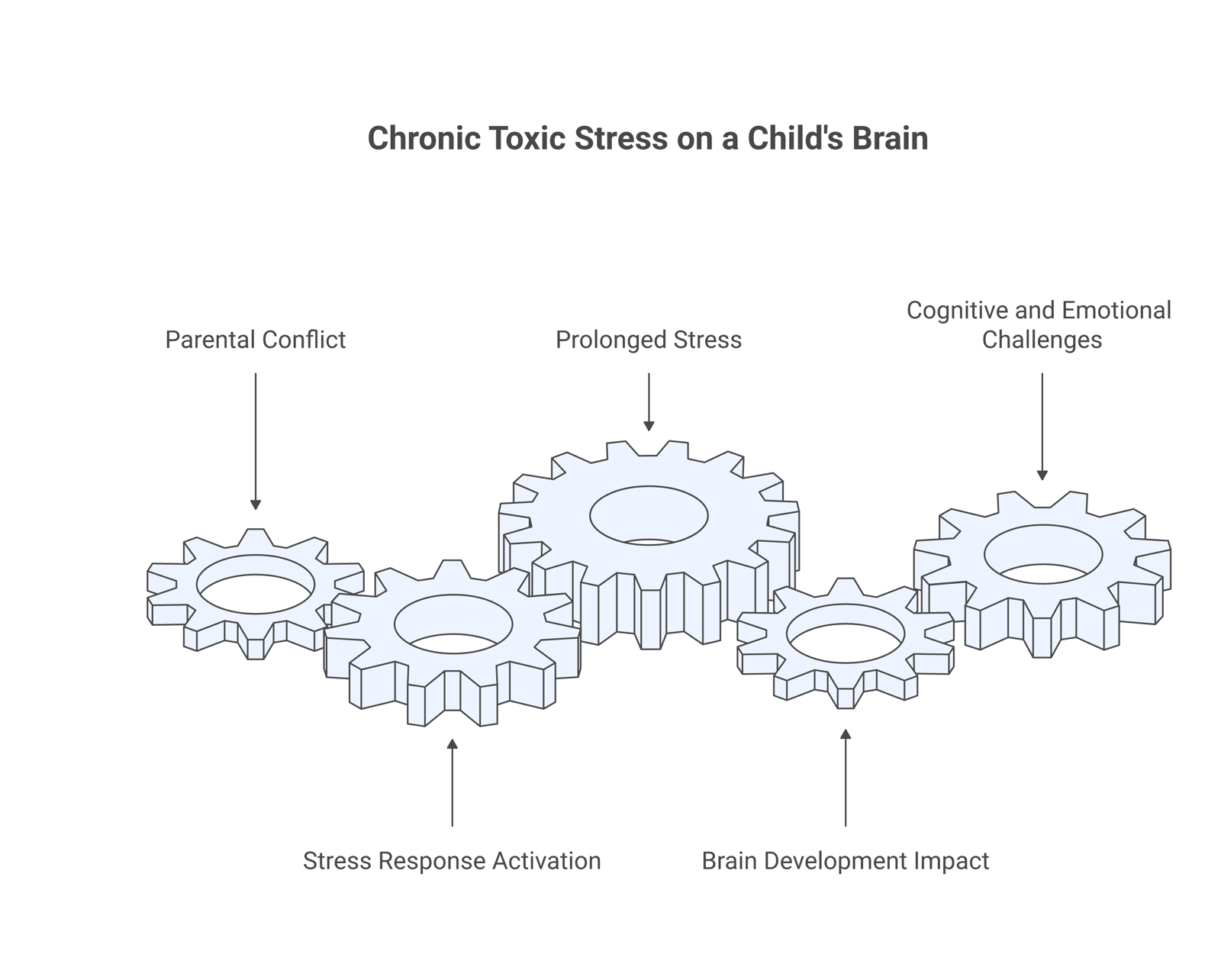
Stress is not always harmful. Brief, buffered stress helps a child grow. Toxic stress is different. It is the body’s prolonged alarm response, switched on again and again without a calming adult to soften it. Researchers studying high-conflict separation describe exactly this state in children caught between warring parents.
Clinician Lisa Rothfus, drawing on the diagnostic category Child Affected by Parental Relationship Distress, explains how chronic conflict alters a child’s brain chemistry, anatomy, and gene expression. Children exposed to sustained conflict show measurably higher electrical brain activity when shown images of an angry couple. The body learns to brace. Over time, that bracing reshapes the developing architecture of the brain.
What looks like hostility often works like survival. When a child cuts off one parent, the move can end an unbearable internal tug-of-war. Side-taking quiets the loyalty bind. Adults then misread the child’s coldness as proof the rejected parent was the problem, when it is closer to a stress response than a considered judgment.
Parental alienation trauma and the ACEs framework
The Adverse Childhood Experiences study, conducted by the CDC and Kaiser Permanente, found that early adversity raises the lifelong risk of mental and physical illness. The more adverse experiences a child carries, the steeper the risk. The framework gives clinicians a shared language for how childhood harm echoes into adult health.
Parental alienation maps onto that framework closely. Dr. Mary Alvarez argues that alienation touches five of the ten recognized ACE categories: emotional abuse, emotional neglect, a parent’s mental illness, separation or divorce, and exposure to coercive control. Counting those overlaps reframes alienation as a documented developmental injury rather than a custody dispute, and it gives courts an evidence base they already accept.
One mechanism Alvarez highlights is priming. Chronic conflict keeps a child’s autonomic nervous system switched on, so their resting stress sits near the edge. A minor setback that another child would shrug off can trigger a meltdown. The dysregulation is physiology, not defiance, and that distinction changes how the adults around the child should respond. The CDC keeps a general reference on Adverse Childhood Experiences and their long reach.
Five ways alienation reshapes the developing brain
Attachment specialist Melanie Gil describes five concrete neurological impacts of alienation on a child. Together they show why the harm runs deeper than hurt feelings.
First, attachment is disrupted. A brain develops more slowly without an attuned parent, because, as Gil puts it, the brain grows in conjunction with another brain. Second, survival adaptations harden into lifelong patterns, such as the very quiet baby who learns not to cry. Third, chronic cognitive dissonance sets in, as a child is repeatedly forced to erase one parent-reality and accept another.
Fourth, being made to echo lies puts the brain in turmoil, and lying becomes self-reinforcing. Fifth, emotional regulation reverses, so the child ends up managing the parent’s feelings instead of the other way around. That last pattern, parentification, robs the child of the experience of being parented at all.
The “part mom, part dad” identity injury
Every child is, in a literal sense, part of each parent. A child carries half their genes, their mannerisms, and their history from one parent and half from the other. Alienation attacks that fact directly. When a child hears that one parent is worthless, dangerous, or unlovable, they absorb a harder message underneath it.
Dr. Mary Alvarez calls this the “part mom, part dad” injury. Denigrating one parent teaches the child that half of themselves is bad. The child cannot reject a parent without rejecting the part of their own identity that came from that parent. The internal cost shows up as self-loathing, low self-worth, and depression that can persist long after the original conflict fades.
This is why specialists treat alienation as an attack on the child, not only on the targeted parent. The wound is carried inside the child’s developing sense of who they are. Naming it helps a recovering survivor separate the planted belief from their actual self. For the contested clinical label sometimes used here, see parental alienation syndrome.
Why this is maltreatment, not ordinary conflict
A fair question is whether this is just the pain of a hard divorce. The research says no. Dr. Jennifer Harman and colleagues, writing in the journal Psychological Bulletin, argue that alienating behaviors map onto recognized patterns of coercive control and amount to a form of family violence. The harm is structural, not incidental.
Harman also names a counterintuitive finding from attachment research. Severely abused children tend to cling to the parent who hurt them, minimizing and excusing the abuse. So a child’s strong, consistent rejection of a once-loved parent is itself a signal of influence, not proof of danger. That paradox is why the safety note at the top of this page matters. Genuine abuse and engineered alienation produce opposite attachment patterns, and they must never be conflated. The behavior pattern is examined further in parental alienation emotional abuse.
What the trauma can carry into adulthood
Because childhood lands during the years identity forms, roughly ages nine to fourteen, the trauma can echo forward. Dr. Venita Mehta’s model of adult outcomes describes survivors who carry anxiety, depression, and post-traumatic stress that they attribute to the alienating parent’s conduct. Many blamed themselves for the conflict and grew up with deep deficits in self-esteem.
The adult identity twist is striking. A survivor often realizes they resemble the targeted parent and feels shame about it, because they were taught that parent was bad. Some re-create the alienating dynamic in their own relationships. These are tendencies, not destinies, and they are the reason early, trauma-informed care matters. The full adult picture across survivors and parents is covered in the long-term effects of parental alienation.
Can the developing brain recover?
Here is the honest and hopeful part. The same plasticity that lets toxic stress reshape a young brain also lets a supported brain heal. Children’s brains stay malleable, and a steady, attuned relationship can lay down new patterns over old ones. Recovery is documented. It is also a process, not a guarantee, and outcomes vary by child, by severity, and by timing.
Consistency helps more than force. Specialists emphasize co-regulation, where a calm adult helps the child’s nervous system settle, rather than confrontation that demands the child feel differently on command. Trauma-informed therapy with a clinician who understands alienation is the repeated recommendation. For how repair is approached when contact resumes, see how to reverse parental alienation.
None of this erases what happened. The goal is integration, not deletion. A brain that adapted to survive can, with safety and time, adapt again toward trust. The American Psychological Association’s guidance on divorce and child custody underscores that reducing a child’s exposure to conflict protects healthy development.
Frequently asked questions
What is parental alienation trauma?
Parental alienation trauma is the psychological injury a child sustains when one parent’s sustained pressure turns them against the other parent. It functions as toxic stress on the developing brain, not as ordinary divorce conflict. Clinicians increasingly classify it as a form of child psychological abuse, with effects that can reach into adulthood.
Is parental alienation a form of childhood trauma?
Many researchers treat it that way. Alienation maps onto several Adverse Childhood Experience categories, including emotional abuse and emotional neglect, and it produces the prolonged stress response that defines toxic stress. The harm lands on a developing brain during years when trust, emotion regulation, and identity are still forming.
How does parental alienation affect the brain?
Chronic conflict and denigration keep a child’s stress system switched on, which can alter brain chemistry and slow healthy development. Specialists describe disrupted attachment, hardened survival adaptations, chronic cognitive dissonance, and reversed emotional regulation. The child’s resulting behavior is closer to a survival response than to a free choice.
What is the “part mom, part dad” injury?
Because a child is literally part of each parent, denigrating one parent teaches the child that half of themselves is bad. The child cannot reject that parent without rejecting part of their own identity. The result can be self-loathing, low self-worth, and depression that persists after the conflict ends.
Can a child recover from parental alienation trauma?
Recovery is documented but not guaranteed. Children’s brains stay plastic, so a steady, attuned relationship and trauma-informed therapy can build new patterns over old ones. Outcomes vary by severity and timing. The consistent recommendation is co-regulation and patience rather than pressure to feel differently on demand.
Where to go next
- For the broader concept and current definitions, read the Learn pillar.
- For the full adult picture, see the long-term effects of parental alienation.
- For the contested symptom label, see parental alienation syndrome.
- For the behavior pattern as abuse, see parental alienation emotional abuse.
- For repair when contact resumes, see how to reverse parental alienation.
Sources and further reading
- Centers for Disease Control and Prevention. About Adverse Childhood Experiences. cdc.gov/aces/about
- Harman, J. J., Kruk, E., & Hines, D. A. (2018). Parental alienating behaviors: An unacknowledged form of family violence. Psychological Bulletin, 144(12), 1275 to 1299. https://doi.org/10.1037/bul0000175
- American Psychological Association. Divorce and child custody. apa.org/topics/divorce-child-custody
If you or your child are in crisis
Free and confidential help is available right now.
- 988 Suicide and Crisis Lifeline. Call or text 988. 988lifeline.org
- Childhelp National Child Abuse Hotline. 1-800-422-4453. childhelp.org
- NAMI HelpLine. 1-800-950-6264. nami.org/help
Last reviewed: 2026-06-06. Author: Alex Buckles (PAC Founder).