

What does the research on parental alienation and abuse show? That both can be real, that they sometimes co-occur, and that the evidence is genuinely contested. Studies disagree sharply over how often alienation claims mask abuse, and serious research exists on every side. Here is the honest landscape.
A note on safety
Alienation and abuse are not opposites that cancel out. A child can be harmed by a parent’s manipulation, and a child can be harmed by real abuse, and sometimes both happen in one family. A child’s rejection of a parent who has been abusive is justified estrangement, not alienation, and the label “alienation” is not proof of anything by itself. If a child is in danger, contact local law enforcement or a domestic-violence resource first.
This page is general education. It is not legal advice or clinical advice, and it does not diagnose any person or family. It summarizes what published research reports, including where that research conflicts. Anyone facing a real situation should consult a licensed clinician or attorney.
What the research actually shows
The research on parental alienation and abuse does not deliver one clean answer. It delivers a live dispute. On one side, studies of custody outcomes suggest that alienation claims can be used to discredit a parent reporting abuse. On the other side, studies of appellate cases suggest that courts rarely hand children to abusive parents and that alienation claims are not generally a cover for abuse. Both bodies of work are real, and both have real limits.
Underneath the dispute sits a finding that almost everyone accepts. Alienation and abuse can each be genuine, and they can occur in the same family at the same time. The old “is it abuse or is it alienation” framing is a false choice. The careful question is what is driving a particular child’s rejection, and that takes case-by-case assessment, not a label.
This page walks through the major findings on each side, then the differentiated middle view, then what the research says about long-term harm, and finally how strong the evidence really is. The aim is to map the terrain, not to crown a winner.
Alienation and abuse can co-occur
The most durable conclusion in this field is also the least dramatic. Rejection of a parent has many possible causes, and alienating behavior is only one of them.
Janet Johnston and Matthew Sullivan laid out this view in a widely cited 2020 paper in Family Court Review, “Parental Alienation: In Search of Common Ground for a More Differentiated Theory.” They name the false dichotomy directly. Abuse and alienation are not mutually exclusive, and they commonly co-occur. A child may reject a parent because of a developmental phase, because of real trauma or deficient parenting, because of a parent’s pernicious influence, or because of some mix of these. Alienating behavior, in their words, is neither necessary nor sufficient to explain a child’s refusal.
Sullivan, Kline Pruett and Johnston pushed this further in a 2023 follow-up titled, plainly, “either/or, neither/nor, both/and.” Their point is that a single case can involve family violence and alienating behaviors together, or neither, or one without the other. They also argue that severe alienating behavior, when it is genuinely the dominant factor and is damaging, can itself amount to a form of psychological maltreatment, with the impact on the child taking precedence over the parent’s intent. They warn of bias on both sides of the field, including confirmation bias and echo chambers.
This middle ground is not a dodge. It is the most evidence-supported position available, and it frames everything that follows.
The Meier finding
The most influential study on the abuse-protective side is Joan Meier and colleagues’ 2020 analysis, conducted for the National Institute of Justice. The team coded thousands of US custody cases drawn from published opinions between 2005 and 2014.
The headline result is specific and striking. When mothers alleged that the father had abused the child or the mother, and the father responded by cross-claiming parental alienation, courts became far more likely to disbelieve the abuse claim. By Meier’s count, a father’s alienation cross-claim roughly doubled the rate at which an abuse-alleging mother lost custody, from about 26 percent to about 50 percent. The effect was gender-specific. It showed up most strongly when abuse was alleged, not in alienation cases generally.
Meier reads this as evidence that alienation arguments can function to suppress abuse claims, especially mothers’ claims of child abuse. That reading underpins much of the recent reform movement, including Kayden’s Law.
The study has limits that its own authors and critics flag. It relies on published appellate opinions, which over-represent certain kinds of cases and may skew toward mothers who lost and appealed. Meier concedes the study cannot show that any individual ruling was wrong. Affirming scholars argue the sample cannot establish base rates. These are fair cautions, and they do not erase the finding. They place it.
The Harman and Lorandos finding
The most influential study on the other side comes from Jennifer Harman and Demosthenes Lorandos, published in 2020 in Psychology, Public Policy, and Law. They examined 967 appellate cases and reached a very different conclusion. They found little evidence that parental alienation arguments were widely misused to override genuine abuse. In their data, alienating parents generally received less parenting time, and they found no pattern of children being placed with actively abusive parents.
Related work by Amanda Sharples with Harman, Lorandos and others extended this line. Their case-level studies report that, where a substantiated abuse finding exists in the record, it is more often against the alienating parent than the targeted parent. The authors read this as evidence that alienation is not, as a rule, a shield for abusers.
This camp has its own limits, and fairness requires naming them. The lead authors are leading proponents of the parental alienation construct, and Lorandos is a practicing alienation litigator, so the work carries an affirming standpoint. The studies also rest on appellate and case-record samples, which share some of the same sampling problems that critics raise against Meier. Strong priors sit on both sides of this dispute.
What honest readers are left with is two careful studies, built on overlapping kinds of data, reaching opposite conclusions. That disagreement is the actual state of the research, and presenting either result as the settled truth would misrepresent it.
The differentiated middle view
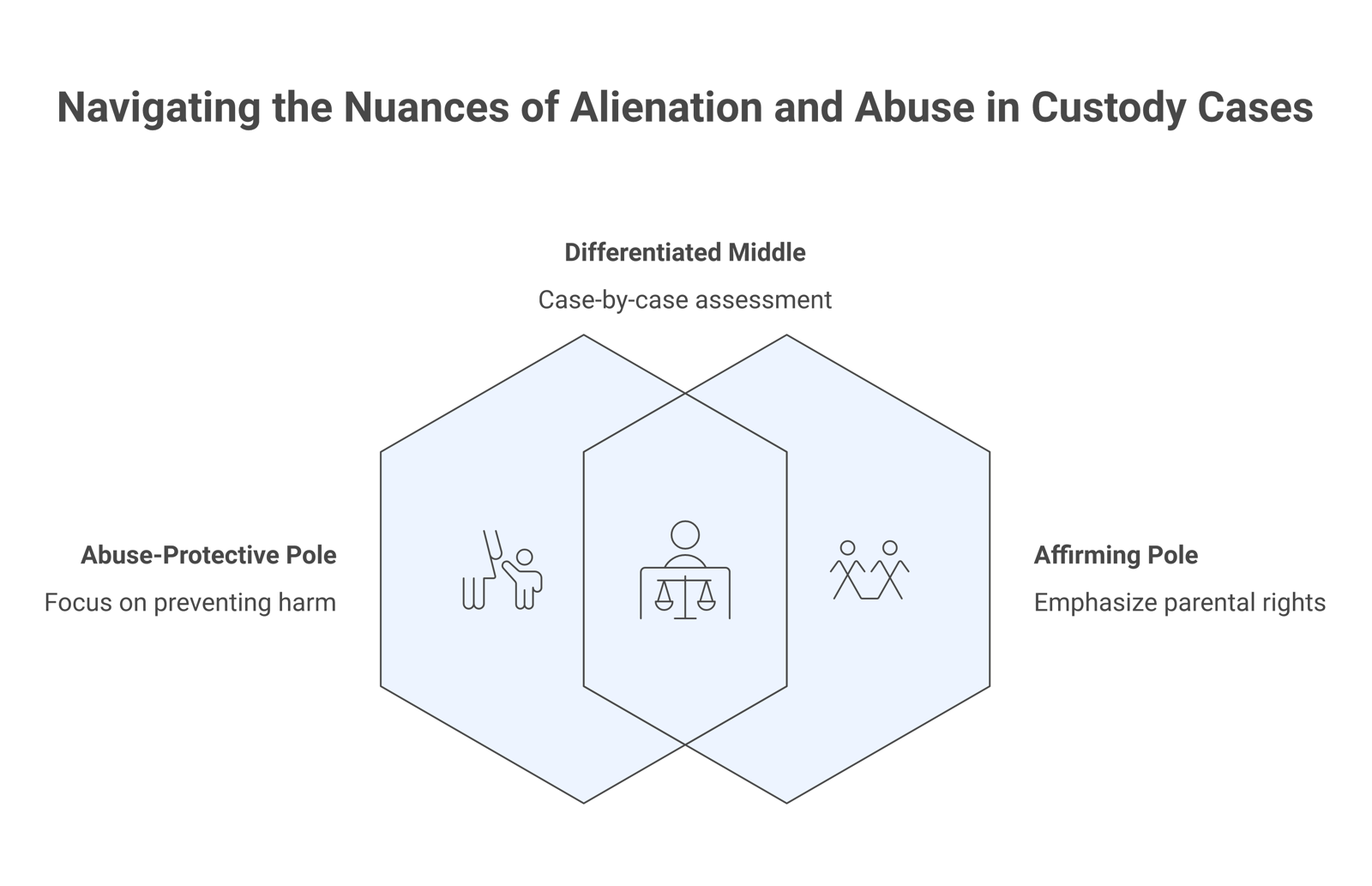
Between the two poles sits a growing professional consensus that refuses the binary. In 2022, the Association of Family and Conciliation Courts and the National Council of Juvenile and Family Court Judges issued a joint statement on parent-child contact problems. Its central instruction is that there should be no immediate label, because multiple factors can explain why a child resists a parent. It calls for screening for safety and for competence across domestic violence, high conflict, and alienating behaviors alike.
This is the practical form of the both/and. It treats alienation as one possible factor that has to earn its place through evidence, alongside abuse, estrangement, affinity, and ordinary developmental change. It does not deny that alienating behavior happens, and it does not assume it.
Empirical chapters in the evaluation literature, including the work of Saini, Johnston, Fidler and Bala, reach the same practical place from the data side. They report that the studies cluster in divorce and custody-dispute contexts, that measures are inconsistent, and that no validated instrument yet separates alienation from justified estrangement. Their conclusion is caution, not denial.
What happens to alienated adults
A separate strand of research asks a different question. Setting aside the custody disputes, what becomes of children who were exposed to alienating behavior, once they grow up?
A 2022 study by Verhaar, Matthewson and Bentley, published in the journal Children, interviewed 20 adults who had experienced alienating behaviors in childhood. The participants reported high rates of depression and anxiety, emotional pain, substance use, and in some cases suicidal thoughts and self-harm. Half reported becoming alienated from their own children later, a pattern the authors describe as possible intergenerational transmission. The authors call the behaviors a form of emotional abuse.
This is sobering, and it deserves weight. It also deserves the same scrutiny the page applies everywhere. The sample is small, self-selected from support groups, and retrospective, so it cannot prove cause and effect or tell us how common these outcomes are. It is best read as evidence that the harm can be serious for those affected, not as a population statistic. Larger reviews of long-term emotional consequences point in a similar direction while sharing the same evidence-quality limits.
How strong is the evidence
Step back, and a pattern emerges that cuts across every camp. The parental alienation research base is real but thinner than advocates on either side often imply.
The most neutral audit is the systematic review by Saini, Johnston, Fidler and Bala, which appraised the empirical studies against quality criteria. Its verdict is blunt. Research in this area, it concludes, remains in its infancy. The studies tend to be small, nonrandom, retrospective, and descriptive. There is no agreed definition, no validated diagnostic instrument, and no long-term outcome studies of the kind that would settle the causal questions.
The critical scholar Jean Mercer makes a sharper version of the same point about the remedies built on the construct, arguing that the court-ordered reunification treatments tied to alienation findings have not been shown to be safe or effective. Affirming scholars respond that the absence of randomized trials reflects ethics and practicality, not failure, and that newer reviews cover hundreds of studies. Both are partly right. The evidence is growing, and it is still not strong enough to resolve the central disputes.
For the reader, the takeaway is humility. The research supports taking alienating behavior seriously and supports taking abuse seriously, and it does not support treating either label as automatic proof.
How this differs from the junk-science page
This page is about the empirical relationship between alienation and abuse: how they co-occur, what the custody-outcome studies find, and what happens to those affected. A separate page, is parental alienation junk science, tackles the different question of scientific validity and courtroom admissibility, including the DSM and ICD status of the construct and the disputes over whether it meets evidentiary standards. Read that page for the validity debate. Read this page for what the studies say about alienation and abuse together.
For the wider map of expert positions, see the three camps in parental alienation. For the specific argument that alienation is a form of child abuse, see the companion page, is parental alienation child abuse. For how these findings land in court, see how judges view parental alienation.
Frequently asked questions
What does research say about parental alienation and abuse?
It shows a genuine dispute. Some studies, like Meier 2020, find that alienation claims can suppress abuse allegations, especially mothers’ claims. Other studies, like Harman and Lorandos 2020, find little misuse and conclude courts rarely place children with abusive parents. Almost all researchers agree alienation and abuse can co-occur and must be assessed case by case.
Can parental alienation and abuse happen at the same time?
Yes. Researchers across the spectrum agree the two are not mutually exclusive and commonly co-occur. A child can be exposed to a parent’s manipulation and also to genuine abuse. This is why a single label rarely captures a real family, and why careful assessment matters more than a quick diagnosis.
Did Meier prove alienation is used to hide abuse?
Meier’s 2020 study found that fathers’ alienation cross-claims roughly doubled abuse-alleging mothers’ custody-loss rates. It is strong evidence of a pattern in published cases, but it relies on appellate opinions and cannot show any single ruling was wrong. It is an important finding, not a final verdict.
Does research show alienation harms children long term?
Studies of adults alienated in childhood, such as Verhaar and Matthewson 2022, report high rates of depression, anxiety, and other difficulties. These studies are small, retrospective, and self-selected, so they show the harm can be serious without establishing how common it is. The long-term evidence base remains limited.
Is the research on parental alienation settled?
No. Multiple neutral reviews conclude the field is still developing, with small samples, no validated diagnostic instrument, and no long-term outcome studies. The research supports taking both alienation and abuse seriously while treating neither label as automatic proof.
What this page does not do
This page does not pick a winner between Meier and Harman and Lorandos, because the research genuinely conflicts. It does not tell any reader what is happening in their family. It does not present alienation as a defense against abuse claims, or abuse claims as automatically false. And it does not offer either label as a tactic. Its job is to describe the evidence honestly, limits and all.
For related reading, see the Learn hub, is parental alienation child abuse, the three camps in parental alienation, and the long-term effects of parental alienation.
Sources and further reading
- Meier, J. S., Dickson, S., O’Sullivan, C., Rosen, L., & Hayes, J. (2019/2020). Child custody outcomes in cases involving parental alienation and abuse allegations. National Institute of Justice, NCJ 304419. ojp.gov
- Johnston, J. R., & Sullivan, M. J. (2020). Parental alienation: In search of common ground for a more differentiated theory. Family Court Review, 58(2), 270 to 292. https://doi.org/10.1111/fcre.12472
- Verhaar, S., Matthewson, M., & Bentley, C. (2022). The impact of parental alienating behaviours on the mental health of adults alienated in childhood. Children, 9(4), 475. https://doi.org/10.3390/children9040475
- Harman, J. J., & Lorandos, D. (2020). Allegations of family violence in court: How parental alienation affects judicial outcomes. Psychology, Public Policy, and Law.
- Sullivan, M. J., Kline Pruett, M., & Johnston, J. R. (2023). Parent-child contact problems: family violence and parental alienating behaviors, either/or, neither/nor, both/and? Family Court Review, 62(1), 68 to 85. https://doi.org/10.1111/fcre.12764
- Saini, M., Johnston, J. R., Fidler, B. J., & Bala, N. (2016). Empirical studies of alienation. In Parenting Plan Evaluations (2nd ed.). Oxford University Press.
If you or your child are in crisis
Free and confidential help is available right now.
- 988 Suicide and Crisis Lifeline. Call or text 988. 988lifeline.org
- Childhelp National Child Abuse Hotline. 1-800-422-4453. childhelp.org
- NAMI HelpLine. 1-800-950-6264. nami.org/help
Last reviewed: 2026-06-07. Author: Alex Buckles (PAC Founder). General education, not legal or clinical advice.