

Parental alienation statistics are best read as ranges, not fixed numbers. Estimates converge on a serious but bounded problem: William Bernet’s arithmetic estimate puts parental alienation near 1 percent of US children, and polls by Jennifer Harman and colleagues put moderate-to-severe alienation at 1.3 percent or more of US children, with roughly 22 million US adults reporting alienating behaviors used against them. Methods and definitions vary widely, so precise prevalence stays uncertain, and every figure here is an estimate.
A note on safety
Statistics about alienation must never be used to deny that some parent-child estrangement is caused by genuine abuse. A child who pulls away from a parent who was abusive, neglectful, or frightening is showing justified estrangement, not alienation. The two are different. If a child’s safety is at risk, contact local law enforcement or a domestic-violence resource first.
This page offers general information, not clinical or legal advice. It does not diagnose any family or address any one jurisdiction’s law. Statistics describe groups, not individuals. Anyone facing a custody or safety question should consult a licensed professional in their own area.
How common is parental alienation?
No one knows the exact figure, but two independent estimates point in the same direction. Psychiatrist William Bernet has estimated that approximately 1 percent of US children and adolescents experience parental alienation, roughly 740,000 children. That is a transparent arithmetic estimate built from divorce and custody-dispute rates, not epidemiology. Survey work by Jennifer Harman, Sadie Leder-Elder, and Zeynep Biringen adds poll-based numbers. In their 2016 representative poll, 13.4 percent of US adults with children, generalized to about 22.1 million adults, reported being targets of alienating behaviors. Their 2019 polls found that 6.7 percent of US parents reported children who were moderately to severely alienated, which works out to at least 1.3 percent of US children.
These are estimates, not a census. The numbers come from population polls, so they depend on how respondents understood the questions, and they measure perceived alienating behaviors rather than clinically verified alienation. Harman and her co-authors present the figures as a reasonable read of the survey data, not as a settled count.
Outside the United States, the first UK prevalence study, by Ben Hine, Jennifer Harman, Sadie Leder-Elder, and colleagues (2025), polled 1,005 separated UK parents and found that 39 to 59 percent reported experiencing parental alienating behaviors, depending on the measure, with 36.5 percent qualifying as non-reciprocal targets. Like the US figures, these are self-reports of perceived behaviors, not clinical verification.
Why the numbers vary so much
Different studies measure different things. Some count children who actively refuse a parent. Others count adults who recall alienation from childhood. A poll of the general public and a review of court files will rarely produce the same rate.
Definitions also differ. There is no single agreed instrument that every researcher uses. The widely discussed Five-Factor Model, proposed by William Bernet and Laurence Greenhill in 2022, is the field’s leading identification framework, but critics such as William O’Donohue and Madelyn Milchman regard it as a premature diagnostic framework. Until that debate is resolved, prevalence figures rest on tools that are still maturing.
Severity adds another layer. Mild, moderate, and severe alienation are not the same, and a study that includes mild cases will report a higher rate than a study that counts only severe ones. When a number sounds precise, the safe assumption is that it carries a wide margin around it.
Who is alienating and who is targeted?
One useful contribution from Harman’s survey work is a classification based on counting behaviors, not assigning blame by gender. It sorts separated parents by how often each parent uses alienating behaviors, distinguishing parents who report being targets from parents who both use and receive such behaviors.
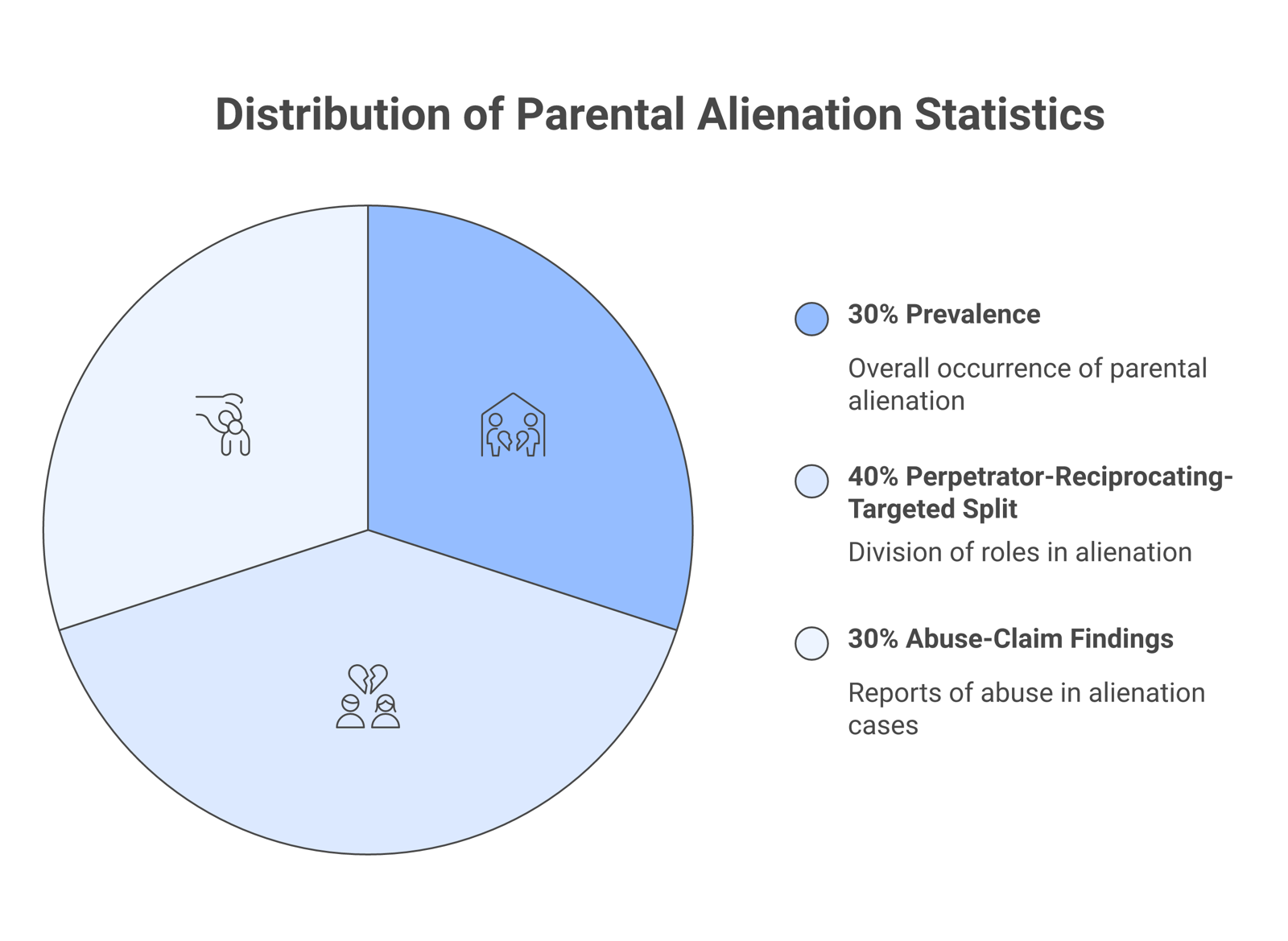
In the 2019 polls, 35.5 percent and 39.1 percent of US parents, and 32 percent of Canadian parents, reported being targets of parental alienating behaviors. The 39.1 percent who reported being targets without using such behaviors in return, the non-reciprocating targets, generalize to roughly 22 million US parents. These shares are poll-based self-reports of perceived behavior, not adjudicated findings.
The data point that stands out is the existence of that large non-reciprocating group: parents who report alienating behaviors used against them but do not report using them back. That pattern cuts against the simple claim that both parents always do it equally, while still allowing that many separated households involve conflict flowing in both directions.
Does parental alienation affect mothers or fathers?
Both. The honest reading of the data is that alienation is not strongly tied to gender. It happens to mothers and to fathers, and mothers and fathers can each be the alienating parent. In a 2018 Psychological Bulletin review, Jennifer Harman, Edward Kruk, and Denise A. Hines argued that parental alienating behaviors function as an unacknowledged form of family violence directed at targets of both genders.
A Canadian study of 500 alienation cases by Jennifer Harman, Christine Giancarlo, Demosthenes Lorandos, and Brian Ludmer (2023), blind-coded from 4,889 trial decisions over 16 years, failed to find the gender-bias patterns claimed in support of legislative changes. In that sample, of the 35 alienating parents who were found to have actually been abusive, 25 were mothers. That cuts against the claim that alienation is mainly a tool used to discredit mothers. The authors are proponents of alienation research, and any one sample reflects the cases that reached court, not all families. Joan Meier’s 2020 study of published US custody opinions reached more critical conclusions about how alienation claims affect mothers who allege abuse, and the methodological exchange between the two camps remains unresolved.
What the research says about abuse claims
The link between alienation and abuse allegations is one of the most contested areas, so the figures deserve care. A study of 492 US appellate cases by Sharples, Harman, and Lorandos (2023) found that, within that sample, a substantiated abuse finding was about 4.4 times more likely to be against the alienating parent than the targeted parent, and about 41% of cases involved no abuse claim at all.
In the Canadian 500-case study, about 70.6% of abuse allegations made against alienated (targeted) parents were found to be unsubstantiated.
These numbers describe cases where a court already identified alienation, and both studies come from proponent researchers. They are not a claim that abuse reports in general are usually false. Read carefully, the finding is narrow: within alienation-found cases, unproven abuse claims tended to run against the targeted parent. That is very different from saying abuse claims at large are unreliable, and the distinction matters for safety. Joan Meier’s 2020 study of US custody outcomes is the standard counter-reference here, finding that a father’s alienation claim sharply reduced the odds that a mother’s abuse allegation was credited; the disagreement between these research lines is unresolved.
What the data shows about outcomes
Children are affected in measurable ways. The clearest signal comes from studies of adults who were alienated as children: Verhaar, Matthewson, and Bentley (2022) documented lasting mental-health impacts among adults who experienced parental alienating behaviors in childhood, and Harman, Matthewson, and Baker (2022) catalogued the losses alienated children sustain, from the relationship itself to extended family and parts of their own identity.
Parents are affected too. Harman’s 2019 prevalence polls found elevated depression, trauma symptoms, and suicide risk among parents who reported being targets of alienating behaviors. The research that frames alienating behaviors as a form of family violence supports treating these harms as serious. Those signals come from self-report surveys, so they should be read as serious mental-health flags rather than precise rates.
What we do not know
The gaps are real, and naming them is part of honest reporting. There is no fully validated, universally used measurement tool yet, so every prevalence figure depends on the instrument behind it. Court-file studies, such as the 492-case and 500-case reviews, describe the families who reached appeal or trial, who are not a random sample of everyone. Public polls depend on self-report and memory.
Severity bands shift the totals. Cross-cultural data is thin, since most studies come from the United States, the United Kingdom, Canada, and Australia. None of this means the problem is fake or minor. It means the precise size of it is still being worked out, and confident-sounding single numbers deserve caution.
Frequently asked questions
How common is parental alienation?
Estimates converge on a serious but bounded problem. William Bernet’s arithmetic estimate is near 1 percent of US children. Poll research by Jennifer Harman, Sadie Leder-Elder, and Zeynep Biringen puts moderate-to-severe alienation at 1.3 percent or more of US children, and roughly 22 million US adults report alienating behaviors used against them. All are estimates, not confirmed counts.
Does parental alienation affect more mothers or fathers?
The data does not show a strong gender pattern. Alienation affects mothers and fathers, and either parent can be the one doing it. A 500-case Canadian study (Harman, Giancarlo, Lorandos & Ludmer, 2023) failed to find gender bias in how courts handled these cases, though Joan Meier’s US research reports different patterns and the debate is unresolved.
Are most abuse claims in alienation cases false?
No. Studies show that within cases a court already labeled as alienation, unproven abuse claims tended to run against the targeted parent. That is a narrow finding about a specific sample. It does not mean abuse allegations in general are usually false, and genuine abuse must always be taken seriously.
Why do parental alienation statistics vary so much?
Studies measure different populations, use different definitions, and include different severity levels. A public poll and a review of court files will report different rates. No single validated instrument is used by everyone yet, so each figure carries a wide margin of uncertainty.
How these statistics should and should not be used
Numbers can inform, and numbers can be misused. Used well, prevalence data shows that alienation is widespread enough to take seriously and worth studying with better tools. Used poorly, a statistic becomes a weapon to dismiss a child’s real fear or to deny a parent’s real harm.
The single most important guardrail bears repeating: alienation statistics must never be used to deny that some estrangement is caused by genuine abuse. A figure about groups says nothing certain about any one child. Journalists, educators, and advocates who want a source built for careful public use can see the parental alienation explainer for educators and press. For the broader foundations, see the Learn hub. For related reading, see parental alienation syndrome, the long-term effects of parental alienation, and parental alienation as emotional abuse.
Sources and further reading
- Harman, J. J., Kruk, E., & Hines, D. A. (2018). Parental alienating behaviors: An unacknowledged form of family violence. Psychological Bulletin, 144(12), 1275 to 1299. https://doi.org/10.1037/bul0000175
- Harman, J. J., Leder-Elder, S., & Biringen, Z. (2016). Prevalence of parental alienation drawn from a representative poll. Children and Youth Services Review, 66, 62 to 66.
- Harman, J. J., Leder-Elder, S., & Biringen, Z. (2019). Prevalence of adults who are the targets of parental alienating behaviors and their impact. Children and Youth Services Review, 106, article 104471.
- Bernet, W. (2010). Parental Alienation, DSM-5, and ICD-11. (Source of the approximately 1 percent arithmetic estimate.)
- Sharples, A. D., Harman, J. J., & Lorandos, D. (2023). Findings of abuse in families affected by parental alienation. Journal of Family Violence. https://doi.org/10.1007/s10896-023-00575-x
- Harman, J. J., Giancarlo, C., Lorandos, D., & Ludmer, B. (2023). Gender and child custody outcomes across 16 years of judicial decisions regarding abuse and parental alienation. Children and Youth Services Review, 155.
- Hine, B., Harman, J. J., Leder-Elder, S., et al. (2025). Examining the prevalence and impact of parental alienating behaviors (PABs) in separated parents in the United Kingdom. Journal of Family Violence. https://doi.org/10.1007/s10896-025-00910-4
- Meier, J. S., Dickson, S., O’Sullivan, C., Rosen, L., & Hayes, J. (2020). U.S. child custody outcomes in cases involving parental alienation and abuse allegations: What do the data show? Journal of Social Welfare and Family Law, 42(1), 92 to 105.
- Verhaar, S., Matthewson, M. L., & Bentley, C. (2022). The impact of parental alienating behaviours on the mental health of adults alienated in childhood. Children, 9(4), 475. https://doi.org/10.3390/children9040475
- Harman, J. J., Matthewson, M. L., & Baker, A. J. L. (2022). Losses experienced by children alienated from a parent. Current Opinion in Psychology, 43, 7 to 12. https://doi.org/10.1016/j.copsyc.2021.05.002
- Bernet, W., & Greenhill, L. L. (2022). The Five-Factor Model for the diagnosis of parental alienation. Journal of the American Academy of Child & Adolescent Psychiatry, 61(5), 591 to 594. https://doi.org/10.1016/j.jaac.2021.11.026
If you or your child are in crisis
Free and confidential help is available right now.
- 988 Suicide and Crisis Lifeline. Call or text 988. 988lifeline.org
- Childhelp National Child Abuse Hotline. 1-800-422-4453. childhelp.org
- NAMI HelpLine. 1-800-950-6264. nami.org/help
Last reviewed: 2026-06-06. Author: Alex Buckles (PAC Founder).