

Parental alienation intervention is the range of responses used when a child unjustifiably rejects a once-loved parent, from early prevention through clinical reunification work to court-ordered remedies in severe cases. The right response depends on severity. Mild, moderate, and severe cases call for different steps, and protection from genuine abuse always comes first.
A note on safety
A child’s rejection of a parent is not always alienation. Where a child’s rejection stems from genuine abuse, the right response is protection and safety, not alienation intervention. The two must never be conflated. If a child’s safety is at risk, contact local law enforcement or a domestic-violence resource first.
This page is general information, not clinical or legal advice. It does not create a therapist-client or attorney-client relationship, and it does not address any one family’s situation. Anyone weighing an intervention should consult a licensed clinician or family-law attorney in their own area.
What parental alienation intervention means
Parental alienation intervention is the range of responses used when a child unjustifiably rejects a once-loved parent. The term covers a wide field, not a single program. At one end sit early, preventive steps taken during a separation. In the middle sits clinical reunification work with a trained therapist. Court-ordered remedies for severe cases sit at the far end. No single method fits every family.
The right step depends on two things: how entrenched the rejection has become, and what is driving it. A mild, recent problem calls for a light touch. A severe, long-standing one may call for intensive help. Many clinicians now picture the whole field as a continuum, much like a public-health response to a spreading problem. That framing, developed by specialists such as Dr. Mary Alvarez, lines up a series of matched responses from prevention through critical care.
Intervention is also separate from diagnosis. Naming the pattern is one task. Choosing the matched response is another. This page focuses on the second task. For the underlying pattern, see the Learn pillar and the explainer on parental alienation syndrome.
The resist/refuse spectrum
Children resist or refuse contact for very different reasons. Clinicians group those reasons on a spectrum sometimes called resist/refuse dynamics. Zack and Randy Flood describe one end as estrangement, where a child’s fear is rooted in real abuse or neglect. The other end is alienation, where a false, contaminated narrative drives the rejection. Between the two sit hybrid cases and cases of well-meaning but counterproductive protective parenting. The way a case moves along this spectrum is covered in the stages of parental alienation.
Why does this spectrum matter so much for intervention? Because the two ends need opposite treatment. Estrangement work paces with the child and respects a fear that is reality-based. Alienation work gently helps the child move past a coached refusal. Apply the wrong approach and the result is harmful. A scared child can be retraumatized. A coached child can be rewarded for a rejection that was never truly their own. Researchers such as Jennifer Harman, Edward Kruk, and Denise Hines argue that severe alienating behavior can rise to a recognized form of family violence, which is one reason careful matching matters.
For that reason, careful programs ask for an evaluative or judicial finding on causation before reunification therapy begins. The finding answers a single question: is this estrangement or alienation? Skipping that step is the most common way these cases go wrong.
The differential-treatment principle
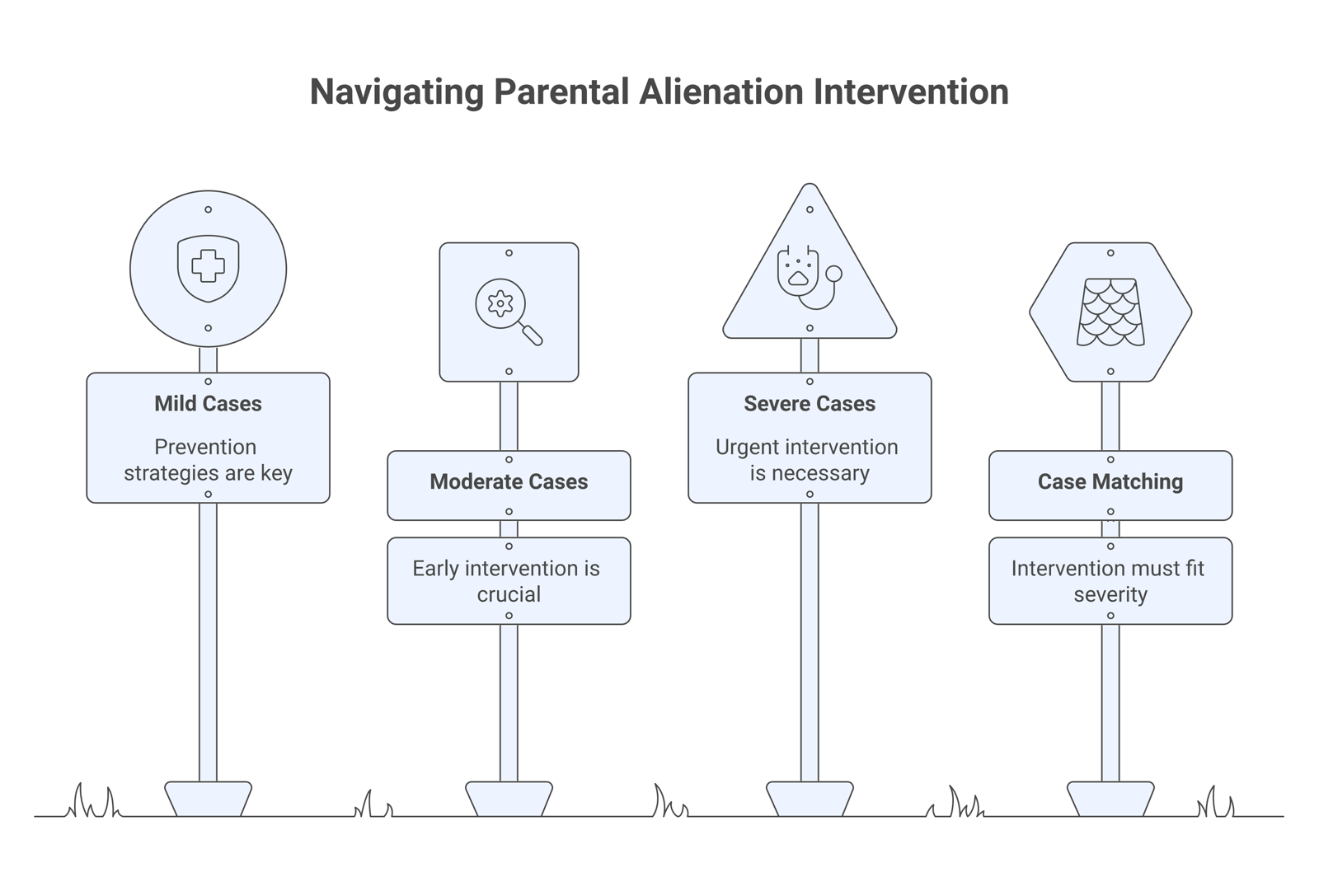
Because cases differ, responses differ. Specialists call this matched approach differential treatment. Mild, moderate, and severe cases each call for a different level of help. Reaching for a severe-case tool in a mild situation can do harm. Using a mild-case tool in a severe one tends to fail.
Mild cases
A mild case shows early warning signs. A child voices borrowed complaints or resists an exchange now and then. Here the goal is prevention. Light, educational steps often work: coaching for both parents, clear parenting-plan structure, and quick support so small problems do not harden. Early action is the cheapest and kindest point on the whole spectrum.
Moderate cases
A moderate case has taken root. The child’s rejection is steadier, and ordinary co-parenting fixes have not held. This tier usually calls for clinical reunification work guided by a trained therapist. The aim is to rebuild the damaged relationship while keeping the child emotionally safe. Many families reach the spectrum at this point.
Severe cases
A severe case involves a deeply entrenched, near-total refusal. Weekly therapy has often already failed. These cases may call for intensive, structured programs and, at times, court-ordered remedies. This is the most demanding tier, and it is where the law is most likely to step in.
This tiered logic mirrors the public-health continuum: prevention first, then early, urgent, and critical intervention as severity climbs.
Protection comes first, reunification second
One precondition runs underneath every tier. Linda Gottlieb, a licensed family therapist, frames it as a sequence: protection first, reunification second. Once a court finds that alienation is occurring, the first job is to shield the child from continued harm. Rebuilding the bond with the rejected parent is the second job, and it cannot proceed safely until the first is handled.
The same rule applies in reverse. Where a child resists because a parent is genuinely unsafe, protection is the whole point, and reunification is not the goal at all. This is why an honest causation finding matters so much. Protection is the shared first step in both estrangement and alienation. Only the second step diverges.
The prevention-to-intervention continuum
The clearest map of the options is a continuum that climbs with severity. Dr. Mary Alvarez and colleagues describe four broad stages: prevention, early intervention, urgent intervention, and critical intervention. Each stage has its own tools.
Early and preventive intervention
Prevention happens before alienation sets in. Courts can front-load the first hearing, set firm expectations, and steer families toward education rather than litigation. Some systems move fast by design. In one model used in Israel, any allegation triggers a hearing before a specialist judge within days, with quick danger assessment and tight deadlines. The point is simple: act early, before conflict hardens into a fixed rejection.
Clinical reunification work
When the problem has taken root, the next tier is clinical reunification work. A trained therapist helps the child and rejected parent rebuild trust at a safe pace. Trauma-informed methods are common, since standard talk therapy alone often falls short. This is the heart of most moderate-case plans. The dedicated overview of parental alienation therapy explains how these sessions are structured.
Intensive and court-ordered intervention
Severe, entrenched cases sometimes need more than weekly sessions. Structured, short-duration programs exist for exactly this situation. Dr. Lynn Steinberg’s four-day reunification model, drawn from earlier work with formerly abducted children, is one example. The related Family Bridges program reports high success rates in published evaluations, though such figures come from selected, severe cases and do not promise the same result for everyone. Courts may order this level of help when softer steps have failed. For a closer look at this tier, see how to reverse parental alienation.
The parent’s own role: stability first
Intervention is not only something done by courts and therapists. The rejected parent has a part to play, and it starts with their own stability. Cindy Hirsch and Lawrence Joss describe the goal as becoming a “lighthouse parent,” steady and calm in any storm. That steadiness is what slowly invites a child back.
Reconnection tends to be a long arc, not a quick reversal. By many accounts it can take years to stabilize, and grief along the way is normal rather than a sign of failure. Boundaries help, and they work best when they protect rather than punish. Parents looking for concrete first steps can start with how to stop parental alienation.
What parental alienation intervention can and cannot promise
Honesty matters here. Intervention outcomes vary widely, and no method guarantees a fixed result. Mild cases caught early tend to respond best. Severe, long-standing cases are harder, and even strong programs report mixed results across different families. Anyone promising a certain outcome is overstating what the evidence supports.
What intervention can offer is a matched, staged plan: prevention when problems are small, clinical help when they grow, and court-ordered structure when they become severe. What it cannot do is force a child to feel a certain way on command, or repair years of damage overnight. The harm can be lasting, as the page on long-term effects of parental alienation explains, which is one more reason to act early and realistically.
Frequently asked questions
What is parental alienation intervention?
Parental alienation intervention is the range of responses used when a child unjustifiably rejects a once-loved parent. It spans early prevention, clinical reunification therapy, and court-ordered remedies for severe cases. The right response depends on the severity of the case and on what is driving the child’s rejection. Protection from genuine abuse always comes first.
What are the types of parental alienation intervention?
The main types follow a continuum: preventive and early steps for mild cases, clinical reunification therapy for moderate cases, and intensive or court-ordered programs for severe cases. Specialists match the response to the severity, an approach called differential treatment. Using the wrong level of intervention can do more harm than good.
Does parental alienation intervention always involve court?
No. Many mild and moderate cases are addressed through education, coaching, and therapy without heavy litigation. Court-ordered remedies are usually reserved for severe, entrenched cases where lighter steps have failed. Early, lower-conflict action is generally preferred where it is safe and possible.
When is reunification therapy used?
Reunification therapy is typically used for moderate to severe cases, after a careful finding that the child’s rejection reflects alienation rather than genuine abuse. A trained therapist rebuilds the relationship at a safe pace, often using trauma-informed methods. Protection of the child comes first, and reunification follows.
Does parental alienation intervention work?
Results vary. Cases caught early tend to respond best, while severe, long-standing cases are harder and show mixed outcomes. Some intensive programs report high success rates, but those figures come from selected cases and do not guarantee the same result for every family. No responsible provider promises a certain outcome.
Sources and further reading
- American Psychological Association. Divorce and child custody. apa.org/topics/divorce-child-custody
- Harman, J. J., Kruk, E., & Hines, D. A. (2018). Parental alienating behaviors: An unacknowledged form of family violence. Psychological Bulletin, 144(12), 1275 to 1299. https://doi.org/10.1037/bul0000175
If you or your child are in crisis
Free and confidential help is available right now.
- 988 Suicide and Crisis Lifeline. Call or text 988. 988lifeline.org
- Childhelp National Child Abuse Hotline. 1-800-422-4453. childhelp.org
- NAMI HelpLine. 1-800-950-6264. nami.org/help
Last reviewed: 2026-06-06. Author: Alex Buckles (PAC Founder).