Parental alienation emotional abuse describes how many researchers and clinicians classify alienating behavior: as a form of child psychological maltreatment. The reasoning rests on child-abuse typologies, the overlap with coercive control, and documented developmental harm. The construct is debated, and naming it abuse must never dismiss a child’s justified estrangement from a genuinely dangerous parent.
A note on safety
Naming alienation as emotional abuse is never a tool to override a child’s real fear. A child who pulls away from a parent who has frightened, hurt, or neglected them is showing justified estrangement, not alienation, and the two must never be conflated. If a child’s safety is at risk, contact local law enforcement or a child-protection resource first.
This page is general information, not clinical advice. It does not diagnose any child or parent and does not replace an evaluation by a licensed professional. Anyone worried about a specific child should consult a qualified clinician.
What parental alienation emotional abuse means
Parental alienation emotional abuse is a way of naming a pattern, not a separate medical diagnosis. The idea is plain. When one parent pressures a child to fear, hate, or reject the other parent without a sound reason, that pressure can harm the child. Many clinicians call this harm a form of emotional or psychological abuse. The phrase “parental alienation psychological abuse” points at the same thing.
The label sits on top of behavior. One parent might run down the other parent in front of the child. Calls and visits get blocked. The child is pushed to take sides. These acts target a child’s mind and feelings, so researchers group them with other kinds of psychological maltreatment.
This page, part of the Learn library, walks through the clinical reasoning behind that grouping. It covers the child-abuse typology, the coercive-control mapping, the attachment and abuse paradox, the developmental harm, and the honest debate among scholars. It keeps one line bright throughout: alienation is not the same as a child’s justified estrangement from a harmful parent.
The child-maltreatment typology
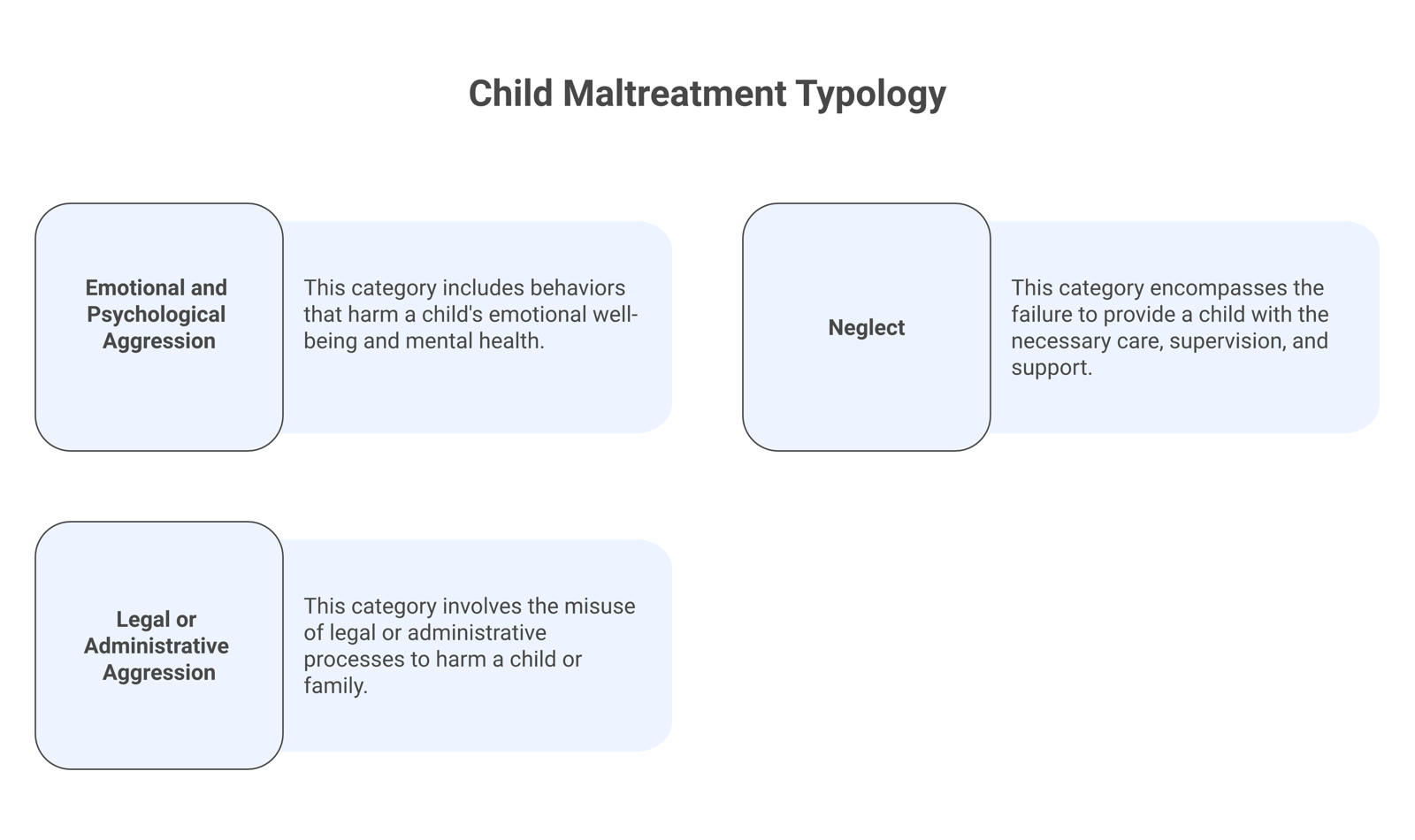
The first pillar of the argument is a maltreatment typology. Researcher Jennifer Harman and colleagues sort alienating acts into the same categories used for other child abuse. In that frame, alienating behavior falls into three buckets. One is emotional and psychological aggression, such as denigrating the other parent to the child. Another is neglect, meaning a failure to support the child’s need for both parents. The third is legal or administrative aggression, where courts, police, or child-protection systems get turned into weapons against the targeted parent.
A related argument separates the parent’s acts from the child’s symptoms and holds that exposure to alienating acts can meet the DSM-5 standard for child psychological abuse even before a child shows visible symptoms. That formal classification debate, the DSM-5 reasoning, who recognizes the label, and the case against it, lives on is parental alienation child abuse. This page stays with the mechanism: how the pressure works and what it does to a child.
The coercive-control mapping
The second pillar is coercive control. Harman, Kruk, and Hines argued in the journal Psychological Bulletin in 2018 that parental alienating behaviors map onto the same power-and-control patterns seen in intimate-partner abuse, describing the conduct as an unacknowledged form of family violence. The framework lens itself, including the point-for-point mapping onto the power-and-control wheel and the criticism of it, lives on parental alienation and coercive control. What matters for this page is what the pattern does to the child.
Coercive control is rarely a single act. It is a pattern that wears down a person’s autonomy over time, which is why alienation tends to unfold in stages of parental alienation rather than all at once. When the target is a child, the pattern teaches the child to watch and please the controlling parent. Clinicians note that children under this pressure often defend the controlling parent and deny that anything is wrong, much as abused children defend abusive caregivers.
The attachment and abuse paradox
The third pillar is the most counterintuitive. Harman points to research on foster care and on animals that reveals a strange pattern. Severely abused children tend to cling to their abusers. They minimize the harm, excuse it, and want to return. Real abuse usually produces attachment, not rejection.
That finding flips a common assumption. If abused children cling, then a child’s strong, consistent rejection of a once-loved parent is itself a red flag. The rejection points toward outside influence rather than toward something the rejected parent did. A youngster who leaps to defend one parent the instant they sense criticism may be signaling who holds the control. This is the attachment and abuse paradox, and it sits near the center of the clinical case for calling alienation a form of abuse.
The triple-abuse finding
Some clinicians put the point even more strongly. Linda Gottlieb, a family therapist with decades of expert-witness experience, argues that a court finding of parental alienation is really three findings at once. It is child psychological abuse. It is domestic violence against the child. It is also domestic violence by proxy, where the child becomes the weapon used against the other parent.
Gottlieb’s grounding observation is short: it is anti-instinctual to reject a parent. A child does not sever a bond with a parent on their own. The extreme pressure needed to override that natural attachment is, in her view, the proof of the abuse rather than a side effect of it.
Developmental harm: a toxic-stress injury
Naming something abuse also means showing the harm. Here the evidence points to lasting developmental damage. Psychologist Mary Alvarez frames parental alienation as a toxic-stress injury to a developing brain. She notes that it maps onto five of the ten widely studied adverse childhood experiences, including emotional abuse, emotional neglect, and exposure to coercive control.
Chronic conflict keeps a child’s stress system switched on. Baseline arousal sits near the edge, so small triggers cause large reactions. That dysregulation is physiology, not defiance. Alvarez also describes a “part mom, part dad” effect: when a child is taught to hate one parent, the child learns to hate the half of themselves that came from that parent, which feeds self-loathing and depression. For the wider picture of this damage across a lifetime, see the long-term effects of parental alienation.
Why the construct is contested
The clinical case is strong, yet it is not universally accepted, and honesty requires saying so. Some legal scholars and advocates worry that the parental alienation label can be misused. Their concern is that an abusive parent might cry “alienation” to discredit a child’s truthful disclosure or a protective parent’s real fear. Inside a custody fight, that misuse can put a child in danger.
Critics also point out that “parental alienation syndrome” never entered the main diagnostic manuals as a formal disorder. Supporters reply that the harm does not depend on a syndrome label, since the underlying behavior already fits recognized definitions of child psychological abuse. For more on that term and its history, see parental alienation syndrome. Both camps tend to agree on one point: the facts of a specific case matter more than any label attached to it.
Emotional abuse versus justified estrangement
This is the line that must never blur. Calling alienation a form of emotional abuse can never be used to wave away a child who pulls back from a parent for good reason. A child who distances from a parent who has frightened, hurt, or neglected them is showing justified estrangement. That response is healthy self-protection, and it is not alienation.
The two can look alike from the outside, yet they differ at the root. One is a child reacting to real danger. The other is a child pressured to reject a safe, loving parent. Confusing them causes harm in both directions. Treating real estrangement as alienation can push a child back toward a dangerous home. Dismissing real alienation as the child’s own free choice can entrench a separate harm. Careful evaluators read the evidence and the power dynamics, never the accusation alone.
How this differs from how courts weigh emotional abuse
Understanding alienation as emotional abuse is a clinical and conceptual point. It is different from how a family court handles emotional abuse inside a custody case. A judge does not rule on whether the academic construct is valid. A judge weighs documented behavior against best-interest factors and decides what serves the child. That separate, practical question has its own page: see how courts weigh child custody emotional abuse.
Frequently asked questions
Is parental alienation emotional abuse?
Many researchers and clinicians say yes. They classify alienating behavior as a form of child psychological or emotional abuse, because it uses pressure, manipulation, and fear to harm a child’s bond with a parent. The view is supported by child-maltreatment typologies and by research linking alienating behavior to coercive control. The construct is debated, and naming it abuse never overrides a child’s justified estrangement from a parent who has genuinely harmed them.
How does parental alienation harm a child emotionally?
The harm works through pressure and fear: the child learns to watch and please the controlling parent, suppresses real feelings to keep the bond safe, and carries a stress system that stays switched on. Clinicians describe the result as a toxic-stress injury, with dysregulation, self-loathing when the child is taught to hate the half of themselves that came from the rejected parent, and elevated risk of depression. The formal classification question is covered on the child-abuse argument page.
What kind of abuse is parental alienation?
When experts classify it as abuse, they usually call it emotional or psychological abuse of a child. Some also describe it as a form of family violence or coercive control, and at least one clinician frames a finding of alienation as simultaneously child psychological abuse, domestic violence of the child, and domestic violence by proxy. The common thread is non-physical harm aimed at a child’s mind, feelings, and relationships.
Is parental alienation the same as psychological abuse?
The terms overlap but are not identical. “Parental alienation psychological abuse” describes the harm caused when alienating behavior meets the definition of child psychological abuse. Parental alienation names the pattern of behavior; psychological abuse names the category of harm that pattern can produce. Not every conflict between separated parents rises to that level, which is why careful, case-specific assessment matters.
Can parental alienation cause long-term harm?
Research suggests it can. Clinicians describe it as a toxic-stress experience that maps onto several adverse childhood experiences, with possible effects on emotional regulation, self-worth, and adult relationships. The harm varies by child, by severity, and by how early it is recognized and addressed. The long-term effects page covers this evidence in more depth.
What this page does not do
This page is general education, not clinical advice. It does not diagnose any child, parent, or family. It does not tell readers what their situation is or what to do about it. Decisions about a real child belong to qualified professionals working with the full facts. The page also does not take sides in a custody dispute or frame one parent as a villain. The aim is to explain how the field reasons about alienation as a form of emotional abuse, fairly and with its debates intact.
For the wider damage over time, see the long-term effects of parental alienation. For the disputed diagnostic label, see parental alienation syndrome. For how the harm typically unfolds, see the stages of parental alienation. For the courtroom angle, see child custody emotional abuse, and the full Learn library covers the rest.
Sources and further reading
- Harman, J. J., Kruk, E., & Hines, D. A. (2018). Parental alienating behaviors: An unacknowledged form of family violence. Psychological Bulletin, 144(12), 1275 to 1299. https://doi.org/10.1037/bul0000175
- American Psychological Association. Divorce and child custody. apa.org/topics/divorce-child-custody
If you or your child are in crisis
Free and confidential help is available right now.
- 988 Suicide and Crisis Lifeline. Call or text 988. 988lifeline.org
- Childhelp National Child Abuse Hotline. 1-800-422-4453. childhelp.org
- NAMI HelpLine. 1-800-950-6264. nami.org/help
Last reviewed: 2026-06-06. Author: Alex Buckles (PAC Founder).