

This page is general information, not legal or clinical advice. It does not diagnose any person or family, and it does not replace a licensed professional. Inter-sibling alienation is an emerging research idea, not a settled diagnosis.
Inter-sibling alienation is the rejection of one sibling by another within an alienating family system. It is an emerging area of research, suggesting alienation can spread along the sibling bond and not only from parent to child. Here is what the construct describes, how it may develop, and why it matters for families.
A note on safety and normal conflict
Ordinary sibling rivalry is not inter-sibling alienation. Siblings argue, compete, and grow apart for many normal reasons. A child who pulls away from a sibling who is genuinely abusive or unsafe is making a healthy, justified choice, not being alienated. If a child’s safety is at risk, contact local resources first.
What inter-sibling alienation means
Most discussion of parental alienation tracks a single line: one parent turns a child against the other parent. Inter-sibling alienation describes something adjacent. It is the rejection of one sibling by another inside the same alienating family. The animosity runs sideways, between children, rather than only down from a parent.
This idea is new. It grows out of doctoral research by Joshua Marsden at Colorado State University, working under Jennifer Harman, whose earlier studies helped define parental alienation as a family dynamic. That work is ongoing, so the construct is best read as a careful hypothesis rather than a finished finding. The broader parent-axis literature it builds on is indexed in the peer-reviewed PubMed research database.
The core claim is simple to state. When one parent runs an alienating campaign, the damage need not stop at the parent-child line. A sibling can absorb that campaign and direct it at a brother or sister. The result is a fractured relationship between two children who, in a healthier system, might have leaned on each other. The parent’s tactics often set the stage, which is why the page on parental alienation manipulation is a useful companion.
A new axis: how alienation spreads to siblings
Researchers have long noticed that alienation does not stay contained. Amy Baker’s well-known list of alienating behaviors includes the spread of animosity beyond the targeted parent. Grandparents, aunts, uncles, and family friends can all be drawn into the rejection. The hostility radiates outward from one targeted adult to a whole branch of the family.
Inter-sibling alienation proposes a parallel path. If animosity can spread outward to extended family, it can also spread sideways to a sibling. The mechanism is the same loyalty pressure, simply pointed at a different target. A child who is loyal to the favored parent may come to see a sibling as part of the rejected side.
This sideways spread is distinct from alienation that passes down through time. Patterns that move from one generation to the next are covered on the page about intergenerational parental alienation. The recognizable child behaviors that signal a child has taken a side appear in the eight behaviors of an alienated child. Inter-sibling alienation borrows from both, then turns the lens onto the bond between two children.
How inter-sibling alienation may develop
The emerging model describes a sequence. No single step is inevitable, and not every alienating family produces it. The pattern, where it appears, tends to move through recognizable stages.
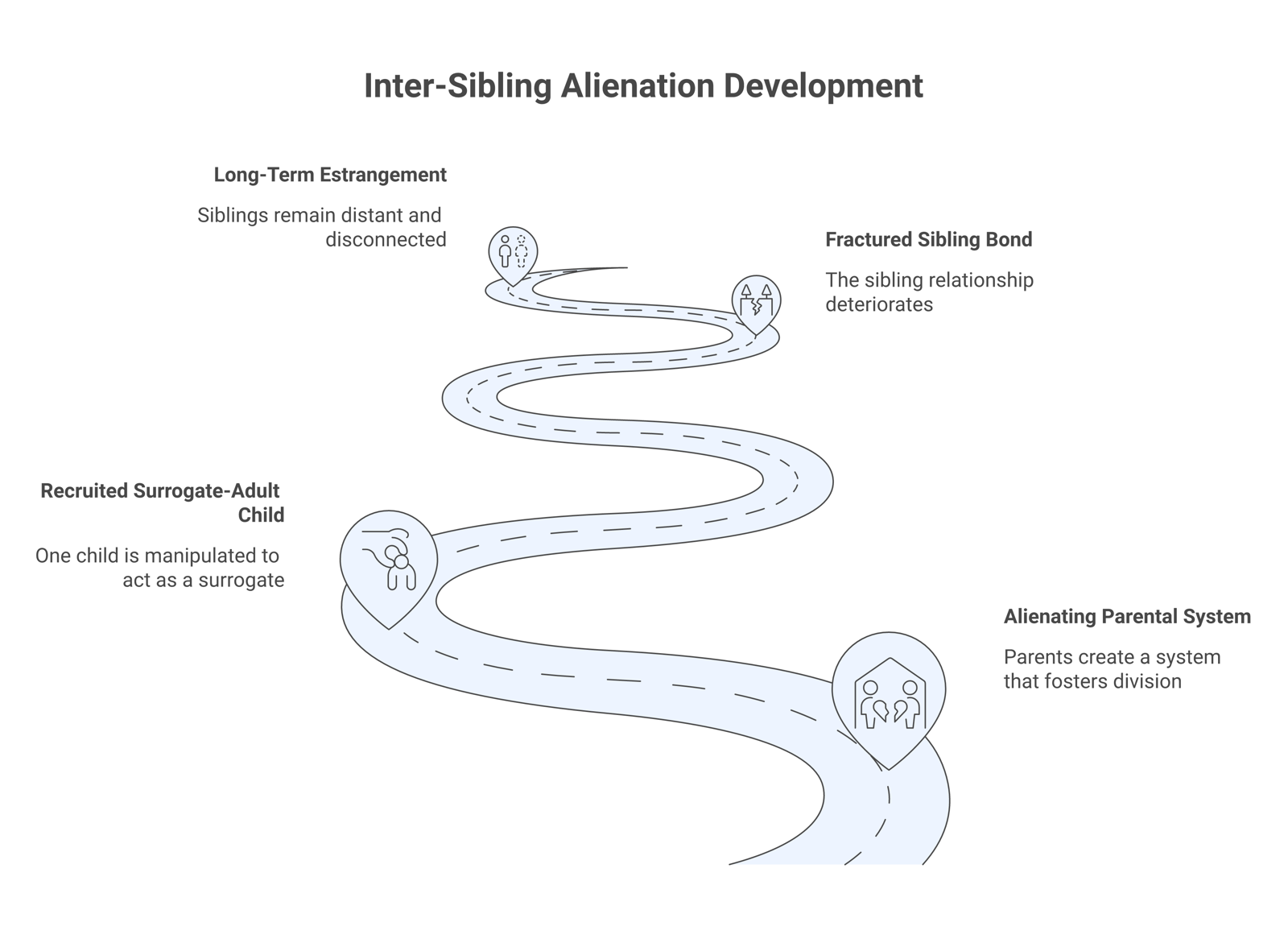
It often begins with the favored child. In an alienating family, one child is frequently elevated. That child may be parentified, meaning they are pushed into an adult role too early. They become the favored parent’s confidant, helper, and ally. Clinicians sometimes describe this child as a surrogate spouse, or with phrases like the family’s “man of the house.” The role feels like closeness, but it is a heavy load for a child to carry.
From there, the favored child can become an enforcer. Recruited into the parent’s view of the family, the child starts to police a sibling. They may report on the sibling, pressure them to take sides, or punish warmth shown to the rejected parent. The sibling who resists the campaign becomes a target inside their own home.
Under that pressure, the sibling bond fractures. Two children who might have been allies are set against each other. Over years, the distance can harden into estrangement. The diagram below traces the sequence.
Four frameworks that help explain it
Because the construct is new, researchers lean on established theory to explain why it might occur. Four frameworks recur in the emerging discussion.
Social Identity Theory looks at how people sort into in-groups and out-groups. Inside an alienating family, a child can come to see one parent’s side as the in-group and the other as the out-group. A sibling who stays close to the rejected parent gets sorted out. Belonging to the favored group can feel safer than holding onto a brother or sister.
Prototype Theory concerns the mental image of an ideal family member. The favored child may be held up as the prototype, the model of the good son or daughter. Measured against that ideal, a sibling is cast as the flawed one. The contrast justifies the rejection in the family’s story about itself.
Enmeshment describes a collapse of healthy boundaries between people. When a parent and a favored child become enmeshed, the child loses room to hold a separate view. The parent’s feelings about a sibling become the child’s feelings. Loyalty leaves little space for an independent relationship with the brother or sister.
Family Systems Theory treats the family as a single interacting system. Roles get assigned, and the system reorganizes around its central conflict. One child is cast as the ally, another as the scapegoat. The sibling rift is not a private quarrel between two children. It is a product of the whole system under strain.
The long road: sibling estrangement and later regret
The cost of inter-sibling alienation is measured in years, not weeks. Childhood roles can calcify. The enforcer and the targeted sibling may carry their assigned parts into adulthood, long after the parents are gone or the divorce is settled. What might have been a lifelong bond becomes silence.
Yet the story does not always end there. An emerging and hopeful thread in the research is the regret some adult siblings later express. With distance from the family system, a grown sibling may recognize the role they were pushed into. Some reach back toward the brother or sister they were turned against. Repair is possible, though it is rarely quick or simple.
That long arc is part of a wider picture of harm and recovery. The long-term effects of parental alienation reach into adult relationships and self-understanding. For families looking to rebuild, the recovery resources gather approaches to reconnection and repair.
What it is not: rivalry and justified estrangement
Drawing the boundary is essential, and the emerging research is careful about it. Two common situations are not inter-sibling alienation.
The first is ordinary sibling rivalry. Siblings compete for attention, argue, and sometimes drift apart. Rivalry is usually mutual, fluid, and a normal part of growing up. Inter-sibling alienation, by contrast, is one-directional rejection driven by an alienating system, not a fair fight between equals.
The second is justified estrangement. A child who steps back from a sibling who is genuinely abusive, violent, or unsafe is protecting themselves. That is a healthy boundary, not alienation. As the clinician Linda Wygant and others stress, the difference lies in whether the rejection is warranted by real harm or manufactured by manipulation. The American Psychological Association’s guidance on divorce and child custody offers context on family conflict during and after separation.
Frequently asked questions
What is inter-sibling alienation?
Inter-sibling alienation is the rejection of one sibling by another within an alienating family system. It is an emerging research idea proposing that alienation can spread along the sibling bond, not only from parent to child. A favored child may be recruited to reject a brother or sister. The term describes a hypothesis, not a settled diagnosis.
Can siblings be turned against each other in a divorce?
Yes, an alienating family system can pull one child into rejecting another. When a parent runs an alienation campaign, a favored or parentified child may absorb it and direct hostility at a sibling. This is different from the ordinary tension siblings feel during a stressful divorce. Researchers describe it as an emerging pattern still under study.
What is a golden child in an alienating family?
A golden child is a favored child who is elevated and often parentified inside an alienating family. Pushed into an adult role early, this child may serve as the parent’s confidant, sometimes described as a surrogate spouse. In the emerging inter-sibling model, the golden child can become an enforcer who polices and pressures a less-favored sibling.
Do alienated siblings reconcile as adults?
Sometimes. An emerging and hopeful thread in the research is the regret some adult siblings later express for the role they played. With distance from the family system, a grown sibling may reach back toward the brother or sister they were turned against. Repair is possible, though it is rarely quick and often needs patient effort.
How is sibling alienation different from normal sibling rivalry?
Normal sibling rivalry is mutual, fluid, and a common part of growing up. Inter-sibling alienation is one-directional rejection driven by an alienating family system, not a fair contest between equals. Rivalry tends to soften with age. Alienation can harden into long estrangement. Justified distance from a genuinely abusive sibling is also not alienation.
What this page does not do
This page is not legal or clinical advice. It does not diagnose any person or family, and it does not name any one state’s law. Inter-sibling alienation is presented as emerging research, not as a settled diagnosis or a label to pin on a relative. The page also does not frame the concept as a weapon or promise that any sibling bond can be restored. Its aim is understanding, not blame.
For the parent’s tactics that drive these systems, see parental alienation manipulation. For the across-generations axis, see intergenerational parental alienation. For the adult outcomes, see the long-term effects of parental alienation. The full Learn silo and the recovery resources cover the rest.
Sources and further reading
- PubMed / NCBI. Parental alienation research (Harman and colleagues). pubmed.ncbi.nlm.nih.gov
- American Psychological Association. Divorce and child custody. apa.org/topics/divorce-child-custody
If you or your child are in crisis
Free and confidential help is available right now.
- 988 Suicide and Crisis Lifeline. Call or text 988. 988lifeline.org
- Childhelp National Child Abuse Hotline. 1-800-422-4453. childhelp.org
- NAMI HelpLine. 1-800-950-6264. nami.org/help
Last reviewed: 2026-06-08. Author: Alex Buckles (PAC Founder). Editorial review: held to the PAC Editorial Standards (balance, primary-source citation, reader safety); an independent expert review board will be appointed.