

This page is general information, not legal or clinical advice. It does not diagnose any child and does not replace a qualified professional. Anyone worried about a child should consult a licensed family therapist, and anyone considering legal action should consult an attorney in their own jurisdiction.
The 8 behaviors of an alienated child are the warning signs you may notice when a child turns cold or hostile toward a once-loved parent. Identified by Richard Gardner and studied in Amy Baker’s research, they describe what alienation looks like in the child. They are recognition signs, not a diagnosis.
A note on safety
These eight behaviors can also appear for reasons that have nothing to do with alienation. A child who pulls away from a parent who has hurt them is not alienated. That is justified estrangement, and it is healthy self-protection. The same behaviors can mean very different things, so this page is for recognition, never for diagnosis. If a child may be unsafe, contact local law enforcement or a child-protection resource first.
What the 8 behaviors of an alienated child are
The eight behaviors are a set of observable signs seen in a child caught up in parental alienation. Richard Gardner first described them in his writing on parental alienation syndrome (1985; 1998). Amy J.L. Baker and Douglas Darnall later studied them empirically in a 2007 construct study that generally supported the eight manifestations.
These behaviors are the child side of alienation. They describe what shows up in the child, not what the favored parent does. That distinction matters, and the page returns to it below.
In the wider research, the eight behaviors sit inside a larger picture. They form one part of the five-factor model of parental alienation, the factor that captures the child’s own behavior. They also trace back to Gardner’s first description of parental alienation syndrome. For the broad view of how alienation looks across a whole family, see parental alienation symptoms.
Reading the list calmly is the goal here. One or two of these behaviors, on their own, prove nothing. Children fall out with parents for ordinary reasons all the time. A teenager who wants more space, a child upset after a hard week, or a kid testing limits is not an alienated child. What Gardner and Baker described is a cluster, a pattern that holds together and that does not fit the child’s actual history with the parent. They are signs to notice, not boxes to tick.
The eight behaviors, one by one
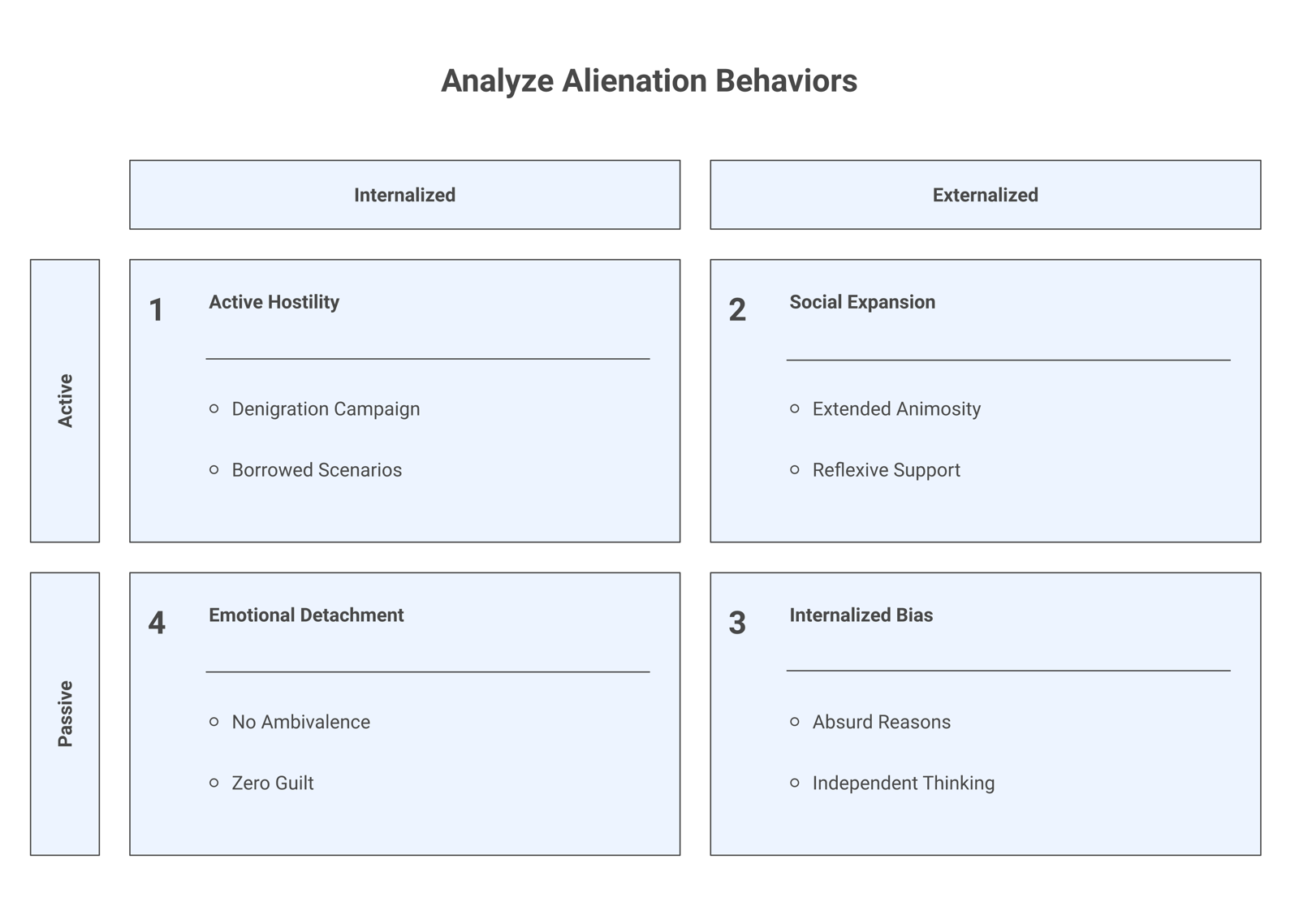
Each behavior below carries a plain definition and a gentle example. Together they form the pattern Gardner described and Baker measured.
1. A campaign of denigration
The child runs the rejected parent down again and again. The criticism is harsh and constant, and it often sounds rehearsed. A child who once loved a parent now speaks of them with open contempt, as if reciting a case against them.
2. Weak, frivolous, or absurd reasons
When asked why they reject the parent, the child gives reasons that are trivial or strange. The reason given does not match the size of the anger. A parent chewing loudly or being five minutes late becomes grounds for total rejection.
3. Lack of ambivalence
Real relationships hold mixed feelings. An alienated child loses that balance. One parent becomes all good, the other all bad. There is no room for the rejected parent to have any redeeming quality at all.
4. The independent-thinker phenomenon
The child insists the rejection is entirely their own idea. They deny that anyone influenced them, often before anyone has suggested it. The denial can sound oddly adult, and it tends to arrive on cue.
5. Reflexive support for the favored parent
In any disagreement between the parents, the child sides with the favored one automatically. They defend that parent without weighing the facts. Even when the favored parent is clearly in the wrong, the child backs them.
6. Absence of guilt
The child shows little or no remorse over treating the rejected parent harshly. Cruelty, broken contact, and rejected gifts bring no visible regret. The empathy that usually softens a child toward a parent appears switched off.
7. Borrowed scenarios
The child describes events they could not have witnessed, or repeats adult phrases that do not fit their age. The account sounds borrowed because it is. The words and the memories often belong to an adult, not to the child.
8. Spread of animosity to extended family
The rejection does not stop at the parent. It spreads to that parent’s relatives and friends, including grandparents and cousins the child once adored. People who did nothing wrong are cut off along with the parent.
Why these are child behaviors, not alienator strategies
It helps to keep two lists separate. The eight behaviors on this page are what you see in the child. They are symptoms. They are different from the things a favored parent may do to cause the rift.
Those parent actions are a separate set, often described as the 17 signs of parental alienation. That list covers the strategies an alienating parent uses, such as badmouthing, limiting contact, or forcing the child to choose. One list is the cause side. The other is the symptom side.
Keeping them apart protects clear thinking. A child showing the eight behaviors is reacting to something. The cause may be alienating behavior by a parent. It may also be something else entirely, which the next section covers. The point is that behaviors in the child do not, by themselves, name their cause. A worried adult who confuses the two can end up blaming a parent who did nothing wrong, or missing real harm that a child is signaling.
Why these are recognition signs, not a diagnosis
The eight behaviors help a worried adult notice a pattern. They do not prove that alienation is happening. This is the most important caveat on the page.
The same behaviors can come from a very different source. A child who rejects a parent who has frightened or hurt them is not alienated. That child is protecting themselves, and the rejection is reasonable. Researchers call this justified estrangement, and it is healthy, not a disorder. The behaviors look similar from the outside, yet the meaning is opposite. A child who refuses contact may be obeying an alienating parent, or may be telling the truth about a parent who scared them. Treating every cold or angry child as alienated risks ignoring a child who needs protection.
This is why no one should use a checklist to label a child. Telling alienation apart from justified estrangement takes a trained professional who can look at the whole family and the child’s real history. The American Psychological Association offers general guidance on divorce and child custody for parents in this situation. For the way a child can be turned against a parent through pressure, see child brainwashed against a parent.
What to do if you recognize these behaviors
Noticing the pattern is a starting point, not a verdict. A few calm steps protect the child and the relationship.
Keep your own record, quietly. Note dates, what was said, and what happened, in plain factual terms. A steady record helps a professional later far more than memory does.
Do not interrogate the child or push them to take sides. Pressure tends to deepen the very behaviors you are worried about. Staying warm, patient, and present matters more than winning any single conversation. To understand the pull a child feels, see why your child sides with the alienating parent.
Seek a qualified family therapist or evaluator. A trained professional can tell whether the behaviors reflect alienation, justified estrangement, or something else, and can guide what helps. That assessment is their job, not a parent’s, and not this page’s. Look for someone who understands high-conflict separation and who will assess the whole family rather than accept one parent’s account at face value. Good help is patient and slow, and it keeps the child’s wellbeing at the center rather than the question of who is right.
Frequently asked questions
What are the 8 behaviors of an alienated child?
The eight behaviors are a campaign of denigration, weak or absurd reasons for the rejection, lack of ambivalence, the independent-thinker phenomenon, reflexive support for the favored parent, absence of guilt, borrowed scenarios, and the spread of animosity to extended family. Richard Gardner first described them, and Amy Baker’s research made them measurable.
What does an alienated child act like?
An alienated child often acts cold, harsh, and one-sided toward a once-loved parent. The rejection can sound scripted, the reasons given are usually thin, and the child shows little guilt. The same child may treat the favored parent as flawless. These are recognition signs, not proof, since other causes can look similar.
What is the independent-thinker phenomenon?
The independent-thinker phenomenon is one of the eight behaviors. The child insists that the decision to reject a parent is entirely their own and that no one influenced them. The denial often arrives unprompted and can sound more adult than the child’s age would suggest.
Can these behaviors mean something other than alienation?
Yes. A child who pulls away from a parent who has hurt or frightened them shows similar behaviors, yet that rejection is justified and healthy, not alienation. The behaviors look alike from the outside but mean opposite things. Only a trained professional, looking at the whole family, can tell them apart.
What should you do if you see these behaviors?
Keep a calm factual record, avoid pressuring the child or making them choose sides, and stay warm and present. Then consult a qualified family therapist or evaluator who can assess what is actually happening. The behaviors are a prompt to look closer with help, not a basis to label the child.
What this page does not do
This page is not a diagnosis. It does not prove that any child is alienated, and it does not replace a qualified professional who can assess the whole situation. The eight behaviors are recognition signs, and they share their surface with justified estrangement from genuine abuse. The page also does not frame recognition as a way to win a case or pressure a child. The right use of this list is gentle, careful, and child-centered.
For the strategies a favored parent may use, see the 17 signs of parental alienation. For the broad symptom picture, see parental alienation symptoms. The full Signs section covers the rest.
Sources and further reading
- Gardner, R. A. (1985). Recent trends in divorce and custody litigation. Academy Forum, 29(2), 3 to 7. (First description of the eight manifestations.)
- Gardner, R. A. (1998). The Parental Alienation Syndrome (2nd ed.). Creative Therapeutics.
- Baker, A. J. L., & Darnall, D. (2007). [Construct study of the eight behavioral manifestations.] Journal of Divorce & Remarriage, 47(1-2), 55 to 75.
- Bernet, W., & Greenhill, L. L. (2022). The Five-Factor Model for the diagnosis of parental alienation. Journal of the American Academy of Child & Adolescent Psychiatry, 61(5), 591 to 594. https://doi.org/10.1016/j.jaac.2021.11.026
- American Psychological Association. Divorce and child custody. apa.org/topics/divorce-child-custody
If you or your child are in crisis
Free and confidential help is available right now.
- 988 Suicide and Crisis Lifeline. Call or text 988. 988lifeline.org
- Childhelp National Child Abuse Hotline. 1-800-422-4453. childhelp.org
- NAMI HelpLine. 1-800-950-6264. nami.org/help
Last reviewed: 2026-06-08. Author: Alex Buckles (PAC Founder).