
This page provides general educational information, not clinical or legal advice.
Why does my child side with the alienating parent? In many alienation cases, the child is not expressing a true preference. The child is appeasing the parent who controls their daily world, an unconscious survival response to pressure. Understanding that the behavior is driven by fear, not genuine feeling, changes how a targeted parent reads it.
A note before you read
A child siding against a genuinely abusive or frightening parent, and toward a safe one, is healthy self-protection. That is not appeasement and not alienation. This page is about a different situation: a child turning against a loving, safe parent under pressure. If a child’s safety is at risk, contact local law enforcement or a domestic-violence resource first.
Why does my child side with the alienating parent? The short answer
Children in alienation cases often side with the parent who holds the most control, not the parent they secretly prefer. The behavior looks like a choice. Underneath, it is usually a stress response. A child living inside a one-sided story learns that agreement brings calm and disagreement brings conflict. So the child agrees.
Clinicians who study these dynamics describe the pattern as pressure, not preference. The child’s siding is a way to stay safe inside a system the child did not build and cannot leave. The rest of this page walks through the psychology behind it: appeasement, the attachment paradox, the loyalty bind, and the role reversal that can turn a child into a parent’s emotional caretaker.
Appeasement: siding as a survival response, not a real preference
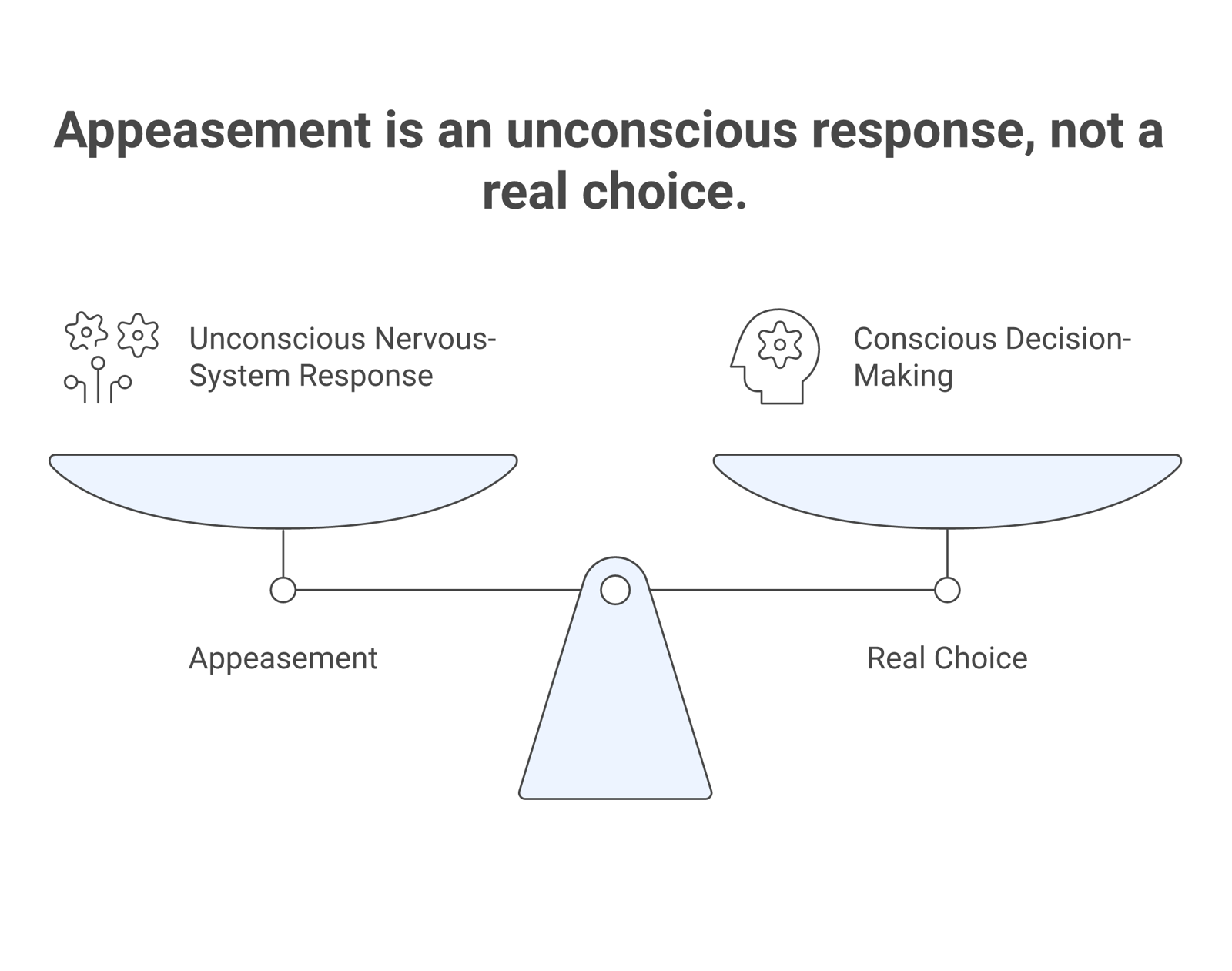
The first piece of the puzzle is appeasement. Dr. Rebecca Bailey, working with polyvagal researcher Dr. Stephen Porges, describes how children “do things out of survival without conscious awareness of trying to side with one parent.” The child is not running a calculation. The nervous system is.
Appeasement is an automatic survival state. When a person cannot fight a threat and cannot flee it, the body reaches for a third option: keep the peace. A child who senses tension at one home learns to soothe the parent who holds power there. Agreeing with that parent lowers the temperature. It keeps the child feeling emotionally safe, not only physically safe.
This is why siding can look so sincere. The child is not pretending. The behavior comes from below conscious thought, the same place a flinch comes from. Bailey uses a herd image to explain it. A horse startles, then quickly returns to grazing once one calm animal steadies the group. People can get stuck in that startled, keyed-up state. Someone in the family has to regulate, or the whole system stays in alarm.
For a targeted parent, this reframe matters. A child who repeats the other parent’s words is not choosing sides in any adult sense. The child is trying to survive a setting that feels unsafe to disagree with.
The attachment paradox: why rejecting a loving parent is a red flag
The second piece is counterintuitive. Abused children usually cling to the people who hurt them. They rarely reject them.
Dr. Jennifer Harman and colleagues call this the attachment and abuse paradox. Drawing on foster-care research and animal studies, they note that severely abused children tend to minimize, excuse, and want to return to their abusers. Fear does not switch off attachment. It often intensifies it.
This finding flips a common assumption. Many people assume a child who rejects a parent must have been mistreated by that parent. The research points the other way. Strong, consistent, ambivalence-free rejection of a parent the child once loved is itself a red flag of outside influence, not proof of abuse.
A large study reinforces the point. Dr. Amy Baker and Dr. Steven Miller examined clinician ratings of 17,733 abused children. Those children scored far higher on behaviors that pull a parent closer than on behaviors that push a parent away. Severely abused children leaned toward closeness, not rejection. When a child instead turns cold and absolute toward a once-loved, safe parent, the pattern does not match what genuine abuse produces. It matches what pressure produces.
A note of care belongs here. None of this means every rejection is alienation. Where real abuse exists, a child’s distancing is protective and right. The paradox is a reason to look closer, never a verdict to act on alone.
The loyalty bind that traps the child
The third piece is the loyalty bind. A child caught between two parents faces an impossible problem: how to love both when one treats loving the other as betrayal.
Clinician Zach Flood describes this as a loyalty contract. The deal is rarely spoken out loud. In exchange for love, security, and a stable sense of identity, the child is required to absorb one parent’s view of the other and repeat it on cue. Affection for the targeted parent breaks the contract. So the child learns to hide it, then to deny it, then to stop feeling it.
Isolation tightens the bind. Ryan Thomas, who was alienated from his own father for years before reconnecting, describes a four-step sequence. First, the child’s world shrinks. Second, anyone who might offer a different view, a kind word, or “two sides of the story” is pushed out. Third, with the child’s world reduced to one viewpoint, control becomes easy. Fourth, the child is made to feel guilty for loving, or accepting love from, the targeted parent.
Inside this structure, siding is not disloyalty to the targeted parent in the child’s mind. It is loyalty to the parent the child cannot afford to lose. The child is not rejecting love. The child is protecting an attachment that feels like survival.
When the child becomes the parent’s regulator
The fourth piece sits deepest. Dr. Craig Childress describes how an alienating parent can turn the relationship upside down, using the child as a “regulatory object” to steady the adult’s own emotions.
In healthy development, the parent regulates the child. A calm, attuned parent helps an upset child settle, and over time the child builds the ability to settle alone. When a parent’s own emotional world is fragile, often from unhealed trauma, the roles can flip. The child becomes the one managing the parent’s moods.
A child in this position learns to read the parent’s distress and head it off. Siding becomes part of that job. Agreeing with the parent, mirroring the parent’s anger at the other parent, and staying close all keep the fragile adult steady. From the outside, this can look like an unusually devoted bond. Childress warns that the closeness is misleading. The child is not thriving in it. The child is working in it.
This helps explain why siding can be so fast and so fierce. The child senses any threat to the parent’s stability and moves to protect it, sometimes before anyone has said a word.
What this means for a targeted parent
Seen together, these four mechanisms tell one story. A child who sides with the alienating parent is usually responding to pressure, not expressing a settled, free choice. The appeasement is automatic. The loyalty bind is real to the child. The role reversal is invisible to almost everyone watching.
This understanding is not a reason for despair. It is a reason to stop reading the child’s behavior as the final word on the child’s heart. The harsh statements, the cold shoulder, the borrowed accusations: these are symptoms of a situation, not a measure of how much the child loves the targeted parent.
Specialists describe parental alienating behavior as a recognized pattern of coercive control, and as a form of family violence, in the work of Harman, Kruk, and Hines. That framing is not about blaming the child. It places the pressure where it belongs, on the adult dynamics, and off the child’s shoulders.
Steadiness follows from this. A targeted parent who understands appeasement is less likely to argue the facts, which tends to deepen the bind, and more likely to stay a calm, safe presence the child can return to. For one map of that path, see how to reconnect with an alienated child. For the full behavioral picture, the parental alienation symptoms catalog and the guide to a child brainwashed against a parent describe what the pressure looks like from the outside.
Frequently asked questions
Why does my child side with the alienating parent?
In many cases the child is appeasing the parent who controls their daily world, not choosing freely. Appeasement is an automatic survival response: agreeing keeps the peace and keeps the child feeling safe. The loyalty bind and, in some families, a role reversal that casts the child as the parent’s emotional caretaker add further pressure. The siding reflects fear and dependence far more than genuine preference.
Does my child siding with the other parent mean they do not love me?
No. Siding under pressure is not the same as a change of heart. A child caught in a loyalty bind often hides love for the targeted parent because showing it feels unsafe or disloyal. The feeling is usually still there, buried under the behavior the child believes they must perform to stay secure.
Why does my child hate me when I have done nothing wrong?
What looks like hate is often fear wearing a hard mask. A child under sustained pressure may produce anger and rejection toward a safe parent because expressing warmth carries a cost at the other home. Research on abused children shows they tend to cling to, not reject, the people who hurt them. So sudden, absolute rejection of a once-loved parent points toward outside influence rather than something that parent did.
Is my child choosing the other parent on purpose?
Usually not in the deliberate way it appears. Appeasement and loyalty responses run below conscious awareness. The child is not weighing two parents and picking one. The child’s nervous system is doing what it learned keeps them safe inside a one-sided system they cannot escape on their own.
Could my child’s rejection mean I actually harmed them?
It can, and that possibility deserves honest reflection and, where needed, professional input. Where a parent has been abusive or frightening, a child’s distancing is healthy self-protection. The pattern this page describes is different: strong, ambivalence-free rejection of a parent who has been loving and safe, which more often signals pressure than harm. A clinician trained in these dynamics can help tell the two apart.
Where to go next
- For the full behavioral inventory, read the signs of parental alienation pillar.
- For the symptom catalog, see parental alienation symptoms.
- For the coached-rejection presentation, see child brainwashed against a parent.
- For sudden rejection after a separation, see child suddenly hates parent after divorce.
- For practical next steps, see how to reconnect with an alienated child.
Sources and primary references
- Harman, J. J., Kruk, E., & Hines, D. A. (2018). Parental alienating behaviors: An unacknowledged form of family violence. Psychological Bulletin, 144(12), 1275 to 1299. https://doi.org/10.1037/bul0000175
- American Psychological Association. (n.d.). Divorce and child custody. apa.org/topics/divorce-child-custody
- Bailey, R., with Porges, S. Polyvagal theory and appeasement in children (Parental Alienation Advocates interview).
- Baker, A. J. L., & Miller, S. G. Clinician survey of 17,733 abused children on attachment-enhancing and distancing behaviors.
- Childress, C. A. An Attachment-Based Model of Parental Alienation: Foundations. The child as a regulatory object and the role-reversal relationship.
- Flood, Z. Clinical description of the loyalty contract and the encapsulated delusional system.
- Thomas, R. The isolation-to-loyalty sequence (RyanThomasSpeaks).
If you or your child are in crisis
Free and confidential help is available right now.
- 988 Suicide and Crisis Lifeline. Call or text 988. 988lifeline.org
- Childhelp National Child Abuse Hotline. 1-800-422-4453. childhelp.org
- NAMI HelpLine. 1-800-950-6264. nami.org/help
Last reviewed: 2026-06-07. Author: Alex Buckles (PAC Founder).